Preparing Ourselves for Passover

Passover is just around the corner—in a couple of weeks. Here’s a checklist to help you prepare for this festival that YHVH commanded his people to celebrate, and which Yeshua, the apostles and early church also celebrated, and which will be celebrated in the Millennium.
Repent of Sin and Get Under the Lamb’s Blood. As the children of Israel applied the lamb’s blood to the door posts and lintels of their house, so we must apply the sin-cleansing and Satan-defeating blood of Yeshua afresh to our lives (i.e. to our thoughts as represented by the door lintel and and to our hands or actions as represented by the door posts). This occurs as we repent of our sins, and pray for and receive YHVH’s forgiveness. He will then cover our sins over or wash away our sins by Yeshua’s blood (1 John 1:9; Rev 1:5).

In Egypt at Passover time, YHVH judged all those who had failed to put the lamb’s blood on the door posts of their houses. In other words, they weren’t under the blood of the lamb, but were still under the penalty of sin, which is death (Ezek 18:4; Rom 6:23). Any unrepented of sin in our lives brings the curse of death on us. To the degree that one has sin in their life is the degree to which the spirit of death has a legal claim on us. Now is the time to repent of sin by confessing it and seeking Elohim’s forgiveness under the blood of Yeshua and then forsaking that sin through YHVH’s grace (1 John 1:9). 

Here are some things of which to repent. 

  • Pride. Do you always think that you’re right? Your opinion is what matters the most? Do you have a hard time with those who don’t see it your way, when you don’t get your way? Do you have a fit when people disagree with you? Do you criticize others and put others down (especially those who are closest to you)? Do you belittle, mock, scorn and ridicule others? Do you focus on other people’s faults? Do you have a hard time identifying any sins that you have committed? Are you proud of your humility? Are you proud of how Torah-observant you are (compared to others)? Are you overly defensive when someone corrects you or challenges your opinion? Do you blame others when things don’t go right instead of taking personal responsibility for your actions? Are you proud of (instead of grateful to YHVH for) your achievements in life? Do you constantly have to be talking about yourself? Is much of what you do, say and think focused on yourself? These are all signs of pride. Pride is self-idolization. Elohim hates pride and calls it an abomination (Prov 6:16–17).
  • Ungratefulness and selfishness. Are you ungrateful? Are you discontent about your place in life? Do you always want more? Are your material possessions and personal belongings really important to you? Do you have a hard time giving things away? This is a form of self-idolatry, pride and idolization of things.
  • The love of this world over love of YHVH and the things that matter to him. This is a form of idolatry. In this case, we’re concerned with what others think more than what Elohim thinks about things. Therefore, our thoughts and actions are geared at trying to please ourself and others instead of pleasing Elohim (Jas 4:4; 1 John 2:15).
  • Sins of the mouth include mean, selfish, unkind, angry, impatient, egotistical words and gossip. This is idolization of self. What matters most is what I have to say, how I feel, my opinions and I have the right to say what I want when I want. This is also pride.
  • The lack of the fear of Elohim. Are you more concerned with what others think than what YHVH Elohim thinks about something? Anything in our lives that we put ahead of Elohim is idolatry.
  • Ask yourself this: In everything that I do and say, am I advancing the kingdom of Elohim and bringing glory to Yeshua or am I doing the opposite? Am I being a river of life to all those around me, or am I dragging them downward by being a purveyor of negativity and darkness? Are my words, thoughts and deeds leading people to the light of YHVH Elohim and to Yeshua or away from them?

Tell the Redemption Story. It is the responsibility of parents and elders to pass on to the next generation the Passover story (Exod 12:24–27). Explain how the Israelites were enslaved in Egypt (a metaphor for the world), to Pharaoh (a metaphor for Satan), and how YHVH delivered the Israelites from the judgment of the destroyer (YHVH’s judgment against sin) because they put the blood of the lamb on their doorposts (a picture of Yeshua’s sin-atoning death on the cross). In reality, this is the basic gospel message. This is what the Passover seder is all about and why we celebrate it. 

Celebrate the Feasts. Prepare your heart and mind to obey YHVH by keeping his appointed times of Passover and Unleavened Bread. Are you willing to obey his commands pertaining to these observances? How much do you love him (John 14:15)? How much do you want to know him (1 John 2:6–7)? Celebrating YHVH’s feasts help us to love him and to know him better.

Examine Yourself. At this time of the year, we must each examine ourselves to insure that we will not be partaking of the cup of redemption (i.e. the communion cup) unworthily (1 Cor 11:28).

Rediscover the Cross. It is time to rediscover the cross of Yeshua again and your place at its foot. It is also time to rediscover the power of the resurrected Yeshua in one’s life. Marvel at the miracle of the resurrection and consider the fact that you have access to Yeshua’s resurrected life through faith in him and through the work of his Set-Apart Spirit as you obey the Word of Elohim. 

A Time of Spiritual Awakening and New Beginnings. Passover occurs in the spring at the beginning of the biblical year. Spring is a time of new beginnings physically and spiritually. It’s the time of year to take stock of one’s life, assess any weaknesses and deficiencies you have, and then resolve to make the necessary changes. It is the time to make improvements through the power of YHVH’s grace, his Word, his Spirit all through a vibrant, daily relationship with Yeshua our Master and Savior.

The Season for Spiritual Housecleaning. It’s Time to Deleaven.  Passover is time of spring cleaning and deleavening our physical houses (Exod 12:15–20) and removing the leaven of sin from our spiritual houses as well (Pss 26:2; 139:1, 23–24). We must root out and eradicate the old sin habits from the crevices and dark areas of our life. In Scripture, leavening represents sin, pride, hypocrisy and false doctrine.  Do the sinful practices, evil habits and illicit delicacies of Egypt still hold sway on us? Do any unclean spirits or filthy habits still have control over us? It is time to take control of these sins and eliminate them and become wholly consecrated unto YHVH-Yeshua, his Word, his plans and purposes. It is time to seek first his kingdom and his righteousness (Matt 6:33). One can’t serve two masters at the same time (i.e. the world and the flesh) and expect to be pleasing to YHVH (Matt 6:24). It’s time to forsake all these things that drag us down spiritually and pull us away from our Father in heaven. It’s time to move onward and upward spiritually!

Time to Renew Our First Love For Yeshua. Take this time to rediscover the glorious beauty of Yeshua our Heavenly Bridegroom (Rev 2:4–5). Now is the time to rekindle our passion and zeal for Yeshua and to repent of spiritual lukewarmness (Rev 3:15–21).

 

Blog Scripture Readings for 3-22 Through 3-28-20

Aside

Parashat Vayikra — Leviticus 1:1 – 5:26 (6:7)*
Haftarah — Isaiah 43:21 – 44:23
Prophets — Isaiah 9:1 – 18:7
Writings — Proverbs 15:1 – 21:31
Testimony — John 13:17 – 18:40

Our new annual Scripture Reading Schedule for 2019-2020 with daily readings is available to download and print. If you are still working through 2018-2019’s Scripture Reading Schedule, the link will still be available on the right sidebar under “Helpful Links”. If you are using a mobile device or tablet, the link may be below, meaning you’ll need to scroll down instead.

Most of this week’s blog discussion points will be on these passages. If you have general comments or questions on the weekly Scripture readings not addressed in a blog post, here’s a place for you to post those. Just use the “leave a reply” link or the “share your thoughts” box below.

The full “Read Through The Scriptures In A Year” schedule, broken down by each day, can be found on the right sidebar under “Helpful Links.” There are 4 sections of scripture to read each day: one each from the Torah, the Prophets, the Writings, and from the Testimony of Yeshua. Each week, the Torah and haftarah readings will follow the traditional one-year reading cycle.

* Verse numbers in parenthesis refer to the verse number in Christian English Bibles when they differ from Hebrew Bibles or the Tanakh.

Weekly Blog Scripture Readings for 3/22 through 3/28/2020.


“Thy way, O Elohim, is in the tabernacle”

Exodus 40:1, You set up the tabernacle. This verse implies that Moses set up the tabernacle single-handedly without any help. To what does this point prophetically? (Read Hebrews 3:3–6.)

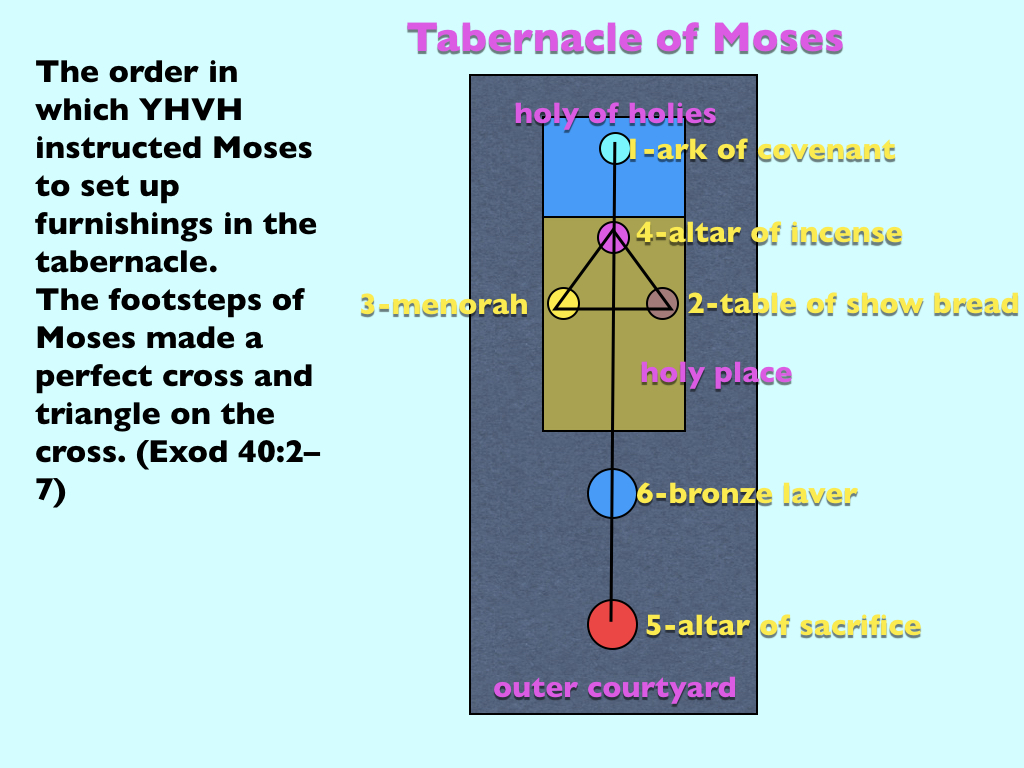
Exodus 40:2–7, Set up the tabernacle. YHVH’s instructions to Moses to set up the furnishings in the tabernacle followed a particular order. In fact, if one traces Moses’s footsteps in doing so, it forms an interesting geometric pattern that is highly significant spiritually. Let’s explore this. 

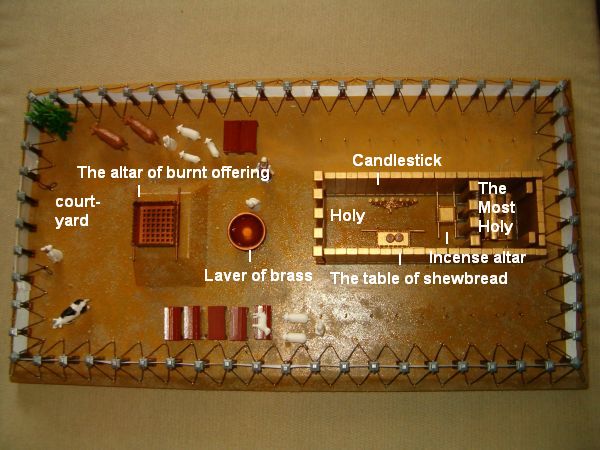
In placing the furnishings in the tabernacle, Moses first started in the holy of holies where he set up the ark of the covenant. After this, he went into the holy place and over to the right side where he set up the table of show bread. He then moved across to the left side of the holy place and set up the menorah. Next, he moved to the center of the holy place in front of the curtain or veil separating the holy place from the holy of holies where he set up the altar of incense. After this, Moses made a straight line and exited out of the tabernacle itself into the outer courtyard we he set up the altar of sacrifice. Having done this, Moses then set up the bronze laver, also in the outer courtyard just in front of the door leading into the tabernacle. If you trace Moses’ steps and make a line in the dirt, what is the outline?

The outline of Moses’ movements makes a triangle on a cross with the base of the triangle forming the arm of a cross. The base of cross corresponds to the altar of sacrifice, while apex of the triangle corresponds to the altar of incense and the top of the cross, which extends past the apex of the triangle is where the testimony in the holy of holies is. Why did YHVH instruct Moses to set up the tabernacle’s furnishings in this order, and not another order? What is the spiritual significance of this particular pattern? How does it relate to you and me? Let’s unpack this.

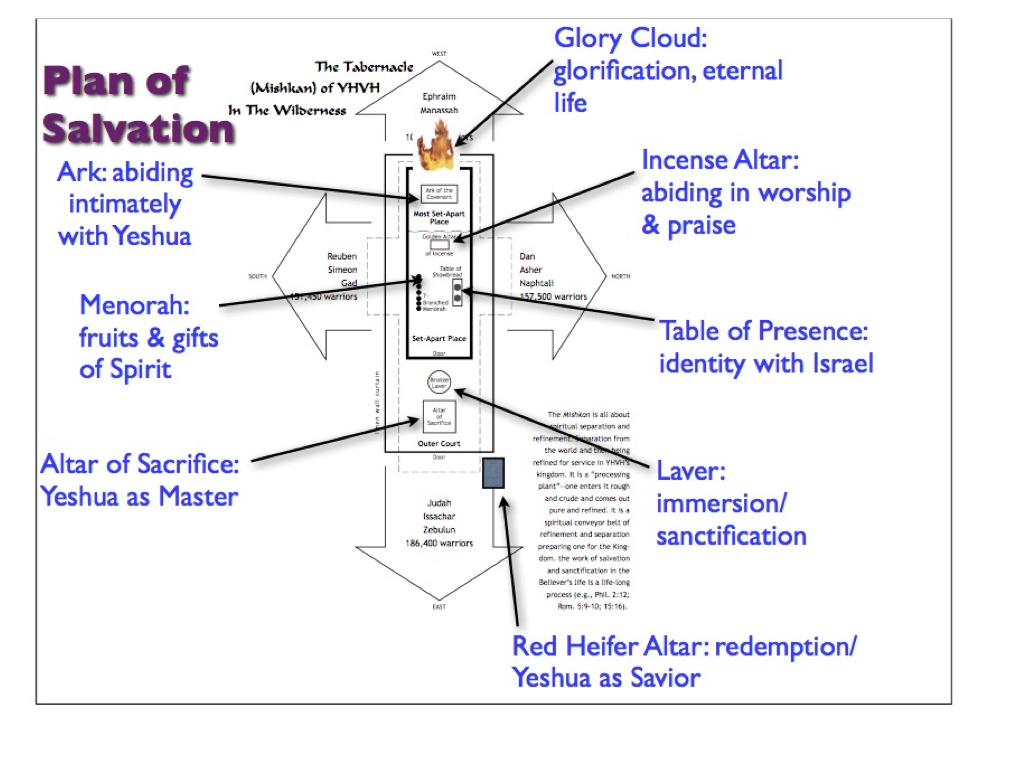
The base of this arrow is at the altar of sacrifice representing Yeshua’s death on the cross atoning for our sins. Next, the arrow points us to the bronze laver picturing a believer’s next step in his spiritual walk which is baptism for the remission of sins and legally identifying with Yeshua’s death, burial and resurrection, as well as receipt of Elohim’s Set-Apart Spirit and the washing of our lives by the water of the Word of Elohim. Next we come to the menorah picturing the Spirit of life in Yeshua the Messiah as the new believer manifests begins evidencing the fruits of the redeemed life, which is the fruits and gifts of the Spirit, which shine like a light into the dark world around us. Next we come to the table of the showbread picturing the regathering and unification of the tribes of Israel around the table of Yeshua’s body in sweet fellowship and covenantal relationship. Through the Messiah of Israel, the scattered tribes are regathered and can pray to and worship Elohim together unified at the altar of incense as they prepare to enter into the eternal kingdom of YHVH Elohim’s presence as pictured by the holy of holies under the glory cloud of YHVH himself.

The way to Elohim through Yeshua the Messiah is laid out in the Tabernacle of Moses making the outline of a cross and an arrow that points heavenward. This goes to show us that the tabernacle is, in reality, a giant gospel tract that shows sinful man the way of salvation leading to his glorification as immortal sons and daughters of YHVH Elohim, our Father in heaven.

Your way, O Elohim, is in the sanctuary; Who is so great a El as our Elohim? (Psalm 77:13)

Exodus 40:34, The glory of YHVH filled the tabernacle. The glory cloud that covered the tabernacle signaled ­YHVH’s approval of the work that was done. Had the Israelites not followed all of YHVH’s minute construction instructions would he have inhabited the tabernacle? Is there a lesson to be learned from this? Could YHVH’s anointing on our lives be greater if our obedience to YHVH’s instructions were greater?


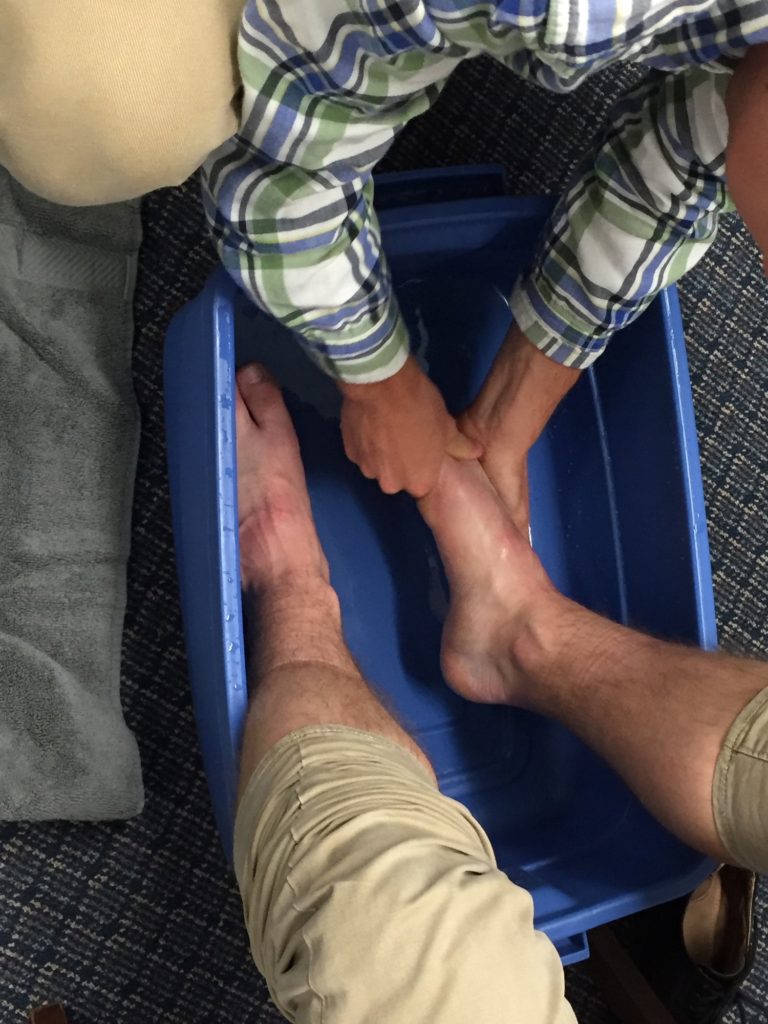
When was the last time YOU “washed” someone’s feet?

John 13:8, You will never wash. Peter rejected Yeshua’s washing his feet not because of human obstinateness, but because of his honor for Yeshua. Washing the feet of one’s guests was an act of hospitality on the part of a host and was usually performed by a servant, not the host. Peter considered it to be demeaning for the Master to be performing the task of a servant, yet this is exactly what Yeshua was attempting to demonstrate. As the Messiah, he came to lay down his life in loving service for his disciples and not to be served (Matt 20:28; John 10:15; 15:13). Yeshua then made the point that his disciples should following his example in serving one another (vv. 12–17). 

John 13:14–15, You also ought to wash. Yeshua is giving a simple and clear command here for the saints to wash one another’s feet. How many Christian churches who claim to be followers and imitators of Yeshua actually wash each others’ feet? If Christian leaders in most churches are teaching their people to obey this command, now many other of Yeshua’s other commandments are they not teaching and obeying?

John 13:35, By this all will know. Love was to be the identifying mark of a disciple of Yeshua. The Bible defines love in several ways. We love Yeshua by keeping his (Torah) commands (John 14:15; 1 John 5:1–3). Yeshua defines the Torah as loving Elohim with all of our heart, soul mind and strength and loving our neighbor as ourself (Mark 12:28–31). Paul says that all the laws of Elohim can be summed up in love (Rom 13:8–10). Yeshua said that the greatest expression of love is to lay one’s life down for another as Yeshua did for us (1 John 3:16; 4:11). Without love, all the good—even religious works—we may do YHVH counts as nothing (1 Cor 13).

It’s important to note that most disciples of Yeshua (including Christians) believe this principle, but, sadly, when it comes down to reality, many fail to live out the identifying principles of love. How easy it is to view our religious works as the main identifying marks of our relationship with Yeshua. We may pride ourselves in the fact that we keep the Sabbath or the biblical holidays, practice full water baptism, speak in tongues, believe in the baptism of the Holy Spirit, practice the gifts of the Spirit, identify ourselves with the teachings of notable religious leaders, are Torah-obedient, eat or don’t eat certain types of foods, or other external practices and identifying marks. In truth, Yeshua looks less at these than the heart condition of the disciple. Does one have a heart of love, and is he obeying his Master and his neighbor as himself out of love to the best of his ability according to the light of the truth he has been given? This is the most important issue.

It’s interesting to note what Yeshua didn’t say in this verse. He didn’t say that all men will know that you’re my disciples because you have the right Bible version, pronounce the name of Elohim (i.e. YHVH) using the correct ancient pronunciation, observe the biblical Sabbath and feasts, follow every jot and tittle of the Torah perfectly, or dress a certain way. Yet, sadly, these prescriptions and strictures often become those things by which people identify themselves, and that end up keeping people separated from each other into exclusivistic tribal clan-like groups who will have nothing to do with anyone outside their group. Acting in this manner is not the heart of Elohim! In reality, in we’re not careful, our obedience issues can become points of pride—something YHVH hates (Prov 6:6–19). 

Once again, Yeshua, in this succinct teaching, pulls the rug out from the religious hypocrites and the deceived who focus on the legalistic and religious externals of what the Bible teaches, but miss the heart and spirit that Yeshua indicates should be the spiritual force driving our obedience—what he calls the weightier matters of the Torah-law, which are justice, mercy and faith (Matt 23:23).


“Ye are gods…” (??)

In these days of uncertainty, geopolitical intrigue, economic uncertainties, mistrust, life-threatening diseases and plagues, faithlessness and hopelessness, and fear on every side, it’s time to look upwards to the Rock of our salvations and to WASH OUT YOUR BRAIN WITH THE FOLLOWING:

John 10:34, You are gods. Yeshua is here quoting Psalm 82:6 where the term elohim in Hebraic thought and as used biblically simply refers to all divine beings whether good (e.g. Elohim, his heavenly council and angels) to evil (e.g. Satan, evil spirits and demons). Elohim can also refer to human (righteous) judges, who are acting on behalf of Elohim on this earth making righteous judgment between humans (e.g. Exod 21:6; 22:8–9). But there’s more.

Yeshua gave this same authority to his apostles (or church leaders) to adjudicate between the saints and to make the same ecclesiastical decisions as did the Jewish Sanhedrin of old, and he promised that as Elohim’s agents on earth, he would honor their decisions (e.g. Matt 16:19; 18:18–20). 

Moreover, in this passage, Yeshua is clearly stating that the Jews in his audience were divine beings. What did he mean by this? The verse here doesn’t indicate that those in his audience were Jewish judges or members of the ruling elite. He was speaking generically to a group of lay people to whom the word of Elohim had been given (v. 35), which is why they were in Jerusalem at that time on the temple mount observing the Feast of Dedication or Hanukkah (John 10:22–23). In making this statement, Yeshua is most likely referring to the fact that spiritually enlightened and regenerated humans have the potential (i.e. at the resurrection) for becoming glorified sons of Elohim if they believe in him (John 1:12). 

Whatever Yeshua means, he is clearly stating that those humans (to whom the Word of Elohim was given, v. 35) possess some divine element, to one degree or another, that qualifies them to be included under the rubric of elohim. Whether he is thinking of the term elohim vis-à-vis humans in present or future prophetic terms is not clear from this passage. He simply states as a fact that “You are elohim” (if you have been given the word of Elohim).


The Priestly Robes, Yeshua and YOU

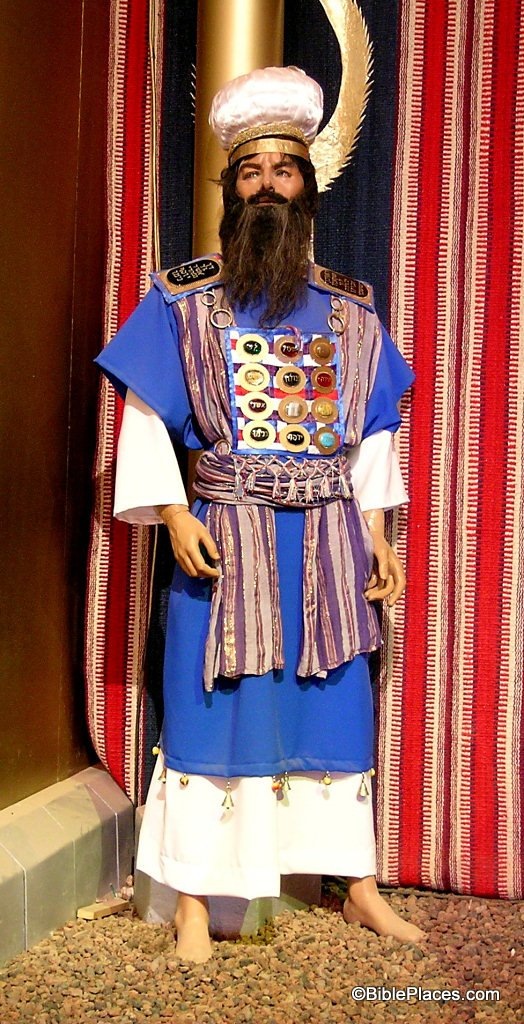
Exodus 39:1, The holy garments for Aaron. The vestments of the high priest (kohen hagadol) are symbolic of the robes of righteousness that saints should be wearing in preparation for the return of the Messiah.

  • Gold symbolizes purity of heart. Blue symbolizes heaven and spirituality.
  • White linen pictures robes of righteousness, purity or sinlessness.
  • Red represents blood—the blood of Yeshua that cleanses us from sin.
  • The high priest wore a belt that represented truth according to Paul (Eph 6:14).
  • The white linen pants represented sexual purity. The white turban represented purity of thought and humility (the opposite of conceit).

The high priest also wore a gold crown inscribed with the words, “Kadosh l’YHVH” meaning “Set-Apart to YHVH.”

The dangling pomegranates attached to the hem of his robe represented the fruits of the Spirit of Elohim, which should be manifesting in the life of the saint. The golden bells, also attached to the hem of his robe, jingled when the high priest walked. These symbolized the righteous walk of the saint: people should hear and see our good spiritual fruits. All of our actions speak loudly and clearly as to who we are and what we believe. Also, Yeshua taught that our words reveal the true condition of our heart (Luke 6:45). How, then, do people really view us? What are we like when we are alone—our thought life and our words—our secret life? Is there a discrepancy between our secret and public lives? If so why? How set apart and righteous are we…in reality?

If YHVH has called us to be his set-apart priesthood, then hadn’t we better get busy cleaning up our act and start acting like one?

Jewish tradition tells us that a rope was tied to the leg of the high priest in Second Temple times so that while ministering in the innermost sanctuary of the temple if he was impure and YHVH struck him dead (as happened to Nadab and Abihu, the sons of Aaron, when they offered up strange fire) the corpse could be dragged out by the rope. This teaches us that we should view being righteous and set apart seriously. Remember Hebrews 12:14 which instructs us to, “Follow peace with all men, and holiness, without which no man will see the Master.”

As YHVH commanded Moses. In chapter 39, please observe the fact that all the work of the tabernacle was done “as YHVH commanded Moses” (or phrases similar to this), and these statements are repeated ten times in this chapter. YHVH gave specific instructions concerning the construction of the tabernacle and expected these instructions to be followed to the letter. The tabernacle was the means by which the Israelites were to approach YHVH. Though the physical tabernacle is long gone, it still serves as a blueprint or pattern showing man the steps to reconciliation with his Creator. There is no other way to be reconciled to YHVH except through the steps of redemption outlined in the mishkan. Furthermore, YHVH never gave any human the prerogative to add or subtract from his instructions. Consider the implications of this with regards to our spiritual walk before our Heavenly Father. How important is it to follow all his instructions in righteousness? How often do we mitigate his instructions and reshape them to accommodate us? Isn’t this what the serpent persuaded Adam and Eve to do at the tree of knowledge, which is how sin entered the world?

Continue reading