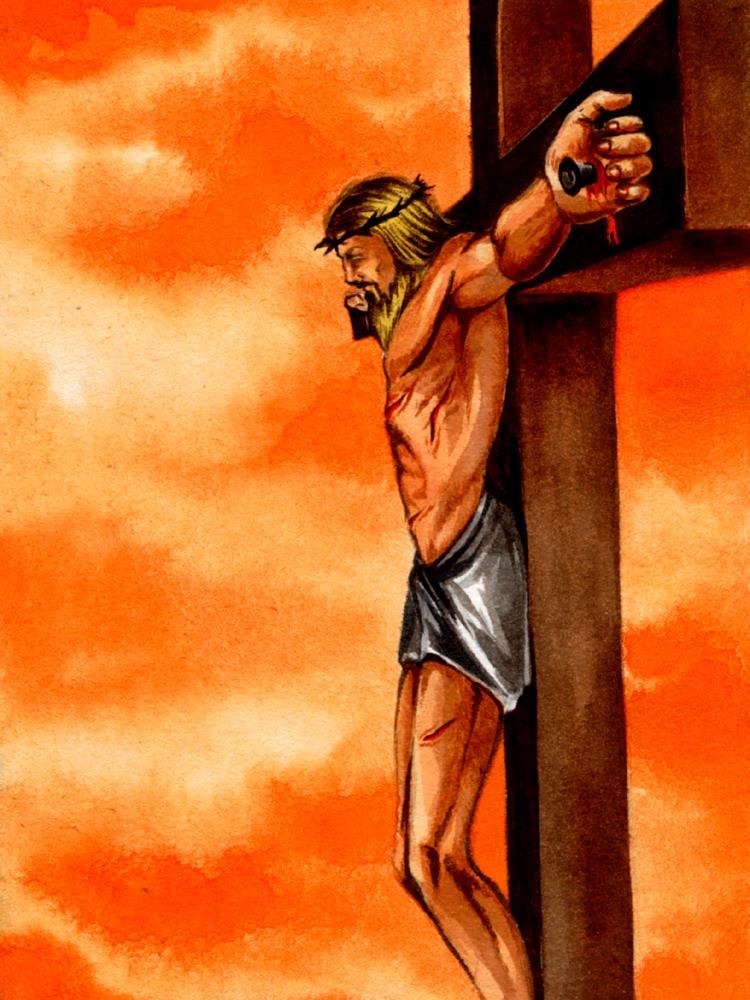
Acts 11:20, Preaching the Lord Yeshua. Yeshua instructed his disciples that if he be lifted up (John 12:32), all men would be drawn to him. This, of course, is a not so oblique prophetic reference to the method by which he would be killed, that is, by crucifixion, but is also a double entrendre referring to the subject matter and method that his disciples were to use when preaching the gospel.
Notice, Yeshua didn’t say to preach the Torah-law of Moses per se. Rather, preach about him.
Of course, when preaching about Yeshua, it automatically will follow that people will come into a loving and heartfelt compliance with the Written Torah because of their love for Yeshua, the Living Torah (John 14:15, 21) and their desire to know him and to imitate his perfect and beautiful life (1 John 2:3–6).
Our new annual Scripture Reading Schedule for 2019-2020 with daily readings is available to download and print. If you are still working through 2018-2019’s Scripture Reading Schedule, the link will still be available on the right sidebar under “Helpful Links”. If you are using a mobile device or tablet, the link may be below, meaning you’ll need to scroll down instead.
Most of this week’s blog discussion points will be on these passages. If you have general comments or questions on the weekly Scripture readings not addressed in a blog post, here’s a place for you to post those. Just use the “leave a reply” link or the “share your thoughts” box below.
The full “Read Through The Scriptures In A Year” schedule, broken down by each day, can be found on the right sidebar under “Helpful Links.” There are 4 sections of scripture to read each day: one each from the Torah, the Prophets, the Writings, and from the Testimony of Yeshua. Each week, the Torah and haftarah readings will follow the traditional one-year reading cycle.
** A different Haftarah is read when it is a special sabbath in Jewish tradition. This week it is Shabbat Rosh Chodesh on the traditional calendar. Otherwise, 2 Kings 7:3-20 would be read.
Weekly Blog Scripture Readings for 4/19 through 4/25/2020.
In Peter’s vision of the sheet covered with unclean animals, the voice from heaven commanded him three times to kill and eat these unclean animals. Peter was confused by the meaning of this vision since being a Torah-law abiding Jew he knew that eating unclean meat was forbidden and in good conscience he could not do that which was contrary to YHVH’s Torah-law, for to do so was sin (sin is the violation of the law, 1 John 3:4).
Often visions are metaphorical in nature and not literal. There are many examples in the Scriptures of people receiving metaphorical visions. For example, read the books of Daniel and Revelation. Indeed, Peter’s vision was no exception, for no sooner had the vision ended when three Gentile men appeared at his door seeking the gospel message and the Spirit of Elohim bade Peter to go and to meet them. Peter then realized that the interpretation of his vision was that he should not call any man common or unclean; that is, the gospel message is for all people regardless of their ethnicity (verse 28). In Peter’s case, Bible itself interprets his vision. The issue is not about whether it is now permissible to eat non-kosher meat or not, but rather the Spirit of Elohim was directing the apostles to begin taking the gospel to the Gentiles, who by Jewish standards were considered common and unclean (verse 28).
Now consider this. If Yeshua had meant to say in Matthew 15:11 and Mark 7:18–19 that it was now permissible to eat all foods including those meats that the Torah prohibits to be eaten (e.g. pork, shellfish, etc.), presumably Peter would have known this, since he was present when Yeshua made the statement (see Matt 15:15). If Peter knew that Yeshua had given the okay for his disciples now to eat unclean meat, why then did Peter so strongly object when the voice from heaven commanded him to eat the unclean animals in the vision (Acts 10:13–14)? Obviously, Peter had not changed his opinion about not eating unclean meat, since Yeshua had never annulled the Torah command forbidding the eating of unclean meats in the first place.
There is another point to consider with regard to Peter’s vision. In the Tanakh, unclean animals or beasts of the field was a Hebraic metaphor for the people of the nations (goyim), or Gentiles. Peter would have been aware of the meaning of this metaphor once the angel explained to him that the unclean animals he had seen in his vision was a not a reference to the biblical dietary laws, but to the Gentiles. Moreover, to the Jewish religious tradition of the day, interaction with the Gentiles was something that orthodox Jews did not do. To do so made one unclean or unkosher. This is not a biblical concept, since in the Tanakh, the nation of Israel was to be a light to the nations and to bring them to Elohim. Furthermore, the Torah is inclusive with regard to allowing Gentiles to be sojourn with the Israelites as long as they would accept Elohim and his laws and abandoned their heathen ways. There was to be one and the same Torah-law for both the native born Israelite and the Gentile that was grafted into Israel. There are also several examples in the Tanakh of Gentiles converting to the Israelites’ religion and being fully accepted (e.g. Ruth and Rahab). Once the angel explained the meaning of Peter’s dream, it would have been clear to Peter that Elohim was expressing disapproval of the Jewish view of Gentiles and that this vision was a mandate from heaven to evangelize the Gentiles. Moreover, the Gentile who was converted and brought into Israel was made spiritually clean, but the Scriptures never considered unclean animals kosher, and never made any provision for unclean animals to be made kosher—ever!
Acts 10:13–15, Rise…kill and eat…Not so, Lord. On occasion, YHVH will give his servants a dream or vision that on the surface or at face value seems outrageous or even anti-Torah as was the case with Peter’s dream. It seemed that YHVH was asking Peter to violate his own Torah-Word by eating unclean meats. This is how the modern church has largely interpreted this vision, while de-emphasizing its metaphorical meaning.
What is the chief attribute of Yehovah Elohim? It is holiness, for this is what Scripture revealed that the spirit beings in his heavenly throne room are chanting day and night.
In the year that King Uzziah died, I saw the Lord sitting on a throne, high and lifted up, and the train of His robe filled the temple. Above it stood seraphim; each one had six wings: with two he covered his face, with two he covered his feet, and with two he flew. And one cried to another and said: “Holy, holy, holy is the YHVH of hosts; The whole earth is full of His glory!” (Isa 6:1–3)
The four living creatures, each having six wings, were full of eyes around and within. And they do not rest day or night, saying: “Holy, holy, holy, YHVH Elohim Almighty, Who was and is and is to come!” (Rev 4:8)
What is holiness? The Bible defines it is as those things, people, times and practices that YHVH himself has determined are to be set apart or are above or are transcendent. Set apart from or transcendent above what? From those things that are mundane or earthly, defiled or polluted by sin or by that which is unholy and ungodly.
Why is it important to know that the chief character attribute of Elohim is holiness? Because he wants his children to be holy as he is holy (Lev 11:44, 45). Why is this? Because he wants to spend eternity with his redeemed and glorified children, for without holiness no one will see Elohim (Heb 12:14). It’s really that simple! Therefore, it’s important that his children learn now the difference between what YHVH considers to be the holy and the profane (Lev 11:47), so we can hang out with him in his holy presence for eternity.
Natan’s Commentary Notes on Leviticus Chapter Eleven
Leviticus11:1–47, The biblical dietary laws are about holiness.
Let’s briefly discuss the subject of clean and unclean meats. The focal point of biblical dietary laws are holiness and separation. There are other issues here that need to be explored as well. How serious are you about obedience to YHVH’s commands, or is your belly your god? (See Phil 3:19; Rom 16:18.) Do your taste buds or the Word of YHVH rule your life? Remember, Torah covers all aspects of life: physical, spiritual, emotional, relational, civil, agricultural, political, jurisprudence, religious and economic. Torah is a very holistic handbook on life. Are you one who takes the (humanistic) pick-and-choose approach to Torah-obedience? “I’ll obey only the biblical laws that suit me.” Such an approach is akin to what the serpent told Adam and Eve when he said, “You can have it your way … YHVH didn’t really mean what he said when it comes to obedience.”
When most people think of word kosher, the biblical dietary laws come to mind. This is only part of the picture that the Bible presents when it comes to the subject of kashrut. The biblical kosher laws involve not only clean and unclean meats, but many other areas as well such as health issues, holiness (not defiling the body, the temple of YHVH’s Set-Apart Spirit), and separation issues—how we’re to act, live, eat, worship, think, dress and talk differently than the heathens around us. The word kosher derives from the Hebrew word kasher/RAF meaning “to be straight, right, acceptable” (see Est 8:5; Eccl 11:6; 10:10). YHVH has called his people out of this world and sanctified (set-apart) them to be “straight, right and acceptable” to him. Therefore, YHVH hasn’t give us the liberty to act, speak, dress, eat and live the way the heathens do. He has called us to a higher moral and spiritual standard. We can’t expect to be called the children of the Most High, and still live like the children of the world. We must choose whom we are going to serve (see Josh 24:15): YHVH or mammon and this world (Matt 6:24).
Leviticus 11:4, 47,Unclean.The word unclean is the Hebrew word tameh meaning “defiled, impure, polluted ethically, ritually or religiously” and the word clean is the Hebrew word tahor meaning “pure physically, ceremonially, morally, ethically.” In verse 43, YHVH says that in eating unclean meats one becomes abominable (or detestable, filthy). In Ezekiel 22:26, YHVH rebukes his people because, “Her priests have violated my Torah-law, and have profaned my set-apart [Heb. kadosh] things: they have put no difference between the set-apart and profane, polluted or common, neither have they shown difference between the unclean and the clean, and have hid their eyes from my sabbaths, and I am profaned among them.” In Leviticus 11:45, the Torah states, “For I am YHVH that brought you up out of the land of Egypt, to be your Elohim. You shall therefore be set apart, for I am set apart/holy.”
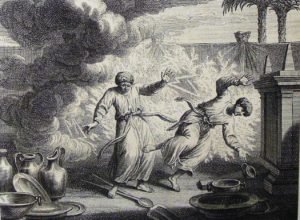
Nadab and Abihu were executed by the fire of YHVH for not following his commandments. This disobedience was induced by the consumption of alcohol, which impaired their ability to follow YHVH’s protocols for the tabernacle service (Lev 10:9). What can we learn from this tragic story of the disobedience of YHVH’s servants who should have known better, and how will this story repeat itself at the end of this present age upon some of YHVH’s unfaithful servants? We will now discuss the prophetic implications of this story and how history will repeat itself shortly.
Nadab and Abihu were unfaithful to Elohim in that they neglected to take his commandments seriously. Perhaps they thought that his instructions in righteousness didn’t apply to them but to someone else, or that his laws were done away with, or that YHVH Elohim simply didn’t really mean what he said. Whatever the case, they became lukewarm and profaned the holy things of Elohim through their excessive use of alcohol and careless indifference to the Word of Elohim. Because they were in leadership as priests and sons of Aaron the high priest, their example of unrighteousness like a spiritual contagion could have infected the children of Israel and destroyed that new nation at its inception. Therefore, YHVH Elohim had to deal quickly and forcefully with the erring and rebellious sons of Aaron. In answer to their sin of not obeying YHVH’s laws, the holy fire of Elohim came out (presumably from the tabernacle—a picture of Elohim’s heavenly tabernacle and throne room) and killed Nadab and Abihu then and there.
What are the lessons that we can learn from this horrific story, and what are the end time prophetic implications of it?
We learn from the book of Revelation that at end of the Messianic Age (or Millennium) unrepentant sinners will be executed by the fire of YHVH in the lake of fire (Rev 20:15) because they have been made drunk by the false religious teachings of the whore system of religious spiritual Babylon and Satan (Rev 18:3–4).
We are now living in an age where, thankfully, most of our sinful actions are not met with instant divine judgment (the case of Ananias and Sapphira in the Book of Acts would be a notable exception). Does knowing that YHVH will not instantly “zap” us with the proverbial lightning bolt from heaven when we sin cause us to become lax and even calloused toward sin in our lives? Do we truly walk in the fear of YHVH? Do we fear the consequences of sin even though the results may not be immediate? How loose is your spiritual walk? How many hidden sins that no one knows about do you have that you are failing to deal with?
The path of righteousness is becoming narrower and narrower. Moreover, there are levels of rewards in Yeshua’s kingdom. Not everyone will be “the greatest in the kingdom of heaven.” Some will be the least, and many will not even be there at all (Matt 5:19 cp. 1 Pet 4:18). Remember that the tares that were mixed in with the wheat were culled out and burned (Matt 13:24–30). This is a picture of the true versus false converts coexisting in the spiritual body of Yeshua or the church to the very end!
It is time for the people of Elohim to wake up from their spiritual lethargic and drunken stupor, repent of their sin of taking a careless and even indifferent view of YHVH’s commandments.
“And to the angel of the church of the Laodiceans write, ‘These things says the Amen, the Faithful and True Witness, the Beginning of the creation of Elohim: I know your works, that you are neither cold nor hot. I could wish you were cold or hot. So then, because you are lukewarm, and neither cold nor hot, I will vomit you out of My mouth. Because you say, ‘I am rich, have become wealthy, and have need of nothing’—and do not know that you are wretched, miserable, poor, blind, and naked—I counsel you to buy from Me gold refined in the fire, that you may be rich; and white garments, that you may be clothed, that the shame of your nakedness may not be revealed; and anoint your eyes with eye salve, that you may see. As many as I love, I rebuke and chasten. Therefore be zealous and repent. Behold, I stand at the door and knock. If anyone hears My voice and opens the door, I will come in to him and dine with him, and he with Me. (Rev 3:14–20)
And I heard another voice from heaven saying, “Come out of her, my people, lest you share in her sins, and lest you receive of her plagues.” (Rev 18:4)
The 50 day count of the omer (the countdown to Shavuot, the Feast of Weeks or Pentecost) began last Sunday. Today is the fourth day of the first week of seven weeks of the counting of the omer. What is the purpose of this interesting ancient ritual? Why did YHVH command the Israelites and us as his commandment keeping (John 14:15, 21; 1 John 2:3–6; 3:4), one new man (Eph 2:11–19), grafted into the olive tree of Israel (Rom 11:11–32), and the “Israel of Elohim” (Gal 6:16) people to observe this curious ritual?
The counting of the omer is yet another step in YHVH’s plan of salvation, and an illustrative walking-it-out learning opportunity for the people of Elohim to discover what it means to grow up into the measure of the stature of the fullness of Yeshua the Messiah (Eph 2:13), and to become his glorious bride without spot or wrinkle (2 Cor 11:2; Eph 5:27) as my article below below explains.
There are 49 days between First Fruits Day, which occurs during the Feast of Unleavened Bread, and the Feast of Weeks (or Pentecost). Why does YHVH in the Torah command us to count the seven weeks or 49 days between these two events, with Pentecost occurring on the fiftieth day? The short answer is that Yeshua doesn’t want to marry a spiritual baby. For the long answer, keep reading…
From the Depths of Slavery to a Kingdom of Priests
Every detail in Scripture is for our learning and edification. All the examples of the past are for our learning upon whom the ends of the world are come (1 Cor 10:11; Rom 15:4). Everyday, YHVH is uncovering the prophetic mysteries hidden in the Scriptures that are being revealed to those who diligently seek him by diligently studying to show themselves approved as a workman rightly dividing YHVH’s Word (2 Tim 2:15).
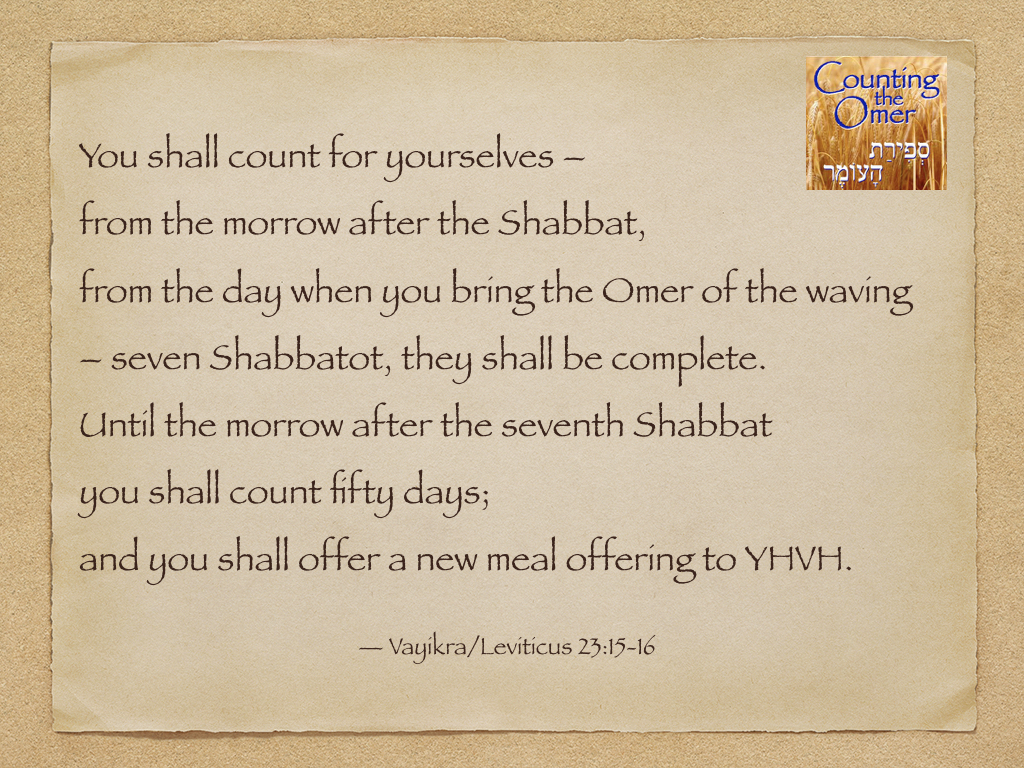
YHVH’s command for us to count the omer as a countdown to the Feast of Weeks (Heb. Shavuot; Gr. Pentecoste,Lev 23:15–16) memorializes the Israelites’ journey from spiritual babyhood to adulthood. During this 49-day count, Israel ascended from out of the depths of slavery and suffering in Egypt, was baptized in the Red Sea, and then arrived at Mount Sinai—a place of a spiritual standing before YHVH as a kingdom of priests (Exod 19:6). It was there that YHVH gave them his instructions in righteousness—the Torah on Shavuot.This period represents Israel’s passage from slavery to freedom. They came out of slavery permeated with the leaven—the sins, values, and pagan concepts—of Egypt leaving it all behind as pictured by the Feast of Unleavened Bread. YHVH gave Israel 49 days to overcome and to get rid of the impurities of Egypt, and to become the nation of Israel—a holy priesthood and the bride of YHVH. There, at the foot of Mount Sinai, YHVH wanted them to become his ambassadors to this world of the truths of his heavenly kingdom.
The counting of the omer is the story of our lives also. It pictures our going from bondage to the world, the flesh and the devil and coming to a place of spiritual standing before YHVH, so that we can be used of him to advance his kingdom.
It’s a process ordained of YHVH and it’s his pattern that we must follow. There is no escape from this process if we are to be groomed and prepared for use in YHVH’s service.
Why Fifty Days Between the Wave Sheaf Offering and Shavuot?
Fifty is the biblical number signifying complete redemption or liberty. In ancient Israel, all debts were forgiven every seven years. This was called the seven-year cycle. Every seven years, one had to let their land rest; no crops were planted. This was called the land Sabbath. Seven seven-year cycles equaled 49 years. In the Scriptures, we see that seven is the number YHVH uses to signify completion or perfection. Therefore, seven sevens, or 49 years, signified total completion. Seven Sabbaths represents redemption, liberty or rest in its fullest or ultimate sense. The fiftieth year was therefore the year of jubilee when all slaves were set free, all land was returned to its original owners and when all debts were forgiven. If Passover and the Feast of Unleavened Bread signified deliverance from sin (Egypt), then Shavuot, occurring 50 days after the wave sheaf offering during the week of the Feast of Unleavened Bread, symbolizes total redemption, deliverance and victory over sin. How? For us, this occurs through the divine gift and glorious power of the indwelling presence of the Ruach HaKodesh (the Set-Apart Spirit), which Yeshua poured out upon his disciples on the day of Pentecost.
We must recognize this YHVH-ordained process, submit to it and realize what he wants to accomplish in our lives as a result. As we are going through the process, we must keep our eyes on the end goal and keep heading in that direction. Yeshua is that end goal. He is the “end” or “final aim, goal of the Torah” (Rom 10:4). He is “the fulfillment of the law” or full manifestation or fruition of the Torah (Matt 5:17). As such, he is our example to follow. Paul says we are to imitate him—to do what he did (1 Cor 11:1).
The 49 Days Represent a Time of Overcoming and Spiritual Development