

From NewMax.com at https://www.newsmax.com/us/vatican-archbishop-carlo-maria-vigano-letter-trump/2020/06/07/id/970927/
Vatican Archbishop Carlo Maria Viganò (AP)
Sunday, 07 June 2020 05:07 AM
Influential Vatican Archbishop Carlo Maria Viganò, the former Papal Nuncio to Washington, D.C., has written to President Trump, praising his leadership during a critical juncture in his presidency as he faces harsh criticism for his handling of the coronavirus and the George Floyd protests.
In a June 7 letter addressed to President Trump and obtained by Newsmax, Vignano writes that the President’s enemy is “the children of darkness – whom we may easily identify with the deep state which you wisely oppose and which is fiercely waging war against you in these days . . .”
The Archbishop indicated that the “Covid emergency” will likely be viewed in the future as a “colossal operation of social engineering.”
“We will also discover that the riots in these days were provoked by those who, seeing that the virus is inevitably fading and that the social alarm of the pandemic is waning, necessarily have had to provoke civil disturbances, because they would be followed by repression which, although legitimate, could be condemned as an unjustified aggression against the population,” Vignano wrote.
The Archbishop claimed that “the same thing is also happening in Europe, in perfect synchrony.”
Vignano praised Trump as a “President who courageously defends the right to life, who is not ashamed to denounce the persecution of Christians throughout the world, who speaks of Jesus Christ and the right of citizens to freedom of worship.”
President Trump came under fierce criticism last Tuesday after visiting the Catholic National Shrine of Saint John Paul II in Washington.
Washington Archbishop Wilton Gregory, a church liberal, publicly chastised the Shrine for hosting the President.
In a statement Gregory stated: “I find it baffling and reprehensible that any Catholic facility would allow itself to be so egregiously misused and manipulated in a fashion that violates our religious principles, which call us to defend the rights of all people even those with whom we might disagree.”
The President’s visit to the Shrine came shortly after he signed an Executive Order at the White House supporting religious freedom around the world. The day before the President had visited St. John Church and held a Bible up in front of a press gaggle. On Sunday night, protesters attempted to burn the historic church down.
In his letter Vignano told Trump that the attacks were “part of the orchestrated media narrative which seeks not to fight racism and bring social order, but to aggravate dispositions; not to bring justice, but to legitimize violence and crime; not to serve the truth, but to favor one political faction.”
Without referencing Gregory by name, Vignano implied he was “aligned on the opposing side” to the President.
“They are subservient to the deep state, to globalism, to aligned thought, to the New World Order which they invoke ever more frequently in the name of a universal brotherhood which has nothing Christian about it, but which evokes the Masonic ideals of those want to dominate the world by driving God out of the courts, out of schools, out of families, and perhaps even out of churches,” Vignano said.
Vignano concluded his letter, “United against the Invisible Enemy of all humanity, I bless you and the First Lady, the beloved American nation, and all men and women of good will.”
© 2020 Newsmax. All rights reserved.
Parashat B’ha’alatkha — Numbers 8:1 – 12:16
Haftarah — Zechariah 2:14 (10)* – 4:7
Prophets — Jeremiah 31:1 – 37:21
Writings — Ecclesiastes 1:1 – 7:29
Testimony — Romans 3:1 – 9:33
Our new annual Scripture Reading Schedule for 2019-2020 with daily readings is available to download and print. If you are still working through 2018-2019’s Scripture Reading Schedule, the link will still be available on the right sidebar under “Helpful Links”. If you are using a mobile device or tablet, the link may be below, meaning you’ll need to scroll down instead.
Most of this week’s blog discussion points will be on these passages. If you have general comments or questions on the weekly Scripture readings not addressed in a blog post, here’s a place for you to post those. Just use the “leave a reply” link or the “share your thoughts” box below.
The full “Read Through The Scriptures In A Year” schedule, broken down by each day, can be found on the right sidebar under “Helpful Links.” There are 4 sections of scripture to read each day: one each from the Torah, the Prophets, the Writings, and from the Testimony of Yeshua. Each week, the Torah and haftarah readings will follow the traditional one-year reading cycle.
* Verse numbers in parenthesis refer to the verse number in Christian English Bibles when they differ from Hebrew Bibles or the Tanakh.
Weekly Blog Scripture Readings for 6/7 through 6/13/2020.
In this video on the book of Romans, we discuss Paul’s view of the gospel, the Torah (the law of Moses) and the reunification of the nation of Israel.The material presented here is totally fresh and is from a Hebraic perspective and is likely totally different than anything you’ve heard on this subject to this point.
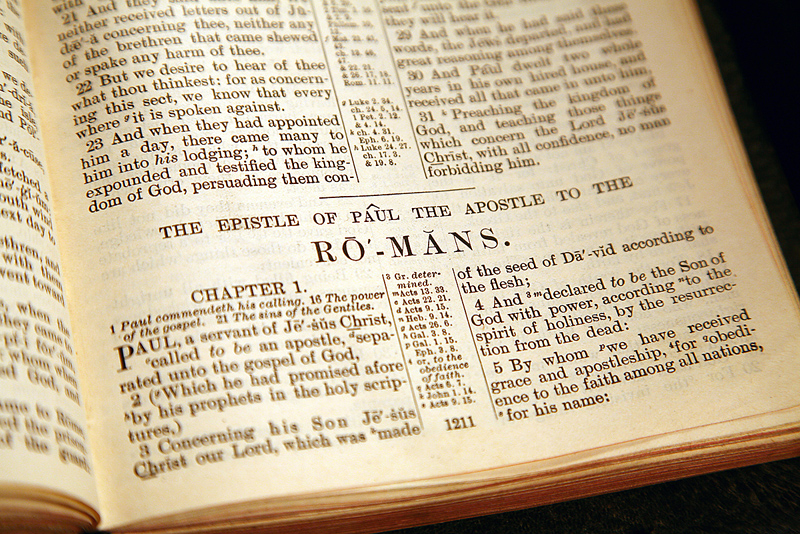
The following overview of Romans is a radical departure from what the mainstream church teaches. Read it and see if what follows doesn’t unite the truth of the Bible from beginning to end, instead of pitting one section of the Bible against the other, which is approach the church typically takes when presenting the teachings of Paul.
The Main Themes of Romans
This is perhaps the only book in the Bible that is organized systematically like a theological textbook from beginning to end with each point leading to the next. This is not how biblical books are typically arranged.
In this epistle, there are several main themes.
Paul’s Epistle to the Romans keeps Yeshua and the gospel message front and center, yet at the same time Paul weaves together the good news of Yeshua with that of the righteous lifestyle of Torah-obedience. Together, these two messages form a beautiful tapestry-like picture encompassing the message of the entire Bible from Genesis to Revelation — a message of the salvation of man resulting in his being reconciled to Elohim, and his becoming elevated to the spiritual status as a child of Elohim. This process occurs through man’s relationship with Yeshua the Messiah who is both the Written Torah incarnate.
Part 1 — Introduction: The Cornerstone of the Gospel Message
At the very beginning of his epistle, Paul carefully and boldly sets in place the cornerstone for what is to follow. He declares the preeminence of the gospel message and his submission to the lordship of Yeshua the Messiah and his unflinching mission to preach this truth.
Continue reading
In Psalm 149:6–7, David, a man after Elohim’s own heart, speaking of the saints wrote, “Let the high praises of El be in their mouth, and a two-edged sword in their hand to execute vengeance upon the heathen, and punishments upon the people.” Was David’s statement merely poetic hyperbole, or was this how he, as the king and a spiritual shepherd of Israel, literally defended the people YHVH had placed under his charge? We know from his life story that the latter was the case.

When Abraham, the father of the faithful and a man who was the model of righteousness had his nephew Lot kidnapped what was his response? Does Scripture record that he prayed, then sat down expecting YHVH to supernaturally intervene and cause the Babylonians to release Lot? No. His response was to muster the 318 soldiers of his own personal army and to pursue the five kings. What was the result? YHVH granted Abraham a miraculous victory over Lot’s captors and Abraham gave a tithe of the spoils of war to Melchizekek (Gen 14).
The Torah, YHVH’s divine instructions in righteousness, in Exodus 22:2, permits and even expects a man to defend himself against a thief breaking into his home. If the defense of one’s home results in the death of the thief, there is no retribution against the defender. There are no penalties or prohibitions in biblical law against a man acting in self defense.
The well-known Aaronic Blessings (Num 6:22–27) contains the following words, “May YHVH bless you and keep [or, safeguard, The ArtScroll Stone Edition Tanach] you.” The word keep is the Hebrew word shomar (Strong’s H8104) meaning “guard, observe, watch, have charge of, protect, save.” Such a promised blessing could be taken in two different ways: one simply sits back and does nothing to protect oneself, for that is YHVH’s job; or one does what one can to protect oneself in a reasonable and prudent manner, and beyond that one trusts YHVH to do the rest. The latter and not the former is the logical approach to follow, and is substantiated by numerous scriptural examples to be the correct interpretation of this verse.
Psalm 145, the famous Ashrei blessing of the daily Jewish prayers, states that YHVH protects all who love him, but all the wicked he will destroy (verse 20). The psalmist restates this idea elsewhere when he declares that YHVH saves his servant “out of all his troubles,” the righteous he “delivers … out of all their troubles,” and “many are the afflictions of the righteous, but YHVH delivers him out of them all” (Ps 34:6, 17, 19, emphasis added). The question we must ask here is this: does all literally mean all, in biblical thought? Clearly Scripture gives us a historical record of many of YHVH’s servants being persecuted and even martyred. Furthermore, the Scriptures prophesy that in the future many saints can expect this fate as well. Such passages are to be found in both the Tanakh (Old Testament) and Testimony of Yeshua (New Testament). Are the promises of YHVH a lie, or are we missing what he is really saying to us when he promises to deliver his people from all their troubles? Clearly, in light of the scriptural promises, the historical record and prophecies recorded in Scripture, all can mean only one thing: YHVH will deliver his people from ultimate evil, namely, death, hell and the grave, and he will avenge them of their adversaries by bringing ultimate judgment against them. This doesn’t mean that he won’t deliver his people from present evil by supernaturally protecting them, but some will suffer and even die a martyr’s death here and now. His people must trust in his sovereignty, love, justice and be assured that he has their best interests in mind even if they suffer and die now. The reward of the righteous is sure as is the fate of the wicked; both are in the hands of a just and all powerful Elohim.
With these truths in mind, it is the responsibility of the righteous to walk in faith, trusting YHVH day-by-day with their lives, but not to be blithely ignorant of the evil around them throwing all caution and prudent preparations to withstand evil to the winds of fate and calling it faith in YHVH. This is not faith; it is folly! Wise saints do not even practice this kind of “blind faith” in their daily physical lives. Most have locks on their doors, have fire extinguishers and first aid kits handy, maintain insurance policies, keep spare tires in their cars, wear seat belts and have extra batteries and food in their homes in case of an emergency. Proper preparation is called wisdom, and to not do so is foolish and fool-hardy. To not prepare, if one is able to do so, is not faith, but is tempting YHVH, something Scripture tells us not to do (Matt 4:7; Deut 6:16).
Scriptures Used to Justify Christian Pacifism
Continue reading
When you see evil coming your way, the first and most important thing to do is to watch and pray (Matt 26:41; Mark 13:3). Pray for discernment and guidance from the Spirit of Elohim as to what to do. Don’t react impulsively out of fear, but out of love, power and a sound mind (2 Tim 1:8); be led by the Spirit. Perfect love casts out fear (1 John 4:18). Reacting out of fear or emotion leads to cloudiness and confusion of thinking leading to wrong action.
Pray and trust in YHVH for deliverance and protection (Ps 3:3; 57:1; 68:1; 69:1; 107:6, 20; 108:6; 121:1, 2; 144:11; 145:19–20).
Do spiritual warfare against the enemy using the Scriptures.
Sometimes there is a time to fight (Ps 94:16; 144:1; 149:6), sometimes a time to flee (Matt 24:16–20; Eccl 3:3, 8). We must pray for discernment and guidance from above to know what to do and when. If YHVH directs us to fight, keep this in mind: fighting doesn’t always involve physically violent confrontation. Fighting can also involve spiritual warfare and clever non-violent tactics. Think Gideon who used lamps and shofars to defeat the Midianites.
If in response to preaching the gospel,
If civil authorities demand one to go against the laws of Elohim, it’s biblically permissible to defy them in deference to the higher governmental authority of Elohim (Act 4:19; 5:29).
If you’re being physically attacked by evil doers, consider the following…
Remember this: when evil times come, this provides an excellent opportunity to share the love of Yesshua and the Truth and hope of the gospel message with those around us including our unconverted neighbors and loved ones. This is an opportunity for them to see our faith and love in action, and to see the hand of Elohim move on our behalf in answer to our prayers of faith. In so doing, the kingdom of Elohim will be expanded.