


Romans 3:7, As we are slanderously reported…let us do evil, that good may come. “Evil” in Hebraic thought is simply another way of saying, “violating YHVH’s Torah-law.” There were those of Paul’s day who were perverting his message of salvation by grace through faith by turning it into a Torahless message. They were slanderously claiming that he was teaching against the Torah. Sadly, this same lie is taught universally in mainstream Christianity to this day.
In the book of Acts, we find much evidence of Paul being slandered again over the same issue as well (Acts 21:27–28). This time, it resulted in his arrest by the Romans and his defense against these false accusation (of him teaching against the Torah) in two courts of law where he confesses that he “believes all thing which are written in the Torah and the Prophets”(Acts 24:14) and “neither against the Torah-law of the Jews…have I offended anything at all”(Acts 25:8). Paul made these statements in Acts about the year A.D. 58 prior to his trip to Rome while the book of Romans had been written about two years earlier in A.D. 56.
Ironically, the very false accusation against which Paul had to so vigorously defend himself was the same accusation leveled against Stephen by his accusers in Acts 6:13. Paul was the one ultimately responsible for the death of Stephen (Acts 7:58). This slanderous report—that both Paul and Stephen were speaking against and changed the Torah—is the very lie that mainstream Christianity teaches today under the guise of the theological term dispensationalism, where it is taught that the Jews were “under the law” , that the law was “done away and nailed to cross” and that Christians are now “under grace” and the “law of Moses” is of little or no relevance to believers today.
Not only did Paul NOT teach against the Torah, but he was defending it against the Jews’ perverted or caricaturized view of Torah by which they had largely nullified the Torah through their religious traditions. (See Yeshua’s comments about this in Mark 15, Matthew 7 and 23.) The same thing can be said of modern Christian teachers who assert a similar anti-Torah bias.
Romans 3:8, Let us do evil, that good may come. This is another way of saying, “What shall we say then? Shall we continue in sin, that grace may abound? Elohim forbid” (heaven forbid, CJB Rom 6:1–2). The prevailing idea in mainstream Christianity is that New Covenant or Gentile believers are no longer bound to Torah-law obedience, therefore, since we are under grace, they some of the more liberal Christians will affirm, anything is acceptable. On this basis, I have heard “Christians” justify homosexuality, fornication, marijuana smoking and a host of other sinful practices justified on the basis of the this fallacious and libertine reasoning. This goes to show that human nature has not changed much in 2000 years since Paul’s day. The warped, twisted and sinful mind of man (Jer 17:9) is still prone to rebellion against the laws of Elohim and refuses to be subject to them (Rom 8:7).
Sadly, mainstream Christian dispensational theology has laid the groundwork for the rationale that we can sin (i.e. violate the Torah [see 1 John 3:4] that grace may abound). Such a belief system is actually a form of circular reasoning meaning that the premise is only true if the conclusion is true. This errant reasoning goes something like this: New Testament Christians are “under grace” and not “under law” and that grace and law are mutually exclusive concepts. Christians are under grace (or free and unmerited pardon) because of their past sin [i.e. the violation of Torah-law (1 John 3:4)], yet because they are “under grace” (or under the so-called “dispensation of grace”) and they are no longer “under law,” for the law is now annulled (the very violation of which caused them to need grace in the first place), and is no longer binding upon them; therefore, they can violate the law (especially laws concerning the Sabbath, the biblical feasts and the biblical dietary laws), the violation of which caused them to need grace in the first place. Can you see the circular reasoning of this argument?
Romans 3:1, What advantage then has the Jew? There were several advantages to being a religious Jew in the first century.
The main problem that the Jews of Paul’s day had to deal with was racial pride and prejudice against non-Jews, and self -righteousness because they viewed themselves as the elect or chosen people of YHVH and the possessors of Torah. This same problem ethnic arrogance exists among many Jews to this day who operate in both rabbinic and Christians circles. This is why Paul had to deal with endemic Jewish racial, cultural and spiritual pride in the previous chapter.
Romans 2:6, Every man according to his works.
The Scriptures are clear: every person will be judged, both the wicked and the saints. The writer of Hebrew says, “And as it is appointed unto men once to die, but after this the judgment” (Heb. 9:27). Paul says in 2 Cor. 5:10, “For we must all appear before the judgment seat of Christ; that every one may receive the things done in his body, according to that he hath done, whether it be good or bad.” Yeshua said in Jn. 5:24 that Believers in him “have everlasting life and shall not come into condemnation, but have passed from death unto life.” The question is begged, therefore, what is the purpose of judgment of believers? It is for believers to receive their rewards in addition to eternal life (salvation). There are various levels of rewards or positions in the kingdom of Elohim. In the Sermon On the Mount Yeshua reveals at least two levels of reward: the least and the greatest. He says in Matthew 5:19,
Whosoever therefore shall break one of these least Torah-commandments, and shall teach men so, he shall be called the least in the kingdom of heaven: but whosoever shall do and teach them, the same shall be called great in the kingdom of heaven.
What we see revealed here is that one’s level of reward will be commensurate to their obedience to his Torah (the righteous instructions, teachings, or precepts of YHVH Elohim as revealed to the nation of Israel through Moses). Revelation 20:12–13 speaks of this:
And I saw the dead, small and great, stand before God; and the books were opened: and another book was opened, which is the book of life: and the dead were judged out of those things which were written in the books, according to their works. And the sea gave up the dead which were in it; and death and hell delivered up the dead which were in them: and they were judged every man according to their works (emphasis added).
What are the works of the saints that will gain them the highest position in Elohim’s kingdom? We have already seen from Yeshua’s words that Torah-obedience will gain one the highest position. Revelation 19:7–9 states the same thing:
Let us be glad and rejoice, and give honour to him: for the marriage of the Lamb is come, and his wife hath made herself ready. And to her was granted that she should be arrayed in fine linen, clean and white: for the fine linen is the righteousness of saints. And he saith unto me, Write, Blessed are they which are called unto the marriage supper of the Lamb. And he saith unto me, These are the true sayings of God (emphasis added).
Scripture defines righteousness as obedience to the Torah commandments of YHVH (Ps 119:172). Yeshua goes on to say elsewhere that, “he shall reward every man according to his works” (Matt 16:27). Paul says in Ephesians 2:8 thought we are saved by YHVH’s grace and not through any human effort the result of our salvation should be good works:
For by grace are ye saved through faith; and that not of yourselves: it is the gift of Elohim. Not of works, lest any man should boast. For we are his workmanship, created in Messiah Yeshua unto good works, which Elohim hath before ordained that we should walk in them.
James says that faith without works is dead (Jas 2:17, 20, 26) and that faith is made perfect through works (Jas 2:22). The works spoken of here are the fruits of the Spirit of Elohim (Gal 5:22–3) which is a summation and end result of the Torah-law’s outworking in the life of the Believer: to love Elohim with all your heart, soul and mind and your neighbor as yourself (Matt 22:37; Mark 12:30; Luke 10:27; Deut 6:5 and Lev 19:18).
The concept of “good works” as related to the life of the saints is a theme that is echoed more than 30 times in the Testimony of Yeshua from the mouth of Yeshua in the Gospels to the end of the book of Revelation (e.g. Matt 5:16; 16:27; 1 Tim 5:10; 6:18; 2 Tim 3:17; Tit 2:7; 3:8; Heb 10:24; 1 Pet 2:12; Rev 2:5, 9, 13, 19, 23, 26; 3:1, 2, 8, 15; 20:12–13). The mainstream Christian church has down-played the role of “works” in the life of the saint, but it must be remembered what Yeshua said in John 14:15, “If you love me, keep my commandments” and what John said in 1 John 2:7, “He that says, I know [YHVH] and does not keep his Torah commandments is a liar and the truth is not in him.” Obedience to YHVH’s commandments is “works” or otherwise stated, “good fruits” of a saint’s life. Such is pleasing to YHVH and will determine our position of service and honor in his kingdom.
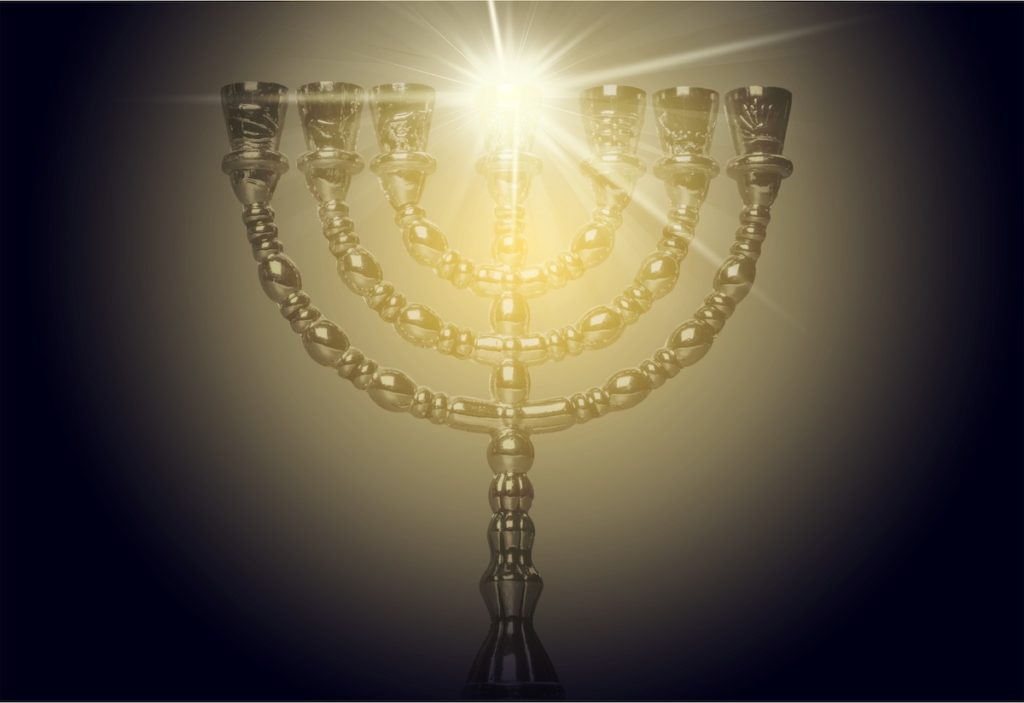
Numbers 8:2, The menorah. The phrase toward the face of the menorah is an interesting one. The Jewish sages teach that the three wicks on the right and the three on the left were all directed toward the menorah’s central stem, thus concentrating light toward the center. The menorah symbolized that YHVH is the Source of all light (The ArtScroll Stone Edition Chumash, p. 775). What are the connotations of this for a believer in Yeshua? How did Yeshua describe himself? (See John 8:12; 9:5.) Moreover, what did he mean when he said that “I am the vine and you are the branches?” (John 15:5) What does this mean and how is this pointing to a type of human menorah? Now relate this to the seven Messianic assemblies of Revelation 2 and 3 being likened to menorahs (Rev 1:13, 20). Is Yeshua the center of all that we do? Do we place all of our focus on him? Can we say, as the Apostle Paul did, that “in him we live and move and have our being” (Acts 17:28)? Does the power of his resurrected life and anointing flow through you even as oil was in the menorah and sap flows through a tree to its branches?
Redeemed Israelites Are That Menorah
The Scriptures plainly states that Yeshua and his body of followers are likened to a tree of which the seven-branched menorah that adorned the mishkan (tabernacle) in the wilderness as well as the sanctuary of Solomon’s Temple is a picture. Furthermore, remember what Yeshua said in John 15:5? “I am the vine and you are the branches …” This is a perfect picture of the menorah, which has a central trunk with six (the number representing man) branches growing out of the trunk. Remember what Yeshua said in Matthew 5:14–15, that his followers were to be lights upon a lampstand on a hill for all the world to see—a clear allusion in the mind of anyone in Yeshua’s audience to the temple’s menorah (which was upon the Temple Mount like a light on a hill).
Additionally, when a redeemed believer in and follower of Yeshua is in a sacred state of worshipping his Master and Savior, he will often lift his arms heavenward. Not only is this the universal sign of surrender (in this case to one’s Heavenly Master), but when we lift our hands our bodies are actually forming a human menorah. By doing this, in worship we are acting out what we are—a lampstand to the world radiating forth the good news of the truth and love of Yeshua.
In fact, The Scriptures shows us that the menorah, and not the cross, is the symbol of Yeshua’s spiritual body of believers. We see this in Revelation 1:12, 20 and 2:1 where the seven congregations are symbolized as a seven-branched menorah! The menorah here is the symbol of the congregation of redeemed believers.
Though the cross is representative of the redemptive work Yeshua accomplished on our behalf, it is not the symbol of the body of believers, commonly called the “church,” but the menorah is! Furthermore, in Jewish thought, the menorah is analogous to an olive tree (the ancient temple menorah was constructed of hollow tubes of solid gold filled with olive oil that burned when lit), to which the Apostle Paul makes reference in Romans 11, as representing the tree of life (which ultimately represents Yeshua) into which all must be grafted if they are to be part the spiritual body of Yeshua and have his eternal life.