Numbers 22:5,Pethor…by the river. Balaam was from the land of Pethor, which is “by the River.” This is a reference to the Euphrates River, the great river of Babylon (The ArtScroll Stone Edition Chumash, p. 857). Thus Balaam was a Babylonian, although he may have been a transplanted Edomite according to some Jewish scholars (see The ArtScroll Bereishis/Genesis Commentary on Gen 36:32).
One of the aspects of Babylon of the last days is her religious system (Rev 13:11ff) the head of which is the false prophet (Rev 16:13; 19:20; 20:10). The Babylonian religious system of the end days is a blend of both good and evil (reminiscent of the tree by that name in Eden from which the serpent beguiled Adam and Eve away from YHVH’s path of truth and righteousness into a false religious system).
In the last days, YHVH is calling his people out of that false religious system (Rev 18:4) with its false prophets who prophesy a mixture of good and evil.
Is not modern traditional Christianity a mixture of good and evil, truth and error (i.e. doctrines and traditions of men along with some paganism mixed in)? Reflect on the implications of this. To what degree have you heeded YHVH’s call to “come out of her”—namely, any man-made religious or church systems that has components that are contrary to the Word of Elohim?
Like many in mainstream Christianity, the Scriptures seems to indicate that Balaam had some knowledge of the truth of YHVH, but he refused to wholeheartedly submit to YHVH’s word and will (2 Pet 2:15).
Let us not forget Yeshua’s warning about false prophets arising in the last days who might deceive the very elect (Matt 24:24).
Numbers 22:10ff,Crossing over. Many carnal people—especially those playing at religion—want to be like YHVH’s saints, and to be the recipients of the blessings of Israel, and to be numbered among YHVH’s chosen, but few want to walk the difficult walk of holiness and righteousness required to receive these blessings and privileges. These may very well be the spiritual tares that surreptitiously exist along side the saints within their congregations.
Numbers 21 and the Wilderness Journey: Salvation, Overcoming and Victory!
21:4–9, Initial salvation. The bronze serpent on the pole is a prophetic picture of salvation at the cross of Yeshua from the sting of death brought on by sin (John 3:14–15; 1 Cor 15:55–57). This is a picture of the believer’s initial salvation.
21:10–22:1,The wilderness trek. Here is a recounting of the Israelites’ wilderness trek before entering the Promised Land. For the Israelites, this was a time of testing, refining, building of faith, and learning obedience. This is a picture of the spiritual walk of the believer through the wilderness of this physical life.
21:14–35,The wilderness struggle. While crossing the wilderness, the Israelites had to fight and overcome the enemy—that is, those who would keep them from fulfilling their YHVH-ordained destiny to possess the land and inheritance he had promised them. First came the fighting and overcoming, followed by the victories. The life of the believer is one of spiritual struggle, as well, against the world, the flesh and the devil. (See Rom 7:14–25; 2 Cor 10:3–5; Eph 6:10–18.)
21:10, 14–18,Salvation in the wilderness. Here we read how Israel was refreshed with water from the rock. Isaiah speaks about the wells of salvation (Isa 12:3). There is a springing up of joy and praise (verse 17) that comes as victory is experienced, and as YHVH makes rivers to flow out of seemingly dry and barren situations (verse 18). We, too, are called to come to the rivers of salvation, the river of life and to become a river of life ourselves to all those with whom we come into contact (John 7:37–39). Yeshua is the source of that living water; he is the spiritual Rock and source of water that never runs dry (John 4:10, 13–14; 1 Cor 10:4).
Numbers 21:4–9, Fiery serpent. The plague of fiery serpents was a righteous judgment Elohim brought upon Israel for murmuring and unbelief. Israel had “sharpened their tongues like a serpent” (Ps 140:3) and “their throat [was] an open sepulcher; with their tongues have…used deceit; the poison of asps [was] under their lips” (Rom 3:13). All this was directed at Elohim and Moses. As a result of their sin, they reaped what they had sown. Elohim loosed fiery serpents upon the Israelites to bite and sting to death the unbelieving murmurers.
The wilderness Elohim led the Israelites through was full of fiery serpents and scorpions (Deut 8:15), yet this is the only account in the Torah of these creatures ever attacking Israel. YHVH had protected them to this point, but this one time he pulled back his hand of providential protection and grace allowing them to experience the due recompense of their sinful actions.
The Jewish sages teach that the commandment (mitzvah) of the red cow is “beyond human understanding.” Like the afikoman (the middle broken matzah that is “buried” and “resurrected,” which is a picture of the death, burial and resurrection of Yeshua) in the Passover (Pesach) Seder, the meaning of which to this day remains unclear to the Jewish scholars, the red cow is a ritual that makes sense only when Yeshua the Messiah is added to the picture.
While the symbolism of the red heifer was, to Jewish Torah scholars, admittedly incomprehensible to human reason, by the second temple era they began to speculate about its spiritual significance in their aggadic literature. Some felt that it was an atonement for the sin of the golden calf (The Encyclopedia of Jewish Religion, Massada – P.E.C. Press, 1965, p. 327; The ArtScroll Chumash, p. 839). Others viewed it as somehow relating to the azazel or scapegoat and the bullock sin offering of Yom Kippur, since all were sacrificed outside the camp of Israel (Lev 16:27).
The sacrifice of the red heifer was for the purpose of purifying someone who had become ritually impure or polluted through contact with the dead, or for purifying metal war booty (Num 31:21ff). This sacrifice was to be made outside of the camp of Israel, and later occurred outside of the walls of the city of Jerusalem on the Mount of Olives, not far from the Temple. The concept of the camp signifies outside of or away from the divine presence or shekinah of YHVH meaning outside the tabernacle courtyard (The ArtScroll Chumash, p. 839).
The heifer was to be three to five years of age and totally red in color, blemish free and to have never born a burden and, according to Jewish tradition, to be without a single black or white hair on its body. The animal was slaughtered with the priest sprinkling its blood seven times toward the tabernacle’s entrance (later this occurred at the temple in Jerusalem). The entire carcass (hide, entrails and meat) was then burned on a wood pyre. Into the fire were tossed cedar wood, hyssop and a scarlet thread. The ashes were then divided into three portion: one part was kept in a secure place on the Mount of Olives (during the second temple period), one part was kept in the area immediately outside the wall of the temple courtyard, and one part was divided among the priests throughout the land of Israel to be used, as needed, in purifying the people (Mishnah Parah 3:11). The ashes to be used in the temple service were then mixed with fresh water (in Jerusalem, from the Pool of Siloam), and then called “waters of separation” (meyi nidah; nidah means “impurity, filthiness, menstruous, set apart, ceremonial impurity”), and were ritually sprinkled over something or someone that was impure. Numbers 19:9 states that the waters of sprinkling were for purification. The Hebrew word for purification is chatat, which according to some rabbinic interpreters is a reference to a sin offering (Ibid.). Others disagree arguing that the plain (pashat) meaning of the text does not speak of the red heifer atoning for sin (see Rashi’s commentary on this verse). This is an interesting debate, but regardless of what the Jewish sages think, the ritual of the red heifer shows striking parallels to Yeshua’s salvific work at the cross, as we discuss below.
The crucifixion implications of the red heifer were not missed by the Jewish-Christian scholar Alfred Edersheim. He links the Yom Kippur scapegoat, which was to remove the personal guilt of the Israelites (Lev 16), with the red heifer, which was to take away the defilement of death that stood between man and Elohim, with the “living bird,” dipped in “the water and the blood,” and then “let loose in the field” at the purification from leprosy (Lev 14:1–7), which symbolized the living death of personal sinfulness, were all, either wholly offered, or in their essentials completely outside the sanctuary. He then observes that the Old Testament sanctuary had no real provision for spiritual wants to which they symbolically pointed; their removal lay outside its sanctuary and beyond its symbols (The Temple and Its Ministry, pp. 280–281). This is why Yeshua had to be sacrificed outside of the temple area. Additionally, he had to be the sacrifice for sin outside of the temple area (Heb 13:12), which symbolized the shekinah or divine presence of YHVH. This speaks of the fact that the Father looked away, turned his back on and forsook Yeshua while he bore the sins of the world on his shoulders (Isa 53:4–6; Matt 27:46).
The writer of Hebrews understood the greater implications of the red heifer as it pointed to Yeshua when he wrote:
Which stood only in meats and drinks, and various washings, and carnal ordinances, imposed on them until the time of reformation. But Messiah being come an high priest of good things to come, by a greater and more perfect tabernacle, not made with hands, that is to say, not of this building; neither by the blood of goats and calves, but by his own blood he entered in once into the holy place, having obtained eternal redemption for us. For if the blood of bulls and of goats, and the ashes of an heifer sprinkling the unclean, sanctifies to the purifying of the flesh: how much more shall the blood of Messiah, who through the eternal Spirit offered himself without spot to Elohim, purge your conscience from dead works to serve the living Elohim? And for this cause he is the mediator of the renewed covenant, that by means of death, for the redemption of the transgressions that were under the first covenant, they which are called might receive the promise of eternal inheritance. (Heb 9:11–15, emphasis added)
Eighteenth-century Christian commentator, Matthew Henry, asks why does the Torah make a corpse a defiling thing? He answers that it is because death is the wages of sin, which entered into the world by it, and reigns by the power of it. The law could not conquer death, nor abolish it, as the gospel does, by bringing life and immortality to light, and so introducing a better hope. As the ashes signified the merits of Messiah’s perfect sin-free life, so the running water signified the power and grace of the blessed Spirit, who is compared to rivers of living water; and it is by his work that the righteousness of Messiah is applied to us for our cleansing (Matthew Henry Concise Commentary on the Whole Bible, p. 137, Moody).
At age 60, I just made my final and seventh ascent of Mount Hood—Oregon’s tallest peak at 11,250 feet. I guided my sons to the summit on June 25, 2020—a mountain climbing tradition my grandfather and professional mountain climber and guide started on this mountain in 1914.
This was my 18th ascent of major Cascade peaks. My first ascent was Mount Saint Helens in 1972 when I was 12—eight years before it blew its top.
The Bible is full of notable mountains and mountain climbers. Abraham guided Isaac to the top of Mount Moriah when he was more than 100 years old and met YHVH there. Jacob encountered YHVH on Mount Moriah or Sion as well. Moses was 80 when he climbed Mount Sinai and met YHVH there. He was 120 when he climb Mount Nebo and saw the land of his promised inheritance. Elijah defeated the prophets of Baal on Mount Carmel and then hiked down to and climbed Mount Sinai to meet Elohim. Yeshua and his disciples climbed a few mountains and had some divine encounters also.
Mountains are special places! Please enjoy these photos. A video documentary is coming. Stay tuned.
While this was my final climb of glaciated mountains, I am waiting with great anticipation and faith on YHVH for my next spiritual mountain climbing assignment and adventure!
Natan and his sons, Aaron, Jared and Kaleb, on the summit of Mount Hood with Washington State’s Mount Adams and Mount Rainier in the background.
Our new annual Scripture Reading Schedule for 2019-2020 with daily readings is available to download and print. If you are still working through 2018-2019’s Scripture Reading Schedule, the link will still be available on the right sidebar under “Helpful Links”. If you are using a mobile device or tablet, the link may be below, meaning you’ll need to scroll down instead.
Most of this week’s blog discussion points will be on these passages. If you have general comments or questions on the weekly Scripture readings not addressed in a blog post, here’s a place for you to post those. Just use the “leave a reply” link or the “share your thoughts” box below.
The full “Read Through The Scriptures In A Year” schedule, broken down by each day, can be found on the right sidebar under “Helpful Links.” There are 4 sections of scripture to read each day: one each from the Torah, the Prophets, the Writings, and from the Testimony of Yeshua. Each week, the Torah and haftarah readings will follow the traditional one-year reading cycle.
Weekly Blog Scripture Readings for 6/28 through 7/4/2020.
Many Christians will casually read this Bible statement by Paul and assume that the Torah-law was done away with. Is this really what Paul is saying here and does such an interpretation line up with the rest of Paul’s writings as well as the truth of the entire Bible? Let’s look at this statement logically and in the larger context of Scripture to see what the truth really is.
1 Corinthians 6:12–13, All things are lawful. When Paul said that all things are lawful to him, what do you think he meant? It’s now all right to murder, commit adultery, lie, steal, have sex with animals, practice witchcraft, and we can also add break the Sabbath, eat pork, etc., etc.? Obviously, violating the commands of Elohim wasn’t what he meant here, for doing such is, by biblical definition, sin (1 John 3:4), and those who love Yeshua will not be sinning, but will keeping his commandments (John 14:15). Moreover, it was our sin that put Yeshua on the cross, so why should we mock Yeshua’s death by continuing to practice sin? In fact, prior to 1 Cor 6:12, Paul listed a number of sins that will prevent one from entering the kingdom of heaven including drunkenness, sexual immorality, theft and so on. So obviously, breaking the laws of Elohim was not what he meant in verse 12. If Paul is here permitting the eating of unclean meat that the Bible forbids and calls an abomination, then he is also permitting sexual immorality—a sin which he juxtaposes in verse 13 with the eating of certain foods.
So if Paul wasn’t opposing the biblical dietary laws in verses 12 and 15, what was he really saying? According to David Stern in his Jewish New Testament Commentary, Paul was coming against the sexually libertine attitudes of the saints in Corinth whereby they had permitted the man who was having sexual relations with this stepmother and even allowing the sinner to remain in fellowship with the saints there. Stern goes on to say that the phrase, “All things are lawful to me…Food for the stomach…” is really analogous to the modern phrase, “If it feels good, do it”—a concept which Paul strongly opposes. Beale and Carson concur with Stern on this in their commentary on this verse (Commentary on the New Testament Use of the Old Testament, p. 713). In verse 15, Paul goes on to make the point that our bodies are the temples of the Set-Apart Spirit of Elohim and that we need to treat them as holy vessels by not engaging in sinful practices (whether sexual immorality or eating unclean meats).
Keener agrees with Stern that Paul was here confronting the ungodly and licentious Greek philosophers who would excuse their libertine carnal appetites by saying “I can get away with anything.” Paul, on the other hand, counters this by saying, “Maybe so, but ‘anything’ is not good for you” (The IVP Bible Background Commentary of the NT, pp. 464–465). Keener goes on to say that “‘Food for the stomach and the stomach for food’ was a typical Greek way of arguing by analogy that the body was for sex and sex for the body….That God would do away with both reflected the typical Greek disdain for the doctrine of the resurrection (chap 15), because Greeks believed that one was done with one’s body at death [which is why they reasoned that it was permissible to do whatever you pleased with your body now]. Paul responds to this Greek position with the Old Testament/Jewish perspective that the body is for God and he will resurrect it” (i.e. in v. 14, ibid.).
Paul then goes on to explain why a philosophy that excuses sinful behavior is not acceptable to Elohim or beneficial to the saint.
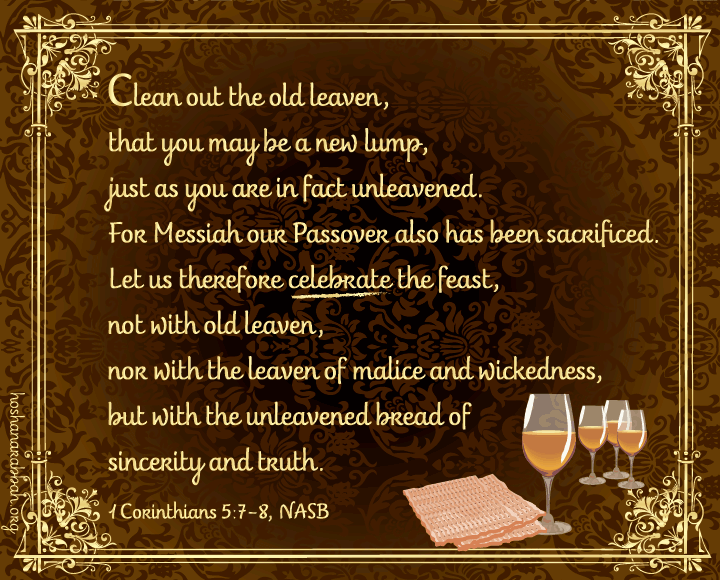
In 1 Corinthians 5 Paul the apostle of Yeshua the Messiah instructs the early Jewish and non-Jewish believers about the spiritual ramifications and significance of the Passover and the biblical Feast of Unleavened Bread. Then in verse eight, he assertively declares, “Let us keep the feast not with the old leaven of malice and wickedness, but with the unleavened bread of sincerity and truth.”
You who call yourselves Christians and who don’t celebrate the biblical feasts including the Feast of Unleavened Bread, what about this command do YOU not understand? How can anyone declare that the YHVH’s biblical feasts were done away with, or were for the Jews only, when the apostle in this letter is addressing the non-Jews as well? How can we justify substituting non-biblical holidays such as Christmas and Easter for YHVH biblical holidays and call ourselves Bible believers and followers and imitators of Yeshua and the early book of Acts church? These are serious questions that many of us need to ask ourselves if we’re serious about our faith walk before YHVH Elohim and Yeshua the Messiah.
1 Corinthians 5:6, Purge out. The greater context of this passage is about putting sin out of our life (which is the temple of YHVH’s Holy Spirit, 1 Cor 3:16–17), which collectively form the spiritual body, church or the greater temple of Yeshua’s spiritual body (John 2:21). Therefore, sin that defiles the temple of Elohim must be put out of the church. In this letter to the Corinthians, Paul is especially concerned about the sin of sexual immorality that the church in Coringh had allowed to come into its midsts (1 Cor 5:1ff). From the context of this passage in light of Paul’s discussion about Passover and the Feast of Unleavened Bread, it would appear that he wrote this letter just prior to the spring festivals (1 Cor 5:6–8). He is urging the church to remove the leavening of sin from its midsts prior to keeping the Feast of Unleavened Bread, which he, by the way, urges the Corinthian believers to do. In fact, Paul’s admonition to “keep the Feast [of Unleavened Bread]” in verse eight, is the strongest imperative command in the Testimony of Yeshua (or NT) to keep the biblical festivals, and from this it’s evidence that in the mind of the apostle the biblical festivals were still relevant to Yeshua’s followers well past the middle of the first century, which means they’re relevant to the saints of today as well.
In his admonition to the Corinthian believers, it’s possible that Paul had in mind two examples in the Tanakh where spiritual revivals occurred after Hezekiah and Josiah cleansed the temple in Jerusalem of the filth of idolatry in preparation for Passover. Similarly, Ezra finished completion of the rebuilt temple in time to celebrate Passover (Ezra 6). These examples teach us that YHVH commands us to cleanse or deleaven our spiritual temples (individually and collectively) of sin annually in preparation for celebrating Passover and the Feast of Unleavened Bread. This spiritual spring house cleaning at the beginning of the biblical new year sets the tone spiritually for the rest of the year to go forward in a sin-free state.
1 Corinthians 5:7, Messiah our Passover. In the Bible, the term Passover refers to both the appointed time or moed and to the sacrifice that was made on that day.
1 Corinthians 5:8, Let us keep/observe the feast. This verse proves several things. First that Paul (a Jewish believer) kept the biblical feasts, that non-Jewish believers kept the feasts, and that all believers could keep the feasts outside of Jerusalem.