Our new annual Scripture Reading Schedule for 2019-2020 with daily readings is available to download and print. If you are still working through 2018-2019’s Scripture Reading Schedule, the link will still be available on the right sidebar under “Helpful Links”. If you are using a mobile device or tablet, the link may be below, meaning you’ll need to scroll down instead.
Most of this week’s blog discussion points will be on these passages. If you have general comments or questions on the weekly Scripture readings not addressed in a blog post, here’s a place for you to post those. Just use the “leave a reply” link or the “share your thoughts” box below.
The full “Read Through The Scriptures In A Year” schedule, broken down by each day, can be found on the right sidebar under “Helpful Links.” There are 4 sections of scripture to read each day: one each from the Torah, the Prophets, the Writings, and from the Testimony of Yeshua. Each week, the Torah and haftarah readings will follow the traditional one-year reading cycle.
Weekly Blog Scripture Readings for 7/19 through 7/25/2020.
Are you confused if not fed up with the conflicting and contradictory information coming out about the Covid “pandemic”? Which “expert” are you going to believe and how do you know what to do, say or think in response to it all? Are you sick of the “fear porn” being dished out like a load of barnyard &%$#? Well, this video will show you how to deal with this mess the biblical way.
Ezekiel 20:12, 13, 16, 20,My Sabbaths. YHVH cites Israel’s failure to keep his sabbaths as a prime reason for YHVH not permitting the older generation to enter the Promised Land. Judah’s not keeping the land sabbaths determined the length of her captivity in Babylon; namely, 70 years. The writer of the Epistle to the Hebrews brings up the Sabbath issue in chapter four of that book. What is the connection between keeping YHVH’s sabbaths and entering the spiritual rest of his Promised Land? (Read Heb 4:1–11.)
The Sabbath was the eternal sign between YHVH and his people, and it was one of the first Torah laws YHVH called upon Israel to practice. As noted, the failure of YHVH’s people to keep his sabbaths prevented the Israelites from going forward into their spiritual destiny.
Likewise, the fourth or Sabbath commandment of the Ten Commandments is the only one of the ten where YHVH instructs his people to “remember” it implying that they would eventually forget to keep his Sabbaths. History records that the Sabbath was the first so-called Jewish law that the early church left replacing it with Sunday (in the second century a.d.). In the modern Hebrew Roots Movement, YHVH’s people are beginning to leave the non-biblical religious traditions of men by returning to a more true-to-Scripture spiritual walk (a fulfillment of Malachi’s prophecy about the heart of the children being turned back to their fathers in the end days in preparation for Messiah’s arrival [Mal 4:4–6]).
How prominently does the Sabbath figure in the lives of those believers who are returning to the Hebrew roots of the Christian faith? How significant is this prophetically? Is history repeating itself in reverse? Instead of YHVH’s people leaving the Sabbath, they are returning to it. The keeping of the Sabbath is an acknowledgment of YHVH’s sovereignty as the Creator of all, and of his sovereignty over our time, work and lives. Keeping the Sabbath is a direct assault on idolatry, materialism, selfishness, rebellion, and assimilation into the surrounding pagan culture that occurred when Israel forsook the Sabbaths of YHVH. Notice how Ezekiel ties the idolatry, rebellion and general apostasy of Israel with her desecration of YHVH’s Sabbaths. What was Israel’s heart condition that caused her to rebel against this commandment of YHVH? What are the excuses used by many today in order to justify themselves in desecrating YHVH’s Sabbaths?
In Ezekiel 20, we see that YHVH’s feasts (or sabbaths) are a covenantal sign between YHVH and his people (Ezek 20:12) that they were to live by (Ezek 20:11), yet which Israel, in rebellion, refused to do while in the wilderness. Instead they defiled his sabbaths by, presumably, not doing them and doing other things on YHVH’s holy days (Ezek 20:13). Israel’s rebellion against YHVH with regard to their refusal to keep his sabbaths brought upon them YHVH’s judgments (Ezek 20:13). In other words, it was YHVH’s will for the Israelites to keep his sabbaths in the wilderness, but because of their idolatrous rebellion, they refused to do so. In fact, YHVH calls refusing to observe his sabbaths idolatry and for this sin (along with other sins), the Israelites had to wander in the wilderness for forty years (Ezek 20:15–16). In profaning his sabbaths, YHVH accuses the Israelites of despising his Torah (Ezek 20:16). YHVH then goes on to urge his people to not follow the example of their rebellious forefathers, but rather to walk in all of his Torah commands (including his sabbaths, Ezek 20:18–20). Because of their profaning his sabbaths, he punished them by scattering them in exile among the heathens. Those modern saints who refuse to keep YHVH’s Sabbath and feasts are walking in the same sin as the ancient Israelites. Often people who refuse to keep YHVH’s feast days holy do so because the feasts conflict with their secular activities (such as their jobs and recreational activities). YHVH calls this idolatry and being like the heathen (Ezek 20:30, 32). In the end times, YHVH is going to separate his people out from the heathen and bring them back into covenantal agreement with him including obedience to his sabbaths (Ezek 20:33–38). He will purge from his people those rebels who refuse to obey him including keeping his sabbaths (Ezek 20:38), which are a sign of his covenantal relationship with them.
Ezekiel 20:33–38, I will bring you out.This prophecy has never been fulfilled. In the end times, YHVH will begin to regather his scattered people (the 12 tribes of Israel) with his mighty, sovereign hand in the midst of his last days fury or judgments that he will pour out upon the earth just prior to Yeshua’s second coming. As an intermediate step before returning his people to their inheritance in the Promised Land, he will bring them into the “wilderness of the peoples.” This is the only place this term is found in the Bible. It appears to be a spiritual wilderness (not a literal one) in the midst of the Gentile nations where YHVH’s people find themselves. Presently, there are many saints who have answered YHVH’s call to come out of the spiritual Babylon of the church system. They presently find themselves alone in a spiritual wilderness where YHVH is teaching them about the Torah and Hebraic roots of their faith. This wilderness is a time to testing for YHVH’s people for him to determine who will love him by keeping is commandments or not (v. 37). This period will be similar to the that of Israel in Goshen, Egypt (v. 36). At that time, YHVH tested the children of Israel by allowing them to go through the first three plagues, but he protected them from the last seven plagues. This is how he refined them spiritually and, at the same time, got their attention focused on him and off of Egypt. YHVH will make all to pass under the rod of his judgment and separation (v. 37). He will purge out from is flock those who refuse to follow his Torah (the rebels and transgressors) and they won’t be allowed into the Promised Land (v. 38).
Ezekiel 20:35–36, Wilderness [Heb. midbar] of the peoples [Heb. am, not goy].This wilderness is like the “wilderness” of Goshen in Egypt. This prophecy doesn’t seem to be referring to a wilderness outside of Egypt, but one that is in Egypt prior to the Exodus. In end times Babylon the Great, this could be a prophetic reference to a spiritual wilderness experience YHVH will force believers to endure to test whether they will be obedient to his Torah or not (vv. 37–38) to determine whether they’re worthy candidates to come into the Promised Land as Yeshua’s warrior bride at his second coming. This wilderness of the peoples seems to be a wilderness in the midst of the heathen people in which believers find themselves as opposed the wilderness of Rev 12:14 that YHVH will carry his end times persecuted remnant into for three-and-a-half years.
All of the details in the Bible are there for a purpose and have different levels of meaning, application and fulfillment. On a literal or plain (Heb. peshat) level of meaning, the cities of refuge were an important aspect of Israel’s jurisprudence system. But on a symbolic and prophetic (Heb. drash) level, they point to something significant far beyond and above the literal meaning of the biblical text that relates to the salvation of the redeemed believer.
On the literal or peshat level meaning of the text, any person who had murdered someone unintentionally or accidentally could flee to a city of refuge and find a safe haven there until the wheels of justice could properly turn to determine the guilt or innocence of the murderer. The gates of these cities were perpetually open and were never closed to anyone for any reason. Anyone who was not guilty of intentional murder could find refuge there from vengeance by the victim’s family free of the fear of retribution for the duration of the high priest’s life. As long as the high priest was living, the murderer had refuge.
On a prophetic, metaphorical or drash level of understanding, the cross of Yeshua our Savior and Redeemer is that place of refuge for sinners where all can come in search of refuge and justice. At the foot of the cross, the Redeemer’s arms are always open wide to receive us, and the doors of salvation are never closed to anyone who desires it! The Scriptures speak of this.
Open to me the gates of righteousness; I will go through them, and I will praise YHVH. This is the gate of YHVH, Through which the righteous shall enter. (Ps 118:19–20)
I am the door. If anyone enters by Me, he will be saved, and will go in and out and find pasture. (John 10:9)
Yeshua is our Great High Priest in heaven who intercedes for sinners in the courtroom of heaven at the right hand of Elohim against Satan who is the accuser of the brethren. As long as Yeshua is alive and on our side as our Heavenly Advocate or Attorney, the saint has nothing to fear regardless of one’s past sins (Heb 8:1; 1 John 2:1).
Have you sought refuge at the foot of the cross, in the arms of Yeshua? Have you repented of and turned from your sins (i.e. violation of the Torah, see 1 John 3:4)? Has Yeshua the Messiah (as prophetically prefigured by the anointed high priest in Num 35:25) upon his death become your Savior or Redeemer and Lord or Master? Does he through his word and by the guiding influence of his Set-Apart Spirit or Ruach HaKodesh guide every aspect of your life including all of your words, thoughts and deeds? Is your name written in the Lamb’s Book of Life (Rev 21:27)?
If you have surrendered to Yeshua and said, “yes” to your Savior, then how do you know that you have been saved from your sins? What are the fruits in your life that are evidence that your are set-apart or kadosh and consecrated unto YHVH, that you have passed from the kingdom of darkness to the kingdom of light, and that your heart, mind and life have been transformed? Yeshua said that by the fruits that our lives produce we will be known (Matt 7:15–20). The evidence of salvation are the fruit of the Spirit evidenced in a person’s life.
But the fruit of the Spirit is love, joy, peace, longsuffering, kindness, goodness, faithfulness, gentleness, self-control. Against such there is no law. And those who are Christ’s have crucified the flesh with its passions and desires. If we live in the Spirit, let us also walk in the Spirit. (Gal 5:22–25)
2 Corinthians 3:11, Passing away. This is not a reference to the Torah-law itself, but to the old or former covenant (i.e. the agreement or contract YHVH and Israel made with each other) as it phases into the new or renewed covenant. Yeshua initiated the new covenant at his last supper, but it will be finalized with the two houses of Israel (see Jer 31:31, 33 and Heb 8:8) at his second coming when the two sticks or houses of Israel are reunited (see Ezek 37:15–27) at which time he will finalize the new covenant with a reunited Israel (v. 26; see also Isa 54:10; 55:3; 59:21; Ezek 34:25; Jer 32:40; 50:5; Hos 2:18–23). We are presently in the intermediate phase between the two covenants. To view it differently, Yeshua betrothed himself to his spiritual bride (redeemed Israel, spiritual Israel or the Israel of Elohim, see Gal 6:16) at his last supper, but will marry her at his second coming. The saints who are now in Yeshua are under the new covenant as the betrothed bride of Yeshua, but all Israel will be brought into the new covenant at his second coming at which time he will finalize the covenant that he initiated with his disciples before his death.
Attaining Spiritual Maturity in the New Covenant—On Being a Spiritual Mountain Climber
This manna from heaven was revealed and downloaded to Natan in the back country of Alaska while sitting, Bible in hand, prayerfully, overlooking Little Port Walter on Baronov Island [75 miles SE of Sitka], and while on a boat in the Pacific Ocean in the Chatham Straights between Baronov and Admiralty islands.
On Being Spiritual Mountain Climbers
The beginning of the upward spiritual journey of YHVH’s people is memorialized in the counting of the omer, which starts on First Fruits Day occurring during the Feast of Unleavened Bread and culminates fifty days later with the Feast of Weeks or Pentecost (Heb. Shavuot; Lev 23:4–16). Each new step in this journey is a stepping stone or a launch pad to the next. For the Israelites, the journey started at sea level in the flat-land river delta of Egypt (a metaphor for this world, Satan and death) and then continues climbing higher and higher until it reaches heaven itself—the abode of Elohim.
From the time that YHVH revealed himself to the children of Israel while they were enslaved in Egypt, he has been calling his people to be spiritual mountain climbers. He first called the Israelites out of Egypt and up to Mount Sinai, and then up to Mount Zion in Jerusalem. He then called his people to come even higher yet to the upper room on the day of Pentecost, and he is now calling his people to come up even higher to the New Jerusalem that is above us and is the mother of us all. This highest mountain of YHVH is the ultimate source of our spiritual sustenance, the source of the river of life along which the trees of life are situated. From this spiritual wellspring comes all divine revelation and ultimately immortal life as children of the Most High.
The problem is that most people only climb so far in their spiritual journey and then stop, or they grow weary along the way or become comfortably complacent at the level they have thus far attained and never move past that spot. This is dangerous!
Natan and his sons on the summit of Oregon’s Mount Hood on a recent climb.
To not move forward spiritually is to stagnate and to die. YHVH wants a people that are on the move, who will obediently follow him wherever he leads, and not stop and park along the way only to construct their religious monuments with their fossilized customs, rituals and traditions. Heaven is a long way above the earthly plane, and YHVH wants children who will seek him no matter what, who have a heart to follow him no matter where, and no matter the cost. Although eternal life is a free gift from heaven, it won’t be given easily. It costs nothing, but, at the same time, it costs everything! Man must be willing to sacrifice his all—to lose his earthly life—to gain eternal life. YHVH refuses to give out his priceless gift of eternal life willy-nilly to anyone and everyone! YHVH requires that his saints be determined, tough and gritty mountain climbers who refuse to give up until that summit is reached. He has no pleasure in those who turn back, or refuse to go on. Only those who doggedly overcome the world, the flesh and the devil remaining lovingly loyal and obedient to him will receive the highest reward he has to offer.
The Spirit Versus the a Letter of the Law—the Two Covenants
Let’s now explore what it is to climb the mountains that YHVH has placed before us to ascertain where we are at on the journey and how far we have to go to reach the ultimate summit.
In 2 Corinthians 3:1–18 we read,
1 Do we begin again to commend ourselves? Or do we need, as some others, epistles of commendation to you or letters of commendation from you? 2 You are our epistle written in our hearts, known and read by all men; 3 clearly you are an epistle of the Messiah, ministered by us, written not with ink but by the Spirit of the living Elohim, not on tablets of stone but on tablets of flesh, that is, of the heart. 4 And we have such trust through the Messiah toward Elohim. 5 Not that we are sufficient of ourselves to think of anything as being from ourselves, but our sufficiency is from Elohim, 6 who also made us sufficient as ministers of the new covenant, not of the letter but of the Spirit; for the letter kills, but the Spirit gives life. 7 But if the ministry of death, written and engraved on stones, was glorious, so that the children of Israel could not look steadily at the face of Moses because of the glory of his countenance, which glory was passing away [brought to an end, ESV; Gr. katargeo], 8 how will the ministry of the Spirit not be more glorious? 9 For if the ministry of condemnation had glory, the ministry of righteousness exceeds much more in glory. 10 For even what was made glorious had no glory in this respect, because of the glory that excels. 11 For if what is passing away [Gr. katargeo] was glorious, what remains is much more glorious. 12 Therefore, since we have such hope, we use great boldness of speech — 13 unlike Moses, who put a veil over his face so that the children of Israel could not look steadily at the end of what was passing away [Gr. katargeo]. 14 But their minds were blinded. For until this day the same veil remains unlifted in the reading of the Old Testament, because the veil is taken away in the Messiah. 15 But even to this day, when Moses is read, a veil lies on their heart. 16 Nevertheless when one turns to the Lord, the veil is taken away. 17 Now the Lord is the Spirit; and where the Spirit of the Lord is, there is liberty. 18 But we all, with unveiled face, beholding as in a mirror the glory of the Lord, are being transformed into the same image from glory to glory, just as by the Spirit of the Lord.
Let’s now explain this passage to understand better the transition between the “old” and “new” covenants and the differences between the two.
Verse 7, Was passing away [NKJV]/brought to and end [ESV], This phrase is the Greek word katargeo meaning “to render idle or useless, to vanish, to abolish, to put away, to make of none effect.” What was brought to an end or rendered idle? Hold that question in your mind. We will answer it below.
Verse 5,Ministers of the new covenant, not of the letter but of the Spirit; for the letter kills, but the Spirit gives life. What Paul is saying here that believers in Yeshua must mature from just a letter-of-the-law orientation in their spiritual walk, to both a letter- and spirit-of-the-law orientation. We know that the letter of the Torah has not been done away with or passed away because Yeshua says so in his Sermon on the Mount (Matthew chapters 5–7), where he teaches, for example, that not only murder (the letter of the law is forbidden), but also hatred for a person (the spirit of the law). He says the same about adultery and lust and so on. We know that this is what Paul believed and taught because he elsewhere instructed us to follow or imitate Yeshua as he did (1 Cor 11:1).
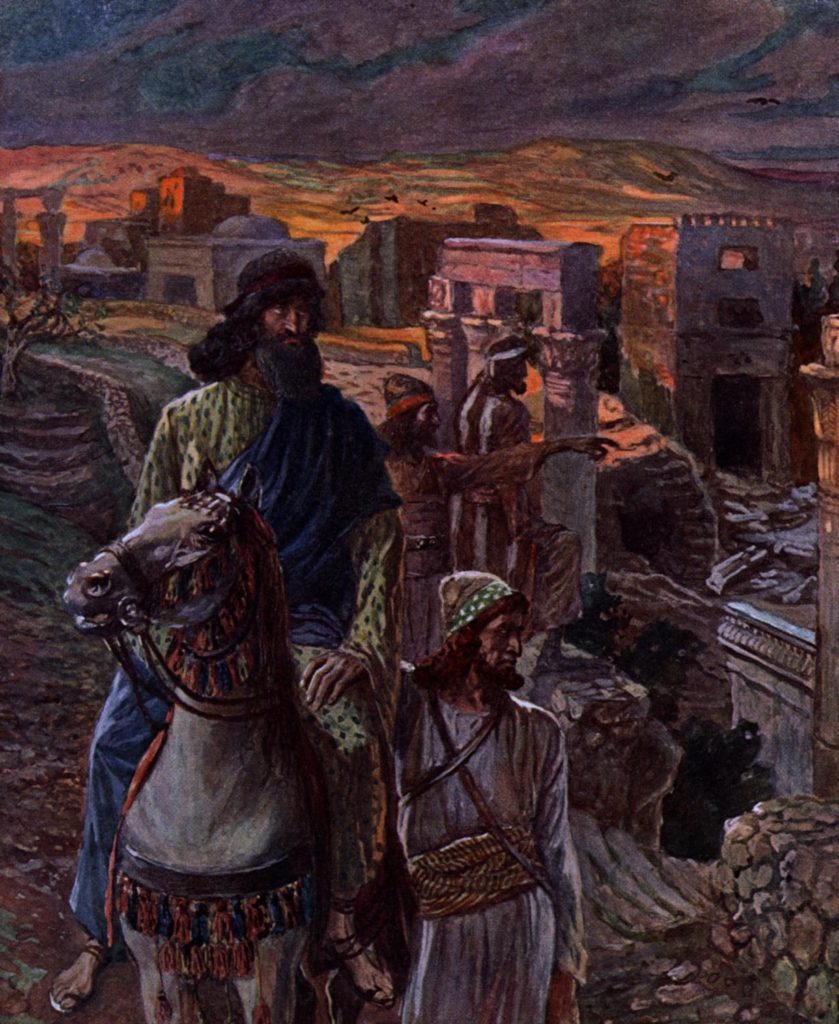
Ezra 2:11–14, Nehemiah surveys the ruins of Jerusalem’s walls. In many of our spiritual endeavors, we are not unlike Nehemiah whom YHVH tasked with rebuilding the broken down and burned walls of Jerusalem to protect the house of YHVH (i.e. the temple) from the enemies of Israel.
Like Ezra, Nehemiah’s predecessor, he faced and had to overcome many physical and spiritual obstacles to complete his divine mission. His initial walk around Jerusalem to survey conditions was prophetic of the battles he’d soon be facing to rebuild the wall.
Before he could celebrate the victory of a completed wall, he’d have to stare down the enemies of YHVH face to face and to overcome the psychologically and spiritually.
First Nehemiah passed through the Valley Gate, which is a prophetic picture of the valley of the shadow of death of David’s famous twenty-third psalm. This death may even include the death of our vision (i.e. the death to our own personal plans and wishes as opposed to those of YHVH).
Next he came to the Serpent Gate, which is a picture of everything Satan, the adversary and accuser of the brethren, will throw at you to hinder you from completing the task YHVH has given you.
Then he encountered the Dung (or Refuse) Gate. This is a spiritual picture of all the garbage the enemy throws at us to keep us from fulfilling our divine mission. This could include things such as physical distractions, false accusations, false brethren, the heathen around us, hindering demonic spirits, physical sickness, lack of finances, doubt, fear, discouragement and unbelief.
Next Nehemiah came to the broken down and burned gates of Jerusalem representing all the broken and failed dreams and attempts of our past to accomplish YHVH’s purposes in our lives including past personal failures and defeats at the hands of our physical and spiritual enemies.
It was necessary for Nehemiah to encounter and to overcome all these obstacles, which, in reality, he used as stepping stones to his success. These passage points served to bring him to the place of victory resulting in the spiritual outpouring represented by the Fountain Gate and the King’s Pool, which he arrived at next. These last two spots in the ancient city of Jerusalem that are references to water are clear spiritual allusions to and are biblical Hebraisms representing the waters of YHVH’s Word or truth (i.e.,the Torah), as well as to the outpouring of the Spirit of Elohim. Spirit and truth combined are what all true worshipers of YHVH need in order to lead them into the deeper waters of a spiritual relationship with the Father as Yeshua indicates in John 4.
In these times of trials and pressure from all sides, may YHVH grant you, as he did to Nehemiah, the strength of vision and faith to overcome the obstacles in your life. May they become mere stepping stones to victory for the glory of Elohim and the advancement of his spiritual kingdom.
We are the Ezra’s and Nehemiahs that YHVH is raising up in our time to help rebuild the one house or stick of YHVH comprised of the two houses of Israel.
Ezekiel 16:12, Earrings in your ears. Some woman in an effort to be scriptural in how they live and dress wonder if it is biblically permissible to wear earrings that required the ears to be pierced. Those in favor of wearing pierced earrings will often quote the reference of Ezek 16:12 which according to the KJV seems to indicate that the allegorical bride of YHVH had “earrings in” her ears. This is one place where the KJV got it wrong, for this is a mistranslation on the part of the KJV translators, since “in” should be “on” in accordance with the true meaning of the Hebrew preposition al or KG. I have checked the best Hebrew lexicons available and they all verify that “on” as the proper translation.
Does this mean that Scripture forbids the wearing of pierced ear earrings? In my opinion, no. Some will quote Lev 19:28 which prohibits the making of “cuttings in the flesh for the dead.” This was a pagan, satanic practice that some devil-worshippers practice to this day to conjure up demons and to increase their spiritual (demonic) power. Would it be a correct biblical interpretation (exegesis) to say that this command would also include ear-piercing for earrings? In my opinion, no, since the Torah commands in Exod 21:6 that if an indentured-type servant after his period of service is completed with this master chooses to continue to serve his master forever, as a sign of his servitude he is to have his ears pierced by an awl against a door post. Now we both know that if a ring were not placed in the hole, the hole would grow over and the proof of his servitude would be gone. So it may be assumed that probably an earring was placed in the ear to keep the hole open.
We know that in the Bible, earrings were used as symbols for pagan deities (Gen 35:4; and likely Exod 32:2-3). From ancient historical sources, we know that this was a prevalent practice in the ancient world, since earrings were worn in honor of various pagan deities and as amulets. A quick examination of this evidence is to be found a http://www.ccg.org/English/s/p197.html. Obviously, the wearing of earrings for pagan spiritual purposes is contrary to scriptural example. However, the fact remains that the allegorical bride of YHVH in Ezek 16 had an earring on her ear, and that a bond servant’s ears were pierce and the hole was possibly kept open via an earring.
On the basis of this evidence it seems to me that Scripture does not clearly forbid the use of earrings (including pierced earrings) for decorative reasons. We know that Scripture defines sin as the “violation of the Torah” (1 John 3:4), and so if Torah doesn’t forbid something, then it is not sin. However, due to a weak or tender conscience due to past worldly practices, some may find it impossible to wear earrings. If this is the case, these people should not violate their conscience. Those who do not share their belief should not try to force them to change their minds and vice versa.