Our new annual Scripture Reading Schedule for 2020-2021 with daily readings that begins 10/11/20 is now available to download and print. The link to the current 2019-2020’s Scripture Reading Schedule will still be available on the right sidebar under “Helpful Links” into next year. If you are using a mobile device or tablet, the link may be below, meaning you’ll need to scroll down instead.
Most of this week’s blog discussion points will be on these passages. If you have general comments or questions on the weekly Scripture readings not addressed in a blog post, here’s a place for you to post those. Just use the “leave a reply” link or the “share your thoughts” box below.
The full “Read Through The Scriptures In A Year” schedule, broken down by each day, can be found on the right sidebar under “Helpful Links.” There are 4 sections of scripture to read each day: one each from the Torah, the Prophets, the Writings, and from the Testimony of Yeshua. Each week, the Torah and haftarah readings will follow the traditional one-year reading cycle.
* Verse numbers in parenthesis refer to the verse number in Christian English Bibles when they differ from Hebrew Bibles or the Tanakh.
Weekly Blog Scripture Readings for 8/30 through 9/5/2020.
Deuteronomy 25:19,Blot out Amalek.The Hebrew name Amalek literally means “I am king.” Remember how the people of Amalek attacked the children of Israel as they were coming out of Egypt (Exod 17:8)? These heathens attacked the weary, stragglers and weak Israelites who were falling behind in the rear ranks (Deut 25:18). For this evil deed, Elohim put a curse on them. What can we learn about Israel’s ancient enemies and it relates to us today? Who are the modern “Amalekites” and how can the saints defeat them?
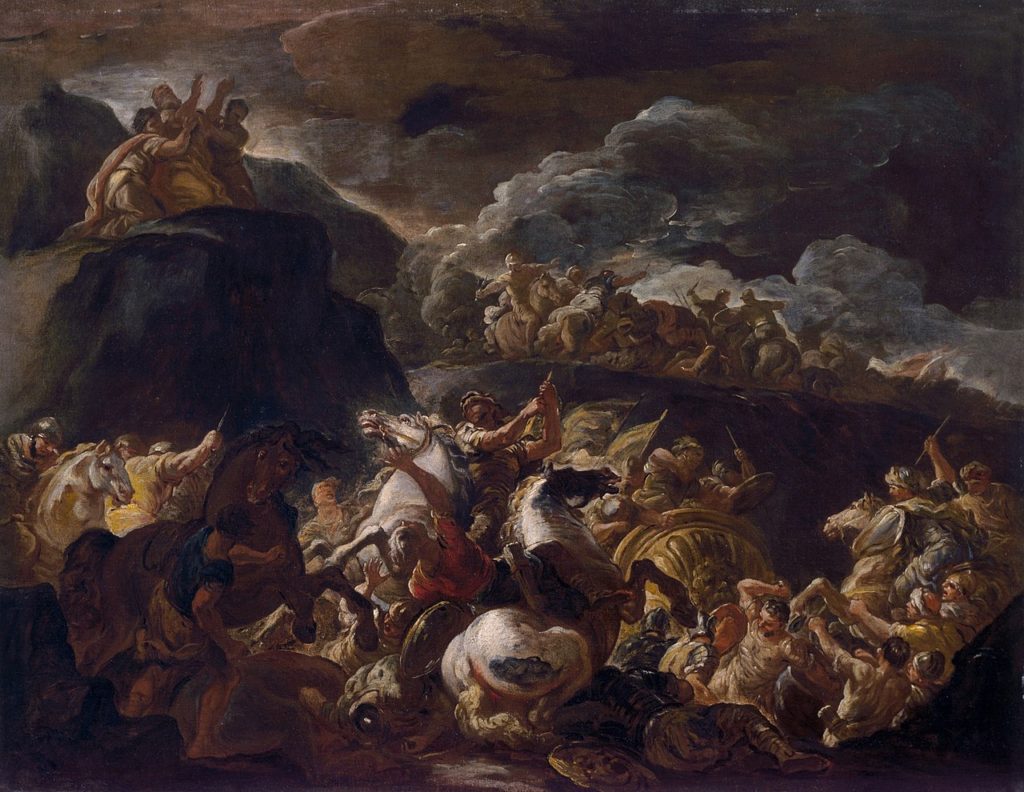
The Israelites ended up defeating Amalek militarily under the leadership of Moses and Joshua when Moses stood on a hill with his arms outstretched in the form of a cross (Exod 17:10–13). It was at this spot that Israel learned that YHVH Elohim was their spiritual banner (Heb. Yehovah Nissi; Exod 17:15).
There is a spiritual lesson in this story for us today. Amalek is a spiritual picture of the world, the flesh and devil that will attack and try to destroy us spiritually as we’re coming out of our own spiritual Egypt and beginning our trek through the wilderness of life en route to Promised Land of our spiritual inheritance, which is the kingdom of Elohim from heaven.
This reminds us of Yeshua’s Parable of the Sower (Matt 13:3–9) where the good seed of the Word of Elohim was sown on four types of soil. The seed failed to grow in the three types of soil representing the world, the flesh and the devil (Matt 13:18–23). This is another picture of Amalek. What defeated Amalek? Joshua the valiant warrior defeated the Amalekites militarily, while at the same time Moses was perched on a hill overlooking the battlefield with his arms raised to heaven. Both Joshua and Moses are a prophetic picture of Yeshua the Messiah. Joshua’s Hebrew name is Yehoshua, which is the long version of the name Yeshua or Joshua in English.
At the same time, on the mountain Moses’ arms grew tired and had to be supported by Aaron and Hur and in so doing his arms took the form, more or less, of a cross or the even universal sign of surrender. What are these things a spiritual picture of? Moses and Joshua combined form a prophetic picture of Yeshua defeating the world, the flesh and the devil at the cross on Golgatha’s hill. Coincidentally, as Yeshua had two other men crucified with him—one on each side, Moses had a man each side of him. This is another shadow picture pointing forward to the Messiah and his death on the cross.
Another way to look at the picture of Moses with his arms upraised is this: When Moses surrendered to the will of YHVH and completely trusted in him, the Israelites experienced victory over their enemies. This same principle can be applied in our lives when we are facing enemies who are intent on destroying us. The Bible declares that we are more than conquerors through Messiah and that nothing can defeat us if we are in the will of our Father in heaven (Rom 8:37 cp. vv. 28–29), and greater is he that is in us than he that is in the world (1 John 4:4). And finally, if Elohim is for us, who can be against us (Rom 8:31)?
Only when Moses’ arms were outstretched and raised up to heaven in openness, surrender and supplication to the Almighty did Joshua experience victory over the Amalekites. Similarly, only through prayer and the intercession with arms open and upraised to heaven as we beseech our Heavenly Father as we come before his throne through the blood of the resurrected Yeshua the Messiah in heaven, who is acting as our Great High Priest before Elohim’s throne will we be able to defeat the spiritual enemies that are attempting to prevent us from entering the Promised Land of our spiritual inheritance.
The enemies of our salvation will attempt to destroy us when are weak, tired and falling behind in our spiritual walk, even as Amalek attacked the weak and straggling Israelites who had fallen behind the camp. However, when we recognize our plight and weakness and then determine to fight, we have Yeshua’s victorious death on the cross as well as his help in heaven to overcome our enemies.
One of YHVH’s covenant names is Yehovah Nissi or YHVH Is My Banner. A military banner is something used to help build the morale of troops during the battle. YHVH is our strength and morale booster in the time of battle, and through or faith in YHVH-Yeshua, we already have the victory over the world, the flesh and the devil!
This lesson illustrates the fact that the Scriptures contain many rich and deep spiritual mysteries and truths that if it weren’t for the physical examples or prophetic shadow-types contained therein they might otherwise be obscured to us and too difficult to comprehend.
Deuteronomy 24:1, Write her a bill of divorcement. Divorce laws and a bill of divorcement (Heb. get)is the subject of this passage. This verse forms the basis of the divorce laws of the Torah and the actual get or bill of divorce, which was a written document that a husband gave to his wife because of some immoral activity on her part (The ArtScrollStone Edition Chumash, p. 1058). The subject of divorce and remarriage is a large subject and is beyond the scope of this present work, yet it is interesting to note that Moses himself, the one who YHVH used to pen the Torah, was very likely divorced and remarried. (We have discussed this subject in Parashat Yitro.) YHVH himself divorced Israel and gave her a get because of her unfaithfulness to him, though he never remarried. (See the teaching below.)
Deuteronomy 24:1–4, For an explanation of this passage in light YHVH-Yeshua’s remarriage to adulterous Israel as sit relates to the gospel message, see notes at Romans 7:1–6.
The Real Purpose for Divorce Under Torah
Deuteronomy 24:1–4, Natan’s Notes on the Biblical Reasons for Divorce
Jeremiah 3:14, After YHVH divorced Israel (v. 8), he was still married to her. What’s going on here? Even though YHVH divorced Israel, he still considers himself married to her because he had made a covenantal vow with Israel, and vows can’t be broken (except by death or under very stringent requirements). Period.
Look at Hosea 1:2 cp. 3:1–3. Hosea’s actions toward Gomer, his adulterous wife, is an example of YHVH’s unfailing love for is Israel, who was his spiritual adulterous wife. Marriage is a covenant vow that when broken by adultery requires the death penalty for the offending party. Gomer committed adultery. Yet Hosea brought her back and redeemed her from adultery. He loved her unconditionally and laid his life down for her (as YHVH does for us, see Eph 5:28).
Deuteronomy 24:1 can’t be used as a justification for divorcing under just any circumstances. Only if the wife has committed or is committing sexual immorality (in Hebrew ervah) can her husband put her away. A bill of divorcement, in Hebrew called a get, must first be issued for the purposes of restoring the immoral woman. One cannot put their wife away for any reason. Even Yeshua confirmed this in Matthew 5:32. Ideally, according to the Torah and to Yeshua, some sexual immorality (in Hebrew ervah)has to have been committed for a man legally to divorce his wife according to the Torah-law. I inserted the word ideally because there are seldom ideal situations in life, and humans rarely live up to YHVH’s ideal moral and spiritual standards. As such, Yeshua admits that the Torah as administered by Moses allowed for divorce to occur, sadly, because of the hardness of human hearts (Matt 19:8). What does “hardness of heart” mean? Scripture doesn’t say. The following is simply my speculation on what this means. For example, I would not expect one to be required to stay married if several severe conditions existed such as physical abuse, criminality, drug addictions, abandonment, total dereliction of responsibilities or extreme heathenism. Such sins make it all but impossible for a righteous person to remain in such a spousal relationship. A spouse who is practicing such has violated their contractual marriage vows and thus there legally and technically is no marriage. A believer shouldn’t be forced to remain in such a relationship. Having said this, it is the saint’s duty, as much as possible, to vet out a prospective mate before marrying them to ensure that they have never been involved nor are currently involved in such activities. One should only marry an Elohim-fearing, commandment-keeping, born again faithful believer in Yeshua the Messiah, who has a long fruit-bearing track record of such a lifestyle. Again, this is Natan Lawrence speaking, not Scripture, but it is my best understanding of scriptural principles as they relate to marriage and divorce.
Marriage between two believers is a vow with YHVH. Marriage between two unbelievers is something else. It is simply an agreement or contract between two people. Maybe YHVH is part of it, maybe he is not. It all depends on the vows and the situation.
1 Timothy 1:4, Doctrine…fables. Both the modern Jews and Christians have exchanged many biblical doctrines for fables. Fables refers to myths or fiction. In Christianity, for example, think of Santa Clause and the Easter bunny for example. In Judaism, the Midrash Rabbah (the rabbinic commentary on the Torah) as well as the Talmud and Zohar are full of myths and fables. Various church denominations have institutionalized into doctrine many unbiblical and man-made traditions, which, in essence, are myths. For example, the doctrine of the immortality of the soul, the wicked being tormented in hellfire forever, the pre-tribulation rapture, the veneration of Mary, purgatory, a male Holy Spirit, the abrogation of the Torah, exchanging the seventh day Sabbath for Sunday and the biblical feasts for Christian holidays, and the list goes on and on.
1 Timothy 1:5, Commandment. When a Jewish writer of Scripture speaks of the commandments, it can only refer to one thing: YHVH’s Torah-law. The commandments or mandates of Elohim are in stark contrast to the fables of men referred to in the previous verse. How quickly humans willingly turn from the Word of Elohim to fables. Adam and Eve listened to the lies of the serpent and quickly turned away from the clear commands of Elohim. The children of Israel quickly turned to golden calf worship. After the death of the last apostles, the early church of the second century A.D. quickly began to turn away from YHVH’s Torah and turn to man-made doctrines, traditions and fables which were then institutionalized into church doctrine and have been passed on down to us to this day.
Commandment…love. The Torah tells us how to love YHVH with all of our heart and our neighbor as ourself. Yeshua in repeating the shema (Deuteronomy 6:4 and Lev 19:18), the traditional Jewish statement of faith, sums up the Torah as such (Mark 12:29–31) as does Paul (Rom 12:8–10) as does James (Jas 2:8) and as does John (1 John 1:7–11; 3:23; 5:2–3).
1 Timothy 1:8, The law is good. This statement is totally consistent with many other similar statements that Paul makes elsewhere in his writings.
1 Timothy 1:12, Putting me into the ministry. Too many people in the church put themselves into the ministry in that they go into it for the wrong reasons. Instead of being a bondservant who lays their life down for those they are serving, they seek to be served, to gain wealth and fame or simply for an easy career. Scripture refers to these people as hirelings and gospel peddlers (John 10:12–12; 2 Cor 2:17)
1 Timothy 2
1 Timothy 2:4, Desires all men to be saved. Although YHVH desires all humans to be saved and has made a way for this to occur through Yeshua the Messiah, not all humans want to be saved or are willing to do what YHVH requires for them to be saved.
1 Timothy 2:8, Lifting up holy hands. Lifting hands is in prayer, praise and worship is an ancient practice that finds precedence in the psalms and when the priests would give the Aaronic Blessing over the Israelites. This gesture is the universal sign of surrender as well as what a young child does when in need of something and approaches his parents.
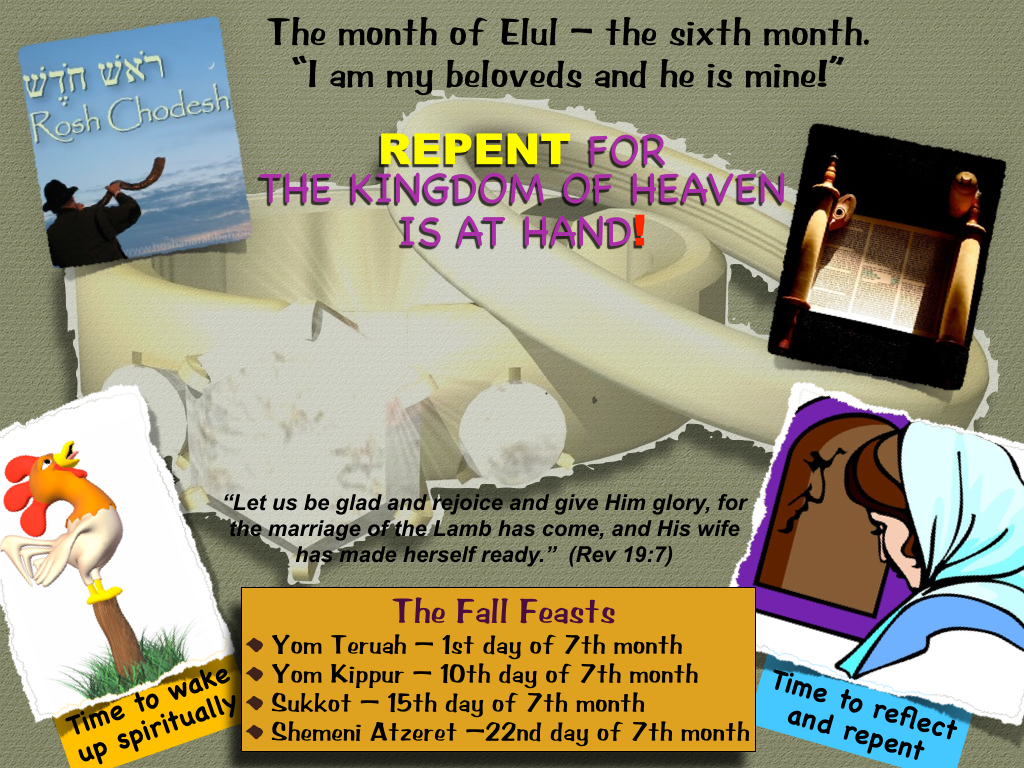
The fall biblical feasts are upon us, and now is time to prepare for them. As children of the light, we are called to NOT be ignorant of the times or seasons (1 Thess 5:1–10), and this includes understanding the biblical feasts which fall in their season (Lev 23:4) and are prophetic of and chronological in the steps YHVH’s glorious plan salvation for humankind.
The autumn feasts speak of events surround the second coming of Yeshua the Messiah. Contrary to biblical Truth, the mainstream church has lied to its people by declaring that Elohim’s Torah-law including the seven biblical feasts have been fulfilled (i.e. done away with) and are no longer relevant to the saint. This is patently absurd, especially when it comes to the fall feasts, since they obviously have not been fulfilled. This is because the prophetic events to which they point HAVE NOT yet occurred. Yeshua has not returned yet, the resurrection of the saints has not occurred, and Yeshua is not reigning with a rod of iron on this earth from his seat of power in Jerusalem.
So the biblical feasts are still important in the life of the Bible believing saint and, therefore, it is important that we not only be aware of them, but that we prepare to celebrate them. As such, the sixth month (the month of Elul) on the biblical calendar is the time to prepare for the fall feasts that occur in the seventh month. This is the time when the bride (the saints) are to prepare themselves for the coming bridegroom (Yeshua the Messiah). How do we prepare? By cleansing our lives of sin and putting on the robes of righteousness. This occurs through repentance from sin, turning from sin and getting our lives in line with the Word of Elohim. The month of Elul is the time to do this.
There is no salvation without true repentance!
What would you hear if you were to ask the average Christian to summarize the basic gospel message in one sentence? You might hear something like “Jesus loves you and has wonderful plan for your life.” Or you might hear, “Jesus died for your sins, so that you might go to heaven.” Some of the more “modern and progressive” or so-called “seeker friendly” Christians might say, “Come to Jesus and he’ll improve your self-esteem,” or “If you want good health and lots of wealth, come to Jesus.” But how does the Bible summarize the gospel message? That’s a question that almost nobody asks and no one knows or preaches about, even though the answer should be obvious to anyone who has read the Gospels. The truth is shocking and radically different from what most modern Christians think!
Matthew in his Gospel after describing the circumstances around the birth of Yeshua the Messiah, opens up by introducing the ministry of John the Baptist, the anointed prophet from heaven who came to prepare the way for the Messiah. The Gospel writers summarizes the preaching of John as “Repent, for the kingdom of heaven is at hand” (Matt 3:2). In the next chapter after his brief introduction to John’s ministry, Matthew then brings Yeshua the Messiah onto the scene. After Yeshua’s temptation in the wilderness, Matthew records, “From that time Yeshua began to preach and to say, ‘Repent, for the kingdom of heaven is at hand’” (Matt 4:17). Mark in his gospel records the same event as follows: “Now after John was put in prison, Yeshua came to Galilee, preaching the gospel of the kingdom of Elohim, and saying, ‘The time is fulfilled, and the kingdom of Elohim is at hand. Repent, and believe in the gospel’” (Mark 1:14–15). Finally, on the day of Pentecost after being pricked in their hearts byu Peter’s convicting sermon, the crowd asked the apostle what they should do next. His answer was, “Repent, and let every one of you be baptized in the name of Yeshua the Messiah for the remission of sins; and you shall receive the gift of the Holy Spirit” (Acts 2:38). A central and recurring theme in all of these passages is the idea of repentance from sin—a biblical concept that is understood by few modern Christians, and a message that is seldom preached in modern pulpits anymore. All of this is in spite of the fact that the writer of the Epistle to the Hebrews refers to “repentance from dead works” as “one of the [six] elementary principles of Messiah [or the gospel message]” (Heb 6:1-3).
So what is repentance? How does Scripture define repentance? It is a Hebraic concept, so we must go back to the Hebrew Scriptures to discover the answer.
Hebrew Word Definitions
There are two biblical Hebrew words that together present the complete picture of what true biblical-based repentance is. The first word is nacham meaning “to be sorry, console oneself, repent, regret, comfort, be comforted.” According to The Theological Dictionary of the Old Testament (The TWOT), the origin of the root of this word seems to reflect the idea of “breathing deeply,” hence the physical display of one’s feelings, usually sorrow, compassion, or comfort. The root occurs in the Ugaritic … and is found in Old Testament (OT or Tanakh) proper names such as Nehemiah, Nahum and Menehem. The Greek Septuagint (or lxx) translates the Hebrew word nacham by the two Greek words metanoeo and metamelomai. The Greek word metanoeo means “to change one’s mind, that is, to repent or to change one’s mind for better, heartily to amend with abhorrence of one’s past sins.” Wilson’s Old Testament Word Studies says this of nacham:
Boy reading from a gevil parchment scroll. This one is written on goat skin.
This section of the Torah (Deut 21:10–25:19) contains 72 commandments, which is more than in any other Torah portion. In this passage there are rules pertaining to all aspects of human relations showing that the “Torah deals with the real world. It does not present a world where all people get along with one another or rush to take care of one another’s property. Instead, it ‘takes into account the grim reality that people do not achieve the desired observance of “you shall not hate others in your heart”’” (A Torah Commentary For Our Time vol. 3, p. 150).
In studying this portion, one can easily miss the point of a particular command if one views it strictly in its pashat (most literal) meaning. For these commands to have relevance in our day, one must view them as principles that have a broad range of applications. The specific examples Torah gives are merely representative of one of but many life situations to which the principle behind the example could apply. Keeping this in mind, this Torah portion will give you much to ponder pertaining to your day-to-day walk (or halakhah).
In these chapters we see a plethora of laws concerning many seemingly small details regarding human life. Many people in the church have the tendency to broadly sweep away these commandments with such dismissive cliches as, “We’re now under grace …” or “We’re not under the law anymore …..” But please observe how many of the civil laws of our nation regulating actions between various members of society are based upon YHVH’s laws found in the Torah.
As many of us make our way back to a more biblically-based lifestyle and orientation, we begin to see that (a) YHVH cares about the details of our lives and (b) these laws, while sometimes hard to understand, are for our own well-being and blessing. Do you still nurse a “pick and choose” or “have it your own way” mentality with regard to YHVH’s biblical commandments choosing to follow the ones you want and making excuses why you can’t (or don’t want to) follow the rest? By doing so, what blessings are you depriving yourself of, and how are you hindering your love relationship with YHVH?
Some of the laws in these chapters may be hard to observe nowadays. With others, due to our church background, we may have the tendency to spiritualize them away, thus, in essence, rendering them of non‑effect in our lives and thereby placing ourselves above YHVH’s Torah-law and thus becoming a law unto ourselves. Is this not humanism: every man doing what is right in his own eyes instead of obeying YHVH whatever the cost? Who is the Master of your life? You or YHVH?
How do you view laws about women wearing men-type clothing, wearing fringes on the corners of your garments, mixed certain types of fibers in clothing, lending without interest, caring for the widows and orphans, personal hygiene, family purity laws (e.g. men not having sexual relations with their wives during their monthly cycles), removing blood from all meat before eating it, men wearing beards, faithfully tithing, following the biblical dietary laws, and observing YHVH’s Sabbaths (weekly and annual), etc.? These are lifestyle-changing laws, many of which go contrary to the mores of our society.
Are we not called to be a kadosh, set-apart, special and peculiar (i.e. treasured) people before YHVH? Following these laws to the best of our ability will help us to be the people that YHVH has called us to be. What progress are you making to bring your life into conformity to his standards of righteousness?
Deuteronomy 20:19,Do not destroy its trees. In its commentary on this passage, A Torah Commentary For Our Times states, “While the commandment deals specifically with cutting down trees during a siege, Jewish interpreters extend it to cover all forms of wasteful destruction under the principle of bal tashchit, or ‘do not destroy’ … [all w]asteful destruction is condemned. ‘Anyone who deliberately breaks dishes, tears clothing, wrecks a building, clogs up a fountain, or wastes food violates the law of bal tashchit’” (various rabbinical sources are cite vol. 3, p. 143).
In Genesis 2:15, Elohim commissioned Adam and Eve to “tend/dress and keep the garden.” The word tend literally means “to serve, work, dress, labor”in the sense of a servant or steward. The word keep means “to observe, guard, watch over, or preserve.” This was one of Elohim’s first Torah-commands to humans—to take care of or nurture the planet. Gardening is the oldest and noblest profession and was given to man by Elohim. Caring for trees and plants is a major aspect of this.
Do you view yourself as a steward with a divine mandate to help preserve, watch over, and guard all that YHVH has given you responsibility over including your body, your marriage, your children, your gifts and talents, your car, your job, your home and garden and everything else in your life? Do you view doing this as a good witness to those around you, as leaving a legacy for future generations, and as glorifying your Father in heaven?