Our new annual Scripture Reading Schedule for 2020-2021 with daily readings that begins 10/11/20 is now available to download and print. The link to the current 2019-2020’s Scripture Reading Schedule will still be available on the right sidebar under “Helpful Links” into next year. If you are using a mobile device or tablet, the link may be below, meaning you’ll need to scroll down instead.
Most of this week’s blog discussion points will be on these passages. If you have general comments or questions on the weekly Scripture readings not addressed in a blog post, here’s a place for you to post those. Just use the “leave a reply” link or the “share your thoughts” box below.
The full “Read Through The Scriptures In A Year” schedule, broken down by each day, can be found on the right sidebar under “Helpful Links.” There are 4 sections of scripture to read each day: one each from the Torah, the Prophets, the Writings, and from the Testimony of Yeshua. Each week, the Torah and haftarah readings will follow the traditional one-year reading cycle.
Weekly Blog Scripture Readings for 8/23 through 8/29/2020.
I just received this comment on one of our Hoshana Rabbah YouTube channel videos from a Jewish fellow:
It is interesting to see how Christians have interpreted the Hebrew scriptures. I think it’s great that you are interested in our faith, but adopting traditions that aren’t yours is not respectful. Talk to a rabbi, you might find new perspective.
Natan addressing the points one by one:
A) The Hebrew Scriptures including the Written Torah were given to ALL people starting with the children of Israel who YHVH commanded to take to all the nations of the world as per Deuteronomy/D’varim. That’s why Elohim placed Israel and Jerusalem at the center of the trade routes of the ancient world between three continents, so that they could be a light to the nations. Isaiah also talks about this as I’m sure you must know. So the Written Torah (Genesis to Deuteronomy) is not just for the Jews who are primarily descended from one of 12 tribes—Judah. In fact, the Written Torah itself says that there was to be one Torah-law for the native born and the one and same Torah-law for the alien and/or sojourner. So the modern Jews DO NOT have exclusive rights over the Hebrew Scriptures. To say they do is unbiblical and a manifestation of ethnic or racial superiority, i.e. a form of racism. I reject racism in all of its permutations. B) The Hebrew Scriptures IS NOT your faith only. My previous point addresses this. Now if by “your faith” you mean rabbinic Judaism, yes then I will concede to your point. You see, rabbinic Judaism is not strictly comprised of the Written Torah, but many, additional and even unbiblical traditions of the elders that are now found in the so-called Oral Torah or Talmud. You are welcome to your extra-biblical, second temple and post-second temple traditions. They are, for the most part, of little or no interest to me. I follow the Hebrew Scriptures of which the Written Torah is the cornerstone foundation. C) As noted above, the Jews are primarily descended from the tribe of Judah as per Scripture and as per rabbinic tradition. There are still 11 other tribes out there that are scattered worldwide. Your own morning shacharis/t prayers call for the regathering of the tribes. The Hebrew Scriptures prophesy this to occur over and over again as well. Your own sages call this regathering of the tribes to the land of Israel “the final redemption,” and which is to occur at the end of the “Messianic Era” and which is part of the beginning of “the Messianic Age.” So how do know that the Christians who are taking an interest in the Hebrew Scriptures, which by the way is part of their Bible as well, aren’t some of those “lost” and returning tribes that the Hebrew Scriptures and your own Jewish sages predict will return to their spiritual heritage? D) Talk to a Jewish rabbi? There is only one Rabbi (a word which in strict Hebrew means “my great one”), and that is Yeshua the Messiah whom the Christian call Jesus. All other “rabbis” though highly learned sages, with all due respect, are not rabbis by technical biblical definition. And frankly, the only perspective I care about is that of Scripture, and not that of some man or woman be they Christian, Jewish or any other faith. It is the Word of Elohim/God that will judge every human in the last days, not unbiblical man-made traditions as ancient or was widely accepted as they may be.
This has been a strong dose of medicine presented in a way you’ve likely never heard before. I pray that at least a point or two contained therein will cause you to ponder the truth-basis of your cherished religious position. In the mean time, I bless you and call you my brother as I am one your tribal brothers who is returning to the Hebraic roots of our faith even as Malachi prophesied would happen in the last days (Mal 4:3–6) and as your own Medieval Torah scholars predicted and observant Orthodox Jews pray every morning will happen. Therefore, you should rejoice that Bible prophecy is being fulfilled meaning Messiah’s coming is imminant rather than decry our videos for encouraging Christians to make teshuvah and come back to the Torah. Shalom aleichem!
The prophet Hosea, a native of the northern kingdom of Israel, ministered to that nation (called Ephraim or the house of Israel, as opposed to the southern kingdom, called Judah or the house of Judah) for about 38 years during the middle part of the eighth century b.c. (from about 770–725 b.c.). He lived in the final tragic days of the house of Israel and prophesied that Israel’s enemy, the Assyrians, would be instruments in YHVH’s hands to bring judgment against Israel if that nation did not repent and cease its spiritual harlotry and idolatry. That the book contains references to the kingdom of Judah is probably due to the fact that the northern kingdom fell in 721–722 b.c. while Hosea was still ministering and that he most likely transplanted to Judah where he may have finished writing his book (NIV Study Bible, p. 1312).
The theme of the Book of Hosea revolves around the prophet’s personal family life. YHVH’s prophets were often required to act out in their personal life something that would serve as a prophetic allegory of what would happen to the people of Israel if they failed to repent of their sin and return to YHVH. In Hosea’s case, YHVH required him to act out what had already happened to the northern kingdom. Because they had turned from YHVH, their spiritual husband, and taken to consorting with foreign spiritual lovers characterized by their forsaking the Torah, turning to serve pagan gods, and succumbing to heathen religious rituals and lifestyles, YHVH instructed the prophet to marry a harlot. In this way, the family life of Hosea would become a spiritual mirror that could be held up in front of the nation so that it could see itself as YHVH’s saw it. Furthermore, being married to an unfaithful wife gave Hosea direct insight into the emotional turmoil a husband endures when married to an adulterous woman that would provide the passion and impetus when defending YHVH in writing about the spiritual plight of adulterous Israel.
Hosea’s life must have been a sad one, for his adulterous wife bore him three children. From the text, it cannot be determined whether they were his children, or another man’s. Despite this, Hosea accepted his wife and children with an unconditional love representing YHVH’s love for Israel, despite her refusal to be faithful to him. The nation of Israel (the northern kingdom) did not heed the prophet’s warnings resulting in her falling to her Assyrian enemies. The Soncino Pentateuch aptly summarizes Hosea’s life this way:
A heavy domestic sorrow darkened Hosea’s life. He had married a woman called Gomer; and she rendered him deeply unhappy. He found that he had wasted his love on a profligate woman. She fled from the Prophet’s house, and sank lower and lower until she became the slave-concubine of another. But Hosea’s love was proof even against faithlessness and dishonour. He, the deeply aggrieved husband, buys her back from slavery, and brings her into his house—as a ward, pitied and sheltered, but subjected to a period of probation that shall show whether her better self can be awakened. (p. 581)
The terms house of Israel and house of Judah are initially used (in chapter one) in this book followed by the simplified terms Ephraim and Judah used throughout the remainder of the Book of Hosea. So that the reader can understand the context of this passage, let’s define these terms:
House of Israel: This term is used 146 times in Scripture. Prior to the division of the united kingdom after the death of Solomon, this phrase referred to all twelve tribes of Israel. Afterwards (during the time of the prophets), it was used in contradistinction to the phrase “house of Judah” in reference to the northern kingdom. In the Apostolic Scriptures, Yeshua makes reference to the “lost sheep of the house of Israel” (Matt 10:6; 15:24). Elsewhere in the Apostolic Scriptures this term refers to all twelve tribes of Israel (Acts 2:36; 7:42; Heb 8:10), and in some references it refers to just the northern kingdom (Heb 8:8). The context of the passage of scripture surrounding this phrase determines its meaning.
Ephraim: This name is used 180 times in the Tanakh and is referring to this specific Israelite tribe or as a metaphor for the northern kingdom of which the tribe of Ephraim was the leading and largest tribe (Isa 7:9,17; 9:9; 11:13; Ezek 37:19; Hos 4:17; 5:12, 13, 14; 6:4; 7:1; 10:11: Zech 9:13). When blessing the two sons of Joseph, Jacob placed his right hand of power and strength upon the head of Ephraim signifying the position of primogeniture for him and his descendants (Gen 48:17–19).
House of Judah: This term is found 41 times in Scripture and is always referring specifically to the tribe of Judah (e.g., 2 Sam 2:4, 7, 10) or to the southern kingdom, which included the tribes of Benjamin and Levi (1 Kgs 12:21, 23; 2 Chr 11:1). In addition, this term can refer to a remnant of Israelites from the northern ten tribes who refused to submit to the spiritual apostasy of Jeroboam and defected to the southern kingdom (2 Chr 11:16). The phrase “house of Judah” is used in contradistinction to the phrase “house of Israel” eleven times in the Scriptures including once in the Apostolic Scriptures (1 Kgs 12:21; Jer 3:18; 5:11; 11:10,17; 13:11; 31:27, 31; 33:14; Zech 8:14; Heb 8:8).
Judah: This name refers to both the tribe of Judah and to the southern kingdom. Scriptural context will determine which is meant.
Listed below are other prophetic allegorical terms found in this scripture passage with their accompanying definitions. Review these terms and their definitions, and then notice how the authors of the Apostolic Scriptures employ these terms applying them to the “Gentile” believers of the first century.
No Compassion or Mercy (Lo-ruhamah): This is the name of one of Hosea’s three children and is a prophetic reference to the house of Israel who, because of their apostasy, would be rejected by YHVH (Hos 1:6).
2 Thessalonians 1:4–8, Persecutions…righteous judgment. The backlash of Elohim’s righteous judgments against the wicked is persecution and tribulation against the saints by the one’s being judged, and their judgment is a result of their treatment of the saints. The saints will finally experience rest from this vicious cycle at the second coming, when Yeshua will take vengeance against the ungodly wicked.
2 Thessalonians 1:9, Everlasting destruction.The ungodly wicked hate Elohim and want nothing to do with him, so Elohim will give them what they want—a place that is far from his presence, along with what they don’t want: everlasting destruction. The wicked want immortality without Elohim, but there is no such thing. There is only damnation and eternal destruction apart from Elohim, but blessing and life for those who seek him.
2 Thessalonians 2
2 Thessalonians 2:3, Falling away [Gr. apostasia]. The Greek word apostasia literally means “a defection from truth.” What is truth by biblical definition? It is that Truth that is divinely revealed from Elohim in heaven to man. The Word of Elohim as found in the Bible is Truth (John 17:17), Yeshua is Truth (John 14:6), and Elohim’s Torah-law is Truth (Ps 119:142, 151), and these are three ways of saying the same thing, and these three are indivisible and indistinguishable from each other. To the degree that one has all three of these things as components of one’s life is the degree to which one is walking in the Truth. So falling away or defecting from truth means walking away from the Bible, Yeshua and the Torah.
2 Thessalonians 2:3–4,Man of sin [Gr. hamartia meaning “to miss the mark”]. The man of sin is an individuals misses the mark of Elohim’s righteous standards, that is, he is one a) who walks contrary to the Torah of Elohim, for sin, by biblical definition is a) violating the Torah (1 John 3:4; Lev 4:2, 13, 22, 27), b) anything that is in opposition to righteousness which is defined by Torah-obedience (1 John 5:17; Ps 119:172), and c) anything that is in opposition to Yeshua the Messiah and not to belief in him (John 16:9; 3:18; 8:24). There are many “men of sin” who fit this description, but the man of sin of the last days will be unlike any other in that he will be demon-possessed, will exalt himself above Elohim and will sit in the temple of Elohim. He will be a highly visible and extremely powerful individual.
2 Thessalonians 2:4,Temple of Elohim. There is debate among Bible students as to whether this will be a rebuilt third Jewish temple sitting atop the Temple Mount in Jerusalem, or whether this an evil, demonic leaders who will sit atop Christendom after a majority of earth’s Christians have been ecumenically united in some way probably under the Roman Catholic Church. Whoever the man of sin may be and wherever will be his seat of power, he will exalt himself as Elohim over the earth with powerful signs and wonders (v. 9).
2 Thessalonians 2:6,What withholdeth/what is restraining. There is much debate as to who or what it on earth that is preventing the man of sin from exercising full authority on earth. Some Bible students believe that it is the Spirit of Elohim, some believe it is Christians. It is unlikely that it is either of these since there will be saints on earth and the Spirit Elohim up until the second coming of Yeshua, which occurs after the great tribulation and, most likely, midway through the wrath of Elohim.
2 Thessalonians 2:7,Mystery of lawlessness [Gr. anomia]. The Greek word anomia literally means “lawlessness” or in the biblical context “Torahlessness.” The man of sin will be opposed to the law or Word of Elohim as revealed in Scripture.
2 Thessalonians 2:11,The lie. What lie in Scripture can be consider so colossal and of such overarching significance that Scripture refers to it as “the lie”? Paul refers to this lie again in Romans 1:23. This is likely the lie of the serpent in the tree of knowledge that led man to commit the first sin. That lie was a) man doesn’t need to obey Elohim’s Word, b) man can become like Elohim, c) man can have immortal life apart form Elohim, d) man can have knowledge that Elohim is allegedly withholding from man. All the false Antichrist religions and philosophies of the world are based on these lies.
2 Thessalonians 2:12,Truth…unrighteousness. Truth and unrighteousness are opposites. This is because Scripture tells us that YHVH’s Torah is Truth (Ps 119:142, 151) and righteousness (Ps 119:172), that the Word of Elohim is Truth (John 17:17) and that Yeshua the Messiah is Truth (John 14:6). (Why do I capitalize the word Truth? It is to differentiate between secular truth and divine or spiritual Truth. The latter is at a much higher level and is eternal and is a reflection of the mind and character of the Almighty Creator.) The opposite of Truth is evil, darkness, sin and unrighteousness. Those who righteous and walk in the light of Truth love and live out righteousness, while those who walk in darkness, evil and sin take pleasure in unrighteousness as this verse states.
2 Thessalonians 3
2 Thessalonians 3:6,Withdraw. Why does Paul instruct the saint to withdraw from “brothers” who are out of order spiritually and don’t follow the basic tenets of Scripture? Simply this. Evil company or companionship corrupts good habits or morals, as Paul writes elsewhere (1 Cor 15:33). Or otherwise stated, one can’t live with pigs and not expect to get dirty. That’s why YHVH is presently calling his people to come out of Babylonian religious systems (Rev 18:4), and to come out from among those who are unclean or unholy spiritually and be separate from them (2 Cor 6:17). This is how the bride of Yeshua is preparing herself to be the chaste virgin for which the Messiah is returning.
Tradition. Whose are what tradition are the saints to follow: the traditions of men or those that line up with the full Word of Elohim? Too many people follow religious traditions established by men and the institutions they have created to perpetuate their own ideas some of which line up with Scripture and many of which do not. Where did Paul or any of the other apostles or any of the other biblical authors instruct people to follow them? Nowhere. Rather, they all instructed their readers to follow YHVH Elohim and Yeshua the Messiah and the Word of Elohim. Even today, too many Christians spend most of their time following men and reading and studying what men have written rather than going directly to the Word of Elohim. For such people, how do they know if the men they are following are preaching the Truth of Elohim or their own man-made traditions if they don’t know what the Bible says?
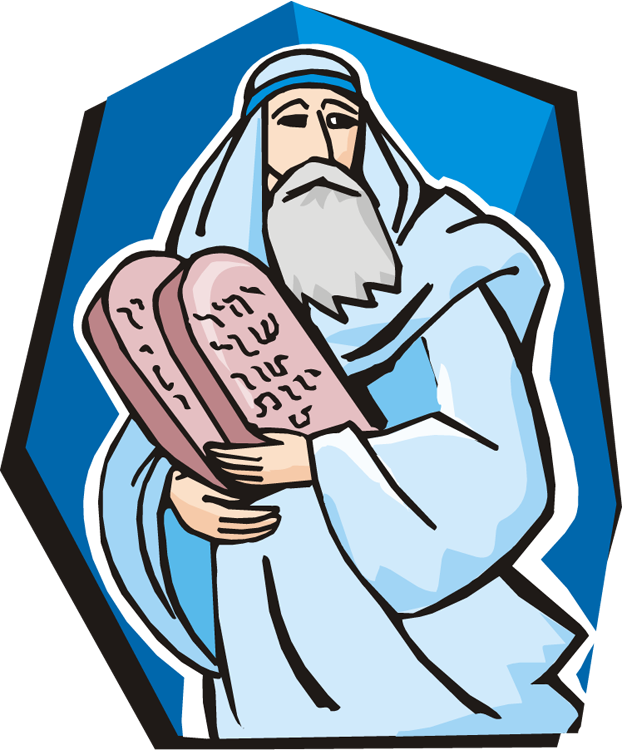
Deuteronomy 18:15, A prophet from your midst, like me, shall YHVH your Elohim raise up for you.
Moses—A Prophetic Type of the Messiah
Obviously, Moses’ Deuteronomy 18 prophecy concerning the Messiah was fulfilled in the person of Yeshua. Who else in the history of the world could have fulfilled this prophecy? Despite this, the non-believing religious Jews, to their discredit, run around in philosophical circles attempting to prove that this verse does not apply to Yeshua. Similarly, the Christian church, in its own way, also disbelieves this prophecy. Let us examine some of the arguments attempting to circumvent the simple truth of this messianic prophecy.
For example, the Orthodox Jewish Torah translation TheArtScrollStone Edition Chumash in its commentary states, “Moses told the nation that just as he was one of them, so God would designate future prophets [plural] from among the people to bring them his word” (p. 1033, emphasis added). What is wrong with this statement? Is the verse quoted accurately? Moses said “prophet” singular, not “prophets” plural, as the commentary says. So in this manner, the Jewish commentators switch the focus off of one single prophet who would arise, and make it appear as if all the prophets recorded in the Scriptures helped to fulfill this prophecy. This is dishonest biblical interpretation.
On another note, does the “Jesus” of the mainstream church who, it is taught by many church leaders, broke the Sabbath and came to do away with the Torah-law of Moses fulfill this prophecy? Didn’t Moses say that the prophet would speak only the words that Elohim would give him (and the implication is that those words would not contradict what was given at Mount Sinai)? So did Yeshua come to do away with the Torah-law or not? (Read Matt 5:17–19.) In commissioning his disciples in Matthew 28:20, didn’t Yeshua tell them to do and to pass on to others all that he had commanded them? Didn’t Paul tell us to, “Follow me as I follow the Messiah” (1 Cor 11:1)? So how is it that so many people in the mainstream church believe otherwise about Messiah Yeshua and Paul relative to their teachings on the Torah-law? The point we are trying to make here is that the “Jesus” of the Sunday church who, it is taught, came to annul the Torah, does not fit the criteria of this prophecy of Deuteronomy 18:15–19. Either the Torah is correct and the mainstream church is wrong or it is the other way around. We choose the former to be the truth, not the latter!
A prophet…like unto me. Let’s now study the parallels between Moses (Heb. Moshe) and Yeshua the Messiah (Heb. Machiach)to see how Yeshua perfectly fulfilled this prophecy.
Moses’ early life seems to foreshadow some details of Yeshua’s life and ministry. This really should not surprise us when we consider the words of the book of Hebrews (10:7 from Ps 40:7), which attributed to YHVH-Yeshua, who said, “The volume of the scroll was written of me.” Yeshua himself, when confronting the Pharisees in John 5:46, said “For had you believed Moses, you would have believed me, for he wrote of me.”
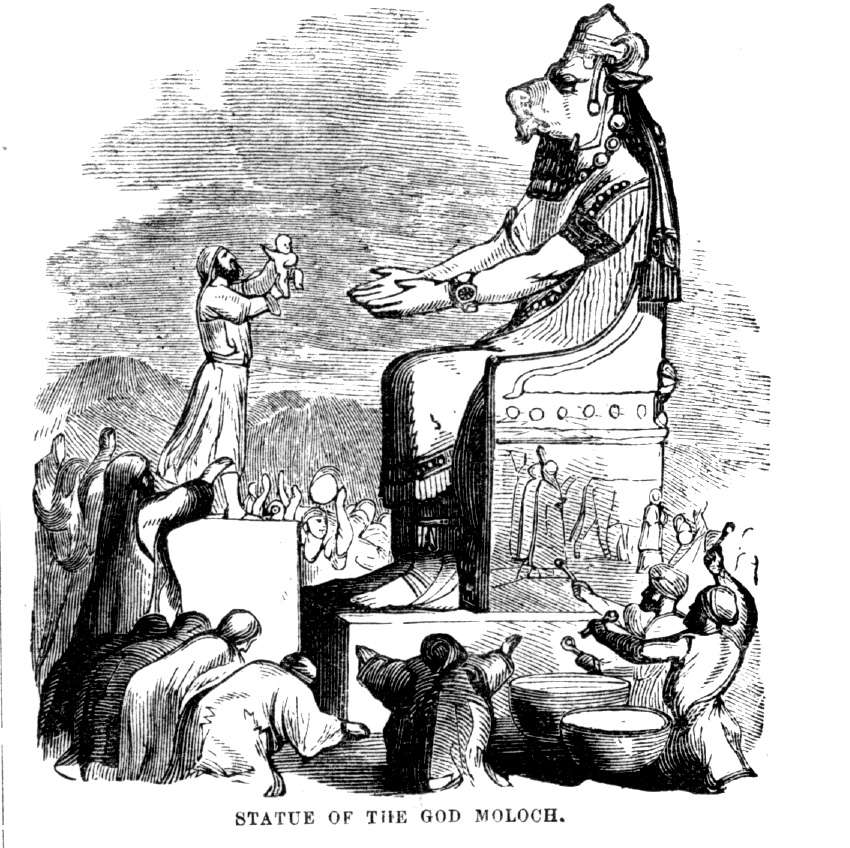
Deuteronomy 18:10,One who causes his son or daughter to pass through the fire. This was done in honor of the Canaanite deity Moloch (see Lev 18:21 and 20:1–6). The name moloch/lKNin Hebrew means “king”with the root of the word meaning “to rule or reign.” Child sacrifice (the ancient form of modern abortion or infanticide) though a pagan practice that YHVH abhorred, was practiced by both houses or kingdoms of Israel as they drifted into syncretism with the heathen cultures around them (see 1 Kgs 11:7; 2 Kgs 16:3; 21:6; 23:10,13; Jer 7:31; 19:5; Ezek 16:20; 23:37).
Baal appears to be a synonym of Molach or Moloch (see Jer 19:5 and the Ency. Britan. eleventh edit., vol. 18, p. 676). After the children were sacrificed to this demon entity, the dead bodies were thrown into the garbage dump of the Valley of Hinnom or Tophet just below the Temple Mount in Jerusalem (Jer 7:31; 19:5–6). Apparently, the children were not burned alive, but were slain (by knife) like any other sacrifice before being thrown into the fire and then into the garbage dump (ibid.). The ancients sacrificed their children to appease their bloodthirsty gods of prosperity, sensuality and fertility (The Story of Civilization, vol. 1, by Will Durant, pp. 66–67, 297).
What can we learn from these random pieces of historical information concerning the ancient practice of child sacrifice? It was done in honor of their deity; in other words, their idol was the king that ruled their lives. What is the chief deity in modern America and most everywhere else in the world? Money and wealth? Sex and pleasure? Fun and entertainment? In ancient times, children were killed by a knife, thrown into the fire and then into the garbage dump. Today, what happens in America and many other countries with unwanted children? Parents abort their babies or have them murdered while being born (partial birth abortion) by using burning solutions to kill the baby in the womb and scalpels and scissors to hack the baby to pieces to aid in its extraction. Afterwards the dead baby is tossed into a dumpster or body parts are sold for “medical” purposes.
What reasons do parents give for killing their children? “It will cost too much to raise them and it’s too much trouble” (greed, hedonism and selfishness). “It will interfere with my career” (greed). “I want to have pleasure without responsibility” (hedonism and greed). Regardless of the excuses, the reasons today are the same as those of the ancients: prosperity, greed, hedonism and so on. Are we any different or any more “civilized” than the ancients? YHVH called abortion an abomination (which means “disgusting, abominable,abhorrent, detestable or loathsome,” Deut 18:12).
Make no mistake about it. The modern practice of abortion is still the worship of the ancient murderous demon-god Moloch or Baal whether those practicing abortion know it or not. The reason for engaging in this abominable practice are still the same, and the evil spirit motivating people to do it is still the same. Humans are no different today than they were thousands of years ago. Only the actors and costumes have changed. The actions and evil heart of man remains the same without transforming power of Word and Spirit of Elohim at work to convert sinful humans from the kingdom of darkness and the worship of and obedience to Baal (Satan) to the kingdom of light and the worship of and obedience to YHVH Elohim.
Do you abhor that which YHVH calls an abomination? In Scripture, does YHVH call children and fertility a curse … or a blessing? (See Deut 28:11, Ps 127:3–5.)
Connecting the Gospel to Its Pro-Torah Hebrew Roots
When I was taking a college level biblical Greek class a few years back, the Christian professor and I had a few discussions about the Torah. It was his belief that the epistles in the New Testament contained very few references to the Torah. In his mind, therefore, the Torah wasn’t a very prominent idea in the minds of the apostolic writers. I tried to enlighten him otherwise.
While the epistles might not contain very many outright references to the Torah—especially direct commands to be obedient to the Torah’s standards of righteousness, the apostolic writers weave the fundamental concepts of the Torah through their writings and make countless allusions to the Torah as we shall see in the study below. The Torah was just part of their spiritual and social fabric and background. It was their spiritual foundation, and to them Yeshua the Jewish, Torah-obedient Messiah, who was the Living Word of Elohim incarnate, was simply an extensions or expression of this basic idea of Torah truth and righteousness, and whose example they expected the saints to follow as his disciples.
Similar words studies as I have done in First Thessalonians can be done to any book of the Bible including every book of the Testimony of Yeshua or New Testament. The fundamental principles of YHVH’s Torah-instructions in righteousness can to be found throughout the entire Bible from Genesis to Revelation.
2 Thess 1:3, Love.The Torah defines how a man is to love Elohim and his neighbor. Biblically speaking, is love merely an emotion, or is it something more? The Bible presents love as an action. Yeshua said, “If you love me, keep my commandments” (John 14:15). This action involves obedience to YHVH’s Torah-commandments. Elsewhere, Yeshua sums up the Torah when he quotes the biblical shema, which states that the duty of man is to love YHVH with all one’s heart, soul, mind and strength and one’s neighbor as oneself (Mark 12:28–31 cp. Deut 6:4 and Lev 19:18). The shema is a summation of the ten commandments the first four of which show us how to love YHVH, while the last six how to love our neighbor. These ten statements form the foundation or cornerstone of the entire Torah, which expand out of them.
2 Thess 1:5, Righteous judgments of Elohim.As the just judge of the universe, YHVH Yeshua will judge all men at his second coming based on his word — the Torah (Rev 19:11, 15 cp. Isa 11:3–5 and Ps 119:172). He will then offer rewards to his servants based on how well they followed his Torah or not (Matt 5:19).