Doubtless, this post is bound to generate some controversial and interesting comments. — Natan
Zechariah 8:19, The fast of. What are these four fasts of the house of Judah (the Jews) that YHVH is here approving and refers to as “appointments” or moedim (though not necessarily “divine appointments” [except for the fast of the tenth month, which is Yom Kippur], since they weren’t mandated by YHVH)? These four fasts are (according to https://www.chabad.org/library/article_cdo/aid/609607/jewish/Jewish-Fast-Days.htm):
The fast of the fourth month of Tammuz: Shivah Asar B’Tammuz— The fast actually commemorates five tragic events that occurred on this date:
Moses broke the tablets when he saw the Jewish people worshipping the Golden Calf.
During the Babylonian siege of Jerusalem, the Jews were forced to cease offering the daily sacrifices due to the lack of sheep.
Apostomos burned the holy Torah.1
An idol was placed in the Holy Temple.2
The walls of Jerusalem were breached by the Romans, in 69 CE, after a lengthy siege. (Three weeks later, after the Jews put up a valiant struggle, the Romans destroyed the second Holy Temple on the 9th of Av.)The Jerusalem Talmud maintains that this is also the date when the Babylonians breached the walls of Jerusalem on their way to destroying the first Temple.
The fast of the fifth month of Av: Tisha B’Av— The saddest day on the Jewish calendar is the Ninth of Av, “Tisha B’Av.” It is the date when both our Holy Temples were destroyed, and an era of exile, persecution and spiritual blackness began.
The fast of the seventh month of Tishrei: Yom Kippur or the Day of Atonement
The fast of the tenth month of Tevet: Asarah B’Tevet— On Asarah B’Tevet, the 10th day of the Jewish month of Tevet, in the year 3336 from Creation (425 BCE), the armies of the Babylonian emperor Nebuchadnezzar laid siege to Jerusalem. Asarah B’Tevet is observed as a day of fasting, mourning and repentance.
What can we learn from this Bible passage? This verse tells us that YHVH is not opposed to our observance of man-made, extra-biblical holidays if they commemorate important events in the religious history of his people and if they are done on the basis of love and peace. This could be applied to such momentous biblical events as the birth and resurrection of Yeshua the Messiah as long as we do not substitute these for YHVH’s commanded biblical festivals as listed and commanded in Leviticus 23 and elsewhere. Of course, it is patently contrary to the Word of Elohim for any man-made holidays to contain any taint of paganism (Jer 10:2–5; Lev 18:3; 20:23; Deut 12:30–31) as do most if not all of the popular modern Christian holidays.
For years, in my Bible, I have had Zechariah 4:6 marked as significant with a large red check mark, and can even quote this verse from memory (admittedly, it’s short and not difficult to memorize):
So he answered and said to me: “This is the word of YHVH to Zerubbabel: Not by might nor by power, but by My Spirit,” Says YHVH of hosts.
But only recently, as a younger senior citizen, have I stopped to consider what this verse really means and to wonder, as I look back over six decades, thirty of which have been in ministry including 25 years pastoring, whether or not and to what degree my life’s major ministry and other life activities have measured up to this wise proverb. To be honest, I believe that much of what I have done “for the Lord” has been weighed in the balances and has been found wanting.
Honestly, I have accomplished a lot for YHVH and, to be sure, there is some good fruit that has come from 30 years of ministry, but I can’t help wonder how much was done in my “might and power” as opposed to “by my [YHVH’s] Spirit.” For example, what have been the effects of my ministry upon my marriage and family? Positive or negative or somewhere in between? The answer to this necessitates pause for some serious reflection, which I have been doing lately. This then begs a couple of questions. First, when doing my ministry ostensibly “for the Lord,” was I doing so in the good, better or perfect will of YHVH (Rom 12:2)? Honestly, it would be arrogance on my part to rate myself very highly on the superlative side of this scale! Second, how much of my ministry has been about self and ego—in other words, pride, which is a pitiable and abominable sin in the eyes of YHVH (Prov 6:16–17 cp. Jer 9:23–24)? How much of my ministry has been done in accordance with my own will and impetuosity, as well intended as it may have been, as opposed to the leading of the Spirit?
Even though this is not the main message behind this Zechariah chapter four passage, when pulling this verse out, it can stand alone as a proverb or adage to live by. If we take our spiritual microscope to this verse, one can’t help but to ask oneself these questions.
So what is the real contextual message of Zechariah 4:6?
Our new annual Scripture Reading Schedule for 2020-2021 with daily readings that begins this week is now available to download and print. The link to the previous 2019-2020’s Scripture Reading Schedule will still be available on the right sidebar under “Helpful Links” into next year. If you are using a mobile device or tablet, the link may be below, meaning you’ll need to scroll down instead.
Most of this week’s blog discussion points will be on these passages. If you have general comments or questions on the weekly Scripture readings not addressed in a blog post, here’s a place for you to post those. Just use the “leave a reply” link or the “share your thoughts” box below.
The full “Read Through The Scriptures In A Year” schedule, broken down by each day, can be found on the right sidebar under “Helpful Links.” There are 4 sections of scripture to read each day: one each from the Torah, the Prophets, the Writings, and from the Testimony of Yeshua. Each week, the Torah and haftarah readings will follow the traditional one-year reading cycle.
** A different Haftarah is read when it is a special sabbath in Jewish tradition. This week it is Shabbat Machar Chodesh on the traditional calendar. Otherwise, Isaiah 42:5 – 43:10 would be read.
Weekly Blog Scripture Readings for 10/11 through 10/17/2020.
As we close out this year’s Sukkot (the Feast of Tabernacles) and Shemini Atzeret (the Eighth Day), our family would like to wish you and glorious rest of the year as we enter into the dark winter season in preparation for a new feast season next biblical year starting with Passover.
By the way, please feel free to share with us your praise reports and testimonies of how you were blessed this year at Sukkot. You can do this in the comments section of this post.
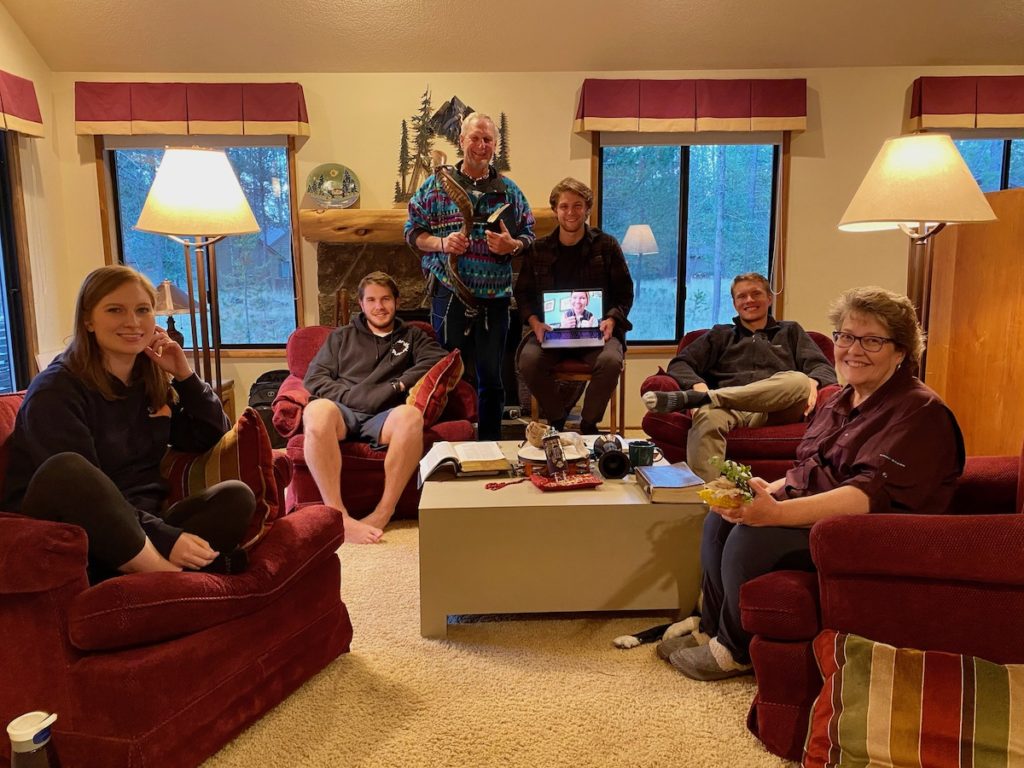
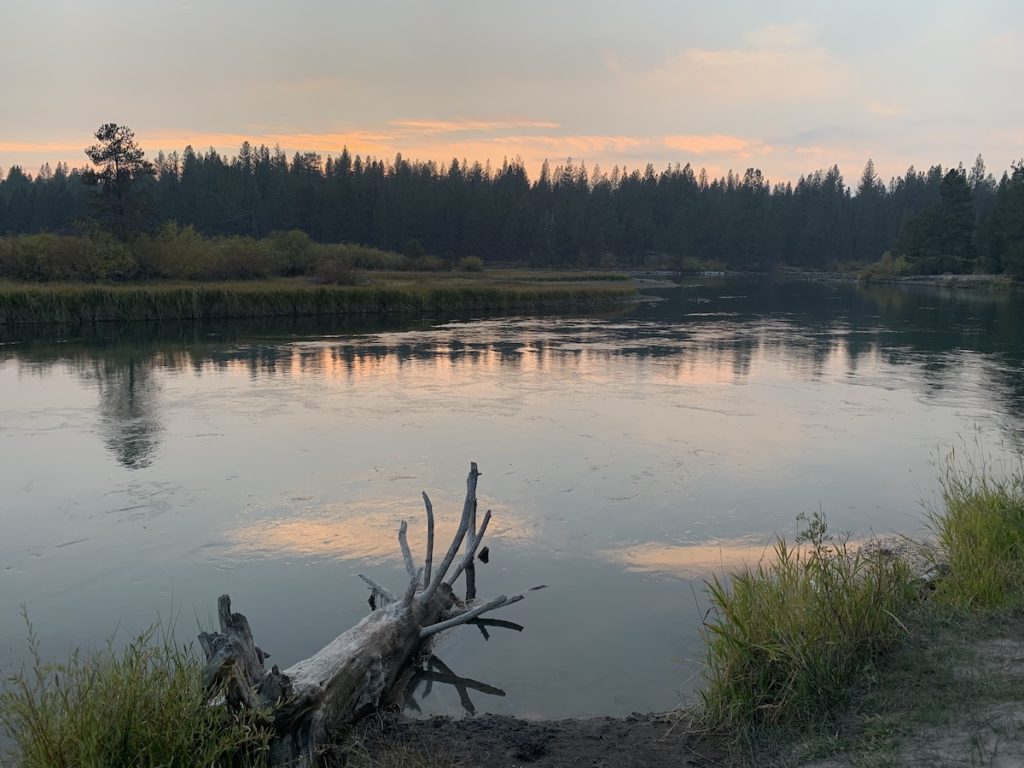
The Nathan and Sandi Lawrence family gathered together on the Shemini Atzeret after a Bible study.Sunset of Sukkot on the Deschutes River a couple of blocks from temporary home.Shemini Atzeret morning on the Deschutes River with a gentle rain falling to wash the dust off of everything, to water the land, and to clear the forest fire smoke out of the air. This coming year, may the gentle rain of the Holy Spirit and the water of YHVH’s Torah-Word clean and refresh us and water the ground of our hearts, so that we can bring forth a bountiful spiritual harvest for our Heavenly Father. Amein.
Revelation 20:1, Bottomless pit. (See notes at Deut 32:22; 2 Pet 2:4; Rev 9:1. Also see notes at Isa 14:18–21.)
Revelation 20:4, A thousand years. This is but one of six references in the Bible to the Millennium lasting for one thousand years. The other references are found in the surrounding verses (vv. 2, 3, 5, 6, 7). Even then, some biblical students still question the idea of the Millennium and categorize it as a NT concept only and, therefore, feel they can relegate it to the realm of the allegorical. An understanding of the prophetic implications of the seventh day Sabbath should settle this question once and for all. In traditional Jewish thought, the seven days of creation picture the time man will be on this physical earth. Six days (for six days or six thousand years) man does his own work, while on the seventh day (or one thousand years) he rests and fellowships with Elohim. This is a picture of the millennial rest, which the Jewish sages have long called the Messianic Era, which is yet to come. The Millennium is not uniquely a Christian or NT concept, but is rooted in Judaism going back before the Christian era. For example, the writer of Hebrews juxtaposes the Sabbath and the Millennium in Hebrews chapter seven when he compares Joshua taking the Israelites into the Promised Land with Yeshua taking the saints into the Sabbath, millennial rest of our spiritual inheritance.
Revelation 20:5, The rest of the dead. This phrase is a parenthetical thought. Before and after this phrase, the author is discussing those who will be part of the first resurrection, which occurs at Yeshua’s second coming. Later in the same chapter, John goes on to discuss what happens to the rest of the dead (vv. 12–13).
Revelation 20:7–21:1, Events after the Millennium. The events in these verses appear to be chronological and occur after the Millennium. In Rev 20:2ff John seems to be receiving a pre-millennial flashback vision. (See my discussion on these verses.)
Revelation 20:8, The four corners. These rebels who will inhabit the millennial earth have removed themselves as far as possible from Jerusalem, which is the seat of King Yeshua’s rule and is at the center of the earth.
Revelation 20:9, Fire came down from heaven. If the New Jerusalem, the seat of Yeshua’s millennial government, is hovering over the earthly Jerusalem during the Millennium, then this is the source of the fire or Yeshua’s judgment against the rebels who dare to defy his divine governance.
Revelation 20:10, The devil…lake of fire. (See notes at Deut 32:22; 2 Pet 2:4; Rev 9:1.)
Tormented forever.The devil as a spirit either can only be contained, but not destroyed meaning Elohim is not all-powerful, or, more likely, Elohim will allow the devil to exist, though in a place of torment, as an on-going example and testimony to his sovereign greatness and power over evil.
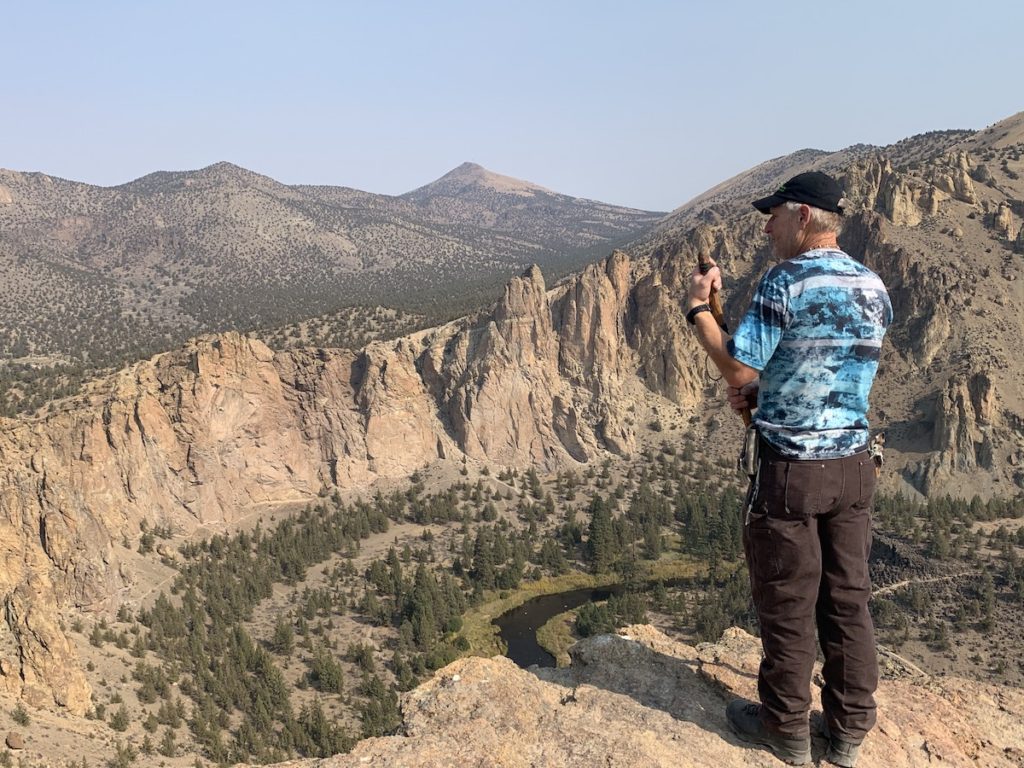
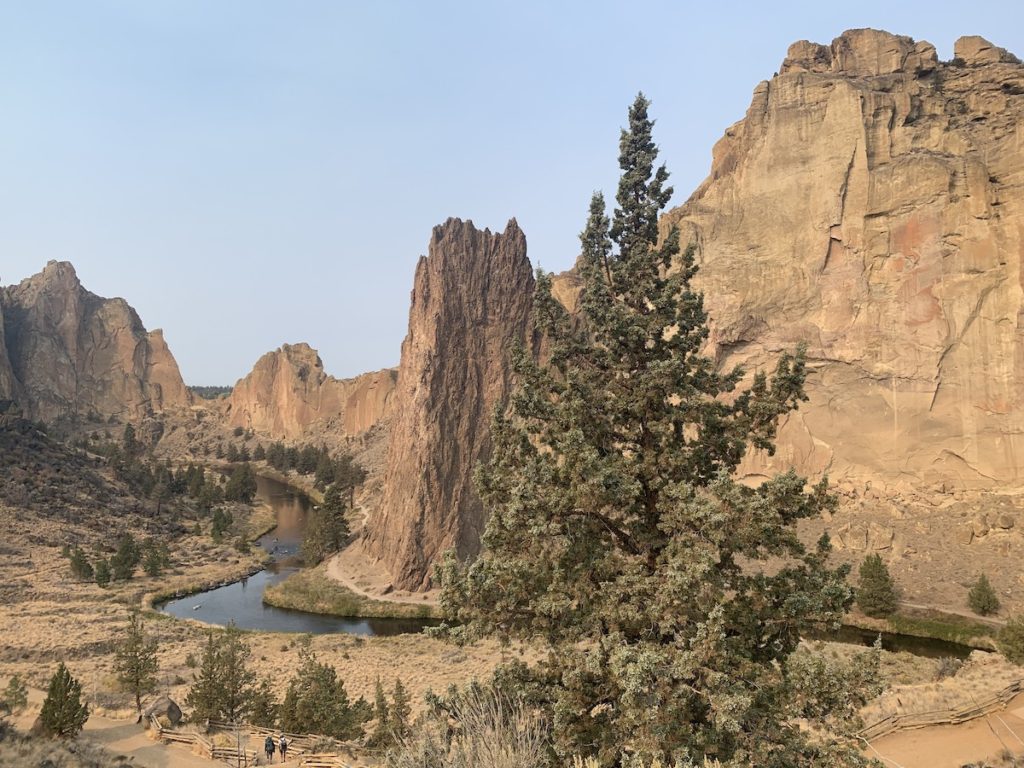
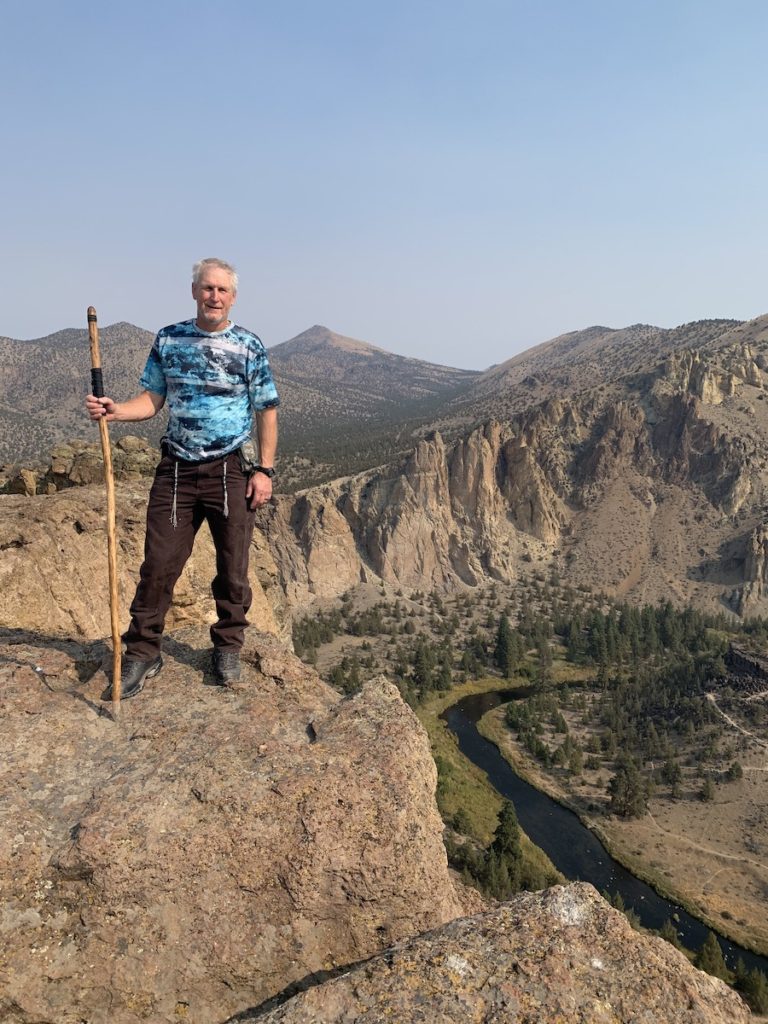
Moses overlooking the Promised Land? Well not quite, but a happy thought nevertheless. It is Nathan overlooking the high mountain desert of Central Oregon atop Smith Rocks—Oregon’s “Mount Sinai”—where he and his family are celebrating Sukkot/the Feast of Tabernacles 2020.
Hello everyone. Hope you’re having a great Sukkot wherever you may be.
My first Sukkot was in 1960, and I’ve been privileged to celebrate Sukkots in various places in the U.S., in Canada and in France. I’ve been apart of Sukkot gatherings with thousands of attendees, and in many with only small groups of hundreds, tens or just my family as is the case this year.
For our family and since I was a little child, the Feast of Tabernacles has always been the highpoint of our year. And it well should be because of what this biblical feast represents in Bible prophecy—a coming time called the Millennium when Yeshua has returned, and has destroyed the New World Order which the Bible refers to as Mystery Babylon the Great with all of its Satan-worshiping and Elohim-hating cast of character. During this time, which some forward-thinking people have referred to as “the world tomorrow”, Yeshua will establish his world-ruling kingdom and rule with his resurrected and glorified king and priest saints teaching the physical humans on this earth the ways and Truth of YHVH Elohim. At this time, Satan will have been bound and placed in the abyss for 1000 years and the world will be at peace as the glory of YHVH covers the earth as the waters cover the sea. It is this paradisiacal time that Sukkot prophetically portrays.
Each year at Sukkot, traditionally my family and I have vacated the city where we live (our “Babylon”) for some beautiful and idyllic place on earth where we can enjoy a small foretaste of Yeshua’s millennial kingdom. This is also why we colloquial refer to Sukkot simply as “the Feast,” for it is a time to rejoice in YHVH Elohim and the blessing he has lovingly and graciously bestowed on us during the past year. Sukkot also represents and points to the marriage feast of the Lamb of Elohim.
In preparation for this “vacation,” we save our feast tithe (or a biblically mandated “vacation fund”) as Scripture commands to help finance our time “away from it all.” During this time, we follow Scripture and use our money to bless others, and to buy whatever our hearts desire and to feast joyfully including with “wine and strong drink.” As we read,
You shall truly tithe all the increase of your grain that the field produces year by year. And you shall eat before the LORD your God, in the place where He chooses to make His name abide, the tithe of your grain and your new wine and your oil, of the firstborn of your herds and your flocks, that you may learn to fear the LORD your God always. But if the journey is too long for you, so that you are not able to carry the tithe, or if the place where the LORD your God chooses to put His name is too far from you, when the LORD your God has blessed you, then you shall exchange it for money, take the money in your hand, and go to the place which the LORD your God chooses. And you shall spend that money for whatever your heart desires: for oxen or sheep, for wine or similar drink, for whatever your heart desires; you shall eat there before the LORD your God, and you shall rejoice, you and your household. You shall truly tithe all the increase of your grain that the field produces year by year. And you shall eat before the LORD your God, in the place where He chooses to make His name abide, the tithe of your grain and your new wine and your oil, of the firstborn of your herds and your flocks, that you may learn to fear the LORD your God always. But if the journey is too long for you, so that you are not able to carry the tithe, or if the place where the LORD your God chooses to put His name is too far from you, when the LORD your God has blessed you, then you shall exchange it for money, take the money in your hand, and go to the place which the LORD your God chooses. And you shall spend that money for whatever your heart desires: for oxen or sheep, for wine or similar drink, for whatever your heart desires; you shall eat there before the LORD your God, and you shall rejoice, you and your household. You shall not forsake the Levite who is within your gates, for he has no part nor inheritance with you. (Deuteronomy 14:23–27)
Now some more Hebraic-minded saints declare that it’s impossible to keep the biblical feasts including Sukkot exactly how the Torah commands, and so they take the minimalist approach to scriptural obedience and use this as a justification for not doing the feasts at all. Over the years I have directly confronted this mindset and shown from Scripture how YHVH favors and desires a heart that is inclined to serve him “the best we can” regardless of our location or circumstances. Instead of finding reasons and excuses why we can’t obey him by keeping his feasts, I prefer to look for every reason why we can obey him. This shows him that our hearts are inclined toward obedience and we are endeavoring to love him in so doing. If we fall short in our obedience, his grace covers us. This is a better approach and heart and mind orientation than that of looking for any excuse not to obey him. And truthfully, YHVH has blessed our family immensely both physically and spiritually as he have endeavored to obey him the best we can as imperfect as it may be.
So some of you may be wondering what we do during Sukkot. For the 18 years Sandi and I pastored a local congregation, we sponsored regional Sukkot gatherings where dozens up to a couple of hundred feast-goers came and celebrated. During this time, we scheduled daily meetings, teachings, praise and worship gatherings, family events and activities, group meals and much more. Needless to say, this kept Sandi and I busy organizing, setting up, tearing down, and overseeing and leading. It has been a couple of years since we “retired” from that, and after we did, it all died since no one was willing pick up that mantle and carry on that work. It was a lot of hard work that few were willing to help us with. Since then, because we have no congregation or group to meet with, we simply gather together as a family, which is our own personal tribe where I am the “patriarch.” During Sukkot, on the high holy day Shabbats, I lead my family in prayer, Bible study and music as we endeavor to rest and keep the sanctity of the day. During the rest of the week, we do our best to keep our hearts and minds on the meaning of Sukkot while, at the same time, building family relationships by engaging in fun activities.
So why am I sharing all of this with you? Simply for this reason. Perhaps our example of how we celebrate Sukkot will inspire you and yours to do the same and to find the blessing therein even as we have. We have found that whenever we obey YHVH, there is always a blessing to be found including temporally vacating spiritual Babylon, meeting with Elohim at his appointed times, building relationships with family and friends, and inspiring ourselves to look upwards toward him and toward a future better world that is coming soon where Yeshua the Messiah will be the King of kings.
HalleluYah! Maranatha!! Yeshua come quickly. The grace of our Master Yeshua the Messiah be with you all. Amein
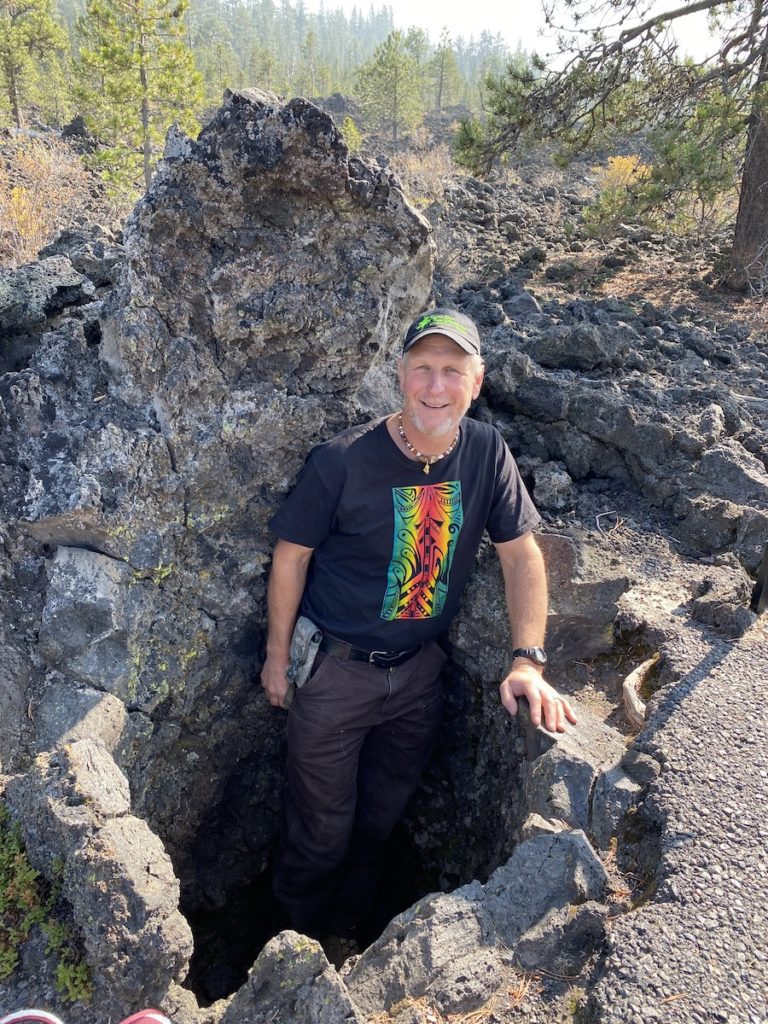
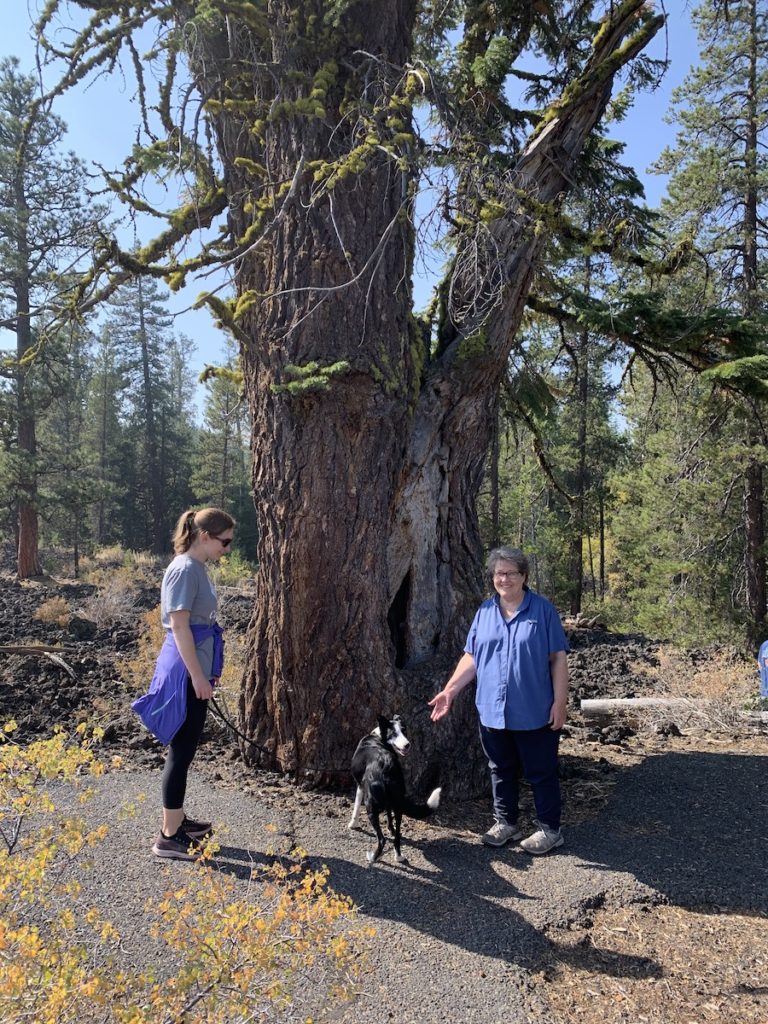
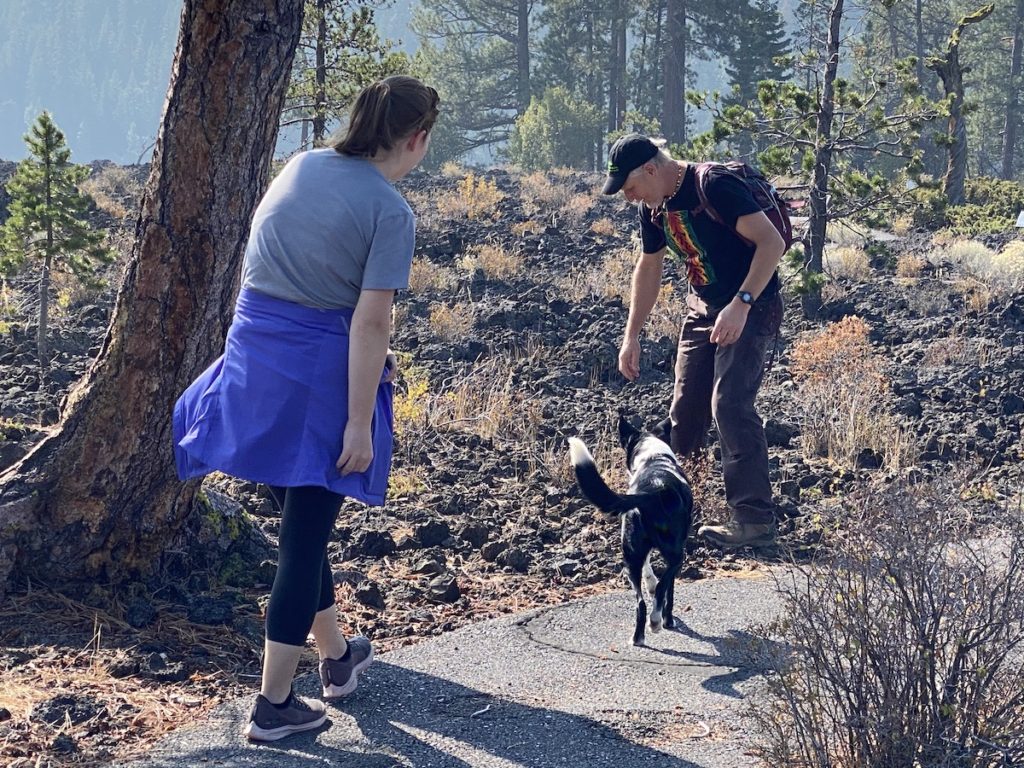
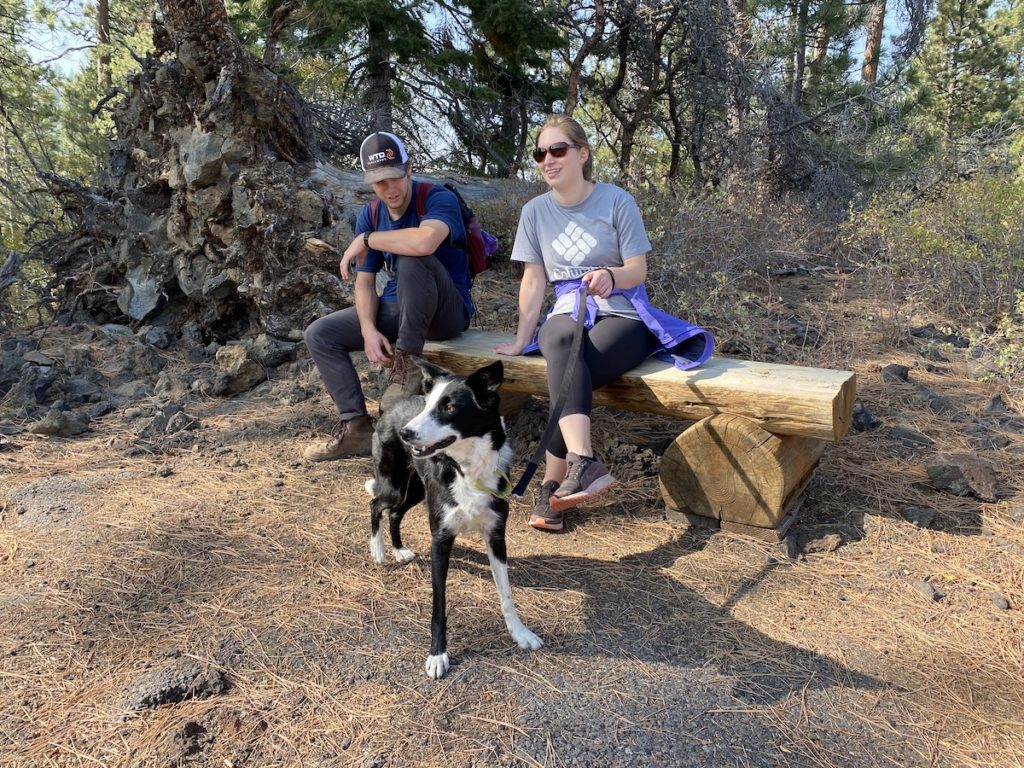
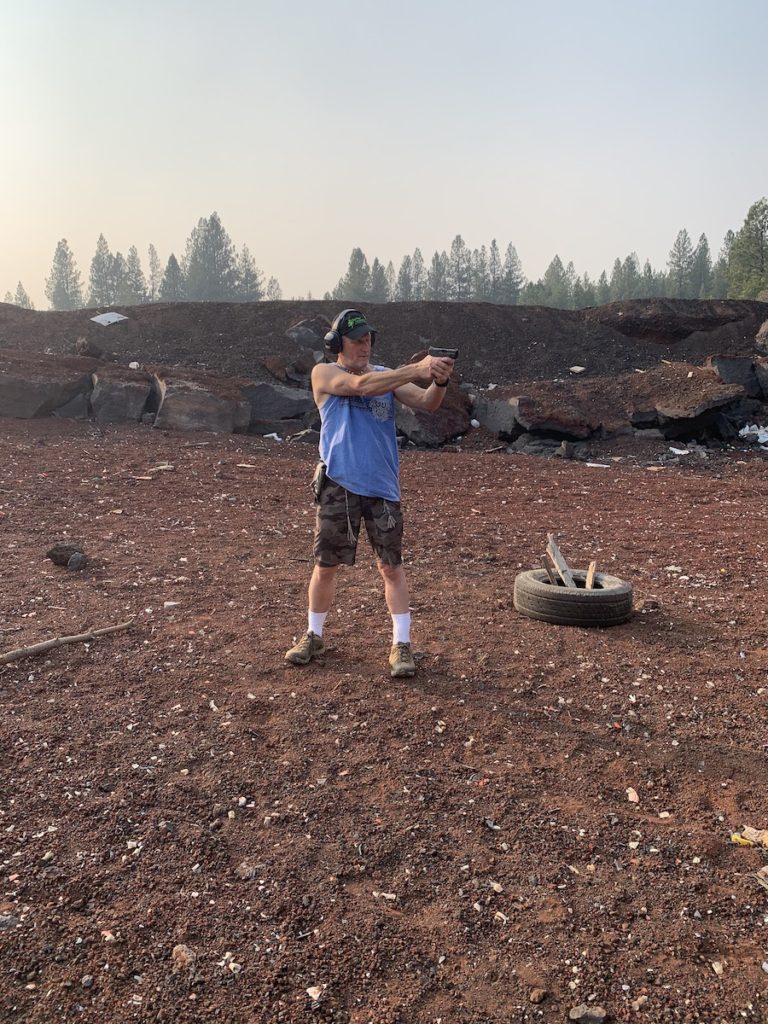
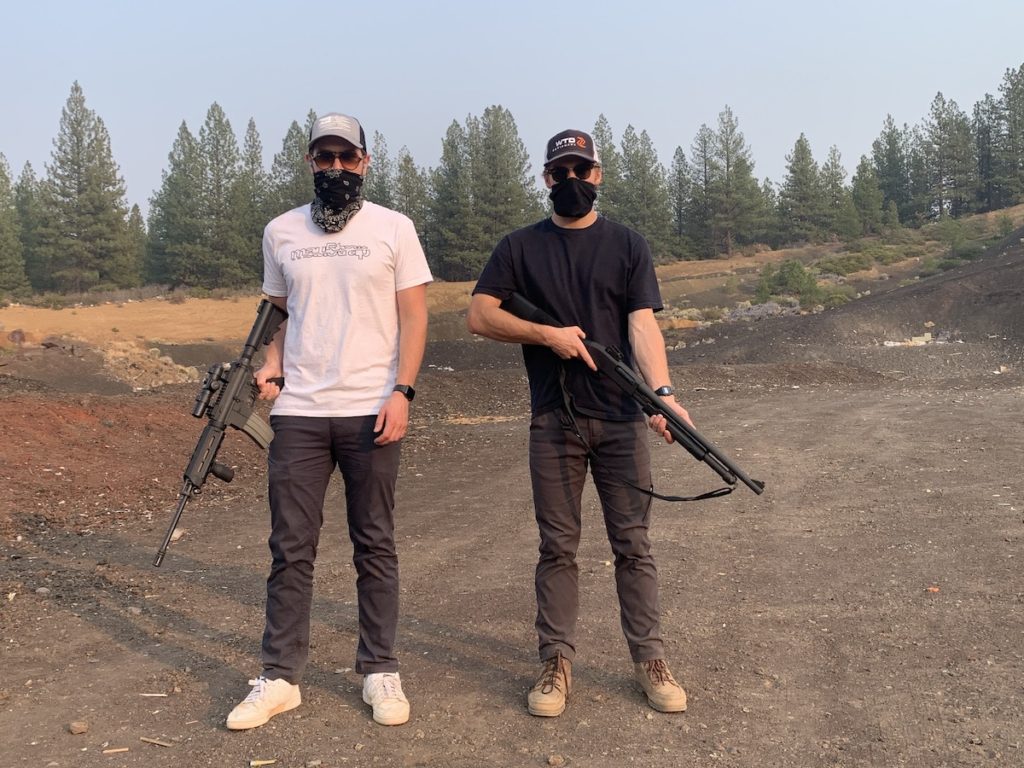
Nathan at Lava Cast Forest standing in a hole made as lava flowed around trees thousands of years ago.Our daughter Lucy, Sandi and Charlie the dog out for a hike in the mountains.Nathan playing stick with Charlie our grand-dog.Jared, Lucy with Charlie.Smith Rocks State Park—Oregon’s Mount Sinai. Jared and I started a the bottom and did the Moses thing and hiked to the top.Nathan at the top of Smith Rock, our local “Mount Sinai.”Natana and his sons doing a very guy and American thing at a local shooting range.Nathan trying out Aaron’s AR-15.Aaron and Jared at the shooting range being politically correct with their Covid-masks. Although they may look like Antifa terrorists, they’re very anti-Antifa and all the wickednesss that it represents.
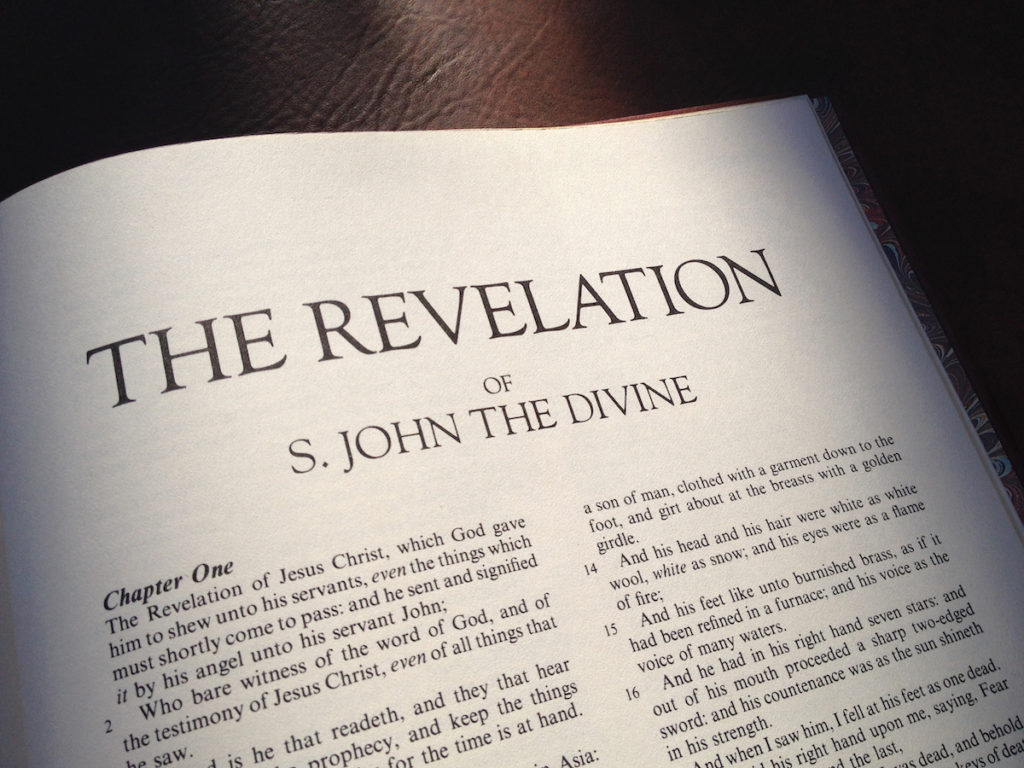
What happens after the return of Yeshua to this earth — after he has put down all of his enemies in battle (Zech 14:1–3; Rev 17:14; 19:11–21)? This we know. He shall set his feet on the Mount of Olives (Zech 14:4) even as he ascended from the same place (Acts 1:9–12), and YHVH-Yeshua shall become king over the earth (Zech 14:9). He shall be King of kings (Rev 17:14; 19:16) and rule with a rod of iron over the whole earth (Rev 12:5; 19:15) for one thousand years (Rev 20:2, 3, 4, 6, 7). This is commonly referred to as the Millennium. This is the earth that Yeshua declared that the meek would inherit (Matt 5:5).
A Quick Overview of the Millennium
What will the 1000 year-long Millennium be like? The Scriptures give us some insights into life on earth during this time.
Elohim will live with his people. (Ezek 37:26–28)
David will rule as King over Israel (Ezek 37:24–25)
YHVH’s annual feast will be kept by all people (Ezek 46:3–6; cf. Col 2,16–17)
YHVH’s government will be established on Mount Zion in Jerusalem: Torah will go forth from Mount Zion and the nations will go up to Mount Zion to worship YHVH in the house (temple) of YHVH (Mic 4:1–2)
A Highway of YHVH, or a highway of holiness will lead to Zion. (Isa 35:8–10)
Whether literal or spiritual, living waters will flow from Jerusalem and Yeshua’s throne. Water was flowing from under the threshold of the temple toward the east (Ezek 47:1; Zech 14:8)
On the bank of the river there were very many trees on each side (Ezek 47:6–9)
People will live to a very old age. (Isa 65:20)
Crowds of people will flock to Jerusalem. (Zech 2:1–4; Isa 49:14)
The temple in Jerusalem will be rebuilt. (Zech 6:15; 14:20–21; Hag 2:6–9)
The Messiah will be king over the whole world. (Zech 6:9–13; Isa 11:1–5; Rev 20:6; 5:9–10)
The nations which do not want to serve and obey YHVH will be destroyed. (Isa 60:12; Zech 14:16–19; Isa 9:5–7)
What Happens After the Millennium?
After the thousand years is completed, Satan the devil who has been bound in the bottomless pit (Rev 20:1–3) will be released briefly to test those on earth as to their faithfulness to King Yeshua (verses 7–8). The devil will then be cast into the lake of fire forever (verse 10).
Next is the final judgment day — commonly called the great white throne judgment. At that time, all the dead, and any others who have died in Yeshua and have yet to receive their reward of eternal life, will be raised from the dead to stand before the Almighty. Those whose names are not written in the Book of Life will be cast into the lake of fire (Rev 20:11–15).
As discussed earlier, I believe that the New Jerusalem will come into view at Yeshua’s return where it will be hovering over the earth during the wrath of Elohim period and during the 1000 year-long Millennium. However, the Scriptures speak of a new heavens and new earth (Isa 65:17; 66:22; 2 Pet 3:13; Rev 21:1).
Before this happens, something very dramatic must first happen.
The Heavens and Earth to Pass Away; Arrival of New Heavens and Earth