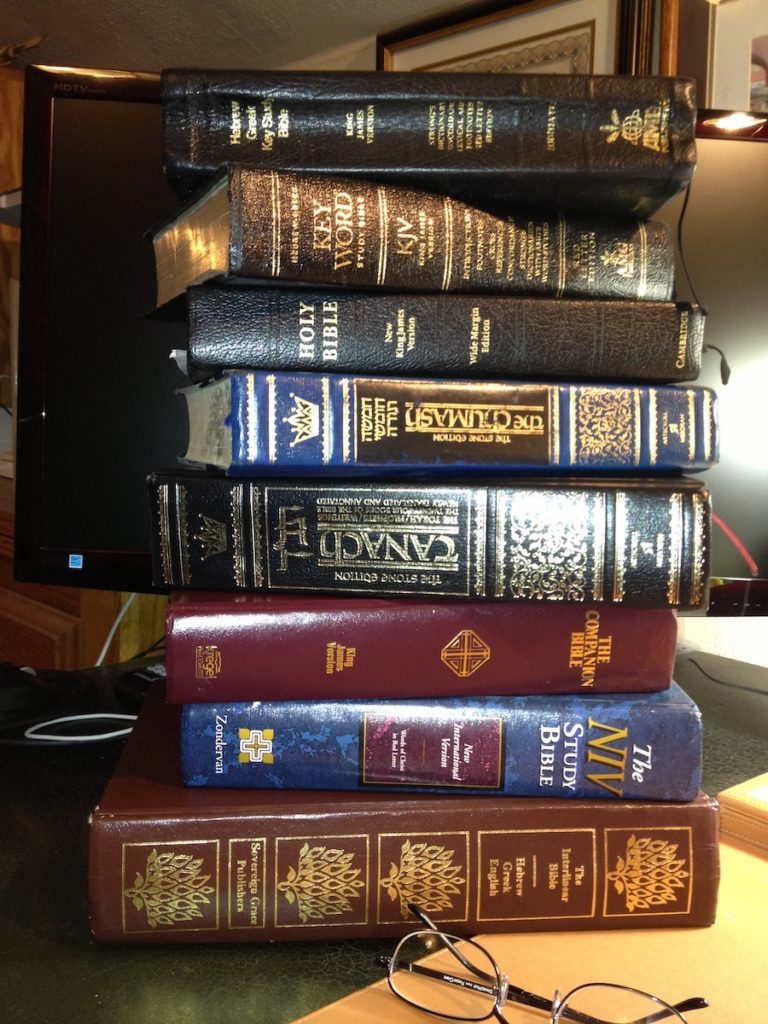
Continually, people ask me what Bible translation I personally use when preaching and when writing. I wish there were a good answer to this question, but there isn’t. I’ve been asked this question many times over the years. The short answer is all of them and none of them. Let me explain what I mean.
The Word of Elohim is something I take very seriously. It is something to be trembled before with a contrite heart (Isa 66:2). Sadly, there are numerous designer Messianic Bibles out there being peddled by money-grubbing charlatans or self-proclaimed experts who have just enough knowledge of the original languages to be dangerous, but not enough to competently translate a Bible. These individuals are duping those who know less than they do, and preying unsuspecting and naive people who are hungry for truth. They are proving the old adage that says “an ‘expert’ is simply someone who knows more than the next guy.” Most of these “translators” have little or no academic training or linguistic expertise in ancient biblical languages, yet this doesn’t stop them producing a constant stream of “new and improved” Bible translations. I actually have some academic background in foreign and biblical languages and have done translating work in both French and Koine Greek at the academic level, so I speak with some understanding on the subject. Yet, I am not an expert, and am not qualified to translate anything.
There is not a single Bible translation on the market today that I can unreservedly recommend. Some of the more popular ones have been translated by questionable individuals who have little or no linguistic training, yet they (dishonestly) refuse to disclose publicly what their qualifications are for translating the Bible. I find this to be a huge red flag to me. If you have linguistic qualifications, why not state them? If you don’t, it’s probably because you have none. I suspect that most of these self-proclaimed Bible translators simply sat down with a copyright free English version (e.g. the KJV) and along with the help of a concordance and a few other lexical aids, made a translation, which they now peddle for big bucks. This is dishonest and unrighteous.
Which Bible version do I personally use? I still use the KJV and NKJV, since at least they were translated by competent linguists. Because I’ve been studying Greek and Hebrew for more than 45 years, I know where all the translation biases are, and I know the Hebrew and Greek words behind many of the English words in our Bibles. As I’m reading the Bible (when preaching) or quoting (when writing), I start with the base of the NKJV, and as I am going along, I “clean” up the English. For example, I insert Hebrew words for the names of deity (i.e., God becomes Elohim, LORD become Yehovah, Jesus becomes Yeshuah, Christ becomes Messiah, Holy Spirit become Ruach HaKodesh, and so on). In cases where there are Hebrew or Greek words that the translators have translated into English using misleading words, based on the lexical meanings of the words I make changes. For example, in Romans 10:4, I change “end” to “final aim, goal.” This is totally consistent not only with the meaning of the Greek word telos but also consistent with biblical truth. Another example would be Matthew 5:17 where fulfill (Gr. pleroo) means “to fill up, to make full, to complete, to fill to the top.” In any place in both the Tanakh (Old Testament) or the Testimony of Yeshua (New Testament) where the word law occurs in referring to “the law of Moses”, I replace it with the Hebrew word Torah meaning “instructions, teachings and precepts [in righteousness of YHVH Elohim].” I could give many other examples, but hopefully the reader gets the point. I don’t carelessly or haphazardly substitute words, but do so full well recognizing the meanings of the words in the original languages, and how the biblical authors use them in the full context of the whole Bible. Again, I tremble before YHVH and his Word, I cringe at the thought of being labeled a false teacher, or bringing curses upon myself for adding or subtracting from the Word of Elohim.
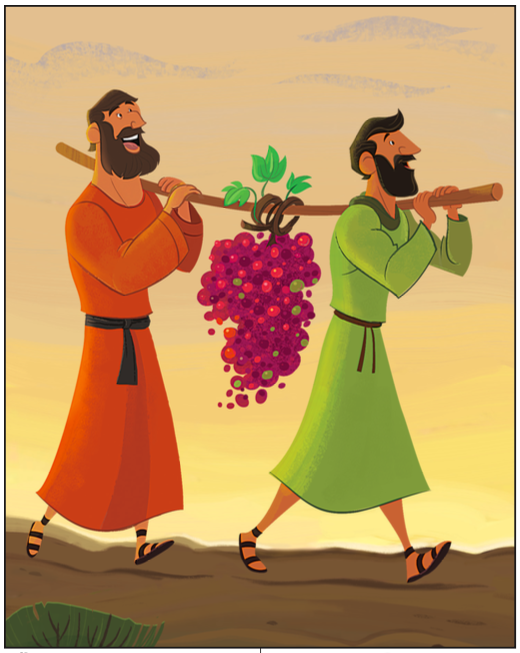
Although Caleb is listed here as being from the tribe of Judah, he nevertheless was of Canaanite heritage having become part of Judah when the Israelites conquered the land of Caleb’s ancestors.
Elsewhere, the Torah lists Caleb as the son of Jephunneh, the Kenizzite (Num 32:12, also Josh 14:6, 14). Who were the Kenizzites (also Kenezite)? They were among the original inhabitants of Canaan (Gen 15:19), that Israel eventually dispossessed when taking the Promised Land. This people originated from Eliphaz, the oldest son of Esau. Thus, Caleb was an Edomite who accepted the Elohim of Israel and became grafted into the tribe of Judah (Josh 15:13). Throughout the Tanakh, Edom (a nickname for Esau) remains a sworn enemy of Israel maintaining a perpetual hatred for YHVH’s people and constantly covetous of their land even into modern times. In fact, the case could be made that the modern day Palestinians, if not descendants of Edom, at least manifest the same hatred for Israel as did the ancient Edomites. It is out of this people that Caleb comes.
The Hebrew name Caleb literally means “dog,” although it can have the favorable connotation of faithful, loving and tenacious like a dog. Some Bible students have noted that the Hebrew name Caleb or Kalev can also mean “all heart” since this name is comprised of two Hebrew word: kol meaning “all” and lev meaning “heart.” Indeed, in his life, Caleb exemplified his name’s meaning in his faithfulness to the Elohim of Israel, in his faith and tenacious zeal to go up and to conquer the Promised Land as YHVH commanded as well as his love for YHVH, YHVH’s people, YHVH’s Torah and the land of Israel.
Evidently Caleb defected from his own tribal peoples and joined the Israelites, while they were wandering in wilderness and before they came up to take the Promised Land. This speaks volumes about Caleb’s character in that he was willing to forsake his pagan heritage and align himself with the Elohim and people of Israel years before they actually dispossessed his people of their ancestral land. Caleb remained aligned with those who took that land and killed his heathen family.
Indeed, Caleb was a unique individual in that he chose a spiritual path less traveled and one that was unpopular, and he clung ardently to that path despite, at times, vicious opposition. The Torah records that he had a different spirit and that he fully followed Elohim (Num 14:24). For this, YHVH promised him an inheritance in the Promised Land (ibid.). May we be like Caleb!
Numbers 13:16, Moses called Hoshea the son of Nun Yehoshua.Prior to sending the spies forth, Moses renames his assistant Hoshea(whose name means “salvation”) to Yehoshua(or Joshua,meaning “Yah [short for Yehovah] Saves”) by adding the Hebrew letter yud /H to Hoshea’s name so that his name would now begin with the first letter of YHVH’s name—the English letter “Y”. What was the prophetic significance of this name change? Who is it that will lead us into our spiritual Promised Land or our spiritual and eternal rest? (See Heb 4:8 and 11, especially verse 8, where the author shows that Yehoshua was the foreshadow of Yeshua.) Do you possess a vibrant and active faith in Yeshua? Is he the Chief Cornerstone of your spiritual house, the Author and Finisher of your faith and the Captain of your salvation to lead you into the spiritual rest of his eternal kingdom? Are you faithfully following him as the Israelites followed Yehoshua/Joshua into the Promised Land?
Numbers 13:32,It is a land which devours its inhabitants.The Jewish commentators in TheArtScrollStone Edition Chumash cogently observe, “Such misinterpretations are typical of people who choose not to have faith. Invariably they interpret events in a way that will conform to their own notions” (p. 803). Having faith in YHVH is a conscious choice that one has to make. Faith does not come automatically. Fear, doubt and unbelief do, however, and are part of the fallen nature or evil inclination that all men possess.
Paul talks about leaving behind the fallen, faithless, sin-bent nature (Rom 7) and moving into a walk of faith in the Spirit of Elohim when in Romans 8:1–2 he contrasts the “law of sin and death” with “the law of the Spirit of life in Messiah Yeshua.” Through Yeshua we become more than conquerors (Rom 8:37). Moreover, 1 John 5:4 tells us, “For whatever is born of Elohim overcomes the world, and this is the victory that overcomes the world, even our faith[i.e. faith in Yeshua who is the Author and Finisher of our faith, the One who gives us the gift of faith, the One in whom we have faith, and on whose words and promises believers stand firm and secure as a house built on a rock].”
The fear of death is the mother of all fears and is what plagued the disbelieving Israelites. Through identification with Yeshua’s death, burial and resurrection at baptism (Rom 6:3–6) we too (through Yeshua) can be victorious over the sting of death and the grave, which is the death sentence upon all Torah-lawbreaking mortals (read 1 Cor 15:47–58 and rejoice!).
Numbers 14
Numbers 14:20–24,I have pardoned.YHVH’s general pardon versus salvational pardon of sin. This Bible passages teaches us that there is a general pardon of sin of which all humans are the recipient, and a salvational pardon of sin that only a few receive.
YHVH pardoned Israel for the sin of disobedient unbelief, but forgiveness in this case only meant that YHVH’s judgment would not come upon them for this particular sin. This pardon did not expiate them of all their sin resulting in eternal life of which entering into the Promised Land was a prophetic antetype.
This is the same genre of pardon that YHVH extended to Adam and Eve after they sinned by eating of the forbidden fruit. They did not die immediately, but were able to live out their lives under that pardon, but it did not guarantee them eternal life.
Later we read that in verse 23 that YHVH would not allow this unbelieving generation of Israelites to see the Promised Land because they had rejected Elohim and refused to obey him. This was in contradistinction to Joshua and Caleb who had a different spirit in them and fully obeyed YHVH (v. 24).
Joshua and Caleb
What can we learn from this? In general sense, YHVH pardons all humans for the sins they commit. If he did not, his judgment would come upon them immediately, for the wages of sin is death, and they would be no more. But humans keep sinning, rejecting Elohim, and yet he graciously, in most cases, allows them to live out their physical lives, but this does not mean that they will have eternal life. This is YHVH pardoning them momentarily, but not saving them or granting them eternal life.
Only those, like Caleb and Joshua, who have a different spirit (i.e. the Holy Spirit) and a personal spirit or heart that is inclined to fully obey him will be rewarded with eternal life in the Promised Land of YHVH’s eternal kingdom.
Numbers 14:22,Have tempted me now these ten times. Israel, while in the wilderness, tested YHVH ten times and refused to heed his voice. According to the Jewish sages, these ten times were: Exodus 14:11; 15:24; 16:3; 16:20; 16:27; 17:2; 32:4; Numbers 11:1; 11:4; and here (i.e. believing the spies’ evil report). Look at each of these incidents where Israel “tested” YHVH and preferred to walk in doubt and unbelief rather than to trust YHVH’s Word. These are examples for us to learn from (1 Cor 10:11). Be blatantly honest with yourself: how many times have you tested your Heavenly Father in the same areas Israel did?
Numbers 14:40–45,We…will go up. Here we see the Israelites preparing to go and to possess Canaan in their own strength and against the will of YHVH. Where did this carnally-driven endeavor lead them?
Matthew Henry discusses how this act demonstrates how the carnal mind is enmity against YHVH (Rom 8:7), for when he bade them to go, they would not, and when he forbade the children of Israel from going, that is when they decided to go. They distrusted his strength, and trusted in their own. What was the result of their expedition? Failure!
Let us take warning from the fate of Israel, lest we perish after the same example of their unbelief. Let us go forth, depending on YHVH’s mercy, power, promise and truth. Do you think that the Israelites were rationally aware of what they were doing? We can easily look back in 20/20 hindsight and see the folly of their ways, but let us pray that YHVH gives us the discernment to see when each of us is guilty of the same in our own lives.
From Psalm 37,
Delight yourself also in YHVH, and He shall give you the desires of your heart. Commit your way to YHVH, trust also in Him, and He shall bring it to pass.…Rest in YHVH, and wait patiently for Him…The steps of a good man are ordered by YHVH, and He delights in his way.
Romans 9:13 declares that YHVH hated Esau. How is it possible for YHVH to be hateful when the Scriptures reveal that he is love (1 John 4:8, 16)? How do we reconcile these two Bible verses?
A misunderstanding of the word hate from a biblical perspective may lead one to the wrong conclusion. The concept of hate has added nuances in Eastern culture that do not exist from a Western viewpoint. Understanding this will help us to understand the nature of Elohim’s “hatred” for Esau in this verse as well in other verses in the Testimony of Yeshua where the word hatred seems too strong for our Western sensitivities.
Defining the Greek behind the word hate in this versewill clear up any misconceptions about the character of Elohim. In fact, it is unfortunate that the translators have chosen to use the word hate in Romans 9:13, since it calls into question the Elohim’s character, which is, in fact, loving.The word hated is the Greek word miseo meaning “to hate, persecute in hatred, abhor or despise, to show hostility toward or, by extension, to love one thing less (than something else).” Miseo basically means “having a relative preference for one thing over another” (see Strong’s, Thayers, Vine’s and TDNT). To these definitions, in the context of the Testimony of Yeshua, the TDNT sees miseo as taking on the added meaning of “disowning, renunciation and rejection.”
According to Strong’s Expanded Concordance and Vine’s Complete Expository Dictionary of OT and NT Words, miseo can refer to “malicious and unjustifiable feelings towards others, whether towards the innocent or by mutual animosity (e.g. Matt 10:22; 24:10; Luke 6:22, 27; 19:14). It can also refer to one hating concepts such as spiritual light (John 3:20); or of those who hate Yeshua (John 7:7; 15:18). Additionally, the world hates the saints (Matt 10:22; 24:10; Luke 6:22, 27; 1 John 3:13). Hate is a general characteristic of the spiritually unregenerate (Tit 3:3). Demonic spirits are full of hate (Rev 18:2). Those who hate their brothers aren’t walking in the spiritual light, but in darkness and are spiritually blind (1 John 2:11).
But miseo has another nuanced meaning as well, which we can obtain from the context in which the word is used. Thayer’s explains that the concept of hatred is different for those of a Western mindset as opposed to those of the Eastern or Oriental (i.e. Middle Eastern) mindset—the culture in which the Bible was written. Easterners are more passionate and excitable, thus they view as hatred differently than those of the West, who are have a cooler temperament view as nothing more than “to love less, to postpone love or esteem or to slight.” For the Orientals, hatred can simply be—to the Western viewpoint—“a cursory interest in or disregard or indifference toward a thing.” Therefore miseo can be “a feelings of aversion from what is evil” (Rom 7:15; Heb 1:9; Jude 23; Rev 2:6, 15; ibid.).
Miseo can also express a relative preference of one thing over another, by way of expressing either aversion from, or disregard for, the claims of one person or thing relative to those of another. In this sense, miseo (according to Strong’s and Vine’s) means “to love less” or “prefer one thing over another” (e.g. Matt 6:24 and Luke 16:13 with regard to preferring one master over another; Luke 14:26 with regard to preferring Yeshua over one’s parents; John 12:25 with regard to loving one’s spiritual life over one’s physical life; Eph 5:29 with regard to a man not loving himself more than his wife; Rom 9:13 with regard to YHVH preferring Jacob over Esau).
In this same vein, the TDNT says that “those who become disciples of Jesus must be committed exclusively to Him; they cannot be bound to anyone or anything else. The term hate demands the separation of the disciple and the warning not to love anyone or anything more is the test.”
So in the verse Romans 9:13, it would be accurate to say, “Jacob I have loved (or preferred), but Esau I have loved less (or had an aversion toward or not preferred).”
Just because someone claims to be prophet speaking for Elohim does not make it so.
Numbers 12:6,A prophet among you.
The Basis Requirements for Being a Prophet of Elohim
The Torah reveals the basic requirements of a prophet. If a person is a prophet, YHVH will reveal himself to a person as per the instructions Numbers 12:6 (see also Jer 23:28). The context of these instructions was the misuse of the mouth in accusation against an elder in Israel. Evidently, Aaron and Miriam (who was a prophetess, Exod 15:20) thought they had gotten a prophetic word from Elohim and felt justified in correcting Moses on that basis. They were wrong and YHVH’s punishments were swift and severe.
There Are Eleven Levels of a Prophet
A little known fact in modern-day church prophetic circles is that the Bible reveals that there are eleven levels of a prophet. The list below is adopted from The Guide to the Perplexed (by Moses Maimonides [or the Rambam] pp. 241–245.) Most so-called prophets in the church if they are on the list of the requirements for being a true prophet are at the lowest levels. This fact alone should cool the prophetic jets of most who think they’re Elohim’s elect and anointed prophet to the body of Yeshua. In reality, considering Israel’s long history, the Scriptures reveal that there were very few Elohim-sent prophets. Long periods of time passed without there being a true prophet of Elohim in Israel. There was no shortage of false and carnal-minded prophets, however. Now here’s the list:
Divine assistance given to a person to induce or encourage him to do something good and grand (e.g. Judg 2:18; 1 Sam 11:6; 1 Chr 12:18; Exod 2:17; 1 Sam 16:17). Scripture often records this occurrence when it states, “And the Spirit of YHVH came upon so and so…”
The person feels as if something came upon him, and as if he had received a new power that encourages him to speak. Such a person is said to speak by the Set-Apart Spirit. The books of Psalms, Proverbs, Ecclesiastes, Song of Solomon, Daniel, Job, Chronicles and the rest of the Ketuvim (Writings or Hagiographa) were written under the inspiration of the Set-Apart Spirit. See also 2 Sam 23:2; Num 11:25; 2 Chron 20:14–15; Num 23:5; etc.) Often prefaced by the phrase, “The Spirit of YHVH spoke to me…” or “So and so prophesied…”
Below are the levels of a prophet. Not all people who have these experiences are prophets. Those who hold the biblical office of a prophet will experience these things regularly and will manifest the biblical fruits, power, authority and anointing of a prophet.
This is the lowest class of a prophet. Those who introduce their speech by the phrase, “And the word of YHVH came unto me…” or a similar phrase. Sometimes he will see a prophetic allegory in a dream. Such was the case with Zechariah.
The prophet hears in a prophetic dream something clearly and distinctly, but does not see the speaker as in the case of the call of young Samuel (e.g. 1 Sam 3).
A person addresses the prophet in a dream, as was the case in some of the prophecies of Ezekiel (e.g. Ezek 40:4).
An angel speaks to him in a dream. This applies to most of the prophets in Scripture (e.g. Gen 31:11).
In a prophetic dream it appears to the prophet as if YHVH spoke to him (e.g. Isa 6:1, 8; 1 Kgs 22:19).
Something presents itself to a prophet in a prophetic vision; he sees allegorical figures, such as were seen by Abraham in the vision “between the pieces” (Gen 15:9–10); for it was in a vision by daytime, as is distinctly stated.
The prophet hears words in a prophetic vision, but does not see the person speaking to him; as is said in reference to Abraham, “And behold, the word came to him, saying, This shall not be thine heir.” (Gen 15:1, 4). This occurred to Paul on the road to Damascus (Acts 9:3ff)
The prophet sees an angel that speaks to him in a prophetic vision as happened with Peter in his vision of the sheet from heaven (Acts 10:3) (also Rev 19:10; 22:9)
He sees an Angel (or Messenger) of YHVH (literally, the preincarnate YHVH Yeshua) that speaks to him in a vision, as was the case when Abraham was addressed by an angel at the sacrifice of Isaac (Gen 22:15) and many other places where the Messenger of YHVH speaks to his servants directly (e.g. Gen 12:7; 16:7–13; 17:1, 22; 18:1; 22:11, 15; 32:24–32; 35:1; Exod 3:2; 13:21; 14:20; 33:9–11; 34:5; Num 11:25; Deut 31:15–16; Num 22:35–38; Josh 5:13–15; Judg 6:11–23; 13:3; Isa 6:1ff; John in the Book of Revelation).
If you fancy yourself being a prophet, where are you on this list? Probably near the bottom. Until Elohim elevates you, it might be best to hold your peace and wait a little longer on him.
A False prophet Versus a Carnal or Presumptuous Prophet
Some Christians who take a dim view YHVH’s Torah-law, often referred to in Scripture as “the law of Moses” or simply “the law,” refer to the Torah as “the law of sin and death”—a term Paul uses in Romans 8:2. Is YHVH’s Torah “the law of sin and death” or is there another law to which Paul is referring in this verse?
In Romans 7:23, Paul talks about “another law in my members, warring against the law of my mind, and bringing me into captivity to the law of sin which is in my members.” This other law is what the Jewish sages refer to as the evil inclination or ha-yetzer rah with which every human is born. This is because due to the fall of man each person is born spiritually cut off from Elohim and is thus subject to the powerful influences of the world, flesh and the devil.
Yielding to our innate yetzer rah or carnal (or fleshly), rebellious, sinful nature brings a person under the death penalty that automatically comes on each human for violating Elohim’s Torah. The law of sin and death is simply a matter of the “law” of cause and effect, that is, one reaps what one sows, or for every action there is a reaction. To wit, Paul states that “the wages of sin is death” (Rom 6:23). Ezekiel states that the soul that sins will die (Ezek 18:4). John goes on to say that “sin is the violation of Torah-law” (1 John 3:4). Therefore, the law of sin and death is yielding to our carnal nature that is prone to sin the results of which brings the consequences of sinful actions as prescribed by the Torah the end result of which is death or extinguishment of life and eternal separation from Elohim.
Just because YHVH’s Torah-law prescribes the death penalty for sin does not make the Torah evil any more than violating the law of gravity by jumping off a cliff makes that law evil, or violating a traffic law makes that law evil. Righteous laws exist for our good—to protect us from harm, and are thus not evil. Both the Torah-law, the law of gravity and other laws (e.g. traffic laws) are for our protection. But if we violate them, we not only jeopardize our well-being and safety and that of other people, but there may be a penalty to pay for breaking them as well.
In Genesis 2:17 Elohim laid down a law: do not eat of the tree of the knowledge of good and evil. He pronounced upon man the curse of death if he violated this law. Man broke the law and ate from the forbidden tree. To go against the law of Elohim is sin (1 John 3:4). As previously noted, the wages of sin is death (Rom 6:23), and the soul that sins shall die (Ezek 18:4). This then is the law of sin and death that Paul talks about in Romans 8:2. When a person obeys the Torah-laws Elohim, he will neither be sinning nor will he bring upon himself the wages of that sin which is death.
YHVH Elohim, man’s Creator, declares that every person has a choice to make: choose life of death.
See, I have set before you today life and good, death and evil… I call heaven and earth as witnesses today against you, that I have set before you life and death, blessing and cursing; therefore choose life, that both you and your descendants may live; that you may love YHVH your Elohim, that you may obey His voice, and that you may cling to Him, for He is your life and the length of your days; and that you may dwell in the land which YHVH swore to your fathers, to Abraham, Isaac, and Jacob, to give them.” (Deut 30:15, 19–20)
Before he died, Moses admonished the people of Elohim to choose to serve and obey YHVH. He referred to the YHVH’s Torah-law as “your life,” and he declared that bodying it was not a futile thing, but would bring blessings and long life.
“Set your hearts on all the words which I testify among you today, which you shall command your children to be careful to observe—all the words of this Torah-law. For it is not a futile thing for you, because it is your life, and by this word you shall prolong your days in the land which you cross over the Jordan to possess.” (Deut 32:46–47, emphasis added)
Therefore, YHVH Torah, that is, his instructions in righteousness, is not the law of sin and death. However, if we choose to follow our carnal, sinful human natures, and to choose to disregard our Creator’s words, then this will bring us under the law of sin and death, which is the negative consequences of our actions.
For the wages of sin is death, but the gift of Elohim is eternal life in Messiah Yeshua our Lord. (Rom 6:23)
But as many as received Him, to them He gave the right to become children of Elohim, to those who believe in His name… (John 1:12)
Behold what manner of love the Father has bestowed on us, that we should be called children of Elohim! Therefore the world does not know us, because it did not know Him. Beloved, now we are children of Elohim; and it has not yet been revealed what we shall be, but we know that when He is revealed, we shall be like Him, for we shall see Him as He is. (1 John 3:1–2)
Each spring of the year, the saints who are faithful to the truths of the Bible celebrate the biblical feast of Passover. Passover is the first of seven step in YHVH Elohim’s plan of salvation or redemption of sinful humans to reconcile fallen man back to him. Did you ever wonder how this process really works?
Let’s now look at this miraculous process of how to overcome sin in more detail through a spiritual magnifying glass. How do we go from being a lost sinner—the walking damned or the living dead—to becoming the glorified and immortalized children of Elohim?
It works like this: When we confess and repent of our sins, Yeshua will pass over or forgive us of our past sins (Rom 3:25; Ps 103:8–12). From this point onward, we must embrace a new mindset and a new spiritual identity and reality; that is, we must reckon our old sinful man as being crucified with Yeshua, in that we are now dead to and no longer slaves to sin, but are freed from the power of sin, and alive to Elohim in Yeshua our Lord or Master (Rom 6:7–11). Yeshua is the one who victoriously defeated the power or sting of sin, which is death, hell and the grave. He did so at the cross and through his resurrection (1 Cor 15:56–57; Col 2:13–15). Through our faith in him and our legal identification with his death, burial and resurrection through the metaphorical ritual of baptism, his victory is legally applied to us by the courts of heaven, which is how he has made us more than conquerors over sin and death (Rom 8:37; 6:1–14), such that the power of sin and death will no longer have dominion over us (Rom 6:12–14). He now gives us strength through his enabling and empowering grace to resist and overcome sin, that is, to not let sin control us any longer (Rom 6:12). He promises to give us a new, circumcised heart as he writes his laws or commandments on our hearts, so that we will be supernaturally inclined to love him by keeping his commandments (Jer 31:33; 24:7; Heb 8:10; 10:16; Ezek 36:25–27; Isa 51:7; Ps 40:8; 37:31; Deut 30:6; John 14:12 cp. Rom 7:22). What is that supernatural power that works in us to help keep us from sinning? It the Spirit of Elohim or the Comforter that Yeshua promised would come along side of us to aid us in the process of overcoming sin (John 14:16–18, 25–26; 15:26–27; 16:7–14).
To summarize, this whole supernatural and miraculous process of being victorious over sin is activated when we first acknowledge our sin, confess our sin, repent of our sin and then place our faith in Yeshua’s death and burial. This occurs when we appropriate or reckon, by faith, our old sinful man to have been crucified with Yeshua, and then we reckon ourselves to have been resurrected in the newness of spiritual life with him. We now embrace the new identity that he has given us—a spiritual reality that he has imparted to us and has been legally recorded in heaven (Col 2:14)—that we are a new creation and are victorious over sin (Gal 2:20; 2 Cor 5:17), and have become Spirit-begotten sons of Elohim.
This whole process is summarized from beginning to end in Romans chapters six through eight. The end result, if we continue in a right spiritual relationship with Yeshua the Messiah for the rest of our lives, is that our names will be recorded in Elohim’s Book of Life, and our physical bodies will be glorified—we will be given immortality—at the resurrection, which occurs at the second coming of Yeshua.
This whole process or chain of events that transforms sinful humans into glorified and immortal children of Elohim begins at Passover which symbolizes the first steps a person takes when he comes to faith in Yeshua the Messiah. The remaining six steps in the process of salvation are symbolized by the additional six biblical feasts that come after Passover (Lev 23).
Our annual Scripture Reading Schedule for 2020-2021 with daily readings that began on 10/11/20 is available to download and print. The link to the previous 2019-2020’s Scripture Reading Schedule will still be available on the right sidebar under “Helpful Links” into next year. If you are using a mobile device or tablet, the link may be below, meaning you’ll need to scroll down instead.
Most of this week’s blog discussion points will be on these passages. If you have general comments or questions on the weekly Scripture readings not addressed in a blog post, here’s a place for you to post those. Just use the “leave a reply” link or the “share your thoughts” box below.
The full “Read Through The Scriptures In A Year” schedule, broken down by each day, can be found on the right sidebar under “Helpful Links.” There are 4 sections of scripture to read each day: one each from the Torah, the Prophets, the Writings, and from the Testimony of Yeshua. Each week, the Torah and haftarah readings will follow the traditional one-year reading cycle.
Weekly Blog Scripture Readings for 5/30 through 6/5/2021.