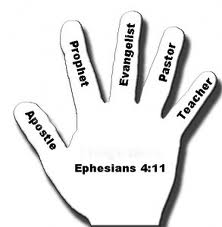
The Five-Fold Ministry Explained

Did the so-called fivefold ministry offices cease after the New Testament era, or do they continue function in the body of Yeshua to this day? In our day, most people agree that the ministries of the evangelist, teacher and pastor are still in operation today, but many say that the offices of apostles and prophet have ceased to operate. Yet in verse 13, we read that these offices would operate “till we all come to the unity of the faith and of the knowledge of the Son of Elohim, to a perfect man, to the measure of the stature of the fullness of Messiah…,” which hasn’t happened yet. Therefore, it would stand to reason, that all these ministry offices are still needed today.

He. It must be kept in mind that Yeshua is the epitome of and over all (authoritatively) ministry offices that follow in this verse. When we ascended to heaven, he spread his own abilities out, as it were, among those he called to be leaders over his spiritual flock below (see Eph 4:8). Collectively, these ministry offices should be doing the work that Yeshua himself would be doing were he here on this earth presently.

Apostles. In addition to the twelve original apostles (including Matthias who replaced Judas Iscariot, Acts 1:26), here is a list of the other apostles, which might be called Yeshua’s ascension-gift apostles (Eph 4:8):

  • James, the half brother of Jesus and leader of the Jerusalem church (Gal 1:19)
  • Barnabas (Acts 14:14)
  • Paul (e.g. Acts 14:14)
  • Apollos (1 Cor 4:6–9)
  • Timothy and Silvanus (1 Thess 1:1 and 2:6)
  • Epaphroditus (Phil 2:25)
  • Titus, and other un-named apostles—at least two (2 Cor 8:23)
  • Andronicus and Junia (Rom 16:7)
  • Yeshua is the Apostle and High Priest of our confession (Heb 3:1)
  • Including Judas Iscariot, this makes a total of at least 26 apostles who are mentioned in the Testimony of Yeshua. 

With this list in mind, it now becomes logical to divide the apostles into at least three categories or level. Yeshua is the Chief Apostle. The original 12 that Yeshua appointed (minus Judas Iscariot) and possibly Paul would be the next tier. They are the foundational apostles. Yeshua mentions that the 12 apostles will rule over the 12 tribes of Israel and that the 12 foundations of the New Jerusalem are named after the 12 apostles (Rev 21:14). It seems that Yeshua commissioned these foundational apostles in direct, face-to-face encounters. After this come the lowest tier or ascension-gift apostles (Eph 4:8), which are all the other apostles.

Apostle Defined

Apostolos means “a delegate, messenger, one sent forth with orders.” According to the Theological Dictionary of the New Testament, apostolos originally was a military or naval term relating to an expeditionary force that was sent out or dispatched. It came to be applied to a band of soldiers, or colonists and their settlement as well as to the commander of the expedition or an admiral. A common feature of all the definitions of the word was its passive character. In none of the definitions is there any suggestion of initiative on the part of the apostle. The word denotes the quality of being sent. In the New Testament, apostolos always denotes a man who is sent with full authority and is synonymous with the Hebrew word shaliach as is evidenced in John 13:16. Here is a legal term relating to one who is lawfully charged to represent the person and cause of another. This meaning is confirmed by the juxtaposition in this verse of the Greek wordsdoulos/kurios and apostolos/pemptsas. Here the servant (doulos) stands under full jurisdiction of his master (kurios) and derives from him all that he is. Apostolos also denotes the “commissioned representative of a congregation” (Acts 13:2ff). Finally, the term signifies the “bearers or proclaimers of the NT message.” The latter meaning applied to not only the original twelve apostles that Yeshua commissioned and sent out, but to the first Christian missionaries or their most prominent representatives (Acts 14:4, 14). According to Paul, the apostles (1 Cor 12:28f) aren’t officials of the congregation, nor the chief of such officials, but are officers of Yeshua by whom the church is built (ibid. vol 1, p. 407ff). 

Attributes of an Apostolic Ministry 

  • Elohim sets or appoints (puts in place, establishes) apostles (as he also does prophets, teachers, etc., 1 Cor 12:28).
  • An apostle is called by God, not men (Gal 1:1).
  • They minister in the power of God, not the wisdom of men (Mark 16:20 cp. 1 Cor 2:1–5).
  • Elohim appoints apostles by the revelation of the Holy Spirit and as confirmed by other established elders ( Acts 9:15; Acts 13:2-4; Acts 22:21).
  • An apostle is given a specific mission to a specific group of people (Gal 2:8–9; Acts 13:2–4).
  • They are spiritual pillars (Gal 2:9).
  • They form part of the spiritual foundation of the church (along with prophets, Eph 2:20).
  • They lay spiritual foundations for others to build on (1 Cor 3:10).
  • They facilitate unity (along with the other five-fold ministries) within the body of Yeshua (Eph 4:11–13).
  • They help the body of Yeshua to mature, to grow up, and to be built up (Eph 4:11–13).
  • Apostles bring revelation to the church (Eph 3:5; Gal 1:11–12).
  • Apostles establish, set, and correct doctrine (Acts 2:42; 15:19–30).
  • They raise up new ministries and ordain elders (Rom 15:20; Acts 14:23).
  • They impart spiritual gifts (Rom 1:11).
  • They defend the gospel­—are defenders of the faith (Phil 1:17).
  • The apostles in the NT were persecuted and rejected or even killed for their service to the body of Yeshua (e.g. 1 Cor 4:11–13; Luke 11:49; Acts 5:18, 40). This is because they’re on the forefront of YHVH’s spiritual battle to advance his kingdom into the enemy’s territory.
  • One has to grow into becoming a fully function and a spiritually powerful apostle. Yeshua’s 12 apostles asked him to increase their faith (Luke 17:5; Mark 16:15 cp. John 21:3 and Acts 2:14).
  • An apostle may initially not be baptized in the Spirit, but once having received this spiritual empowerment will be released into the full authority of the office, as was the case with the original 12 apostles.
  • Apostles take their marching orders directly from Yeshua (Acts 1:2).
  • Apostles have authority to pronounce judgment on sinners within the body of Yeshua (Acts 5:3–10; 1 Cor 5:1–5).
  • Apostles work many signs and wonders (Acts 5:12).
  • Apostles lay down the doctrinal foundation within the body of Yeshua (Acts 2:42; 2 Pet 3:2).
  • Apostles are often called to testify before secular and religious leaders (Acts 5:29).
  • Often apostles have to stay in the thick of the spiritual battle while the rest of the saints escape from harm’s way (Acts 8:1).
  • After the gospel is preached in an area, apostles are sent in to establish spiritual order and to plant congregations (Acts 8:14).
  • Apostles go into new areas to preach the gospel (Acts 13:1–14:7).
  • Apostles along with elders are called to help resolve conflicts within the body of Yeshua (Acts 15:2, 6).

There are false apostles (2 Cor 11:13; Rev 2:2).

He gave some to be …prophets. The Greek word prophetes translated as prophetsome 140 times in the NT and means “one who, moved by the Spirit of God and hence his organ or spokesman, solemnly declares to men what he has received by inspiration, especially concerning future events, and in particular such as relate to the cause and kingdom of God and to human salvation; of men filled with the Spirit of God, who by God’s authority and command in words of weight pleads the cause of God and urges salvation of men; in the religious assemblies of the Christians, they were moved by the Holy Spirit to speak, having power to instruct, comfort, encourage, rebuke, convict, and stimulate, their hearers.

According to the TDNT, prophetes as it relates to the primitive church was inspired speech of charismatic preachers through whom Elohim’s plan of salvation for the world and his will for the life of individual believers was made known. The prophet knows something of divine mysteries (1 Cor 13:2), about Elohim’s saving will for the Gentiles (Eph 3:5f), and one of his chief concerns is to declare imminent eschatological events (Rev 22:6f). He also knows other aspects of the future (Acts 11:28; 21:10f). The prophet speaks on contemporary issues as well relating to the ministry of the gospel (Acts 13:1ff; 1 Tim 1:18; 4:14), and edifies, comforts and exhorts the members of the body of Yeshua (1 Cor 14:3; Acts 15:32). Through his preaching, he brings to light the secret wickedness of men (1 Cor 14:25). Since he speaks with a sense of God-given authority, he gives authoritative instructions (ibid., vol. 6, p. 848).

He gave some to be …evangelists. An evangelist (Gr. yoo-ang-ghel-is-tace) by definition is a bringer of good tidings or news, or one who heralds of salvation through the Messiah and who were not apostles. It derives from the word euanggelidzo meaning “to preach the gospel, bring or declare good tidings or news. This word occurs only three times in the NT (Acts 21:8 of Philip; Eph 4:11 as listed among the other “fivefold” ministry offices; and in 2 Tim 4:5 of Timothy). The TDNT says that this term denotes a function more than an office. In the NT, it appears that all apostles were evangelists, but not all evangelists were apostles, and that former was subordinate to the latter. They are more than mere missionaries, since they preach in and lead congregations as well (2 Tim 4:2, 5; ibid., vol. 2., p. 736f).

Continue reading →
 

Ecclesiastes 2—Is this all there is to life?

Ecclesiastes 2

Ecclesiastes 2:1–10, Come now. The Preacher, King Solomon, looked for a meaning and purpose to life in all of the usual ways that humans indulge themselves: mirth, pleasure or goodness (i.e. being a good person), laughter (merriment, comedy, fun entertainment), hedonism (fulfilling the sensual pleasures of the flesh), alcohol (or mind altering chemical substances), vast building projects including  constructing houses, and exquisite gardens, procuring servants, along with the acquisition of herds of livestock, precious metals, special treasures gathered from around the world, and other great possessions. He also surrounded himself with gifted people to provide musical entertainment. While indulging himself in all of these, he kept his wits about him, so that through it all and afterwards, he could critically analyze the merits and demerits of it all.

Ecclesiastes 2:11, Vanity…grasping for the wind. No matter what grandiose adventures in life the Preacher pursued, regardless of his vast array of accomplishments, and his endless pursuit of satiating the lust of the flesh and its endless craving for pleasure, he found that it all leads to the same place: emptiness and nothingness—a grasping at the elusive wind, or like trying to scratch an itch that will not go away, or to satisfy and unquenchable thirst. He had eaten of all of the finest delicacies that life had to offer until he was gorged, yet he was still hungry. How maddeningly confusing and frustrating to indulge oneself with all these things and still come up empty handed. This is what most people spend their lives doing, yet they never figure out that in the end it leads nowhere—that the answer to the inner longings are not to be found in this physical existence. Rather, the answer is outside of it. He must look up! This is the message cryptic message of Ecclesiastes—of the whole Bible.

Ecclesiastes 2:12, Who succeeds the king. After having achieved and experienced more than any king before him, he asked himself, “What now?” What more can my son after me do that I have not already done? Is there an end to this madness? Does it lead anywhere, or ultimately accomplish anything of lasting value?

Ecclesiastes 2:13–16, Wisdom excels folly. The Preacher concludes that ignorance or folly (or foolishness) is not better then wisdom (or intelligence), even as darkness is not preferable to light. It is better to possess wisdom and intelligence than to go ignorantly and foolishly through life. Yet whether one is foolish or wise, all humans still end up in the same place at the end—dead. So again what is the point of it all? Whether wise or foolish, it all amounts to vanity or emptiness and nothingness—to a big zero—at the end. Therefore, the Preacher concludes, a wise man and a fool are equal in status. Even the wise man dies a fool, for he has not perceived that life is eventually meaningless and pointless (when this physical existence is all there is to hope for).

Ecclesiastes 2:17–23, Must leave it. What is the point of working hard, slaving away and heaping up wealth only to leave it all to someone else after one passes from the scene? It is unlikely that one’s heir will appreciate the tireless effort their parent spent building their estate, and will likely foolishly squander it all away. So what is the point of it all? There is none. So why kill oneself heaping up wealth and accomplishments? You cannot take it all with you. (None of this makes any sense, unless there is a higher purpose to it all beyond this physical existence—a supreme purpose which is revealed elsewhere in the pages of the Bible. The problem is that most people are too busy slaving away on the hamster wheel of life going nowhere, while satiating human ego and accumulating material stuff that they have little time to stop for even a moment to consider the deeper issues of life. This too is foolishness, vanity or emptiness and chasing the wind, since it all leads to the same place—death.)

Ecclesiastes 2:24–26, Nothing is better. If the only hope that a person has in their life is this life, then there is nothing better than to work hard, enjoy the fruits of one’s labors, cherish the simple things of life such as a job well done, and good food and drink, which are blessings from Elohim. The Creator has blessed each of us with the ability to find a certain measure of happiness and contentment in the work of one’s hands and enjoying the fruits of one’s hard work. In the process of it all, if one attempts to be a “good” person and to do right by others, then his earthly reward for good behavior, while a prisoner on this earth to the cosmic machine called time and space, will not be taken away. To be sure, this is a gift from heaven. But in the end, even though a person may find a certain amount of physical happiness, the end results are still the same: vanity or empty nothingness and grasping at the wind. One still dies without escaping the endless, cyclical treadmill of this physical existence of the time-space continuum in which man finds himself trapped. 


Spiritual Nuggets from Ephesians 1 and 2

Ephesians 1

Ephesians 1:3, With every spiritual blessing. Our best and ultimate blessings are reserved for us in heaven time, and are not necessarily ours to experience on this earth at this time.

Ephesians 1:4, Without blame. The saint is without blame before YHVH, not without sin.

Ephesians 1:10, All things in the Messiah. Heaven and earth unit in the Messiah who died suspended between the two to reconcile both while using his life as a bridge between heaven and earth. He is the ladder that Jacob dreamed about—the stairway to heaven to which he referred in John 1:51 that all most climb to be reconciled to his Father in heaven.

Ephesians 1:11, An inheritance. Our inheritance is to be adopted as sons into the family of Elohim as Paul states in verse 5.

Ephesians 1:13–14, Sealed…guarantee. YHVH’s depositing his Spirit in the saints at the time of their conversion is his investment in his set-apart people. Whether such a person proves to be a good investment or not is up to that person based on their obedience and faithfulness to YHVH until the end of their life. If they victoriously overcome the world, the flesh and the devil, then YHVH will make a return on his investment and will have gained an immortal addition to his family.

Ephesians 1:15, Faith in…love for. This is a restatement of the shema, which involves loving Yeshua and the saints.

Ephesians 1:18, Inheritance. The saints’ inheritance is eternal life and membership in the family of Elohim for eternity. This is his return on his investment he made in the saint’s life when he gave them his Spirit.

Ephesians 1:19, Inheritance. Explore dunamis versus kratos power, since both words are used in this verse. The same power is at work in us that raised Yeshua from the dead and gave him heavenly dominion (see Eph 2:5). The same process that happened to him is occurring in our lives if we follow in his footsteps.

Ephesians 2

Ephesians 2:2, Sons of disobedience. In reality, sons of Torahlessness.

Ephesians 2:3, Lusts of our flesh. Anti-Torah inclinations.

Children of wrath. This refers to all unrepented and unforgiven sinners who will experience YHVH’s wrathful judgment at the end of days (see Rom 1:18, 32).

Ephesians 2:4–5, He love us…when we were dead. This is the unconditional love Elohim has for lost sinners. (See Rom 5:8).

Ephesians 2:7, Ages to come. Referring to Elohim granting eternal life to his saints at the resurrection and adoption into his spiritual family (Eph 1:11).

Ephesians 2:8, 10, Saved … good works. Are we saved by faith through grace or by our good works? This verse clearly answers this question.One is saved by the free gift of YHVH’s grace through faith (in Yeshua). Salvation isn’t based on good works (Torah obedience), or else prideful man would boast about how good his is, and that YHVH must have saved him on the merits of his good works. However, once one is saved, and a result of his salvation one will produce the fruits good works, which is Torah-obedience. This is the definition of biblical righteousness (Ps 119:172) and shows us how to walk in the Spirit by loving YHVH with our all and our neighbor as ourself. When we live out this pattern, we become Elohim’s workmanship through Yeshua.

Grace… good works. Grace is a free gift, but it demands a response that we might become the workmanship of Elohim and perform good works through our relationship with Yeshua.

Good works…prepared. Elohim prepared good works or a ministry for us to do before we were born. That’s the outworking and divine enablement of his grace through us and the purpose of our salvation—our spiritual destiny!

Covenants of promise. There are three covenants to which Paul is referring here: they are the Abrahamic, Mosaic and Renewed Covenants. Paul mentions “covenants of promise” (plural) in Eph 2:12 of which the ex-Genitles are now a part when they come to Messiah and become the one new man (v. 15), the seed or offspring of Abraham (Gal 3:29), part of the olive tree of Israel (Rom 11:11–32) and the Israel of Elohim (Gal 6:16). The mainstream church focuses only on “the New Covenant,” while omitting and rejecting the first two covenants. Obviously, the exclusion of the first two covenants wasn’t in Paul’s thinking or else he would have said “covenant” not “covenants.” This is because the Word of Elohim never changes; his laws and standards are immutable. Therefore, each succeeding covenant is built upon the foundational truth of the previous covenant and is an expansion of the previous one (e.g. Isa 42:21).

Those who are walking in accordance with Elohim’s entire word including all three of his covenant are those that John describes as keeping the law and having the testimony or faith of Yeshua (i.e. they walk in accordance with the OT and NT covenants; Rev 12:17; 14:12).

It follows, therefore, that these saints are those who haven’t bent the knee to Baal (i.e. they’re not following the downward, gravitational pull of the carnal or evil inclination by following the world, the flesh and devil as does the world around them, and, for the those in churchianity, this includes all forms of Torahlessness, following Christo-pagan traditions, and whitewashed church doctrines of men by which the word of Elohim has been made of none effect). To wit, the number 7,000, as in the righteous saints who hadn’t bowed the knee to Baal in the time of Elijah to which Elohim makes reference in 1 Kgs 18:18, has the following metaphorical or drash-level biblical meaning: seven is the biblical number of perfection, and the three zeros are the three covenants YHVH Elohim made with Israel to bring them into a relationship with them potentially ultimately leading to them becoming his glorified sons and daughters in his everlasting heavenly kingdom.

Ephesians 2:12, Without God. The Greek word here is atheos meaning “without God.” It can also mean “denying, failing to worship Elohim or God, ungodly or godless. The Gentiles in their unsaved state were essentially atheists. For this and other reasons, I refuse to refer to myself as a Gentile.


Deep Wisdom from Deuteronomy 3 and 4

Deuteronomy 3

Deuteronomy 3:22, Must fear them. Know Elohim, No Fear; No Elohim, Know Fear.The Scriptures reveal an interesting, and counter-intuitive spiritual principle that humans have a hard time wrapping their heads and hearts around. It is this: When we fear Elohim, we will not fear our enemies, and we will be blessed by Elohim. When we do not fear Elohim, we will fear and be tormented by our enemies and we will not be blessed by Elohim (Ps 34:9; Acts 9:31). 

What is it to fear Elohim? It is to walk in the wisdom of his commandments or his loving instructions in righteousness (Deut 10:12). Rebellious humans have a hard time doing this, since their sin nature is opposed to submitting to YHVH legal instructions (Jer 17:9; Rom 8:7). 

Once, however, one gets their sin nature under control with the help of Yeshua, and one begins to love and fear Elohim by keeping his commandments, suddenly the physical things they once feared no longer have any hold on their hearts and minds. 

Having defeated the greatest enemy of all—one’s sin nature—with Elohim’s help effectively empowers and emboldens the saint. He no longer fears what other people think about him because, in the long run, all that matters is what Elohim thinks. He no longer is concerned about his future physical needs and well-being because Elohim promises to take care of us when we trust and obey him. He no longer fears those who attack and persecute him, because he knows that with Elohim’s help, he can overcome any enemy. 

Deuteronomy 3:23, Pleaded with YHVH. YHVH forbids Moses from fulfilling his life-long dream of entering the Promised Land. What was Moses’ repsonse? Did he cry, pout and pitch a fit, or did he accept YHVH’s will for his life? What can we learn from this? Do you have so much love for and faith in YHVH that you would be willing to let go of your greatest dream—even your life on the altar of faith and trust in YHVH and obey him no matter the outcome? Though YHVH were to slay you, will you like Job still love and trust him (Job 13:15)? If your entire life was devastated, you lost all your money, the land was desolate and your life become a desert, would you like Habukkuk still praise YHVH (Hab 3:17–19)? Selah.

Deuteronomy 4

Deuteronomy 4:2, You shall not add to the word that I command you, nor shall you subtract/diminish from it. YHVH warns his people against adding or subtracting from his written word elsewhere as well (Deut 12:32; Rev 22:18–19). Men seem inclined to ignore YHVH’s command in this regard. In fact, whole religions have been founded based on disregarding this prohibition. Some claim to be Bible-based (e.g. Mormonism with their Book of Mormon and rabbinic Judaism with its Talmud), and some have supplanted the entire Bible with their own book (Islam with its Quran). This doesn’t even include the numerous unbiblical traditions and man-made doctrines that many traditional churches and denominations have constructed out of whole cloth and patched into the teachings of the Bible. This cannot be pleasing to Elohim!

Who is the author of and real power behind adding to and subtracting from or twisting YHVH’s Word? It is Satan the serpent. (See Gen 3:1ff and Matt 4:3ff.) Make no mistake, adding or subtracting from the Word of Elohim is to fall for the lie that the devil told the first humans at the tree of knowledge that the Word of Elohim can be molded and formed to fit men’s ways of  thinking instead of Elohim’s.

What did Yeshua warn the religionists of his day against in this regard? He said, “Thus have you made the commandment of Elohim of none effect by your tradition” (Matt 15:6) and, “Howbeit in vain they do worship me, teaching for doctrines the commandments of men” (Mark 7:7). What are some examples of traditions and theologies in the modern-day Christian and Jewish religions where YHVH’s word has been superseded by man’s traditions? What are some traditions and doctrines of men you have turned away from in order to bring yourself into greater alignment with YHVH’s Word? How is your life better for it? What has been the reaction of those around you in response to your aligning your life more closely with the truth of YHVH?

Finally, the Bible ends with a warning to those who would add to the word of Elohim.

For I testify to everyone who hears the words of the prophecy of this book: If anyone adds to these things, Elohim will add to him the plagues that are written in this book; and if anyone takes away from the words of the book of this prophecy, Elohim shall take away his part from the Book of Life, from the holy city, and from the things which are written in this book. (Rev 22:18–19)

When this passage says “this book,” which book is it talking about? The book of Revelation or the entire Bible? To err on the side of caution, it is prudent to assume that John is referring to the whole Bible, since Revelation is the last book of the Bible. Why do I assume this? Simply because I personally do not care to experiences any of Elohim’s curses; life is already difficult enough as it is!

Deuteronomy 4:2, Observe the commandments of YHVH. The word observe (RNA/shin-mem-resh)is a common Hebrew verb meaning “to keep, guard, give heed, watch, protect, have charge of.”In its noun-form, shamar means “a watchman.” According to The TWOT, the basic meaning of shamar is “to exercise great care over something.” One of the most frequent uses of this verb in Scripture is how it is used in this verse. YHVH commands his people to shamar his Torah-commandments some 30 times in the Torah alone. What does this mean to you? Are you learning to not only “hear,” but “to do” his commands (the Hebrew word shema)? How has your life changed and what are the resulting blessings? Though YHVH clearly commands his people “to keep” or “to guard,” what is commonly taught in most Christian churches in regard to “the law”?

Continue reading →
 

Natan’s Notes of Galatians—What is the bottom line?

Galatians 3:13, Curse of the law. The curse of the law is not the Torah-law, but the penalty for violating it. Yeshua came to save us from the penalty of the law, not from the law itself. Through his grace and forgiveness coupled with our repentance, we are saved from the consequences of violating the law (the penalty of the law, which ultimately is death), but we have not been liberated from obedience to the law. That would be like saying that if someone pays your fine for speeding, the speeding laws no longer apply to you and you are free to drive at any speed you like. This of course is absurd.

Galatians 3:19, It was added/sent again. This refers to the Torah in its codified form as given to the Israelites at Sinai, and to the sacrificial system that was imposed on the rebellious Israelites until the time of Yeshua’s death on the cross (see notes at Jer 7:22). Let me explain.

The Levitical priesthood (along with the elaborate tabernacle sacrificial system) was a temporary institution that YHVH added (Gal 3:19 cp. Jer 7:21–22) to the nation of Israel’s legal system because of the firstborn Israelites’ (who YHVH commissioned to be the priests of their families, Exod 19:22 cp. Exod 13:2, 11–16) failure to prevent Israel from worshipping the golden calf and to sin by faithlessly grumbling and murmuring against Elohim. In a general sense, YHVH didn’t give the Israelites the Torah at this time—the principles of which they and their forefathers already knew (e.g. Gen 26:5), and which were in existence since the foundation of the earth. These eternal and inviolate principles had already been passed on down to successive generations by men like Enoch, Noah and the patriarchs. So what other law was added? At Mount Sinai, the eternal principles of the Torah were codified into an administrative legal system (with civil penalties including the institution of a sacrificial system as a penalty for sin, which the Bible calls this system “the law of Moses”), and this codified system became the constitution of the nation of Israel. At the same time, YHVH gave them the institution of the Levitical priesthood and the sacrificial system (Gal 3:19), which (along with the rest of the Torah) pointed them to their need for Yeshua the Savior (Gal 3:16, 24). An example of such a codified system of law would be the American Constitution, the principles of which the founding fathers gleaned from many sources (including the biblical Torah, the ancient Greeks, English common law, the English Magna Carta and the French philosophers), which they then combined to make the legal code that now governs the United States (in theory). A similar situation occurred with the law of Moses, except the source for it was the Word, will, heart and character of Elohim, which he had revealed his servants of antiquity, and which then had been passed on down as well as additional laws that were given to Moses pertaining to governing the nation of Israel.

The civil penalties that the law of Moses prescribes along with the sacrificial and Levitical systems were temporary institutions that pointed, like a schoolmaster, tutor or pedagogue (to use Paul’s analogy in the latter part of Galatians chapter four), to Yeshua the Messiah, and which were completely fulfilled by the Messiah as the writer of Hebrews goes on to explains in great detail (see Hebrews chapters 5–11). 

The general principles of the Torah are inviolate and have never changed. This includes the ten commandments, the biblical feasts, the Sabbath, the dietary laws, and all the laws and principles that regulate moral behavior as well as tell us how to love Elohim with our total being and our neighbor as ourselves. These are the eternal principles of the Torah of which Yeshua said that not one jot or tittle would pass away, that we must obey (both letter and spirit), and that obedience to will determine the saint’s rewards in the kingdom of Elohim. Yeshua explains all these things in his landmark and pivotal teaching that history now refers to as the Sermon on the Mount (i.e. Matthew chapters five through seven). Read it, believe it and follow these principles as they lead and guide you into the kingdom of heaven through Yeshua the Messiah!

Galatians 3:24, Schoolmaster. The church’s concept and understanding of the schoolmaster is incorrect. Consider what David Stern has to say about it:

Stern in his Complete Jewish Bible translates schoolmaster as custodian. He explains why in his JNT Commentary (p. 553). The word translated as schoolmaster in the KJV and other English Bibles is the Greek word paidagogos which literally means boy-leader. In ancient Greece a paidagogos was a slave who conducted a boy to and from school and was not actually the school teacher. You can verify this definition in Webster’s dictionary. As languages evolve words change in meanings. Therefore, a secondary modern meaning of pedagogue is a teacher or schoolmaster and pedagogy is the science of teaching. Stern explains that the ancient Greek paidagogos had no teaching function and although the Torah had as one of its goals the leading of Jewish people to the Messiah, as Paul explicitly states at Romans 10:4, that is not the import of the present verse. The paidagogos actually would have been a harsh disciplinarian for the Jewish people, providing some protection but generally making the Jewish person aware of many transgressions so that Jews might turn from legalistic rule-following and be declared righteous legally on the basis of faith and being faithful to Yeshua, whose trusting faithfulness to God the Father purchased our salvation.”

Just because the Torah-pedagogue brought us to the Messiah, doesn’t mean we don’t need it anymore. This is a presumptuous and false understanding of Paul in Galatians 3:24 in its broader context. 

One purpose of the Torah was to identify our sin (1 John 3:4) and hence our need for the Messiah who forgives that sin. This is what Paul is saying in Gal 3:24. 

Continue reading →
 

What Is the Biblical Definition of Legalism?

Galatians 3

A Wild and Crazy Place to Be

The spiritual Babylon of the church system is a warm and comfortable place in which to live. Within its comfort zones, it has fixed boundaries and clear delineations. When one steps out of the mainstream church system, however, and into a more Hebraic and Torah-pursuant spiritual orientation, it can becomes the shooting gallery of the wild, wild west of doctrines and ideas. 

Outside the so-called organized church system, or churchianity for short, it’s a free-for-all wilderness of every man doing what’s right in his own eyes. In this wilderness outside of organized religion, one has to determine which church beliefs to hold on to and which ones are lies and unbiblical traditions our spiritual fathers have passed on down to us. Here one must learn to separate the spiritual wheat from the chaff. As one’s eyes are opened to the pro-Torah Hebrew roots of the Christian faith, there are many new ideas and doctrines to consider. When coming onward and upward to a fuller knowledge of the truth, one must determine priorities without falling prey to more false doctrines and legalism. This includes determining which biblical truths are the trunk of the tree issues, and which areas are the twigs and the branches. 

In the midst of this confusion, there are many winds of doctrines blowing around capturing people’s attention. People often get sidetracked from the trunk of the tree issues and get hung up on nonessential issues. Paul warned about this.

That we henceforth be no more children, tossed to and fro, and carried about with every wind [violent agitation, very strong tempestuous wind] of doctrine [teaching, instruction], by the sleight [deception] of men, and cunning craftiness, whereby they lie in wait to deceive [to delude, lead astray from the right way]. (Eph 4:14)

If one is not grounded firmly on the foundation of essential biblical truths, one can get hung up on side-issues that can become nonessential pet doctrines. Those who fall prey to this tendency will often gravitate toward biblical teachers who agree with them. A pet doctrine can become so important to a person that it can become a spiritual idol in one’s heart. One can become so convinced of the importance of a nonessential doctrine or belief that one will begin to demand that others around them conform to it, and then view those who don’t as somehow inferior spiritually. This is legalism. These pet doctrines often lead to pride and exclusivism toward those who do not agree with us and our pet doctrines. If not careful, we can develop an us versus them mentality, and become prideful because we posses a truth that the next guy doesn’t. 

For the time will come when they will not endure sound doctrine; but after their own lusts shall they heap to themselves teachers, having itching ears; and they shall turn away their ears from the truth, and shall be turned unto fables. (1 Tim 4:3)

What Is Legalism?

When one begins to emphasise pet doctrines there is a tendency toward exclusivism (wanting to hang out with others who also hold to these same pet doctrines), which can lead to legalism. 

So what is legalism? It’s not what exactly what the church has led you to believe it is. One of the definitions of legalism is an extra-biblical term that is often thrown out as a sort of insult against others who don’t believe as we do. 

Another definition of legalism according to the dictionary is “an excessive adherence to law or formula.” 

Those in the churchianity often use the term legalism as an invective against those who have discovered the validity of YHVH’s Torah and are now pursuing a more Hebraic or Torah-compliant lifestyle. This, however, isn’t how Yeshua or the apostles understand the concept. Yeshua told his disciples that if they loved him they would keep his Torah commandments (John 14:15). He said that the saint’s eternal spiritual rewards—not their salvation—are based on Torah-obedience (Matt 5:19). He then goes on to tell his disciples that their righteousness had to exceed that of the Pharisees who were punctiliously obedient the Torah (Matt 5:20). The apostles for their part in numerous places uphold the validity of the Torah in a believer’s life as well (Acts 21:20, 24; 24:14; 25:8; Rom 3:31; 7:12, 22; 13:8–10; 1 Cor 7:19; 9:21; 1 John 2:3–4; 3:4, 24; 5:2–3; Rev 12:17; 14:12; 22:14).

People who are zealous for righteousness and righteous standards of conduct can easily and unwittingly fall prey to legalism. Legalism must be differentiated from righteous living out of a heart of love, faith and humility. YHVH demands that the saints live a righteous life (Matt 5:20; Rev 19:8; 1 John 2:29; Rom 8:4; 1 Cor 15:34; Eph 4:24; 6:14).The Bible defines righteousness as Torah-obedience (Ps 119:172). All unrighteousness is sin (1 John 5:17; 3:10). The Bible prescribes righteousness, but proscribes self-righteousness and legalism.

The apostolic writings reveal that there are two kinds of legalism that had become an issue in the first century Messianic community. These types of legalism are still with us today. These are…

Salvational legalism. This is the idea that salvation is based on one’s good works. Paul addresses this issue and warns against this false teaching in several places (Eph 2:8–9; Gal 3:1–3, 5; Rom 3:20, 27; 4:2; 11:6; 2 Tim 1:9; Tit 3:5).

Halachic legalism. Halachah is a Hebrew word that means “to walk” and refers “how one walks out their faith.” Halachic legalism is demanding that others conform to our pet doctrines, our extra-biblical man-made doctrines or traditions, or our specific interpretation on how to walk out a Torah command. It boils down to the idea that “your spiritual walkor halachah needs to conform to mine.” Halachic legalism involves doctrines or beliefs that are nonessential to salvation.

In his Jewish New Testament Commentary, David Stern defines these two types of legalism. Salvational legalism is based on…

[A]ctions stemming from boastful, self-righteous belief that by doing them, by following a set of rules in one’s strength, without any trust [faith] in God or faithfulness towards him, one can earn God’s praises and applause and obligate him to grant one a berth in [the kingdom of] heaven. (p. 345–346)

 [T]he false principle that God grants acceptance to people, considers them righteous and worthy of being in his presence, on the ground of their obedience to a set of rules, apart from putting their trust in God, relying on him, loving him and accepting his love for them. (p. 521)

Stern then goes on to define halachiclegalism.

Continue reading →
 

Who Are the Real Judaizers?

Galatians 2:14, To live as a Jew. The Greek word here is Ioudaidzo from which the term Judaizer derives. This is the only occurrence of this work in the Testimony of Yeshua. Biblically speaking, who and what is a Judaizer?


Mainstream Christians label those who believe in the gospel and, at the same time, adhere to the Torah as Judaizers. Is this a correct label and what is the biblical historical origin of this term? 

The term Judaizing or Judaizer as the mainstream church understands it to mean is not found in the Bible per se. However, church historians and Bible teachers have applied this term retrospectively to those in the primitive Christian church as well as to modern saints who advocated adherence to the Torah. This is ironic since Paul in many places in his writings advocated Torah obedience to the believers in Rome (who were both Jewish and Gentile) and elsewhere. So while Paul teaches Torah observance on the one hand, many believe that Paul was teaching liberty from the Torah (in book of Galatians, for example) on the other hand. This has led to much confusion about what Paul really believed. Was he conflicted in his beliefs in that it seems that he was both for and against the Torah? Or maybe he gradually changed his opinion from pro-Torah to anti-Torah. This latter proposition seems unlikely since Bible scholars tell us that Romans and Galatians were written nearly at the same time. So the term Judaizer as used by modern Bible scholars seems to be a canard­—a fabricated concept or one built on a false premise. 

The fact is that the phrase “to become Jewish” from which the English term Judiazer derives is found only twice in the entire Bible. The first place is in Esther 8:17 where the Greek Old Testament (LXX) uses the Hebrew verb Ioudaizon meaning “to become a Jew,” or “to profess oneself to be Jewish.” It was used in reference to those Persians who suddenly “converted” to Judaism to escape Jewish persecution. The second reference is found in Galatians 2:14 were Paul accused Peter, not of being Torah-obedient, but rather of adhering to non-biblical Jewish traditions, which forbad Jews and Gentiles from eating together. In this verse we find the phrase “to live as do the Jews.” This phrase is the Greek word Ioudaizō meaning “to become Judean, to live after Jewish customs or manners.”

In reality, adherence to these extrabiblical Jewish traditions was Judaizing—a fact that seems to be missed by the majority of Christian scholars from the second century to this day! The issue here was not whether YHVH’s Torah-law was still binding on Christians, but whether Christians needed to follow non-biblical or extra-biblical—in some cases, even unbiblical—manmade traditions. This would be like telling a person who has just become a Christian that celebrating Christmas and Easter are required to be a Christian, when, in fact, the Bible requires no such things. Such a requirement would be an extra-biblical, manmade traditions. Such was what Paul was accusing Peter of doing.

Religious systems trying to foist their unbiblical requirements upon their adherents is not a new thing, for Yeshua accused the learned Jewish religious leaders of his day of doing the same thing, that is, of “making the word of Elohim of no effect through your traditions which you have handed down” (Mark 7:15). Earlier he said, “You reject the commandment of Elohim, that you may keep your tradition” (Mark 7:9).

In reality, what Paul was fighting against was not YHVH Elohim’s Torah-laws, which in numerous places in his writings (which we have chronicled and discussed elsewhere) he advocated, defended and claimed to follow himself. Rather he is rejecting the idea that one can be saved by their own good works including circumcision. 

After all, this issue was the focus of the debate of the first Jerusalem council in Acts 15. In verse one of this chapter we read, “And certain men came down from Judea and taught the brethren, “Unless you are circumcised according to the custom of Moses, you cannot be saved.” The fact is that circumcision was never a biblical requirement for salvation going back to Abraham (see Paul’s discussion of this in Romans 4 where he shows that Abraham was justified by faith, not by works, including circumcision). Yet over the course of time, and due to a misunderstanding of the Torah law requiring all males to be circumcised before taking Passover, it became the belief among some Christians that circumcision is a prerequisite for salvation. This and other unbiblical Jewish traditions that were hindering the spreading of the gospel and Gentiles from coming to faith in Yeshua is what Paul was vigorously combatting in his Galatians epistle and elsewhere. For Paul, it never was about Torah-obedience as the mainstream Christian church has made it out to be. To say that it is a bald-faced lie, and the mainstream church has been peddling this lie for nearly 2,000 years! It is time that people wake up and realize this.

In combatting the false notion that circumcision, for example, must be a prerequisite to salvation, Paul opposed this idea in a grand and logical step-by-step manner in his epistle to the Romans, and again in his epistle to the Galatians in a knock-out-the-opponent-quickly manner. 

So if we are to apply the term Judaizer to anyone, it must be applied to those advocating a works-based salvation formula, not to those who teach that salvation is by grace alone through faith in Yeshua with the spiritual fruits of conversion being love toward Elohim and one’s fellow man as defined by the Torah—something this author strongly advocates. 

Sadly, the fundamental truth of who a so-called Judaizers really were seems to have been missed by the majority of early church fathers and modern mainstream church theologians and leaders, who have continued to repeat their predecessors’ anti-Semitic and anti-Torah theological viewpoints. These traditions of men have been handed down to them by many second century Torah and Jew hating church fathers, incorporated into Roman Catholic theology and subsequently picked and peddled by the Protestants to this day. For one to now go against these institutionalized manmade and unbiblical traditions by which the word of Elohim has been made of none effect carries with it serious implications. These include excommunication from various Christian institutions, rejection by one’s peers, and most importantly, many ministers would lose their financial security. This means that many pastors, Bible teachers and countless others who make their living in Christians ministry sucking off the tit of Christianity Inc. would be forced to go out and get a real job like the rest of us! As Scripture declares, “the love of money is the root of all kinds of evil” (1 Tim 6:10).