Cut Mark 16:9–20 out of the Bible? Really?!?

Mark 16:9–20, The Great Commission. Many modern scholars call into question the genuineness of these last twelve verses. For a discussion on whether these verses of Mark’s Gospel should be included in the Bible, see E. W. Bullinger’s (1837-1913) The Companion Bible (appendix 168).

Bullinger states that the two oldest Greek manuscripts of the Testimony of Yeshua (from the fourth century) don’t contain these verses. On the other hand, more than six hundred other Greek manuscripts do contain them as do the oldest Syriac manuscript known as the Peshitto (which Bullinger believes is from the second century) and the Curetonian Syriac (from the third century). He notes that Jerome when translating the Bible into Latin (The Vulgate, A.D. 382) had access to Greek manuscripts older than any now extant included these twelve verses in his Bible. Additionally, he notes that the Gothic Version (A.D. 350), the Coptic (fourth or fifth century), the Armenian (fifth century), Ethiopic (fourth to seventh centuries) and Georgian (sixth century) versions all contain these last twelve verses. Bullinger goes on to say that there are nearly one hundred ecclesiastical writers before the oldest extant Greek manuscripts who attest to the authenticity of these verses. Moreover, between A.D. 300 and 600 there are about two hundred more writers who do.

Bullinger gives two reasons why he believes these verses may have been omitted from several of the oldest Greek NT manuscripts. After the destruction of Jerusalem in A.D. 70 extending one hundred years there is a complete blank regarding the history of the early church and a complete silence about this era from Christian writers. Therefore, no one knows what was going on in the church during this period including whether such signs and wonders as enumerated in these last verses in Mark’s Gospel were still occurring. He speculates that when later translators came to the last twelve verses of Mark and saw no trace of these spiritual gifts currently being manifested in the church (in the fourth century), some marked them as doubtful, spurious or even omitted them altogether. This same doubt has been passed on to modern scholars.


 

Keep your eyes on the light at the end of the tunnel!

Genesis 45:5, 7, 8, Elohim sent me. Joseph was sold into slavery at age 17, was freed from prison and made ruler of Egypt at age 30, then seven years of plenty followed, and two years of famine had passed by the time he was reunited with is brothers.

Only after 22 years in Egypt did Joseph finally figure out Elohim’s grand and wonderful plan for his life, and how it involved the saving of his family. Had Joseph lost faith along the way, become embittered over his misfortunes, and turned from Elohim, the nation of Israel may have never been preserved.

Keeping one’s eyes on Elohim, and refusing to lose faith during the dark times can yield some amazingly triumphant outcomes, as we learn from the life of Joseph.

Keep the faith and don’t let go!


Questions and Answers About Who the Descendants of Joseph and Judah Became

Genesis 44:18, And Judah came near. What is the spiritual prophetic significance of Judah initiating the approaching of Joseph? Remember who the descendants of Judah became? The Jews became the Southern Kingdom of Israel, and Joseph’s sons Ephraim and Manasseh became the Northern Kingdom or house of Israel and eventually the “lost sheep of the house of Israel.”

Prophetically-speaking, who is the most notable descendant of the tribe of Judah? (See Rev 5:5.). Did Yeshua, the Lion of the Tribe of Judah, seek you or did you seek him when you were lost? (See Rom 5:8; Luke 19:10; Matt 18:11.)

Why is Judah coming near to Joseph (who he does not yet recognize as Joseph)? What were Judah’s heart motives in coming near? (See Gen 44:18–34). Was Yeshua motivated to come near to us out of love for his Father as well? (See John 8:28; chapter 17.)

Did Judah offer to lay down his life as a ransom for his youngest brother? (See Gen 44:33.) Who does this point to prophetically? Who else freely gave his life as a substitute for his brothers? (See Mark 10:45; Matt 20:28; 1 Tim 2:5; John 10:11, 15, 17–18; 1 John 3:16.)

  • Please note that Judah is an antetype (prophetic forerunner) of Yeshua the Messiah.
  • Both sought to please their fathers.
  • Both acted out of unconditional love for their younger brother.
  • Both stood to gain nothing personally, but rather stood to lose much, if their plan did not work. Judah, a prince, would become a slave in Egypt; Yeshua would become a slave to death and hell, if he sinned.

It is interesting to note that classic Christian commentator Matthew Henry draws a similar analogy between Judah’s actions here and Messiah Yeshua, as well (A Commentary On the Whole Bible, vol. 1, p. 243, by Matthew Henry).

Judah’s love for his father and Benjamin and his willingness to lay down his life as a ransom to become a slave in Egypt to Joseph is analogous to Messiah Yeshua’s love for the lost sheep of the house of Israel to whom he came to reach out and to ransom in order to bring them back into the fold of Israel (John 10:15–16; Matt 10:6; 15:24).

What was the burden on the Apostle Paul’s heart in this regard? (Read Romans 9:1–5.) Who does Paul later go on to talk about and extend his heart burden to in Romans 9:23–24? Remember that the term Gentile simply means “ethnic or people groups, or the people of the nations.” Who is Paul specifically referring to here? Paul had the same intense love for his Jewish brethren as he did for those “people groups of the nations” whom he equates with the lost, adulterous and apostate house of Israel (the Northern Kingdom of the ten tribes of Israel). Compare Romans 9:25 with Hosea 2:23 (the former being a direct quote from the latter) in context with the whole book of Hosea, which is addressed particularly to the apostate house of Israel and who had become “lost” among the nations, of which Joseph in Egypt is a prophetic antetype.


Blog Scripture Readings for 1-1 Through 1-7-17

Aside

THIS WEEK’S SCRIPTURE READINGS FOR STUDY AND DISCUSSION:

Parashat Vayigash — Genesis 44:18 – 47:27
Haftarah — Ezekiel 37:15-28
Prophets — 1 Samuel 26:1 – 31:13; 2 Samuel 1:1 – 2:32
Writings — Psalms 78:40 – 84:12
Testimony — Mark 14:53 – 16:20; Luke 1:1-66

Our new Scripture Reading Schedule for 2016-2017 is available to download!

Most of this week’s blog discussion points will be on these passages. If you have general comments or questions on the weekly Scripture readings not addressed in a blog post, here’s a place for you to post those. Just use the “leave a reply” link below.

The full “Read Through The Scriptures In A Year” schedule, broken down by each day, can be found on the right sidebar under “Helpful Links.” There are 4 sections of scripture to read each day. One each from the Torah, the Prophets, the Writings, and from the Testimony of Yeshua. Each week, the Torah and haftarah readings will follow the traditional one-year reading cycle.

Weekly Blog Scripture Readings for 1/1/17 through 1/7/17.


More Prophetic Pictures in the Story of Judah, Joseph and Benjamin

Genesis 44:32–34, Became surety for the lad. Christian commentator Matthew Henry on this passage states, “Judah’s faithful cleaving to Benjamin, now, in his distress, was recompensed long afterwards by the tribe of Benjamin keeping with the tribe of Judah, when the other tribes deserted it” (Matthew Henry Concise Commentary on the Whole Bible, p. 56).

It is amazing that some 800 years later this fraternal love between the two tribes of Judah and Benjamin continued to work in the collective psyches of these tribes such that the heart of the younger was still knit in loyalty with that of older brother. What does this say about generational blessings (and curses) or attitudes that are passed on down to one’s descendants? If curses can be passed on down to the third or fourth generation (Exod 20:5), how about blessings? The Book of Proverbs states that, “Death and life are in the power of the tongue, and those who love it will eat its fruit,” (Prov 18:21) and that, “ A wholesome tongue is a tree of life, but perverseness in it breaks the spirit,” (Prov 15:4).  ­

Generations of our descendants can be affected positively or negatively by the inclination of our hearts and the words of our mouth. It had been Judah’s idea to sell Joseph to slave traders. In the meantime, Judah’s heart had changed so that he was willing to lay down his life for his brother, Benjamin, Joseph’s only full brother. This change of heart on Judah’s part and the resulting outpouring of love for his youngest brother had lasting positive results. What are the prophetic implications of this relationship between Joseph (Ephraim and Manasseh) and Judah?

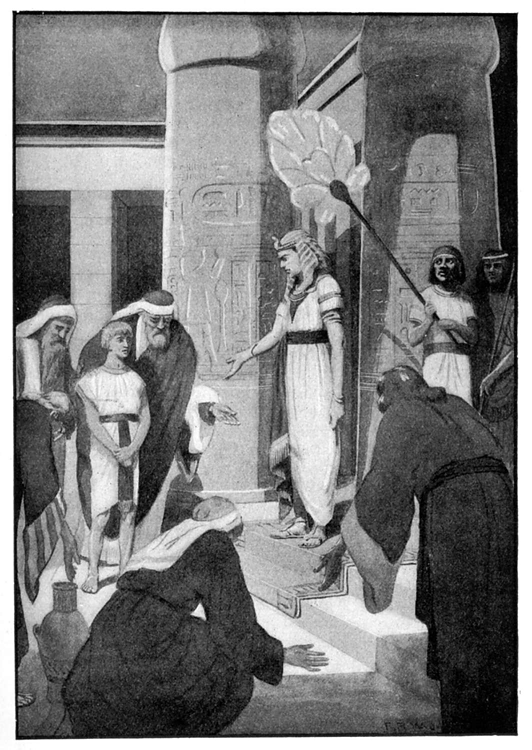
Did Judah recognize Joseph, or did Joseph have to reveal himself? (Read Gen 45:1–4.) Was Judah “blinded” to whom Joseph was? Why? What is this a prophetic picture of? (See Rom 11:25.) As we have seen in the previous studies, Joseph was a type of the Messiah as well as the father of Ephraim and Manasseh, the dominate tribes of the Northern Kingdom of Israel, who went apostate and become “lost sheep” among the nations of the world (Hos 7:8; 8:8; Ezek 34:16 and numerous other Scriptures). Therefore, who does Joseph prophetically represent? This is a prophetic picture of the “lost sheep of the house of Israel” and the Messiah who would come to seek out those lost sheep (Matt 15:24; 10:6). And whom does Judah represent? Is Judah a prophetic shadow of the Lion of the Tribe of Judah who would later come as the Messiah to redeem his “brother” who would be lost in spiritual Egypt? Or does he represent the Southern Kingdom of the house of Judah who is “blind” to his Messiah? Perhaps he is a prophetic picture of both. These are potentially difficult questions to answer. One could easily force these scriptures in Genesis to fit into a false prophetic scenario.

This has been a head scratcher for the Jewish sages as well. They have seen in the story of Joseph, the Suffering Servant, a Messiah Son of Joseph figure who they felt would be a descendant of Ephraim and who would come to redeem the lost sheep or exiles of the house of Israel in preparation for a second Messiah to come whom they refer to as the Conquering King or Messiah the Son of David, (Mesorah Publications ArtScroll Bereishis, vol. 1(b), pp. 2121–2122). They see these Messiahs as two separate individuals. Yet in our story of Joseph and Judah can we see the antetypes of these two Messiahs acting out their roles at the same time? Could Judah and Joseph point to both comings of Messiah Yeshua? At his first coming, did not Yeshua, the Suffering Servant, come to redeem a remnant of lost Judah in addition to a much larger portion of “the lost sheep of the house of Israel”? Yet at his second coming, will this same Messiah Son of Joseph come back as the Lion of Judah to be revealed to his Jewish brothers who had previously rejected him?