Are you possessing the land or just warming a pew with your blessed ASSurance waiting the second coming?

Deuteronomy 2:31, Begin to possess [the Promised Land]. Possession of the Promised Land was a process. This concept is as true for us as much as it was for the children of Israel. The idea in mainstream Christianity that when you receive salvation at the beginning of your spiritual walk and that’s all there is to possessing or entering the kingdom of Elohim is a seriously incomplete one. It doesn’t fit the biblical models or the teachings of the apostolic writers about the need for the believer to persevere and overcome to the end to receive his ultimate eternal inheritance.

15654254

When this verse states that Israel “began to possess [the Promised Land],” what does this mean? Why didn’t YHVH give it to Israel all at once? What did Israel have to do to “possess” the land? What do we have to do to possess our spiritual inheritance? Does YHVH just hand it to us, or do we have to persevere, overcome and fight for it?

Leaving Egypt is a picture of a believer’s initial salvation, while entering the Promised Land is a picture of a believer’s ultimate salvation involving his glorification or the redemption of his physical body and being granted eternal inheritance at the resurrection. It’s also a picture of rewards for obedience.


Dealing With Difficult Family Members

Deuteronomy 2:2–9, Edom. Edom (another name for Esau, brother of Jacob) and Moab and Ammon (sons of Lot) were blood relatives of the Israelites. Often those of our own family will stand in our way as we go in to possess our ­spiritual, Elohim-given inheritance and destiny.

109234040

What is the lesson from this passage of scripture on how to deal with less-than-cooperative family members who fail to recognize the calling on your life? Are we to make war with them? Are we in any way to be beholden to or dependent on them for our physical needs? If we became dependent upon them could this help or hinder our chances of entering our own spiritual destiny or “Promised Land”? Does YHVH desire our families to be saved? (See Acts 16:31; 2 Pet 3:9.) How can we be a light to our families if we are fighting and attempting to destroy those who would spiritually stand in our way?

This passage also teaches us to avoid conflicts with family members at all costs. No good can come from such confrontations. How does verse 5 start out? Now go on to read verse 6. YHVH instructed the Israelites to treat their cousins with respect and civility—almost in a business-like manner.

Nowhere does Scripture tell us that we have to like our heathen family members. But neither are we to act offensively toward them. Like the Israelites when forced to encounter long lost relatives, sometimes it is best to smile, be nice, but keep moving on!


What’s in the name Caleb?

Deuteronomy 1:36, Because he has wholly followed YHVH. What does this statement say about the heart of Caleb? If you check most Hebrew lexicons, you will find that the name Caleb (or Calev) means “dog.” But this is not the whole story.

21564818

Hebrew is a very flexible language, and one word can have multiple definitions. The Hebrew word kal and lev literally mean “all heart.” When you think of a dog, what comes to mind? Always happy to see its master, unconditional love, a faithful companion, guarding and protecting its family no matter the cost.

How does Calev’s name fit his spiritual characteristics? What can we learn from Calev about what is pleasing to YHVH. (For more on Calev, read Num 13:30; 14:6, 24, 30; 32:12; Josh 14:6–14.)

Be inspired by this mighty man of faith.


Is obedience to Torah legalism and a system to earn YHVH’s favor?

Here is an excellent question from Marcus G. that I will answer below. He writes:
“Our works can’t earn favour from YHWH yet, as you’ve said, we read that obedience is life and disobedience is death/curse. How do we get our head around this? We don’t want to do it in a legalistic way, where we declare YHWH owes us blessings and yet we know that not living in obedience is not loving our GOD either. We can never “earn” YHWH’s favour.”
My answer is this: The term works is a term Paul uses in his writings and relates to the process of receiving salvation from Elohim. Paul makes it clear in several places that one does obtain salvation based on works, but based on faith (e.g. Eph 2:8-9). However, Paul goes on to say that once one is saved through faith in Yeshua from the wages of sin which is death, one is expected to produce or walk in the fruits of good works, which is obedience to YHVH’s commands or, as Paul puts it, good works (Eph 2:10). Yeshua said it this way, “If you love me, keep my commandments” (John 14:15).
We also see that though our salvation isn’t initially based on our works, since we can never be good enough or do enough good works to merit YHVH’s favor, our rewards in his eternal kingdom are clearly based on our good works. Those who faithfully obey YHVH’s commandments will have higher rewards in his kingdom than those who don’t (Matt 5:19; 16:27; see also Rom 2:6; 2  or 2 Cor 5:10; Eph 6:8; 1 Pet 1:17; Rev 2:23; Rev 19:8;  20:12; 22:12).
Now having established that our works don’t earn us salvation, but  our works will determine our rewards in YHVH’s kingdom, let’s consider a couple other things.
When the children of Israel were given the Torah, they were never promised eternal life if they faithfully obeyed it. They were promised a blessed and abundant life here and now in the Promised Land. On the other hand, in the gospel message of the Testimony of Yeshua, eternal lift is promised to those who place their faith in Yeshua. Once they are saved (in the initial sense), they are to show the fruits of salvation and that they love Yeshua by obeying him and keeping his commandments. To the degree that one keeps the commandments will determine one’s level of rewards in YHVH’s kingdom.

Continue reading


What is the Book of Deuteronomy all about?

More Insights About the Book of Deuteronomy

In stark terms, YHVH warns the Isaelites in Deuteronomy of the struggles Israel will have as it walks between two world: the lower world that attaches itself to man’s soul and attempts to pull him downward, and the upper world that pulls the spirit in man heavenward.

Deuteronomy 65289264

Deuteronomy presents Torah (as does Ps 119) as the way to be spiritually, physically, mentally, emotionally, materially elevated before Elohim and in the eyes of the surrounding nations (Deut 4:6).

In Deuteronomy, YHVH lays out two extremes: blessings for obedience and curses for disobedience; curse for following the ways of this world, and blessings for following the Word of YHVH. But seldom do individuals find themselves in one extreme or the other, for few are either totally worldly or totally heavenly in the orientation of their lives. They are usually caught up somewhere in the middle ground between the two: not totally evil and not totally good. Their lives are a mixed bag of good and evil, blessings and curses, and a double-orientation toward the heaven and the world. The Bible calls this double-mindedness (Jas 1:8; 4:8), and Yeshua decries such an individual (Matt 6:24, “one can’t serve both God and mammon”). The Bible also calls this being lukewarm­—being neither hot nor cold, and YHVH hates this as well (Rev 3:15–16). Such an individual, if he isn’t careful, can find himself feeding spiritually more from the tree of the knowledge of good and evil rather than the tree of life.

YHVH lays out the highest spiritual ideal for Israel: to be wisdom in the sight of the nations (Duet 4:6), to be the head and not the tail, to be the greatest and not the least, and to be the lender and not the borrower. Such a position of status is possible thanks to following the Torah. He wants the best for his people, but achieving such is conditional on their obeying him. Many people make claim to believe in the God of the Bible, to love him and many even claim to follow and to obey him—just ask them! But in reality, do they? What are the fruits of their lives? Their true spiritual status is based on what they do, not what they profess with their mouths!

Deuteronomy affirms the sufficiency of Torah. The Torah is the Word of Elohim and nothing more needs to be added to it. It is the full revelation of YHVH when it says not to add to the Word of Elohim (Deut 4:2; 12:32). It is the bedrock of the Scriptures and the bedrock of truth. If Torah is the bedrock of YHVH’s word, then the Ten Commandments are the cornerstone in that foundation of truth, which Moses reiterates in Deuteronomy five. The rest of the Scriptures are just commentary or elucidations on Torah, or Continue reading


Blog Scripture Readings for 7-19 Through 7-25-15

Aside

THIS WEEK’S SCRIPTURE READINGS FOR STUDY AND DISCUSSION:

Parashat D’varim — Deuteronomy 1:1 – 3:22 
Haftarah — Isaiah 1:1-27
Prophets — Ezekiel 28:1 – 34:31
Writings —Nehemiah 4:1 – 10:39
Testimony — Galatians 3:29 – 6:18; Ephesians 1:1 – 3:21

Most of this week’s blog discussion points will be on these passages. If you have general comments or questions on the weekly Scripture readings not addressed in a blog post, here’s a place for you to post those. Just use the “leave a reply” link below.

The full “Read Through The Scriptures In A Year” schedule, broken down by each day, can be found on the right sidebar under “Helpful Links.” There are 4 sections of scripture to read each day. One each from the Torah, the Prophets, the Writings, and from the Testimony of Yeshua. Each week, the Torah and haftarah readings will follow the traditional one-year reading cycle.

Weekly Blog Scripture Readings for 7/19 through 7/25/15.


A Tithe on War Booty and the Holy Half Shekel — A Memorial Pointing to Yeshua’s Atoning Death

Numbers 31:50, Make atonement. 

Exploring the Concept of Atonement as It Relates to the Tabernacle and Salvation

In this verse we read, “We have therefore brought an oblation for YHVH, what every man has gotten, of jewels of gold, chains, and bracelets, rings, earrings, and tablets, to make an atonement for our souls before YHVH.” In a similar passage in Exodus 30:15–16, we read, “The rich shall not give more, and the poor shall not give less than half a shekel, when they give an offering unto YHVH, to make an atonement for your souls. And you shall take the atonement money of the children of Israel, and shall appoint it for the service of the tabernacle of the congregation; that it may be a memorial unto the children of Israel before YHVH, to make an atonement for your souls(emphasis added). The question before us is this: Do these passages in the Torah imply that YHVH grants man absolution based something other than the shedding of blood, and by logical extension, does this call into question our redemption from sin through our faith in Yeshua the Messiah’s blood atonement?

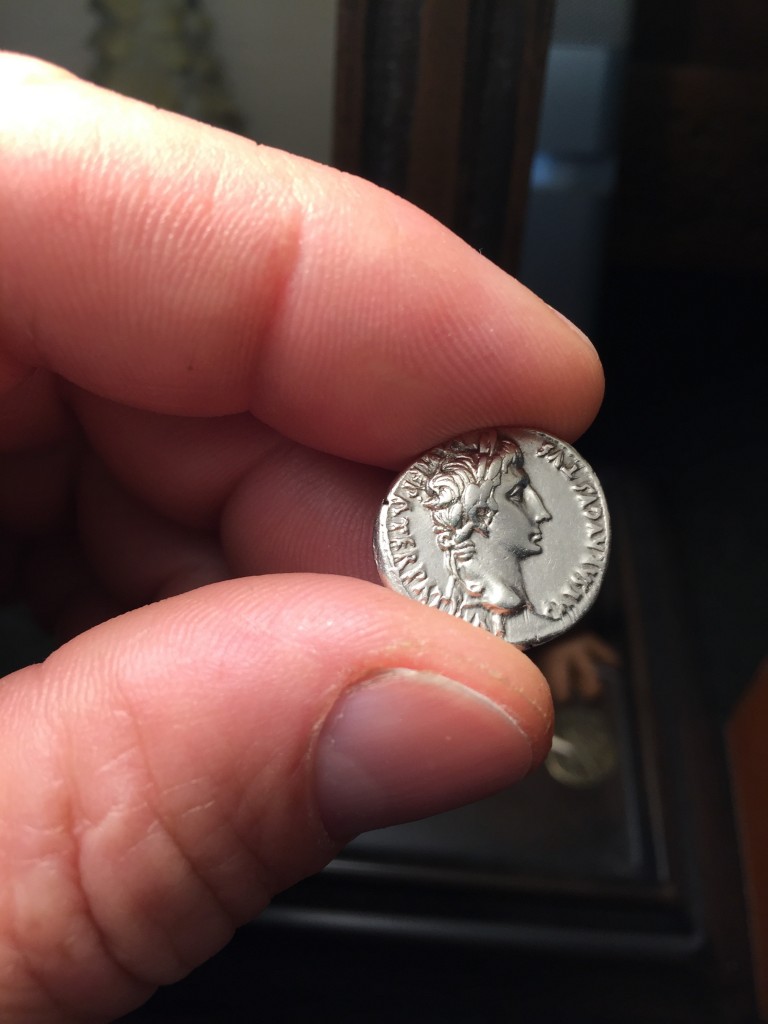
Natan holding an actual 2000 year old silver half-shekel from his biblical antiquities collection. This actual coin likely passed through the temple treasury in Jerusalem.

Natan holding an actual 2000 year old silver half-shekel from his biblical antiquities collection. This actual coin likely passed through the temple treasury in Jerusalem. YHVH commanded the Israelites to a pay yearly temple tax of a half-shekel of silver to help fund the sacrificial system that  was a prophetic picture of Yeshua’s atoning death on the cross.

The concept of atonement can be a confusing one. Some in rabbinic Jewish circles teach that the Torah (i.e., the first five books of the Bible) does not require the shedding of blood for atonement of one’s sin to occur. According to the above scripture, this could appear to be the case. Before briefly discussing the subject of atonement, let us not forget the stern warnings of the Apostle Peter when he warned end-time saints against false teachers who would lure people away from the simple truth of the gospel:

But there were false prophets also among the people, even as there shall be false teachers among you, who privily shall bring in damnable heresies, even denying the Lord that bought them, and bring upon themselves swift destruction. And many shall follow their pernicious ways; by reason of whom the way of truth shall be evil spoken of. And through covetousness shall they with feigned words make merchandise of you: whose judgment now of a long time lingers not, and their damnation slumbers not…. But these, as natural Continue reading