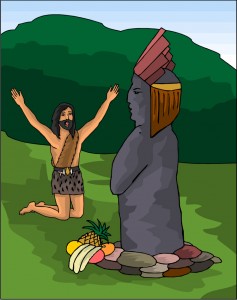
Parent! Are you teaching your children Torah or to be idolators?

Deuteronomy 6:7, 10–16, 20–25, Instruct your children in the Torah, so they don’t fall into idolatry. YHVH is constantly warning his people against idolatry; idolatry is anything that gets in the way of our relationship with him. What is of higher priority in your life than serving YHVH? What in your life takes more of your time, energy and money than serving YHVH? What draws your heart away from the study of his written Word, from prayer and fellowship? What or who hinders you from moving forward in your spiritual walk? What in your life keeps YHVH from getting out of a spiritual box in your life? This is idolatry!

Boy reading from a gevil parchment scroll.  This one is written on goat skin.

Boy reading from a gevil parchment scroll. This one is written on goat skin.

Several times YHVH instructs the children of Israel to be certain to instruct their children in the ways of Torah-righteousness. In the Shema, YHVH commands, “And you shall teach them [i.e., his Word] diligently to your children, and talk of them when you sit in your house, and when you walk by the way, and when you lie down, and when you rise up” (6:7). Then in verses 20–25 of the same chapter we read,

When your son asks you in time to come, saying, `What is the meaning of the testimonies, the statutes, and the judgments which YHVH our Elohim has commanded you?’ Then you shall say to your son: `We were slaves of Pharaoh in Egypt, and YHVH brought us out of Egypt with a mighty hand; and YHVH showed signs and wonders before our eyes, great and severe, against Egypt, Pharaoh, and all his household. Then He brought us out from there, that He might bring us in, to give us the land of which He swore to our fathers. And YHVH commanded us to observe all these statutes, to fear YHVH our Elohim, for our good always, that He might preserve us alive, as it is this day. Then it will be righteousness for us, if we are careful to observe all these commandments before YHVH our Elohim, as He has commanded us.’

Too often in the church-system the children have had to take the backseat when it comes to discipleship and ministry. They get a few table scraps thrown at them called “Vacation Bible School” (once a year) and a little “Jonah and the Whale” type teaching on Sunday morning accompanied by some, often inane, craft project. Seldom does the head pastor of the church bother with the children’s ministry. Usually, this function is relegated to the younger associate pastor. Typically, the position of “Youth Pastor” is viewed as nothing more than a stepping stone to the “top dog” position of “Head Pastor.”

Furthermore, seldom do parents spend any meaningful time during the week instructing their children in the ways of YHVH. As redeemed Israelites, it is our opportunity to follow the Torah and to place the highest ministry priority on instructing our children in the truths of the written Torah, in the truth of Yeshua the Living Torah, and in the fundamentals of who they are as members of the commonwealth of Israel (Eph 2:12) and in preparing them for the kingdom of Elohim. If we don’t, who will?

As parents, what are you doing on a regular basis to diligently instruct your children all day, every day? As grandparents, aunts and uncles and members of gospel-orientated Torah community, what are you doing to help in teaching the children?

What was the attitude of the disciples when they attempted to shoo the children away from Yeshua. What was Yeshua’s response? Read and compare Matthew 19:13–15 with 18:1–5 and go and do likewise, for they are our future and our legacy!


A Pastor Is a Herder of Sheep

Ephesians 4:11, He gave some to be …pastors. The word pastor is the Greek word poimen (pronounced poy-mane) occurs 18 times in the NT and is translated in the KJV as shepherd (17 times) and only once as pastor (pl., Eph 4:11). Poimen literally means “a herdsman, esp. a shepherd or one who cares for sheep.” In the Near East, it was the duty of the shepherd to watch for enemies trying to attack the sheep, to defend the sheep from attackers, to heal the wounded and sick sheep, to find and save lost or trapped sheep, to love them, and to share their lives with them thus earning their trust.

Shepherd w- Sheep 33398033

The TDNT summarizes the role of the shepherd in this manner: In the Gospels, the shepherd’s sacrificial loyalty to his calling is depicted with loving sympathy using true-to-life pictures. For example, he knows each animal by name (John 10:3, 14, 17), seeks the lost sheep, is happy when he finds it (Luke 15:4–6), and is prepared to hazard his life to protect the sheep form the wolf (John 10:11–13). Yeshua even uses the shepherd as figure for Elohim in two parables (Luke 15:4–7; Matt 18:12–14; Ibid., vol. 6, p. 490).

As noted, only once in the NT are congregational leaders called shepherds (Eph 4:11). The absence of the article before teachers in the list of church offices (Eph 4:11) indicates that pastors and teachers are to form a single leadership group as it relates to ministering to the individual congregations, yet there’s no indication in this verse of pastor being an ecclesiastical title (Ibid.)

The verb poimainein, a derivative of poimen, gives some indication of the work of the pastor in the congregation. By definition, poimainein indicates the leadership responsibility of feeding, nourishing, tending, leading, ruling and cherishing Elohim’s flock or church (1 Pet 5:2; Acts 20:28; John 21:16) as a shepherd feeds his flock.


The Bible’s Aversion to Mathematics: Don’t Add or Subtract

Deuteronomy 4:2, You shall not add to the word that I command you, nor shall you subtract/diminish from it. YHVH warns his people against adding or subtracting from his written Word elsewhere, as well (Deut 12:32; Rev 22:18–19).

33401708

Men seem inclined to ignore YHVH’s command in this regard. Whole religions have been founded based on disregarding this prohibition. Some claim to be Bible-based (e.g. Mormonism with their Book of Mormon and rabbinic Judaism with its Talmud), and some have supplanted the entire Bible with their own book (Islam with its Quran).

Who is the author of and real power behind adding to and subtracting from or twisting YHVH’s Word? It is Satan the serpent. (See Gen 3:1ff and Matt 4:3ff.)

What did Yeshua warn the religionists of his day against in this regard? He said, “Thus have you made the commandment of Elohim of none effect by your tradition” (Matt 15:6) and, “Howbeit in vain they do worship me, teaching for doctrines the commandments of men” (Mark 7:7).

What are some examples of traditions and theologies in the modern-day Christian and Jewish religions where YHVH’s Word has been superseded by man’s traditions? What are some traditions and doctrines of men you have turned away from in order to bring yourself into greater alignment with YHVH’s Word? How is your life better for it? What has been the reaction of those around you in response to your aligning your life more closely with the truth of YHVH?


New Video: Does Atonement for Sin Require Shedding of Blood?

How can a man have his past sins absovled, atoned for or washed away? There is only one way. The Bible reveals what that way is. Watch this video to find the answer.


Blog Scripture Readings for 7-26 Through 8-1-15

Aside

THIS WEEK’S SCRIPTURE READINGS FOR STUDY AND DISCUSSION:

Parashat Va’etchanan — Deuteronomy 3:23 – 7:11 
Haftarah — Isaiah 40:1-26
Prophets — Ezekiel 35:1 – 41:26
Writings — Nehemiah 11:1 – 13:31; 1 Chronicles 1:1 – 3:24
Testimony — Ephesians 4:1 – 6:24; Philippians 1:1 – 4:23

Most of this week’s blog discussion points will be on these passages. If you have general comments or questions on the weekly Scripture readings not addressed in a blog post, here’s a place for you to post those. Just use the “leave a reply” link below.

The full “Read Through The Scriptures In A Year” schedule, broken down by each day, can be found on the right sidebar under “Helpful Links.” There are 4 sections of scripture to read each day. One each from the Torah, the Prophets, the Writings, and from the Testimony of Yeshua. Each week, the Torah and haftarah readings will follow the traditional one-year reading cycle.

Weekly Blog Scripture Readings for 7/26 through 8/1/15.


Pithy and Life-Changing Lessons from Deuteronomy Chapters One to Three

Deuteronomy 1:29, He will fight for you. How does Elohim fight for us? Let’s look at the example of the children of Israel. We can learn a lot from them (1 Cor 10:11). How many examples are there of the Israelites sitting down and doing nothing while YHVH fought for them? Few if any. What then does YHVH require? We must do our part, and he will do the rest. What is the part we are to do? That depends. Sometimes it depends on what we we’re capable of doing. Often he requires us to come to the end of our resources and abilities, and then he will step in and finish off fight on our behalf to the victorious end. We also have to fight only the battles he has told us to fight. Sometimes we choose to fight battles he has not instructed us to fight. This was the case with the Israelites who chose to go up and take the Promised Land when YHVH told them not to do so. They were defeated (Deut 1:42–45). YHVH will not support his people in a battle he has not sanctioned. When YHVH tells us to go to battle we have to fight how he tells us to fight, who he tells us to fight, and when he tells us to fight. If the Israelites had gone up against Jericho using conventional warfare tactics, they would have been defeated because that’s not how YHVH instructed them to defeat that city. The same is true of Gideon’s unconventional method of defeating the Midianites. Often YHVH will fight for us when we submit to his battle plans and fight the enemy his way. The Israelites defeated the Amalakites when Moses stood on a hill with his arms outstretched in a cross-like formation. Likewise, they overcame Jericho by marching around it blowing shofars. Gideon used lamps and shofars to defeat the enemy. David used a slingshot. Sometimes the Israel defeated their enemy with the help of the ark of covenant, through prayer and praise and so on. The biblical list of unconventional methods of YHVH’s people defeating their enemies is a long and inspiring one! What can we learn from all of this? For YHVH to fight for us, we must first do things his way so that he’ll fight for us. This means knowing when and who to fight and how to fight. Often we have to wait on YHVH for the answers to these questions even as a military officer has to wait for headquarters to give him his marching orders. Headquarters won’t back or support the soldier who takes matters into his own hands. Conversely, headquarters won’t tolerate a solider who refuses to obey orders. The same is true of YHVH.

Deuteronomy 1:39, Little ones…knowledge of good and evil. “Little ones” were those under the age of 20 (see Num 14:29; 32:11). Certainly, children under the age of 20 Continue reading


Are you and Gentile?

Ephesians 2:11, Gentiles. Paul says in a number of places that those who come to Yeshua are no longer Gentiles but are the children or seed (literally “sperm,” which is the meaning of the Greek word) of Abraham (Eph 2:11–19; Rom 4:16; 9:8–11; Gal 3:7,9,14,28–29). The word Gentiles as used in the Scriptures (both in the Hebrew and the Greek languages) simply means “ethnic groups or nations.” There are many places in the Scriptures where Jews and Israelites are referred to as “Gentiles.” However, there is no class of people called Gentiles in the spiritual body of Yeshua. Scripture uses the following terms for the redeemed of YHVH: the saints, the called out ones (or church), the body of Yeshua (1 Cor 10:16; 12:27; Eph 4:12) the one new man (Eph 2:15), sons of Elohim (Rom 8:14, 19; Phil 2:15; 1 John 3:1, 2), children of Elohim (Rom 8:16, 21; Gal 3:26; 1 John 3:10), or Abraham’s offspring (Gal 3:29), the bride (Rev 18:23; 21:2, 9; 22:17) for example.

Are you a Gentile without Elohim and without hope?

Are you a Gentile without Elohim and without hope?

Any attempt by anyone to keep the Jew—Gentile division alive within the body of Yeshua is in effect keeping up the middle wall of partition that the Apostle Paul gave his ministry life and eventually his physical life to tearing down (see Eph 2:11–19). It is also going against the clear teaching of the Scriptures, which say that within the spiritual body of Yeshua, there is no longer Jew or Gentile/Greek (Rom 10:12; Gal 3:28; Col 3:11).

The Scriptures reveal that there are only two classifications of people: Israelites and non-Israelites or Gentiles. The former has eternal life because of their relationship with the Continue reading