Exodus 34: A Prophecy About the Second Coming

Exodus 34:1–35, Moses’ second ascension of Mount Sinai is a prophetic picture of the saints’ resurrection and glorification at the second coming of Yeshua the Messiah.

According to Jewish tradition, Moses ascended Mount Sinai to receive the second set of stone tablets containing the Ten Commandments on the first day of the sixth month or 30 days before Yom Teruah, which occurs on the first day of the seventh month. Forty days later on Yom Kippur he descended from the mountain carrying with him the second set of tablets as a sign of YHVH’s forgiveness of the children of Israel after the golden calf incident. This signaled YHVH’s renewed relationship with Israel after they had repented of golden calf worship.

We know that a biblical Israelite bride, while waiting for her betrothed to arrive from his father’s house, would hear the sound of the shofar in the distance as her bridegroom approached. If she were alert and not asleep (as were the ten virgins in Matt 25), she would have had time to put on her wedding robes, trim her lamp’s wick, and have it filled with oil and ready to light as soon as he arrived.

Prophetically, the Scriptures tells us that the saints of Yeshua are to be resurrected and to meet the returning Messiah Yeshua in the air at the seventh or last shofar blast on Yom Teruah (Day of the Trumpets, Shouting or Shofar Blasts, see 1 Cor 15:52; Rev 11:15–18). From the time the saints begin hearing the shofar blasts in the distance signaling the arrival Continue reading →


Holy Water: Your Ticket into the Kingdom of Elohim

John 3:5, Of water and the Spirit. This phrase is a literary device that is common in Hebraic literature called a hendiadys, which is a grammatical structure where two nouns are linked by the word and, and at the same time have a coordinate rather than a subordinate relationship. The two nouns represent a single modified concept rather than two separate concepts. For example, if we say “the coffee is nice and hot,” what we really mean is “it’s nice hot coffee.”

15221168

In this case, a better translation of Yeshua’s words would be “unless one is born of spiritual water, one cannot enter the kingdom of heaven.”

Biblically, water is a spiritual metaphor for both the Holy Spirit and the Word of Elohim, which are, in reality, two sides of the same coin. That is to say, one can’t understand the Word of Elohim without the Holy Spirit who, according to Yeshua, helps us to understand the Word of Elohim (John 16:13–14).

Perhaps this understanding gives new meaning to the concept of “holy water.”


The Golden Calf Incident: A Prophetic Picture of the Church

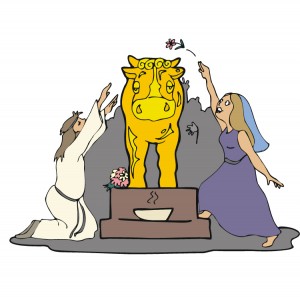
Exodus 32, On Shavuot (the Feast of Weeks or Pentecost), at Mount Sinai, YHVH entered into a marriage covenant with the children of Israel, but they were not ready to live up to the terms of that covenant. Those terms, simply stated, involved the Israelites being faithful and obedient only to YHVH, Israel’s Elohim (God) and spiritual husband, and to his instruction in righteousness, the Torah. This Israel quickly demonstrated they were not willing to do, for they had hardly said “I do” to their marriage vows (Exod 24:3, 7) when they turned their hearts away from YHVH and began worshipping the golden calf—a pagan deity from Egypt. After the golden calf incident and up until Yom Teruah (the Day of Trumpets or Shofar Blasts) when Moses received the second tablets of stone from YHVH containing the Ten Commandments, the children of Israel, the bride of YHVH, prepared herself not only to receive YHVH’s instructions again, but this time to be faithful to her marriage vows. This Israel did. She remained faithful to YHVH for approximately 38 years while trekking through the wilderness of Sinai, after which she entered the Promised Land and “stayed the course” until after the death of Joshua.

Golden Calf 6 21409020

Sadly, the cycles of history often repeat themselves. This time, it involved the descendants of the children of Israel who were at Mount Sinai. In the early first century A.D.,  the redeemed Israelite followers of Yeshua received the Torah written on the fleshly tablets of their hearts by the finger of the Spirit of Elohim on the Day of Pentecost (Shavuot) as recorded in Acts 2. But starting at about A.D. 70 with the destruction of the temple in Jerusalem and continuing up through the Second Jewish Revolt of A.D. 135 until the time of Emperor Constantine (in the fourth century), the first-century spiritual bride of Messiah had, for the most part, abandoned YHVH’s Torah-commandments and turned, to one degree or another, to a mixed form of worship (of which ancient Israel’s worship at the golden calif was a prophetic foreshadow) where some pagan practices were assimilated into the early churches’ belief system (most notably, Sunday replaced the Sabbath, and Christmas, Easter and other paganistic holidays replaced the biblical feasts).

Moses’ descent of Mount Sinai on Yom Teruah with the second set of tablets containing the Torah prophetically foreshadows Yeshua’s second coming. As Moses renewed YHVH’s Continue reading →


Who was the God of the Old Testament?

John 1:1, The Word was Elohim. Is Yeshua or the Father the God (Elohim) of the Old Testament (Tanakh)? For many believers in Yeshua, there is confusion as to who it was in the Godhead who interacted with the Israelites in the Tankah. Was it the Father or the Son? In the minds of the apostolic writers, there was no confusion about this.

Yeshua, in his preincarnate state, was the One that YHVH Elohim the Father used to both create (John 1:3; Col 1:16; Heb 11:3), and then to interact with mankind. He was the Word of YHVH Elohim, the Father, who become flesh and dwelt among men (verse 14). This truth is easily confirmed in several passages in the Testimony of Yeshua (New Testament).

First, Yeshua himself claims to be YHVH or the I Am of the burning bush (see John 8:58 cp. Exod 3:14). The Jews viewed Yeshua’s claim to be deity as blasphemous, which is why they picked up stones to kill him (John 8:59). Next, Yeshua in declaring to the Jewish religious leaders that “I send you prophets, wise men and scribes: some you will kill…” (Matt 23:34), he is claiming the rights and prerogatives of YHVH — a right and role that solely belonged to YHVH in the Tanakh.

Yeshua also declared that no man has seen the face of Elohim the Father (John 5:37). Yet Continue reading →


New Video: Tabernacle of Moses, the Hebraic Wedding & the Saints

The Tabernacle of Moses contains the seven-step outline of salvation for mankind and the wedding ceremony between Yeshua (Jesus) and his bride, the saints who love him and keep his commandments. This is a marriage made in heaven to last for eternity in the New Jerusalem. Watch this video to see how you can be part of it.


Blog Scripture Readings for 2/9 through 2/15/14

Aside

THIS WEEK’S SCRIPTURE READINGS FOR STUDY AND DISCUSSION:

Parashat Ki Tisa — Exodus 30:11 – 34:35
Haftarah — 1 Kings 18:1 – 39
Prophets — 2 Kings 17:1 – 23:37
Writings — Psalms 124:1 – 130:8
Testimony — John 1:1 – 4:54

Most of this week’s blog discussion points will be on these passages. If you have general comments or questions on the weekly Scripture readings not addressed in a blog post, here’s a place for you to post those. Just use the “leave a reply” link below.

The full “Read Through The Scriptures In A Year” schedule, broken down by each day, can be found on the right sidebar under “Helpful Links.” There are 4 sections of scripture to read each day. One each from the Torah, the Prophets, the Writings, and from the Testimony of Yeshua. Each week, the Torah and haftarah readings will follow the traditional one-year reading cycle.

Weekly Blog Scripture Readings for 2/9 through 2/15/14.


The Tabernacle: A Glorious Love Story

The Bible Is the Story of Reconciliation Between Two Lovers —The Tabernacle Contains the Outline of that Love Story

Love and romance has captured the imagination of man since time immemorial. Today we see this fascination evidenced in music, movies, literature and numerous other ways including modern man’s obsession with sexuality and even, sadly, in rise of pornography and the societal acceptance of sexually perverse lifestyles.
tabernaclekit4

The Creator of the universe, the Set Apart One of Israel, the Author of the Scriptures, is captivated by the concept of love and romance as well. He is the Creator of marriage and sex. In fact, his first command to man was to be fruitful and to multiply and to fill the earth with humans (Gen 1:28). To accomplish this involves sexual relations in marriage. The writer of Hebrews declares that marriage is honorable and the marriage bed is not to be defiled (Heb 13:4). Much of the Bible is devoted to the subject of love and marriage. Love and marriage at a human level is merely a shadow of something much deeper: love and marriage at a spiritual level. John 3:16, the most popular verse in the Bible, talks about Elohim’s quintessential love for mankind and alludes to this higher spiritual level.

Most people understand that poetry and poetic prose is the language of love, yet few realize that much of the Scripture is poetry (or poetic prose) in Hebraic style. Much of this poetic style is lost in the translation from Hebrew into other languages like English. For example, all the books of Psalms, Proverbs, Job, Song of Solomon, Ecclesiastes and most of the writings of the  Hebrew prophets are written in a poetic style. Moreover, a Hebrew poetic style known as aggadic literature is also found in the Testimony of Yeshua (New Testament) in the parables of Yeshua.

Perhaps the greatest love song ever written by man is found in the Scriptures in the Song of Solomon. This poem is a tender and romantic story about the great love between a man and his bride. Many believe this is an allegory about YHVH-Yeshua and his bride, Israel, the body of believers called the saints. In Ephesians 5:21–33, Paul carries this marriage theme to the next level where he writes about the marriage relationship between a husband and wife and how that is a picture of Yeshua and the body of believers (the saints). He then goes on to say in verse 32 that, “This is a great mystery: but I speak concerning Messiah and the church.” The word mystery here in the Greek refers to “secret or hidden things relating to the deep and wise counsel of YHVH which is hidden to ordinary individuals and revealed only to a select or special group of people, in this case, the saints.”

Taking the idea of Yeshua and his bride, the saints to its highest level, John in Revelation 19:9 talks prophetically about the marriage supper of the Lamb and says in verses 7 and 8 that this marriage has come and his wife, the saints who have the testimony of Yeshua and keep his commandments has made herself ready by putting on the clean and white wedding garments which is the righteousness of the saints. These saints will rule and reign with Yeshua the Messiah forever and ever in his kingdom after his return to this earth.

In the Gospels on several occasions, Yeshua alludes to his upcoming marriage to his spiritual bride in typical poetic Hebraic fashion known as aggadic literature. We see this, for example, in the Parable of the Ten Virgins (Matt 25:1–13) and the Parable of the Wedding Banquet (Matt 22:1–14), not to mention the prophetic and allegorical implications found in his first recorded miracle — the changing of the water into wine at the marriage feast in Cana of Galilee. This upcoming marriage forms an essential aspect of the good news or gospel of the kingdom message that Yeshua preached. He came to prepare his bride for this wedding by urging her to “repent [of sin] for the kingdom of Elohim is at hand.” His kingdom on this earth will be fully and universally established when, at his second coming, he marries his bride, the spiritual body of believers (called the “one new man” in Eph 2:11–16), who he has redeemed with his blood, and who keep his commandments (Rev 12:17 and 14:12). At this marriage to redeemed Israel, there will be an exchange of vows (in Heb. ketubah), which Scripture refers to as the Renewed (or New) Covenant, which will be a fulfillment of Jeremiah’s prophecy (Jer 31:31 cp. Heb 8:8–13). This will cement a spiritual love relationship between YHVH and his people that will last for eternity as they together dwell in the New Jerusalem, which will be heaven on earth!

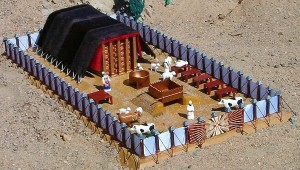
The Bible, from Genesis chapter one to the final chapter in the Book of Revelation is a love story that starts in a garden paradise with the Creator and a man and woman and ends in a city-garden and involves an eternal marital relationship between YHVH and his people. The Tabernacle of Moses outlines this story from beginning to end.

The Tabernacle, the Saint, and the Seven Stages of the Biblical Wedding

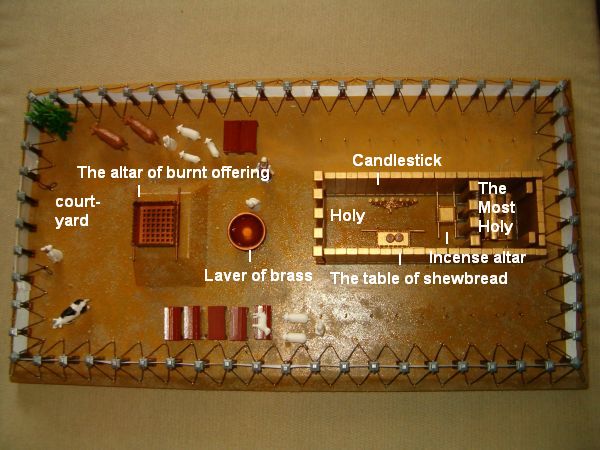
What follows is our attempt to integrate the seven stages of the biblical wedding with the seven stations in the Tabernacle of Moses in an attempt to show how YHVH’s plan of salvation as revealed in the tabernacle also relates to his plan to marry redeemed Israel (the saints) at his second coming. This is but one possible way to understand this complex subject. As we shall see, the numbers seven and eight figure prominently into this scenario. Seven is the biblical number for perfect completion, while eight is the number for new beginnings or infinity.
tabernaclekitdiagram Continue reading →