Christmas—The Rest of the Story

How and When Christmas Came Into the Church

Did you ever wonder how the non-biblical holiday called “Christmas” came into the mainstream Christians church? What follows is the backstory to Christmas: the rest of the story.

Christmas was not among the earliest festivals of the Church. Irenaeus and Tertullian omit it from their lists of feasts;  Origen glancing perhaps at the discreditable imperial Natalitia, asserts (in Lev. Hom. viii in Migne, P.G., XII, 495) that in the Scriptures sinners alone, not saints, celebrate their birthday;  Amodbius (VII, 32 in P.L., V, 1264) can still ridicule the “birthdays” of the gods. (The Catholic Encyclopedia, “Christmas”)

Saturnalia was an ancient Roman festival in honour of the god Saturn, held on 17 December of the Julian calendar and later expanded with festivities through to 23 December. The holiday was celebrated with a sacrifice at the Temple of Saturn, in the Roman Forum, and a public banquet, followed by private gift-giving, continual partying, and a carnival atmosphere that overturned Roman social norms: gambling was permitted, and masters provided table service for their slaves. (https://en.wikipedia.org/wiki/Saturnalia)

Saturnalia may have influenced some of the customs associated with later celebrations in western Europe occurring in midwinter, particularly traditions associated with Christmas, the Feast of the Holy Innocents, and Epiphany. (ibid.)

The popularity of Saturnalia continued into the 3rd and 4th centuries AD, and as the Roman Empire came under Christian rule, many of its customs were recast into or at least influenced the seasonal celebrations surrounding Christmas and the New Year. (ibid.)

According to The Catholic Encyclopedia, Christmas is not included in Irenaeus’s nor Continue reading


Notes on Luke Chapter One

Luke 1:6, Righteous…blameless. Zachariah and Elizabeth (Heb. Elishevah) were totally Torah-observant to the point of being blameless in YHVH’s eyes. This confirms Moses’ words in Deut 30:11–14 that Torah-obedience isn’t outside the realm of human possibility as some in the church erroneously teach today.

Luke 1:10, Praying … incense. Incense is not only a biblical metaphor for prayer (Ps 141:2; Rev 5:8; 8:3–5), but in the temple, was used while praying. 

Luke 1:19, Gabriel. Beside this reference, Gabriel is only elsewhere mentioned in Daniel (Dan 8:16; 9:21). Gabriel means “strong, mighty man or warrior of El.” Michael is the only other archangel mentioned in the Scriptures (Dan 10:13, 21 12:21; Jude 9; 12:27).

Luke 1:20, Because you did not believe. There is a lesson for us in YHVH muting the mouth of Zachariah for a season. If the spiritual leaders are unable to believe what YHVH has told them already, how can he give them more revelation—more things to speak and teach about? If we’re not hearing new revelation from Elohim, maybe it’s because we haven’t believed what he has already told us.

Luke 1:28, Blessed are you among women. These words of Gabriel were repeated verbatim in Elizabeth’s prophecy concerning Yeshua (verse 42). Doubtless this was a supernatural confirmation to Mary concerning her role as the mother of the Messiah, for how could her cousin have known what the angel had spoken to her previously?

Luke 1:36, Elizabeth your relative. While Mary was of the royal lineage of David through her father, she also was a relative on her mother’s side of Elizabeth, the priest-wife of Zacharias, who was a daughter of Aaron (Luke 1:5).  In Matthew one and Luke three two different genealogies are given for Yeshua, both of which  go back to King David. One is presumed to be that of Joseph and the other is that of Mary. In this way, Yeshua was a direct descendant of David legally through Joseph, his step-father, and genetically through Mary, his mother. Does this mean that Mary was of priestly as well as Davidic lineage. Yes, but not patrilineally, only matrilineally. In the Scriptures, tribal lineage was determined through the father’s family line and not the mother’s. 

In the case of Mary and Elizabeth, they would have shared common grandparents making them cousins. Their grandfather would have been a priest. In the case of Elizabeth, her father—the son of her priestly grandfather—would have carried the priestly line making her a daughter of Aaron (Luke 1:5). In the case of Mary, her mother would have been her priestly grandfather’s daughter meaning that she was of priestly lineage but not her children, unless she married a priest.

It seems that Yeshua would have carried some priestly blood in his genes, but he was not legally a priest through patrilineal descent. To be sure, Yeshua was a priest, but not one of Aaronic lineage but after the order of Melchizedek, which was the priesthood of the firstborn son passed on generationally. Yeshua was the first born son of Elohim eternally, which is why he is presently at the right hand of Elohim acting as our Great High Priest (Heb 1:3 cp. 3:1; 4:4; 8:1).

Therefore, Mary laid claim to a Davidic as well as a priestly lineage (Jesus the Messiah, by Edersheim, p. 105). This means that Yeshua was not only of direct Davidic lineage but was of priestly lineage as well.

Has also conceived…in her old age. Was Mary an older, barren woman like Elizabeth? If not, why the word also?


Notes on Exodus Chapters One and Two

Overview of the Book of Exodus (Main Themes)

Exodus (Heb. Shemot) is the book whose principle theme is redemption—Israel’s deliverance from Egypt. Here we learn how YHVH saves his people and we are shown that his people are redeemed in order to worship him. 

The Theme of Redemption

Say, therefore, to the sons of Israel, “I am YHVH, and I will bring you out from under the burdens of the Egyptians, and I will deliver you from their bondage. I will also redeem you with an outstretched arm and with great judgments. Then I will take you for My people, and I will be your Elohim; and you shall know that I am YHVH your Elohim, who brought you out from under the burdens of the Egyptians. I will bring you to the land which I swore to give to Abraham, Isaac, and Jacob, and I will give it to you for a possession; I am YHVH.” (Exod 6:6–8, emphasis added)

Worship

And he said, “Certainly I will be with you, and this shall be a token unto you, that I have sent you, when you have brought forth the people out of Egypt, you shall serve Elohim upon this mountain.” (Exod 3:12, emphasis added)

And I say unto you, “Let my son go, that he may serve me, and if you refuse to let him go, behold, I will slay your son, even your firstborn.” (Exod 4:23, emphasis added)

And you shall say unto him, “YHVH Elohim of the Hebrews has sent me to you, saying, ‘Let my people go, that they may serve me in the wilderness, and, behold, until now you would not hear.’” (Exod 7:16, emphasis added)

The Basic Outline of Exodus

Chapters 1–6 show us the need for redemption.

Chapters 7–11 show us the power or might of the Redeemer as the ten plagues are poured out upon Egypt.

Chapters 12–18 show us the character of redemption; purchased by blood and emancipated by power.

Chapters 19–24 teaches us the duty of the redeemed.

Chapters 25–40 instructs us about the restoration of the redeemed—provisions are made for the failures of the redeemed when they fall spiritually.

The Metaphors in Exodus

Egypt is a metaphor for the world, the place of sin and bondage where one is held captive before being delivered or redeemed by the power of YHVH and the blood of Yeshua, the Lamb of Elohim. It is interesting to note that ­although Egypt was the land of science and art, it was simultaneously the land of death in that their religion that is was morbidly fixated with death. 

Pharaoh is a metaphor for Satan, a merciless taskmaster who opposes the people of YHVH every step of the way.

Pharaoh’s magicians represents demonic spirits that are active in the world and are doing Pharaoh’s (Satan’s) bidding in opposing Israel, the people of Elohim, and Elohim’s plans.

Moses is a prophetic metaphor for Yeshua (his first coming), the Deliverer of his people from the bondage and power of sin, death and hell, which is the power of the enemy, Satan.

The blood of the lamb on the door posts is a metaphor for Yeshua, the Redeemer, whose death on the cross atoned for man’s sins causing YHVH’s judgment against sin to pass over his people.

The crossing of the Red Sea is a metaphor the saint’s union with Messiah Yeshua in his death and resurrection via the ritual of tevilah (immersion or baptism) at a mikvah (a gathering of waters).

The journey through the wilderness is a metaphor for the trials and testing that occur during the redeemed believer’s spiritual walk through this life with YHVH’s provision to meet every need and his protection from every attack of the adversary.

The giving of the Torah represents one’s spiritual walk after having exited spiritual Egypt, and teaches YHVH’s people the importance of obedience and submission that they owe him for freeing them from Satan and the world. He is now their new Master.

The Tabernacle of Moses with its furnishings is a picture, layout or blueprint of the steps in YHVH’s plan of redemption (salvation) for mankind and the steps in man’s spiritual maturation into intimacy with the Father through Yeshua the Messiah. It is like a giant gospel tract!

Exodus 1:11, Taskmaster…afflict them. Taskmaster literally means “gangs of government officials who exacted or levied tribute or taxes from the Israelites by forcing them to work as serfs.” These government bureaucratic goons forced the Israelites, through affliction, into compulsory service involving government works projects. The Egyptians imposed a fascistic socialistic system upon the Israelites, which was a form of slavery. 

Exodus 1:19–21, Midwives said. The righteous, Elohim-fearing midwives (v. 17), chose to obey Elohim rather than to follow government edicts that violated the laws of the Creator. This necessitated them lying to the Egyptians to preserve the lives of the innocent babies. This teaches us that it is not only acceptable to lie, but it is even commendable in YHVH’s eyes, to preserve life (see also Josh 1:17 where Rahab lied to protect the Israelite spies from certain death, and 1 Sam 20:6 where David had Jonathan lie for him to save his life from the murderous Saul). For their work of preserving innocent lives, YHVH blessed the midwives (vv. 20–21). In reality, the midwives were pro-life, anti-abortion activists who were given a place of honor in YHVH’s hall off fame for the righteous.

Exodus 2:16; 3:1 (also 18:1), Priest of Midian. Heb. kohen meaning “priest, principal officer or chief ruler.” In the days prior to the Levitical priesthood, the Bible considers a father to be the priest of his family (see Exod 19:22, 24). Since Torah mentions three times that Jethro was the priest of Midian, evidently he was more than just a spiritual leader to his family; he was likely also a regional leader.


 

Ezekiel’s Temple: Literal or Metaphorical or Both?

I often get asked what I think about the vision that Ezekiel had of a temple (commonly called  “Ezekiel’s Temple”), which is recorded in chapters 40 to 48 of the book bearing his name. Here are my thoughts on the subject to this point. —Natan

Ezekiel 43:10–27,Understanding the Mystery of Ezekiel’s Temple. Ezekiel’s vision of a temple is enigmatic. Few passages in the entire Bible are more difficult to understand than chapters 40 to 48 of the Book of Ezekiel where the prophet describes in detail a temple—a habitation for YHVH himself—that he saw in a vision. Ezekiel’s temple is similar to the Tabernacle of Moses and Solomon’s Temple, but different and grander. 

Is this temple to be actually built during the Messianic Era or Millennium (which is the most common interpretation of this prophetic passage)? Or is this temple not a literal temple that will be built, but only figurative and spiritual in nature containing some hidden spiritual message? Bible commentators are uncertain. The Christian commentator Matthew Henry brushes off the vision with a scant commentary giving the following reasoning why: “Here is a vision … which is justly looked upon to be one of the most difficult portions in all the book of God. When we despair to be satisfied as to any difficulty we meet with, let us bless God that our salvation does not depend upon it, but that things necessary are plain enough; and let us wait till God shall reveal even this unto us.” Not content to leave this issue on Matthew Henry’s spiritual back burner, this author has assembled a series of insightful quotes from scholars who have studied Ezekiel’s Temple in depth and have some thought-provoking ideas as to its spiritual significance that may well spur the reader to examine this subject more thoroughly for himself.

Next, we present some excerpts from some Jewish and Christian commentaries on the subject of Ezekiel’s temple.

The Soncino Pentateuch sees this vision describing a temple that will be built in the New Jerusalem after the return of the exiled Israelites, which occurs when Messiah comes to establish his kingdom on earth. “This new temple was … to symbolize and embody in concrete form the teachings of Holiness and Purity preached by the Prophet in the preceding 39 chapters of his book.… The real hope of the future for Ezekiel lies in perfect and willing obedience to the Law” (p. 350).

The ArtScroll Chumash notes that at the beginning of the Book of Ezekiel the prophet is shown the glory of YHVH departing the Temple in Jerusalem because of all the abominations done therein (Ezek 9 and 10). That Temple became but an empty shell destined for soon destruction at the hands of the Babylonians. “But [Elohim] removes his Presence from places, not from his people. Throughout Ezekiel’s sad task of warning the nation of the consequences of its waywardness, [Elohim] told him that Israel would remain his people, that he would share their exile, and that he would bring them home again. In the concluding chapters of the book, Ezekiel saw the vision, the architecture, the dimensions, the laws of the Third Temple. Finally, he saw the vision of the Shechinah’s [YHVH’s glorious Presence] return—the same Shechinah whose departure he had tearfully witnessed twenty years earlier” (pp. 1158–1159).

The essence of the nine chapters devoted to describing this temple is found in 48:35 where the name of the city is given: YHVH Is There/YHVH Shama (vnÑ vuvh), according to the ArtScroll Tanch Series Ezekiel Commentary. The focus of the New Jerusalem is that it is the resting place of the Divine Presence. “[Elohim] wills that there be a New Jerusalem only because he wills that there be a place of welcome for the Divine Presence.… This Temple is to become the throne and footstool for the Divine Presence (43:7) and, in contrast to the two previous Temples which became defiled—and subsequently destroyed—through Israel’s sins, this one is to stand inviolate. [Elohim] is to dwell in it, never to depart (43:7)” (p. 605).

Adam Clarke in his commentary sees a direct correlation between the layout of Ezekiel’s temple and the message of the cross. “The tabernacle and temple were types of the incarnation of [Yeshua the Messiah]: ‘Destroy this temple, and after three days I will raise it up;—but this he spoke of the temple of his body’ (John 2:19,21). And in that Temple ‘dwelt all the fullness of the Godhead bodily.’ Into this immaculate humanity did the glory of the Supreme [Elohim] enter; and thus, ‘[Elohim] was in [Messiah] reconciling the world to himself.’ And this [Yeshua] is Immanuel, [El] with us” (Clarke’s Commentary, vol. 4, p. 540).

E.W. Bullinger in his noted Companion Bible says of Ezekiel’s Temple or Sanctuary, that it is the palace or habitation of the Messiah in connection with “the city of the great King” (Ps 48:2; Matt 5:35) (Appendix 88, p. 126).

“These closing chapters [Ezek 40 through 48] describe the new temple and a new order of worship for Israel. Most important they conclude with the name of the city, [YHVH] Is There. This is the key for understanding this whole vision of Ezekiel, which is paralleled by Revelation 21:1–22:15. As John has an angel guide to show him around his New Jerusalem, so Ezekiel has an angel to explain to him his temple vision. Though scholars vary in their interpretation, the temple is best interpreted symbolically, representing the ­worshiping community of the Messiah, during the church age, the Millennium, and climaxing in the world to come” (Spirit Filled Life Bible, notes on Ezek 40:1).

So what is the bottom line here? Will Ezekiel’s Temple literally be built or is it merely metaphorical symbology or both? There are valid points to be made on all sides the issue. My answer is that I don’t know who is right or wrong.


Blog Scripture Readings for 12-23 Through 12-29-18

Aside

THIS WEEK’S SCRIPTURE READINGS FOR STUDY AND DISCUSSION:

Parashat Shemot — Exodus 1:1 – 6:1
Haftarah — Isaiah 27:6 – 28:13; 29:22-23
Prophets — 2 Samuel 8:1 – 14:33
Writings — Psalms 82:1 – 88:18
Testimony — Luke 1:1 – 2:51

Most of this week’s blog discussion points will be on these passages. If you have general comments or questions on the weekly Scripture readings not addressed in a blog post, here’s a place for you to post those. Just use the “leave a reply” link below.

The full “Read Through The Scriptures In A Year” schedule, broken down by each day, can be found on the right sidebar under “Helpful Links.” There are 4 sections of scripture to read each day: one each from the Torah, the Prophets, the Writings, and from the Testimony of Yeshua. Each week, the Torah and haftarah readings will follow the traditional one-year reading cycle.

Weekly Blog Scripture Readings for 12/23/18 through 12/29/18.


The Corpse of Jacob Shows the Way to the Promised Land?

Genesis 50:11, Beyond the Jordan. Beyond is the Hebrew word eber meaning “across.” This was the roundabout way of reaching Machpelah.

The Jewish and Christian commentaries I have studied don’t give a good reason for Jacob’s burial entourage taking this most indirect route to the burial cave of the patriarchs.

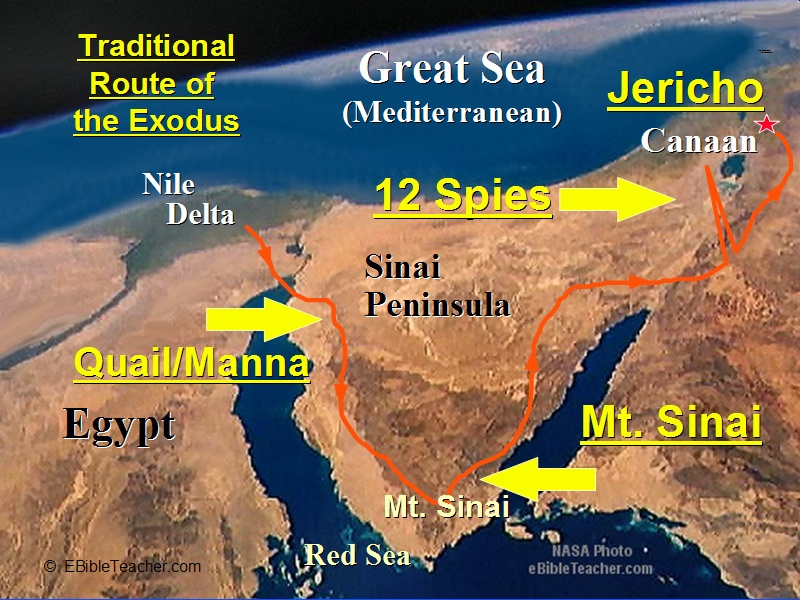
It’s possible that Jacob was, out of faith in the promises of Elohim, prophetically tracing the steps his descendants would take several generations later in entering the Promised Land. It’s almost as if Jacob was showing the future generations of Israelites the route he wanted them to take from Egypt to the Promised Land to fulfill biblical types and shadows.


Mark 16:9–20—Include or Exclude from the Bible? That is the question.

Mark 16:9–20, The Great Commission. Many modern scholars call into question the genuineness of these last twelve verses. For a discussion on whether these verses of Mark’s Gospel should be included in the Bible, see E. W. Bullinger’s (1837-1913) The Companion Bible (appendix 168). 

Bullinger states that it is true that the two oldest Greek manuscripts of the Testimony of Yeshua (from the fourth century) don’t contain these verses. On the other hand, more than six hundred other Greek manuscripts do contain them as do the oldest Syriac (Aramaic) manuscript known as the Peshitto (which Bullinger believes is from the second century) and the Curetonian Syriac (from the third century). He notes that Jerome when translating the Bible into Latin (The Vulgate, A.D. 382) had access to Greek manuscripts older than any now extant,which is why he included these twelve verses in his Bible. Additionally, he notes that the Gothic Version (A.D. 350), the Coptic (fourth or fifth century), the Armenian (fifth century), Ethiopic (fourth to seventh centuries) and Georgian (sixth century) versions all contain these last twelve verses. Bullinger goes on to say that there are nearly one hundred ecclesiastical writers before the oldest extant Greek manuscripts who attest to the authenticity of these verses. Moreover, between A.D. 300 and 600 there are about two hundred more writers who do.

Bullinger gives two reasons why he believes these verses may have been omitted from several of the oldest Greek NT manuscripts. After the destruction of Jerusalem in A.D. 70 extending forward one hundred years, there is a complete blank regarding the history of the early church and a complete silence about this era from Christian writers. Therefore, no one knows what was going on in the church during this period including whether such signs and wonders as enumerated in these last verses in Mark’s Gospel were still occurring. He speculates that when later translators came to the last twelve verses of Mark and saw no trace of these spiritual gifts currently occurring in the fourth century church, some marked them as doubtful, spurious or even omitted them altogether. This same doubt has been passed on to modern scholars.

I vote that we leave these verses in the Bible!