Author Archives: Natan Lawrence
There’s No Shalom Like Shabbat Shalom!
I just got this email question from someone:
I was wondering where it is stated in the Bible that the Sabbath is to be a day of shalom?
This was my response:
I don’t know if it’s explicitly stated anywhere in the Scriptures, but it’s certainly implicit. Here are scriptural reasons that immediately come to mind:

- YHVH sanctified the Sabbath, which means his blessing (including his shalom) is on it.
- It’s a moed or a divine appointment (Lev 23:1), which means YHVH will show up to fellowship with his people on this day. With him comes his love, joy and peace.
- Because it’s a day of rest and no work, then it naturally follows that with rest comes peace.
- For those of us who have walked in the Shabbat for a long time (and who have done Sunday as well), we know from experience that there is a special blessing of peace on the Sabbath like no other day. There is no shalom like Shabbat shalom!
- The Sabbath is a picture of Eden, and a prophetic picture of the Millennial kingdom of Yeshua when peace will reign on this earth. The weekly Sabbath is a foretaste of that peace that once was and is yet to come
There are probably some other examples that I could give, but this is what comes to mind quickly. Can you think of any biblical reasons that imply that the Sabbath is a day of peace? If so, please share.
Conservative Jewish Clergy Ordaining Homosexuals
I just read this news piece from Ha’aretz News in Israel and wanted to pass it on. This development illustrates the moral and spiritual slide going on in even the most unlikely places.
Israeli Conservative Movement Approves Ordination of Gay Rabbis
’A very important development in Jewish law,’ says President of the Israeli Conservative Movement Rabbinical Assembly.
By Revital Blumenfeld and Yair EttingerTags: Jewish World Jewish Diaspora
Israel’s Masorti (Conservative) Movement decided to approve the ordination of homosexual rabbis, in a dramatic vote on Thursday.
The Schechter Rabbinical Seminary, affiliated with the movement, will admit gay and lesbian students for training as spiritual leaders as of the upcoming school year.
![]() |
A Conservative rabbi marries a same-sex couple in the U.S. |
| Photo by: Courtesy of Gregg Drinkwater / Forward |
In doing so the Israeli Conservative Movement is joining the American branch of the movement, whose rabbinical seminaries have been admitting gay students for some years.
The question whether or not to ordain gay and lesbian rabbis has been rattling the Conservative Movement in Israel and the U.S. for the past decade. Unlike the Reform movement that took to the question with ease, deciding firmly on the acceptance of gay rabbis. The Conservative Movement, whose rabbis see themselves bound to Jewish law, has been caught up in heated debate over the subject.
Years of discussion led to two contradictory religious rulings in 2006, one requiring the ordination of gay and lesbian rabbis and another banning any such act. The two rabbinical seminaries affiliated with the movement in the U.S. move the ruling allowing the ordination, while the seminaries in Jerusalem and Buenos Aires adopted the ban on ordination. The issue nearly caused a rift in the movement.
To continue reading this story: http://www.haaretz.com/jewish-world/israeli-conservative-movement-approves-ordination-of-gay-rabbis-1.425491
Blog Scripture Readings for 4/22–4/28/12 Midrash
Aside
For the third week of seven weeks of the 50-day count of the omer.
Leviticus 25–27; Numbers 1–4; Jeremiah 15–28; and Psalms 24–30
Most of this week’s blog discussion points will be on these passages. The full year’s Bible Reading Schedule can be found on the right sidebar under “Helpful Links.”
If you have general comments or questions on the weekly Scripture readings not addressed in a blog post, here’s a place for you to post those. Just use the “leave a reply” link below.
Why Study and Celebrate YHVH’s Feasts?
Here are seven biblical reasons to celebrate the feasts of YHVH Elohim:
- The biblical feasts are a prophetic shadow-picture of things to come (Col 2:16-17; Heb 10:1). When they were given to ancient Israel they pointed forward to future events that would occur to the nation of Israel. The spring feast days, for example, pointed to Messiah’s first coming while the fall feast days point to his second coming leading into the Messianic Age (Millennium) and into eternity beyond.
- All the biblical feasts point to Yeshua. The name Yeshua means “salvation” and these days all point to the various steps of the path of salvation that believers find themselves on.
- Many of the feasts point back to historical events that occurred in Israel’s history from which we can learn lessons and that are representative of our own spiritual journey (1 Cor 10:1–6, 11).
- The people of YHVH are commanded to keep what the Scriptures call the appointed times. They are times when he makes an appointment that he will meet with his people (Lev 23:1–2, 4). It is at these festivals or commanded assemblies that YHVH teaches his people about his wonderful plan of salvation or redemption of the world through Yeshua the Messiah.
- The feasts are in the Bible and the whole Bible is the inspired word of Elohim (2 Tim 3:16). Yeshua commands us to live by every word that comes out of the mouth of Elohim (Matt 4:4).
- The feasts set forth the pattern of heavenly things on earth (Heb 8:1–2, 5; 9:8–9, 23; Exod 25:8–9, 40; 26:30; Num 8:4; Ezek 43:1–6, 10–12).
- We as physical beings need physical means and methods to help us understand spiritual mysteries. YHVH gives us the natural to help us to understand the supernatural (spiritual) (1 Cor 2:9–13).
The Torah on Abortion/Infanticide
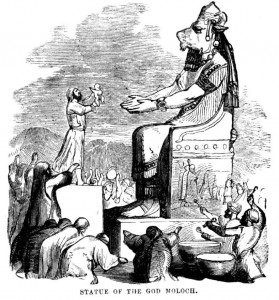
Leviticus 18:21, Pass through the fire. In the juxtapositioning of this passage directly after the Torah’s prohibition of illicit sex, it would appear that YHVH is broadcasting a clear message to his people. Extra-marital sex often results in unwanted babies. In our day, many choose to murder their undesired offspring through abortion. In ancient times, some of these unwanted children were likely sacrificed to the pagan Canaanite god Moloch by being burned alive. That is certainly the implication in this passage. Whatever the case, YHVH hates the murder of children for any reason!
This passage (along with Exod 21:22) is one of the strongest pro-life, anti-infanticide verses in the Scriptures. The penalty for those who sacrificed their children to Moloch was that the land would vomit the people out of it (vv. 25 and 28.) Could any clearer statement be made about how the Creator feels about the sanctity of life?
The murder of the innocent children is perhaps the greatest sin that a nation can commit. Abortion is a form of child sacrifice, which is something many ancient cultures practiced (the Aztecs, Incas, Phoenicians, pre-Islamic Arabs, and the biblical Canaanites). In the Bible, YHVH condemns the practice of heathens and apostate Israelites who made their children pass through the fire in worship of the demon-god Moloch (See Lev 18:21; 20:2–5; Deut 12:30–31; 18:10.) What judgment did YHVH place on the Jewish nation for sacrificing its children to Moloch? (See Jer 7:30–34; 32:35–36.)
By the way, here are some statistics about abortion:
- 42 million abortions occur worldwide each year (that’s 115,000 per day).
- In 2008, 1.21 million abortions occurred in the U.S.
- From 1973 to 2008, 50 million legal abortions occurred in the U.S.
- 22 percent of all U.S. pregnancies end in abortion.
- In 2007, 84% of all abortions were performed on unmarried women.
- At current rates, nearly one-third of American women will have an abortion.
(Sources of information: abortionno.org/Resources/fastfacts.html; guttmacher.org/pubs/fb_induced_abortion.html; abort73.com/abortion_facts/us_abortion_statistics/)
If It Looks Like a Duck… It Must Be Xmas!
Jeremiah 10:1, Do not learn the way of the nations. This passage is familiar to a few people, but unfamiliar to the majority. After YHVH’s admonition to his people to not follow the idolatrous customs of the heathen nations, Jeremiah describes one of their “futile” or “vain” (literally, empty or meaningless) customs—one with which we are all familiar! What follows is a perfect description of a Christmas tree minus the star on top, twinkle lights and a few other garish ornamentations. Some ardent devotes of Christmas aver that Jeremiah’s tree is not a Christmas tree, since this passage was penned long before the birth of Christ. This is true. However, much later (in about the fifth century AD) the church simply added “Christ” to a pagan custom that long pre-existed the birth of the Messiah. Therefore, as the expression goes: If it looks, acts and sounds like a duck, it must be one!

But what is the greater message of this passage in the larger context of the surrounding scripture verses? This is often overlooked. Understanding context is perhaps the greatest key to understanding the truths of the Bible!
Before and after Jeremiah’s description of the modern Christmas tree, are numerous lamentations about YHVH’s people abandoning his Torah-laws for heathen and carnal practices (e.g., 8:9; 9:13–14). They have backslid spiritually (e.g., 8:5–6) by turning to the idolatrous practices of the surrounding pagan nations (e.g., 8:19; 10:8–9, 14–15). Even their shepherds (spiritual leaders such as pastors have become brutish or dull-hearted in this regard and have turned away from YHVH (e.g. 10:21).
In the midst of Jeremiah’s woeful lament over Israel’s spiritual declension are warnings from the Almighty about the judgments that will come upon Israel if it fails to repent and turn from its heathen ways (e.g. 8:13, 15–19; 9:7–12, 15–22, 25–26; 10:10–11; 17–25).
Perhaps YHVH’s greatest accusation against his people comes in the last verse of chapter 9, just before the description of the Christmas tree. YHVH accuses the people of Israel of being “uncircumcised in heart.” This is a biblical expression that means that a person’s heart is hardened or calloused to the truth of YHVH as revealed in his Word. Such a person is more inclined to follow the ways of the world, the flesh and the devil than to love YHVH Elohim by obeying his commandments (see John 14:15) whether it’s convenient, expedient or popular or not (note what Yeshua says in John 12:43).
We’ve all heard the excuses… “I can’t give up Christmas because…. Our family… My mother-in-law… My kids… What will people think if…” You fill in the blanks. More Importantly, what does YHVH Elohim say about this? Well, he tells us quite clearly and unmistakably in Jeremiah 10 and the surrounding chapters!