Vine … Branches: A Lesson From Tree Anatomy

John 15:5, I am the vine, you are the branches. Yeshua likened his followers to tree branches that when attached to him will produce much fruit. Let’s examine tree biology to see what we can learn spiritually from how trees operate.

Trees are phototropic. Tropism is the orientation of the direction of the tree’s growth in response to external stimulus. The leaves of a tree are phototropic. They orient themselves to catch the maximum energy from the sun’s light.

  • Spiritual parallel: Yeshua is the Sun of Righteousness (Mal 4:2) whose face shines like the sun (Rev 1:16), and the righteous man orients himself to catch the light and energy from Yeshua.

Trees are geotropic. They grow away from the earth and toward heaven.

  • Spiritual parallel: The spirit of righteous man must reach toward Elohim in heaven, though he came from the earth and the feet of his flesh are planted firmly in this world. His soul is in the middle with both heaven and earth battling for control over it.

Continue reading


What Is it to “Abide in Yeshua”?

John 15:1–10, Abide in me.
The term abide is found nine times in this passage. Seven of the those nine times are in reference to abiding in Yeshua or his Father. Seven is the biblical number of completion or perfection. When we abide in Yeshua and his Father, then we’re made perfect or complete in all areas of our life: spiritually, physically, mentally, and emotionally.

Let’s explore what it means to abide in Yeshua so that we produce good spiritual fruit for our Master and Savior.

  • We are made clean/katharos [to be made pure, blameless, innocent; free of corrupt desire, sin, guilt and from that which is false] through the Word of Elohim (John 15:3, 7).
  • We must continue/abide in the love of Yeshua by keeping his/the Father’s commandments (John 15:10).
  • We must love one another (John 15:12–17).

We must practice the key elements Yeshua taught in the Sermon on the Mount.

  • We must do the beattitudes (Matt 5:3–12)
  • We must love the Torah (Matt 5:17–19)
  • We must love our enemies (Matt 5:21–26, 38–42).
  • We must keep our word (Matt 5:33–37).
  • We must be a charitable giver (Matt 6:1–4).
  • We must pray without ceasing (Matt 6:5–15; 1 Thess 5:17).
  • We must fast regularly (Matt 6:16–18).
  • We must flee materialism and greediness (Matt 6:19–21).
  • We must set our life’s priorities spiritually straight — seek first the kingdom of Elohim in all that you do (Matt 6:24–34).
  • We must seek Elohim’s help/trust in him in every way in all that you do, say and think (Matt 7:7–11).
  • We must live by the golden rule (Matt 7:12).

What are the results of abiding in Yeshua?

  • Being made clean, pure, free of sin, corruption, defilement and guilt (John 15:3).
  • Bearing much fruit (John 15:5). What fruit? The fruit of the Spirit (Gal 5:22–25).
  • Avoiding the (lake of) fire (John 15:6).
  • We can ask whatever we want of the Father and he will give it to us (John 15:7, 16).
  • Glory comes to the Father as a result of our bearing much fruit (John 15:8).
  • We are filled with joy (John 15:11).
  • We become the friends of Yeshua (John 15:14).
 

Nuggets in Isaiah

Here are some precious pearls and gold nuggets from the first several chapters of Isaiah. Bon appetite!

Isaiah 6:3, Holy, holy, holy. (Also Rev 4:8.) Since these are the words of worship being proclaimed to Elohim in his throne room continually, then holiness must be his chief attribute—not love, mercy, grace, etc. as many in the church teach and believe.

Isaiah 6:8, Us. Here is another proof of the plurality of the Godhead. Compare this with Gen 1:26; 3:22; 11:7 and Matt 28:19.

Isaiah 7:11 and 14, Here is a scripture proving the virgin birth of Yeshua. (See http://www.hoshanarabbah.org/pdfs/vbirth.pdf .)

Isaiah 8:14, A stone of stumbling. This an obvious reference to Yeshua who is a stone of stumbling to both houses of Israel (i.e., the non-believing Jews and the Christians.) The Christians stumble over or reject (at least, in part) Yeshua who is the Written Torah-Word of Elohim (John 1:1). The non-believing Jews, on the other hand, reject Yeshua, the Living Torah-Word of Elohim who came in flesh form (John 1:14).

Isaiah 8:16, Bind up the testimony. Here Isaiah is prophesying the canonization of the NT by the disciples of Yeshua (who is mentioned in verse 13). Did you know that the NT’s name for the NT isn’t the NT, but the Testimony of Yeshua—a name that John who finalized the NT canon gave it when he was writing the Book of Revelation? There, he calls the OT/Tanakh  the “Word of God/Elohim” and the NT “the Testimony of Yeshua” (see Rev 1:2, 9; 6:9; 12:17; 14:12; 20:4). If you didn’t know that John canonized the NT before his death, read my article on the subject (http://www.hoshanarabbah.org/pdfs/nt_canon_full.pdf .)

Isaiah 9:7, Increase. Here is another proof of the virgin birth of Yeshua. How you say? You have to dig into the Hebrew on this one. (See my article http://www.hoshanarabbah.org/pdfs/closed_mem.pdf .)

Isaiah 11:11–16, The second exodus. This is one of the main Tanakh passages on this subject. It’s too detailed to discussed in this blog. Stay tuned to a full-scale teaching that I have written on the second exodus, which is about to be published on the hoshanarabbah.org website.

Isaiah 12:2 literally says, “God/Elohim is my salvation/Yeshua…He [YHVH Elohim] has become my salvation/Yeshua.” Then verse 3 says, “Therefore with joy you will draw waters from the wells of salvation/Yeshua.” This verse was quoted on Hoshana Rabbah (the last or seventh day of Sukkot) during the water pouring ceremony. Yeshua referenced this in John 7:37–38. Can anyone shout HALLELUYAH (!) for this Tanakh passage that not only proves the deity of Yeshua, but shows how Yeshua fulfilled the OT prophecies like no one else ever did!


Back to the Future with Moses at Mount Sinai

Moses’s bringing the children of Israel into a covenantal (marriage) agreement with YHVH at the foot of Mount Sinai contains powerful prophetic symbolism that applies to us now. Point-by-point, it foretold the steps that Yeshua would take through his death on the cross as he brought the spiritually lost (you and me) into a covenantal (marital) relationship with him.

Exodus 24:6, Moses sprinkled half the blood of a sacrificed animal on the altar, which prophetically pointed to Yeshua shedding his blood on the cross, so that we might enter into a covenantal relationship with YHVH. The wine Yeshua drank at the last supper that ratified the Renewed Covenant signified the blood he was about to shed at the cross (Matt 26:26–28). When we as redeemed believers drink the third cup (i.e., communion) of the Passover Seder and eat the bread, we are signifying our marital commitment to YHVH-Yeshua. We are accepting the terms (our marriage agreement or ketubah) of the covenant—the Renewed Covenant, which includes the Torah being written on our hearts by the Spirit of Elohim (Jer 33:31–33; Heb 8:8–10).

Exodus 24:7, Israel agreed to the terms of the ketubah the third time (see also Exod 19:8 and 24:3). As Israel pledged loyalty and obedience to YHVH, even so, we also must confess with our mouths and believe in our hearts that Yeshua was raised from the dead, and then walk in righteousness, which is obedience to the Torah (Rom 10:9–13; Ps 119:172).

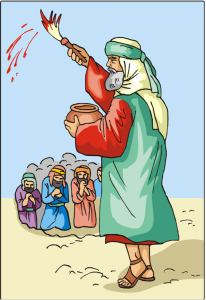
Exodus 24:8, Moses sprinkled the blood of an innocent animal over the people, which is a prophetic picture of Yeshua shedding his blood at the cross for the redemption of sinners from the penalty of sin, so that they might enter in a sinless state into a covenantal relationship with YHVH (Heb 9:18–22).

Exodus 24:9–12, Only after the blood of the sacrificed animal was shed and sprinkled over the people were the elders permitted access into the Presence of Elohim. Only through the shed blood of Yeshua and through the veil of his flesh are we able to come boldly to Elohim’s throne of grace (Heb 10:19–20; 4:16).


Did Yeshua Break the Sabbath?

John 5:18, [Yeshua] … broke the Sabbath. Listen to an interesting and sad, but true story. About ten years ago, I was in a meeting where a Bible teacher was giving a message on the end times. In the middle of his teaching and totally out of context, he quoted this passage from John and claimed that Yeshua broke the Sabbath. There was a rustle in the audience of about 300 people. A little later, he made the same statement again and began to deride the Sabbath. This time there was an audible moan from some in the audience—many of whom were Sabbath keepers. I felt like he had hit me in the gut. A little later, he made the same statement again, and continued to bash Sabbath observance. This time, I could hold my peace no longer. I stood up and challenged him in the middle of the meeting. To say that Yeshua had broken the Sabbath was to call Yeshua a sinner, and that Yeshua had not broken the Sabbath, but some Jewish legal traditions (or halakhah) pertaining to the Sabbath. The speaker was flustered and had no response, and the host of the meeting decided to take an intermission.

A year later, this Bible teacher had suddenly and unexpectedly dropped dead in the pulpit while preaching. I can’t help but wonder…. Had this false teacher simply pulled down a concordance from his bookshelf and looked up the word broke in the Greek, and had read John’s statement in verse 12 in the context of verses 8–10, he wouldn’t have been teaching this blasphemous heresy about our Master and Redeemer!

Here is the explanation of this passage:

The word broke is the Greek word luo meaning “to loose, untie someone or something bound, to dissolve, destroy.” According to The Theological Dictionary of the NT, luo means “to free from prison, open something closed; destroy fetters, foundations, walls; to release.”

What Yeshua was breaking was the Jews’ extra-Torah legal traditions that made the Sabbath a burden by prohibiting the alleviation of human suffering and need on this day (John 5:8–10). He was in no way violating the Torah, since there is no Torah prohibition from healing on the Sabbath or carrying one’s bed roll.

In attempting to follow the Torah through men’s traditions, many of the Jews of Yeshua’s day had actually omitted the weightier matters of the Torah (justice, mercy and faith, Matt 23:23), and had forgotten that YHVH is more concerned with heart issues rather than religious legalism, since he desires mercy over sacrifice, and the knowledge of Elohim over burnt offerings (Hos 6:6).


Who Is the God of the Old Testament: Yeshua or the Father?

John 1:1, The Word was God [Elohim]. Is Yeshua or the Father the God (Elohim) of the Old Testament (Tanakh)?

For many believers in Yeshua, there is confusion as to who it was in the Godhead who interacted with the Israelites in the Tankah. Was it the Father or the Son?

In the minds of the apostolic writers, there was no confusion about this. Yeshua, in his preincarnate state, was the One that YHVH Elohim the Father used to both create and then to interact with mankind. He was the Word of YHVH Elohim, the Father, who become flesh and dwelt among men (verse 14). This truth is easily confirmed in several passages in the Testimony of Yeshua (New Testament).

First, Yeshua himself claims to be YHVH or the I Am of the burning bush (see John 8:58 cp. Exod 3:14). The Jews viewed Yeshua’s claim as blasphemous, which is why they picked up stones to kill him (John 8:59).

Next, Yeshua in declaring to the Jewish religious leaders that “I send you prophets, wise men and scribes: some you will kill…” (Matt 23:34), he is claiming the rights and prerogatives of YHVH—a right and role that solely belonged to YHVH in the Tanakh.

Yeshua also declared that no man has seen the face of Elohim the Father (John 5:37). Yet in the Torah, we have several instances of men seeing YHVH (e.g., Gen 17:1; 18:1; 26:2; 48:3). If we are to take what these scriptures say as literal, then it could not have been YHVH the Father these individuals saw, but YHVH the Son who later become Yeshua.

Not only that, Yeshua even goes so far as to say that the Israelites of old not only didn’t see the Father’s face, but neither at anytime even saw his form nor heard his voice (John 5:37). Therefore, it becomes evident that while on Mount Sinai, Moses didn’t see the backside of the Father, but of the pre-incarnate Yeshua (Exod 33:18–23).

What’s more, in John 14:15, Yeshua, speaking to his disciples, declares, “If you love me, keep my commandments.” When Yeshua says commandments here, we know from Luke 18:20 that he has the Torah in mind. In this statement, Yeshua is actually quoting himself when he made the same statement to the children of Israel while he was delivering to them the Oracles or Torah of Elohim (Exod 20:6; Deut 11:1).

Stephen, in agreement with John, clearly demonstrates that Yeshua was the prophesied “prophet like Moses” who was to come (see Deut 18:15), and who was the Angel, or more correctly, the Divine Messenger from Elohim, who gave the Torah to the Israelites (Acts 7:37–38).

Paul goes on to say in enigmatic terms that Yeshua was the spiritual rock from which the Israelites drank and that followed them (1 Cor 10:4). And finally, Paul equates Yeshua, “the Word of Elohim made flesh and that dwelt among us” (John 1:14) with the Written Torah that YHVH gave through Moses to the Israelites. This he does when he quotes Deuteronomy 30:11–14 and substitutes the word Torah for Yeshua (see Rom 10:5–13). In Paul’s mind, Yeshua was not only synonymous with the Torah, but he was very much present with the children of Israel.

Do you have some additional proofs from the Testimony of Yeshua to share with this blog family that show how Yeshua is the God of the Old Testament?

 

Yeshua, the Song of Moses and End-Times Prophecy

Exodus 15:1, This song. This Song of Moses may be more aptly titled, “The Song of the Redemption,” for it is a song about our Heavenly Redeemer, as we shall now discover.

I will sing. Will this Song of Moses be sung again in the future? In Revelation 15:3, we see that the glorified bride of Yeshua will be singing the Song of Moses. Why is she singing this joyous song? Because YHVH has delivered her from his judgments of wrath that he is pouring out upon a wicked end-times world. These same redeemed Israelites are those whom YHVH has brought out of Babylon the Great as part of the second exodus of redeemed Israelites from the nations where they have been long scattered and spiritually enslaved. The Song of Moses here (in Rev 15:3) also relates to the Song of the Lamb. As we shall see next, the Song of Moses in Exodus 15 does relate to Yeshua the Lamb.  Continue reading