The Torah and Testimony—A Stone of Stumbling

In the following several verses we see an amazing prophecy concerning the two houses of Israel who, generically speaking, have become the modern church and the rabbinic Jews.

Here Isaiah prophesies about the canonization of the Bible into two subdivision—the Torah (or loosely speaking, the Old Testament) and the Testimony (the New Testament). He also predicts that each of these two religious groups (the Jew and he Christians) would spiritually stumble over or have a problem with the identity of the Messiah, who is the Stone of Stumbling and the Rock of Offense. In general, as we shall see, the Christians struggle with the pro-Torah message of the Old Testament (or Word of Elohim), and the Jews reject the message of the New Testament (or Testimony of Yeshua) about the Messiahship of Yeshua.
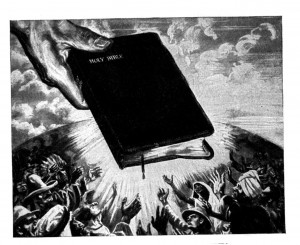
Bible for the world

Isaiah 8:14–15, Stone of stumbling. Both houses of Israel (Ephraim and Judah; i.e., the Christian [see notes at Gen 48:14,16] 48: and the Jews) have stumbled over the stone of stumbling, who later on is identified as Yeshua, the Messiah (1 Pet 2:4–8; Rom 9:32–33; 1 Cor 1:23). The non-believing Jews stumbling over the Messiahship of Yeshua who is the Living Torah-Word of Elohim incarnate (John 1:1,14), while the Christians stumble over the Written Torah, which they claim was abolished and is minimally relevant to them.  This stone of stumbling is an obvious reference to Yeshua who is a stone of stumbling to both houses of Israel (i.e., the non-believing Jews and the Christians.) The Christians stumble over or reject (at least, in part)Yeshua who is the Written Torah-Word of Elohim (John 1:1). The non-believing Jews, on the other hand, reject Yeshua, the Living Torah-Word of Elohim who came in flesh form (John 1:14). Continue reading


 

New Video: YHVH’s Plan of Salvation in the Seven Biblical Feasts

In this video, learn how the seven biblical feasts as outlined in Leviticus 23 are YHVH’s seven-step plan of salvation (or redemption) for mankind. They are the chronological template of the seven steps each one must take to go from being a slave to the world, flesh and the devil in the spiritual Egypt of this world to becoming a child of Elohim (God) forever in the New Jerusalem. The feasts show man how to be reconciled to our Father in heaven through Yeshua the Messiah.

Watch this video now at


Did Yeshua Break the Sabbath?

John 5:18, [Yeshua]… broke the Sabbath. Listen to an interesting and sad, but true story. Many years ago, I was in a meeting where a Christian Bible teacher was giving a message on the end times. In the middle of his teaching and totally out of context, he quoted this passage from John and claimed that Yeshua broke the Sabbath. There was a rustle in the audience of about 300 people. A little later, he made the same statement again and began to deride the Sabbath. This time there was an audible moan from some in the audience — many of whom were Sabbath keepers. A feeling of being hit in the gut went through me. A little later, he made the same statement again, and continued to bash Sabbath observance. This time, I could hold my peace no longer, and I stood up and challenged him in the middle of the meeting. I told him that to say that Yeshua had broken the Sabbath was to call Yeshua a sinner, and that Yeshua had not broken the Sabbath, but some Jewish legal traditions (or halakhah) pertaining to the Sabbath. The speaker was flustered and had no response, and the host of the meeting decided to take an intermission.

A year later, it was announced that this Bible teacher had suddenly and unexpectedly dropped dead in the pulpit while preaching. One can’t help but wonder…

Yeshua didn't come to set men free from the Sabbath. He came to set the Sabbath free from men's unbiblical traditions.

Yeshua didn’t come to set men free from the Sabbath. He came to set the Sabbath free from men’s unbiblical traditions.

Had this false teacher simply pulled down a concordance from his bookshelf and looked up the word broke in the Greek, and had read John’s statement in verse 12 in the context of verses 8–10, he wouldn’t have been teaching this blasphemous heresy about our Master and Savior!

Here is the explanation of this passage: The word broke Continue reading


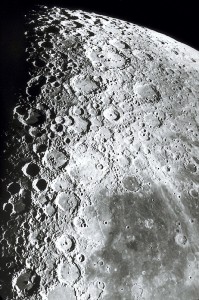
The Moon—Pockmarked Like Us

Elohim made two great lights to shine in the darkness—the sun (the greater light) and the moon (the lesser light) (Gen 1:16). The sun is a spiritual picture of Yeshua whom the Bible calls the Light of the world (John 1:9; 8:12), the Sun of Righteousness (Mal 4:2), whose face shines like the sun (Rev 1:16), and who will be the light of the New Jerusalem replacing the physical sun (Rev 21:23).

Moon 19002709

But who does the moon represent in this spiritual picture? If the sun is a picture of Yeshua, the Light of the World, then who has been tasked with the responsibility of reflecting Yeshua’s light into the spiritual darkness of this world? Of course, this is the job of the saints who Yeshua called to be a like light on a hill (Matt 5:14), or a menorah lamp stand (Rev 2:1).

Now think about this. Although the moon is a quarter of a million miles from the earth, because it has no atmosphere to absorb the sun’s light, it is able to reflect the sun’s light to this earth so that a person is able to see in the darkness of night. The amazing thing is that the moon’s surface isn’t a polished mirror. Rather, it’s a dull rocky surface. Not only that, it’s not even flat. It’s pockmarked—covered with huge craters, mountains, valleys and canyons. With such an uneven, gray and nondescript surface, it seems miraculous that it’s even able to reflect any light at all, much less all the way to the earth! This speaks to the unimaginable power of the sun to throw its light such a great distance through space and then to ricochet it off the moon earthward even though the moon’s surface is anything but reflective.

The moon is a perfect picture of each of us. We are nondescript in appearance, possess rough natures, stony hearts, gray dispositions, barren of spiritual fruit, possessing no power of our own, pockmarked by sin, covered by mountains of human pride, and etched with canyons of guilt and shame. In truth, YHVH has not chosen many wise or noble people to reflect the light of his Son, Yeshua, the Sun of Righteousness, but instead he has chosen the weak, foolish, despised and base things of this world to put to shame the things that are wise (1 Cor 1:26–28). As the lesser light, like the moon is to the sun, YHVH has called the saints to be his sons of light (Luke 16:8; John 12:36; Eph 5:8; 1 Pet 2:9) to shine the Light of Yeshua into the midst of a crooked and perverse world (Phil 2:15).

Since Yeshua has called us out of spiritual darkness into his marvellous light, let us embrace and demonstrate the fact that he calls us a chosen generation, a royal priesthood, a holy nation and his own special people by being ready and quick to proclaim his praises to everyone everywhere every time (1 Pet 2:9)!


The Prophetic Implications of Water to Wine

Yeshua’s First Recorded Miracle: Water to Wine

John 2:1–12— And the third day there was a marriage in Cana of Galilee, and the mother of Yeshua was there, and both Yeshua was called, and his disciples, to the marriage. When they wanted wine, the mother of Yeshua said unto him, “They have no wine.” Yeshua said unto her, “Woman, what have I to do with you? Mine hour is not yet come.” His mother said unto the servants, “Whatever he says unto you, do it.” And there were set there six water pots of stone, after the manner of the purifying of the Jews, containing twenty or thirty gallons apiece. Yeshua said unto them, “Fill the water pots with water.” And they filled them up to the brim. And he said unto them, “Draw out now, and bring it unto the superintendent of the dining room.” And they brought it. When the superintendent of the dining room had tasted the water that was made wine, and knew not where it came from (but the servants which drew the water knew;) the superintendent of the dining room called the bridegroom and said unto him, “Every man at the beginning does set forth good wine; and when men have well drunk, then that which is worse, but you have kept the good wine until now.” This beginning of miracles did Yeshua in Cana of Galilee, and manifested forth his glory; and his disciples believed on him. After this he went down to Capernaum, he, and his mother, and his brethren, and his disciples, and they continued there not many days.

Water to wine 20438978

Prophetic Points to Analyze:

  • verse 1— and the third day
  • verse 1— a marriage
  • verse 1— in Cana of Galilee
  • verse 3— wine
  • verse 6— six water pots of stone
  • verse 7— water
  • verse 10— old versus new wine
  • verse 11— this was the first miracle of Yeshua’s ministry

“And the third day there was a marriage in Cana of Galilee …” The phrase “the third day” is a prophetic term meaning “in three thousands years” or “in the third millennia” (cp. Gen 22:4; Exod 19:11; Hos 6:2). In this passage, “the third day” is pointing to the time when there will be a marriage between Yeshua and his bride (the saints, Rev 19:7–9).

The wedding occurred at Cana of Galilee. Galilee is in the historic homeland of the house of Israel (Ephraim) or Northern Kingdom, yet in the time of Yeshua Continue reading


Make No Mention

Exodus 23:13, Make no mention of the name of other gods, neither let it be heard out of your mouth. (See also Ps 16:4.) Not only is YHVH against the worship of pagan deities and wants their names to be destroyed (Deut 12:3), but he says that he will take from the lips of his people the names of pagan deities (Hos 2:17), and eventually, he will restore a pure language (presumably one that is free of pagan names) to his people (Zeph 3:9).

256826

Living this Torah principle out today is difficult in view of the fact that such common things as the days of the week and some of the months of the year are named for pagan deities making normal communication without using these names difficult. Nevertheless, the redeemed righteous of YHVH will endeavor to be mindful of this command and speak as cleanly as possible.

In our modern society, only a few people worship ancient pagan deities. In our materialistic and secular society, people are more likely to worship themselves, money, the mind of man, pleasure, power, fame, sex, entertainment, education, possessions, success or whatever else is first place in their lives ahead of YHVH Elohim.

By the way, the name Jesus doesn’t derive from the name of the Zeus, the name of a pagan Greek god, as some have erroneously claimed.


The Prophetic Implications of the The Song of Moses

Exodus 15:1, This song. This Song of Moses may be more aptly titled, “The Song of the Redemption,” for it is a song about our Heavenly Redeemer, as we shall now discover.

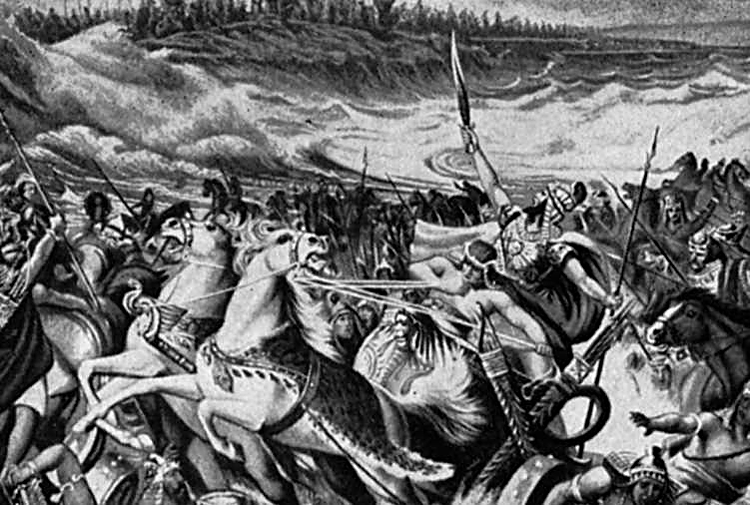
Pharaoh and his army drowning in the Red Sea.

Pharaoh and his army drowning in the Red Sea.

I will sing. Will this Song of Moses be sung again in the future? In Revelation 15:3, we see that the glorified bride of Yeshua will be singing the Song of Moses. Why is she singing this joyous song? Because YHVH has delivered her from his judgments of wrath that he is pouring out upon a wicked end times world. These same redeemed Israelites are those whom YHVH has brought out of Babylon the Great as part of the second exodus of redeemed Israelites from the nations where they have been long scattered and spiritually enslaved. The Song of Moses here (in Rev 15:3) also relates to the Song of the Lamb. As we shall see next, the Song of Moses in Exodus 15 does relate to Yeshua the Lamb. Exodus 15:2, The LORD [Heb. Yah]. Yah is the shortened form of YHVH. The verse goes on to say about this same Yah “that he has become my salvation [Heb. Yeshua].” It literally says that YHVH has become Yeshua! This is yet another Tanakh (OT) prophecy confirming the deity of Yeshua. I will praise him. The KJV translates this phrase as “I will prepare him a habitation.” The ArtScroll Stone Edition Tanach has, “I will build him a sanctuary.” Couple this with verse 17, which speaks of “the sanctuary [Heb. miqdash],” which YHVH has made for his dwelling, and we have a solid reference to the Tabernacle of Moses, which YHVH instructed the Israelites to build, so that he could dwell among them (Exod 25:8), and commune with them (verse 22). What’s more, everything in the tabernacle pointed to Yeshua, the salvation of YHVH, and to his death on the cross to redeem man from sin and bring him into close communion with the Father in heaven! Exodus 15:6,12, Your right hand. Three times this phrase is found in the Song of Moses. Who is the outstretched arm or YHVH? It is Yeshua (Isa 53:1 cp. Isa 52:10; 40:10; Ezek 20:34–35) who is presently at the right hand of Elohim (e.g., Rom 8:34; Col 3:1; etc.). Exodus 15:12, The earth swallowed them. Even as the earth (or seas) swallowed up Pharaoh (a picture of Satan) who was attempting to destroy YHVH redeemed people, the earth will come to the rescue of the end times saints who have fled into the wilderness after leaving the Babylon the Great world system (Rev 12:16).