New Video: Elijah and John the Baptist Generations—Rise Up Against Evil!

In the end times before the second coming of Yeshua (Jesus) the Messiah, Elohim (God) is raising up a new generation of righteous servants who will boldly and in the power of the Holy Spirit stand against evil on this earth preparing the way for Messiah. They will walk in the powerful anointing of Phinehas, David, Elijah and John the Baptist. In this video, find out if you’re called to be part of this end-times army of spiritual warriors.


Q & A From the Mail Box: Is Yeshua on the Father’s Throne?

Question:
From Susan: Is there a Scripture that shows Jesus is on the throne as God?
21123161
Answer:
First, John 1:1 says that Yeshua is God (in Hebrew: Elohim). He is called God in other places in the NT (or Testimony of Yeshua) as well (e.g., Tit 2:13; 3:4).
Second, in the Book of Revelation, there is only one throne mentioned (e.g. Rev 3:21; 4:5; 5:6,13; 7:10, 11, 17; 22:1), not two or three, as is often supposed; that is, one for the Father, the Son and the Holy Spirit. Please note Rev 22:1 where it mentions the throne (singular) of God and the Lamb. The Scriptures reveal that Yeshua is both the Lamb of God (John 1:29; 36) and God (Elohim).
What else can we deduct from this except that Yeshua is on the same throne with his Father, that they are one (Hebrew: echad meaning “a compound unity”). Also note Rev 3:21 where Yeshua says that he will sit down on his Father’s throne (singular). The word throne can be taken literally or metaphorically, but even so, it’s still singular, and it’s his Father’s throne and he’s on it (note also Rev 7:17). It must be a rather large throne!
 

Know Yeshua, No (Longer) Gentile

Ephesians 2:11, Gentiles. Paul says in a number of places that those who come to Yeshua are no longer Gentiles but are the children or seed (literally “sperm,” which is the meaning of the Greek word) of Abraham (Eph 2:11–19; Rom 4:16; 9:8–11; Gal 3:7,9,14,28–29). The word Gentiles as used in the Scriptures (both in the Hebrew and the Greek languages) simply means “ethnic groups or nations.” There are many places in the Scriptures where Jews and Israelites are referred to as “Gentiles.” There is no class of people called Gentiles in the spiritual body of Yeshua. Scripture uses the following terms for the redeemed of YHVH: the saints, the called out ones (or church), the body of Yeshua (1 Cor 10:16; 12:27; Eph 4:12) the one new man (Eph 2:15), sons of Elohim (Rom 8:14, 19; Phil 2:15; 1 John 3:1, 2), children of Elohim (Rom 8:16, 21; Gal 3:26; 1 John 3:10), or Abraham’s offspring (Gal 3:29), the bride (Rev 18:23; 21:2, 9; 22:17) for example.

Cross at St. Augustine

Any attempt by anyone to keep the Jew—Gentile division alive within the body of Yeshua is in effect keeping up the middle wall of partition that the Apostle Paul gave his ministry life and eventually his physical life to tearing down (see Eph 2:11–19). It is also going against the clear teaching of the Scriptures, which say that within the spiritual body of Yeshua, there is no longer Jew or Gentile/Greek (Rom 10:12; Gal 3:28; Col 3:11).

The Scriptures reveal that there are only two classifications of people: Israelites and non-Israelites or Gentiles. The former has eternal life because of their relationship with the Elohim of Israel through the Messiah of Israel. The latter group, unless they repent of their sin (i.e., lawlessness or Torahlessness, see 1 John 3:4), will burn in the lake of fire because their names weren’t written in the book of life (Rev 20:11–15).

Whenever Paul uses the term Gentiles, he is either referring to ethnicity, and not using the Continue reading


New Video: Are You a Light on a Hill?

Yeshua  commanded  his disciples (that’s you and me) to take the gospel message to the world and to make disciples. This is called the Great Commission. Sadly, many view it as the Great Suggestion, and as such, for most believers, spreading the gospel has become the Great Omission. In this video, Natan will challenge you to help spread the good news of Yeshua (Jesus) by being like a light on a hill to those around you.


The Serpent on a Pole, Yeshua and Us

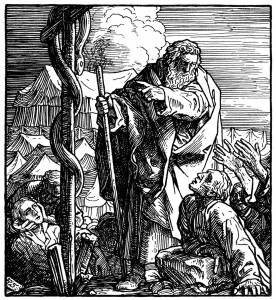
Numbers 21:4–9, Fiery serpent. The fiery serpents were a righteous judgment Elohim brought upon Israel for murmuring and unbelief. Israel had “sharpened their tongues like a serpent” (Ps 140:3) and “their throat [was] an open sepulcher; with their tongues have … used deceit; the poison of asps [was] under their lips” (Rom 3:13). All this was directed at Elohim and Moses. They reaped what they had sown. Elohim loosed fiery serpents upon the Israelites to bite and sting to death the unbelieving murmurers.

176144

The wilderness Elohim led them through was full of fiery serpents and scorpions (Deut 8:15), yet this is the only account in the Torah of these creatures ever attacking Israel. YHVH had protected them to this point and just this once he pulled back his hand of providential protection and grace allowing them to experience the due recompense of their sinful actions. How often has our merciful Father withheld the just desserts of our faithless, rebellious and abominable action against him and gracefully protected us from the full consequences of our sin? If we fail to hear his soft voice of correction he will deal more harshly with us until our attention is gained (Ps 32:8–9). All he has to do is withdraw his hand of protection that restrains the judgments we all deserve and the “fiery serpents” will likewise attack us. What happened to Ananias and Sapphira in the book of Acts is an example of this (Acts 5:1–11). Job experienced a similar situation as well.

Israel’s Murmuring. Israel complained for lack of food and water. In unbelief they concluded and confessed (literally prophesied upon themselves a curse) that they would die in the wilderness. Elohim gave them the fulfillment of their faithless delusions—serpents to sting them and leave them physiologically in a parched and burning condition. (The poison of these snakes actually leaves the victim burning with a fiery pain in his body and a desperately dry and thirsty condition [See Adam Clarke’s Commentary, vol. 1, p. 684]). Continue reading


The Life of Yeshua in the Bread and Wine

1 Corinthians 11:23, This is my body. We are sanctified through the offering of the body of Yeshua (Heb 10:10). When we eat the bread of communion, we are “eating” Yeshua who is the incarnate Word of Elohim (John 1:14). We are announcing that Yeshua is the spiritual bread of life from heaven that leads to eternal life (John 6:48–51), and we are announcing our desire to live by the totality of his Word (Matt 4:4).

Communion 2

The bread symbolizing the body of Yeshua was unleavened, which is a picture of Yeshua’s sinless life. By eating this bread, we declare our faith in his sinless life by which he was able to pay for our sins. We also declare our identification with his sinlessness as an example for us to follow.

Yeshua took the unleavened bread and broke it signifying our deliverance from our sin nature by the breaking or death of his sinless body. The unleavened bread broken in the Lord’s supper speaks of our deliverance from the power of sin by the death of our old man. The rite of baptism is a picture of this (Rom 6:4–13). This paves the way for us to live a sanctified (sin-free) life.

We become unleavened or sinless (known as sanctification) because Yeshua our Passover Lamb was sacrificed for us (1 Cor 5:7). Continue reading