Introduction to the Study of Genesis 28:10–22
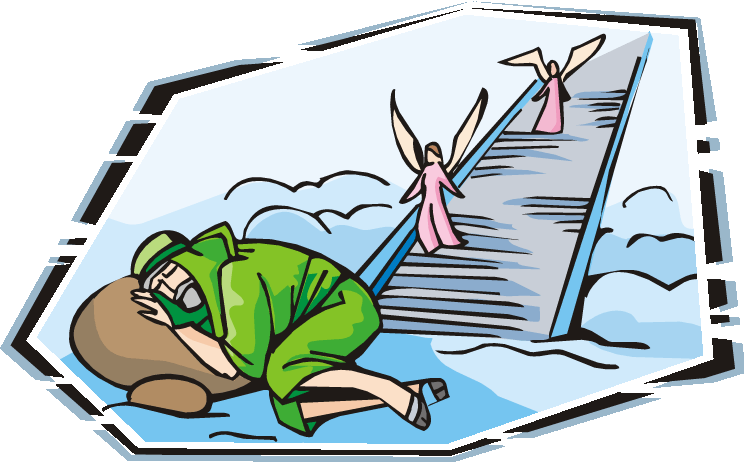
Jacob’s vision of a ladder to heaven is one of those enigmatic scriptural passages which has befuddled the
keen intellects of many Bible scholars down through the ages. Perhaps the deeper elucidations of Jacob’s
vision has escaped the reader as well. If so, you are not alone, for even well-known Christian commentators such as Matthew Henry and Adam Clarke struggled to find the deeper meaning of this allegorical dream but fell short of an adequate explanation. They realized that it had something to do with the Person of Yeshua the Messiah and his heaven-ordained ministry to reconcile earth’s inhabitants to their Heavenly Father and Creator but had little more to say on the matter. Keil and Delitzsch don’t even connect Jacob’s dream to the Person of Yeshua. Other than vague explanations as to the dream’s interpretations, these esteemed scholars have nothing more to proffer the reader. Little if anything is said of the allegorical meaning of the ladder, the dust, the stones (plural) becoming a stone (singular) or of the significance of “the place.” Even the unusually insightful biblical scholar Arthur W. Pink in his book, Gleanings In Genesis,though he draws 101 parallels between Joseph and Yeshua the Messiah, gives the reader no more insights into the spiritual and prophetic implications of Jacob’s ladder than do Henry and Clarke. This is some of the best that Christian scholars have to offer on this subject. As we are about to discover, below the tip of this gigantic biblical iceberg there is a vast revelation of truth in Jacob’s prophetic and allegorical dream that is waiting to be explored.
But before delving into the prophetic and symbolic significance of Jacob’s ladder dream, perhaps Jewish Torah scholars have something to offer us. It goes without saying that the traditional Jewish interpretations will be devoid of any references to Yeshua the Messiah, but otherwise, perhaps we glean some pearls of understanding from them anyway. After all, these sages have been studying this passage for more than 3800 years! Curiously, Shlomo Yitzchaki known by his rabbinic acronym as Rashi and viewed by many Jews as the greatest Torah expositor of the last 1000 years, has little to add to our understanding as does Samson Raphael Hirsch, the great nineteenth-century rabbinic Torah scholar. The Baal HaTurim in his Torah commentary adds some interesting insights relating to the subsurface or hidden meaning of some of the Hebrew words used in the text that not only confirm the simple or plain meaning of the text, but add depth to it as well on an allegorical or prophetic level. We will cite a number of other Jewish scholars who between them contribute greatly to our understanding of the text. But for all their collective wisdom, these Jewish scholars, not surprisingly, fail to connect the meaning of the ladder to YHVH’s plan of redemption and salvation for Israel and ultimately for all of mankind. They fail to see the big picture and master plan involving the Messiah, the Living Word of Elohim, sent from heaven to redeem lost mankind. Yet as we will discover, this revelation and much more besides is to be found in this dream that takes up only one verse in the Bible!
Both the Christian scholars and the Jewish sages are blind in part to the truth behind Jacob’s dream, since both have rejected half of the key to unlocking the full depth and panoramic understanding of this vision. The former has, to one degree or another, rejected its Jewish or Hebraic roots and the relevance of YHVH’s written Torah, while the latter has rejected Yeshua, Living Word or Living Torah sent from Heaven to give us wisdom, understanding, redemption and salvation. Each side is spiritually blind in part to one-half of YHVH’s truth (Rom 11:25). Both have stumbled over the stone of stumbling and the rock of offence (Isa 8:14). The Christians have rejected much of the truth of the written Torah, while the Jews have rejected the spirit of prophecy and YHVH’s plan of salvation as revealed through Yeshua, the Living Torah (Rev 19:20). To understand the heart of the Father as revealed in his written word, Yeshua said that it would take both spirit and truth (John 4:23–24). With these realities in mind, let us proceed to understand the vision of Jacob in its full spirit and truth, panoramic scope.
The Text
Let’s now read the text in Genesis 28:10–22 pertaining to Jacob and his dream of the ladder to heaven. The bolded words are defined below under the “Word Definitions” section of this teaching.
10 And Jacob went out from Beersheba, and went toward Haran.
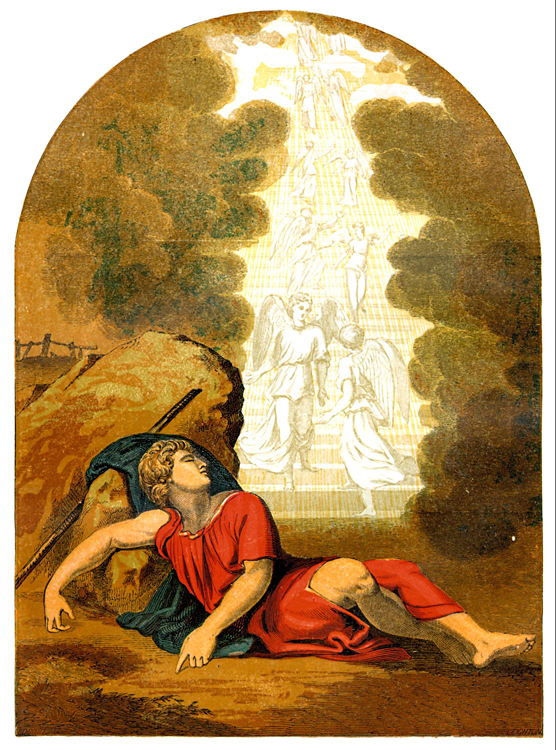
11 And he encountered/interceded/prayed at the place, and spent the night there, because the sun had set; and he took of the stones of the place which he arranged around his head, and lay down in the place to sleep.
12 And he dreamed, and behold a ladder set up earthward/on the earth, and the top of it reached to heaven: and behold the angels of Elohim ascending and descending on it.
13 And, behold, YHVH stood above it, and said, I am YHVH, Elohim of Abraham your father, and the Elohim of Isaac: the ground upon which you are lying, to you will I give it, and to your seed/descendants;
14 And your seed/descendants shall be as the dust of the earth, and you shall spread out powerfully to the west, and to the east, and to the north, and to the south: and in you and in your seed/descendants shall all the families of the earth be blessed.
15 And, behold, I am with you, and will guard you in all places wherever you go, and will bring you again into this land; for I will not forsake you, until I have done what I have spoken about you.
16 And Jacob awoke out of his sleep, and he said, Surely YHVH is in this place; and I knew it not.
17 And he was afraid, and said, “How awesome is this place! This is none other but the house of Elohim, and this is the gate of heaven.
18 And Jacob rose up early in the morning, and took the stone that he placed around his head, and set it up for a pillar, and poured oil upon the top of it.
19 And he called the name of the place Bethel: but the name of that city was called Luz originally.
20 And Jacob vowed a vow, saying, “If Elohim will be with me, and will guard me in this way that I go, and will give me bread to eat, and clothes to wear,
21 So that I come again to my father’s house in peace; then shall YHVH be my Elohim:
22 And this stone, which I have set for a pillar, shall become a house of Elohim: and whatever you give me I shall repeatedly give a tenth/tithe to you.” (emphasis added)
Word Definitions
To understand this passage properly and to discover the deep spiritual mysteries contained therein, we must first define some of the words from a biblical, Hebraic perspective.
Verse 11, The place [haMakom]. In Jewish understanding, this Hebrew word is a reference to Mount Moriah, that is, the “Temple Mount” (The ArtScroll Stone Edition Chumash, p. 144, commentary on verse 11) where Isaac was “sacrificed” and the Jerusalem temple was eventually built. The imminent Jewish Torah scholar, Rashi (Solomon Yitzhaki, 1040–1105) in his definitive Torah commentary also identifies the place mentioned in this verse with Mount Moriah. In The ArtScroll Bereishis, quoting Rashi,we read, “The Torah does not tell us which place. Instead it uses the definite article in the place, implying that the identity of the place was so well known that it need not be specified. This indicates that it refers to the site referred to elsewhere by the designation the place: Mount Moriah, of which it is said [in Gen 22:4 (see also Deut 16:16)]: ‘he saw the place from afar’” (p. 1219). The same commentary continues, “It cannot refer to any place other than Mount Moriah since the Torah itself refers to that holy site as makom, the place, in several places [Gen 22:4; and as Ralbag notes, the future Temple site on Mount Moria is also obliquely referred to in the Torah as the ‘place’ Hashem [YHVH] shall select (Deut 16:16 and frequently)] Accordingly, by its reference to place here, the allusion to Moriah is clear (Mizrachi)” (ibid.). Baal Ha Turim notes in his Torah commentary that in verse 11 the term the place appears three times “which is an allusion to the three pilgrimage [aliyot] festivals [i.e., Pesach/Passover and Chag haMatzot/the Feast of Unleavened Bread, Chag haShavuot/the Feast of Weeks or Pentecost and Chag haSukkot/the Feast of Tabernacles] at which times Jacob’s descendants would ascend to this place [i.e., the temple in Jerusalem].”
Verse 11, Encountered, interceded, prayed [Heb. paga]. According to The ArtScroll Bereishis Commentary, the Jewish sages interprets the word paga, as used here and in Genesis 23:8 and Jeremiah 7:16 to denote prayer and intercession (p. 1219). If we realize that this place was Mount Moriah where the future temple would be built (explained below), then Jacob’s praying at this spot is symbolic and prophetic, since the temple was to be known later as a house of prayer (Isa 56:7; Matt 21:13; Mark 11:17; Luke 19:46), and became the place on earth where YHVH would hear the prayers of his people (2 Sam 7:27; 1 Kgs 8:29; 2 Chr 6:20, 29; 7:12).
Verses 11, 18, 22, Stone(s) is the Hebrew word ehben meaning “stone through the meaning to build” (from banah [meaning “to build, builder”]).
Examples of the usage of the word ehben elsewhere in the Tanakh (Old Testament) include the following:
- Refers to the 10 Words (“Commandments”) on tablets of stone (ehben) (Deut 4:13; 5:22; Exod 24:12; 34:1, 4).
- Refers to the Messiah who was the Stone (ehben) the builders (banah) rejected that eventually became the head of the corner (Ps 118:22).
- Refers to the Messiah who was to become a stone (ehben) of stumbling and a rock of offence to both the houses of Israel (Isa 8:14).
- Refers to the Messiah when YHVH through Isaiah prophesied, “Behold I lay in Zion for a foundation a stone [ehben], a tried stone [ehben], a sure foundation” (Isa 28:16).
- A title for Elohim: the Stone (ehben) of Israel (Gen 49:24).
Verse 12, Ladder is the Hebrew word sulam meaning “staircase”(from salal [meaning “cast up, lift up, exalt”and according to The Theological Wordbook of the Old Testament (The TWOT) probably means “a highway or literally a road that is higher than the adjacent terrain.” The TWOT notes that this word is used by the prophets in the sense of “God’s [spiritual] highway” from which Israel had departed to follow false bypaths (Isa 57:14; 62:10]).
In Jewish mystical literature, this ladder is equivalent to a tree (Heb. etz)(e.g., as in the sephirotic tree in later Jewish mystical thought) and a tzelon Elohim; (i.e., a supernatural image of Elohim; Messiah Vol. 3, p. 149; by Avi Ben Mordechai).
On verse 12, Jewish sage Ya’acov Baal Ha Turim (born ca. AD 1269) in his Torah commentary notes several interesting facts about the word ladder (Heb. sulam). First he states that the word sulam is spelled defectively (with the kubutz vowel point replacing the vav after the letter samech). Therefore, sulam is spelled samech, lamed, mem or okx instead of samech, vav, lamed, mem or okux. What is the significance of this occurrence in the Torah? According to Michael Munk in his book, The Wisdom In the Hebrew Alphabet (pp.100–103) defective spelling of words occurs occasionally in other words in the Torah such as shalom/o`uKA(peace, well being) and owr/r~ut (light). When a word is spelled defectively, it signifies that the word should be understood to take on a diminished or defective meaning as opposed to the full expression of the word at its highest spiritual level. For example, in the first chapter of Genesis prior to verse 14 (when the physical luminaries were created) the light that shown prior to the fourth day was a supernatural or spiritual light emanating from Elohim himself, and therefore the Hebrew word for light, owr/r~ut,is spelled complete with the vav (r~ut) whereas the light that shone from the physical luminaries after the creation on the fourth day was a physical or low level of light, and therefore the word light is spelled defectively, without the vav (r~t). This occurs in the Tanakh with the word shalom/o`uKA as well. Spelled defectively (i.e., o`K{A) it refers to a physical, man-made peace, whereas spelled complete it represents the spiritual peace which comes only from Elohim. So what is the significance of the defective spelling of the word sulam (ladder) in our text? Hold this question in abeyance for the time being, for we shall answer it below.
Baal HaTurim also notes that the gematria (or numerical valuation of the Hebrew letters) for sulam is the same as that for the words wealth or money and poverty as well as for the words sound or voice. Keep this in mind also. Understanding these concepts are all part of unravelling the mystery of what (or who) the ladder represents!
Finally, Baal HaTurim has one other observation to make about the word sulam. The letters or consonants (S-L-M; Hebrew words generally consists of only consonants) are the same as the word for idol (S-M-L, pronounced seh-mehl). Based on this association, Baal HaTurim suggests that Elohim was showing Jacob a prophecy that his descendants would eventually fall into idolatry. We shall explore some other implications of the similarity between these two words later on.
Verse 12, Set up is the Hebrew word natsab meaning “to set up, put, place, stand firmly, fix, establish, to be planted”(Judg 9:6). Examples of usage of the word natsab elsewhere in the Tanakh include:
“YHVH stands in his congregation.” (Ps 82:1)
“I saw YHVH standing upon the altar.” (Amos 9:1)
Verse 12, Earthis the Hebrew word eretz or artzah meaning “to be firm, the earth, a land, country, ground, world.” Eretz throughout Scripture and in modern Hebrew is a colloquial expression denoting “the land of Israel.”
Verse 12, Topis the Hebrew word rosh meaning “head, beginning, captain, chief, first, height, highest part, summit or foremost.” Examples of the usage of the word rosh as found elsewhere in the Tanakh include:
- The stone which the builders refused is become the head of the corner [i.e., the Messiah, Ps 118:22)
- Matthew 21:42 quoting Psalm 118:22 referring to Yeshua.
- Other Hebrew-speaking Jewish authors of the Testimony of Yeshua (New Testament) carry this same idea into their writings:
- First Peter 2:7–8 speaks of the stone which the builder disallowed, the same is made the head of the corner, a stone of stumbling, and a rock of offense which stumble at the Word or Torah of Elohim (i.e., Yeshua, who is the Living Torah).
- The saints are the house [Heb. bethel] of YHVH and are built on the foundation of the apostles and prophets, Yeshua the Messiah himself being the chief cornerstone in whom all the building fitly framed together grows into a set-apart [Heb. kadosh] temple in YHVH in whom you are also built together for a habitation of YHVH through the Spirit (Eph 2:20–27).
Baal Ha Turim in his Torah commentary on this verse notes that the numerical values of the words “a ladder set up or standing”is equivalent to the ramp leading up to the altar of the temple and the concept of the ladder “set up on the earth or earthward”is an allusion to the altar which in Exodus 20:24 is described as an “altar of earth.” The expression its “top or head reaching heavenward”is an allusion to the fragrance of the offerings, which ascended heavenward as a sweet savor to YHVH (Exod 29:18; 29:25; etc.). Below we will learn the spiritual significance of this to the redeemed believer in Yeshua.
Verse 14, Dust is the Hebrew word aphar meaning “pulverized earth, clay, dry, loose earth.” On the phrase in this verse, “Your descendants shall be as the dust of the earth,” The ArtScroll Bereishis Commentary states that Sforno (a notable sixteenth-century Italian Jewish philosopher and Bible exegete) connects this phrase with the following one, rendering: Only after your offspring shall have become as degraded as the dust of the earth (see Isa 51:23) shall they spread out powerfully to the west, east, north, and south. For, as the Sages have taught, God’s future salvation [or, the Final Redemption which is to occur prior to and during the Messianic Age (or Millennial Age) will come only after Israel has experienced much degradation. R. Bachya (a late eleventh-century Jewish philosopher and moralist) interprets this word similarly. He notes that Elohim compared Israel to the dust of the earth rather than to the stars in heaven (as he did when he blessed Isaac in Gen 26:4) to intimate that Israel will become like dust in ways other than abundance. Dust has the connotation of lowliness inasmuch as Israel would be downtrodden like the dust while in exile. Also, like dust, however, they would endure everything and prevail, just as the earth survives all those who tread on it. As Isaiah foretold (Isa 26:5): He brings it to the dust, yet it is from the dust that Israel will be redeemed, as it is written (ibid. 52:2): Shake yourself from the dust, arise…O Jerusalem” (p. 1231). Here are several examples in the Tanakh of the Israelites being likened to dust trampled under the feet of the heathen:
YHVH to Abram: I will make your seed as the dust of the earth… (Gen 13:16)
Who can count the dust of Jacob, and the number of the fourth part of Israel? (Num 23:10)
Now, O YHVH Elohim, let thy promise unto David my father be established: for thou has made me king over a people like the dust of the earth in multitude. (2 Chron 1:9, emphasis added on all)
Verse 17, Gate (of heaven) is the Hebrew word shah-ar meaning “opening, gate, door.” According to The TWOT, the root idea of this word is “to split open, to break through.” The term gate in Scripture can sometimes be used as a metonymy where the gate represents the whole of the city (e.g., Gen 22:17; 24:60). In Genesis 28:17, it is a symbol of the means of access to heaven (ibid.). The ArtScroll Bereishis Commentary says, “It is the gate through which prayers and sacrifices ascend to heaven [according to the Jewish sages, Rashi and Ramban]” (p. 1238).
This heavenly gate is literally a portal into the spirit or heavenly world beyond.This spot where the future temple was built was a portal or a gateway to heaven. Down through the ages, spiritist-type people are often looking for sacred spots where they believe portals exist in an effort to connect to the spirit world beyond in order to receive secret knowledge or to seek wisdom and understanding about the meaning of life. The wonderful thing for the saints is that Yeshua promised that his disciples would receive the Holy Spirit, who would live within them and through their human or personal spirit would connect them to the divine. Christians do not need sacred spots or portals, relics, magic rituals, incantations or psychotropic drugs to bring us into the throne room of the Creator. For the redeemed believer, Yeshua the Messiah is our portal, our gate to heaven, our way to the Father in heaven, the way, the truth and the life. If Yeshua is your Lord and Savior, rejoice, child of the Most High Elohim, for you are the temple of the Spirit of Elohim, who now lives in you because of your personal relationship with Yeshua the Messiah! Savor, treasure and abide in this divine Truth!
Verse 19, Beth El means “house of El.” Beth Elwas formerly Luz meaning “almond (tree), turn aside, depart.”
Jacob’s Dream Explained
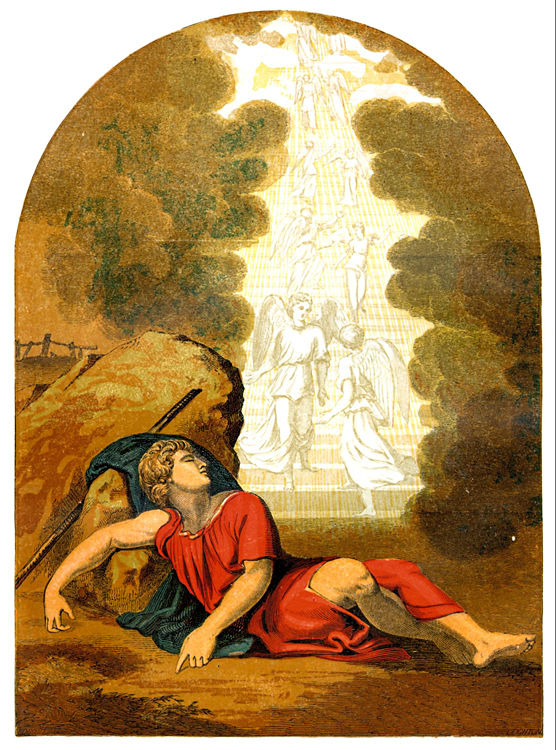
Now that we have defined our terms, it is time to start putting the pieces of this allegorical and prophetic puzzle together. The Jewish sages know that this dream is prophetic when they state, “In general, the expositors [of the Torah] agree that the vision was a disclosure of the future of the Jewish nation” (The ArtScroll Bereishis Commentary, vol. 1(b), p. 1224).
Classical Christian commentator, Adam Clarke, in his commentary on Genesis, in grasping to comprehend the meaning of the dream, suppositions that the ladder “was probably a type of [Messiah], in whom both worlds meet, and in whom the divine and human nature are conjoined. The ladder was set up on the earth, was manifested in the flesh, and in him [Messiah Yeshua] dwelt all the fullness of the Godhead bodily. Nothing could be a more expressive emblem of the incarnation and its effects; [Yeshua the Messiah] is the grand connecting medium between heaven and earth, between God and man. By him God comes down to man, through him man ascends to God” (Clarkes Commentary, vol. 1, p. 176).
Continue reading