The Arab-Israeli Conflict—Prophesied Long Ago

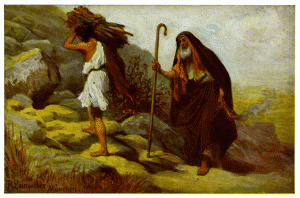
Genesis 27:40, By the sword you shall live. Compare this verse with the description of Ishmael in Genesis 16:12. In Genesis 28:9 Esau married the daughter of Ishmael thus uniting these two family lines from which some of the present-day Arabs descend. Look at these two verses and compare the character traits of Esau listed there with those of the Palestinian Arabs et al who live to kill the Jews and to destroy the nation of Israel today. The roots of today’s hatred among these people originate in jealousy and rivalry between Jacob and Esau.
The entire one-chapter Book of Obadiah is a prophecy against Edom. Let’s note several key points in this prophecy that might help us to understand some things about Edom in light of end-time Bible prophecy and how this relates to the end-times Arab-Israeli conflict.

  • Verse 2, The descendants of Edom are greatly despised (scorned, held in contempt, disdained).
  • Verse 3, Though they dwell in the clefts (places of concealment, retreats) of the rocks, they are proud and view themselves as invincible.
  • Verse 4, YHVH promises to bring Edom down.
  • Verse 7, Esau has a confederacy (league, alliance) of nations, which include many of the modern Moslem and Arab nations.
  • Verse 11, Edom’s eyes are on Jerusalem. Edom among other foreigners will cast lots for Jerusalem (seek to divide it among the nations/religions of the world as an international city under the control of the United Nations?).
  • Verse 13, Edom has entered into the gates of the land of Israel in the day of her calamity/disaster.
  • Verse 14, Edom will kill Jewish refugees trying to escape the land of Israel in her time of distress.
  • Verse 15, The time frame of the fulfillment of these prophecies is “near” the day of YHVH, when he will judge Edom and the other heathen nations.
  • Verse 16, Edom will be drinking (celebrating?) on the Temple Mount/YHVH’s “holy mountain,” and as a result, they shall drink the cup of YHVH’s wrath.
  • Verse 17, The house of Jacob will get the Temple Mount back!

How many descriptions of the modern Palestinian and other Islamo-terrorists do we see in Obadiah? What other people-group fits this description? Is Esau a picture of many modern-day Palestinians and their Moslem backers who hate the Jews, the state of Israel and even America?


 

Your Advice Please…

I’m preparing to record some short teachings (15 to 30 minute-long) videos for Hoshana Rabbah’s YouTube channel. Although I have done both television and radio in the past, this is a new venue for us.

This is my question for you… and please take a little time to reflect on the question, and then get back to me with an answer. What are some biblical topics that most need to be covered and put on YouTube — especially subjects relating to the Hebraic roots of the Christian faith? What are some of the most pressing questions in your mind? What do you think a new believer, or someone who is new to their Hebraic roots would be most interested in learning about?

I’d be most grateful for your input. Thank you in advance for your thoughtful consideration and response.

Natan Lawrence


The Power of One

If this blog has been a blessing to you, please let those in your sphere of influence know about it. My desire has always been to touch as many lives as possible by making the Bible, the Word of Elohim, come alive, exciting and relevant.

We all need a fresh, cool drink of good news in the daily wilderness journey of our life. Not only that, most of us are craving for spiritual direction, purpose, and help in understanding the world around us, and the spiritual world beyond us—and what it has to do with us, and how we fit into it.

Additionally, if this blog has been helping in some small way to accomplish this for you, please prayerfully consider making a donation to the ministry that makes this blog possible. Though Hoshana Rabbah Biblical Discipleship Resources gives its resources away for free, there are still costs involved. If you have been blessed, please consider donating five dollars a month to help with these on-going expenses.

Just one person has the power to make a difference. Are you that person? If so, for your convenience, there’s a donate button on the right side of this window. Or, checks (made payable to Hoshana Rabbah) can be mailed to PO Box 641, Wilsonville, OR., 97070. Many thanks!

For the scripture saith, Thou shalt not muzzle the ox that treadeth out the corn. And, The labourer is worthy of his reward. (1 Tim 5:18)

[F]or the labourer is worthy of his hire.…for the workman is worthy of his food. (Matt 10:7, 10)

Do ye not know that they which minister about holy things live of the things of the temple? and they which wait at the altar are partakers with the altar? Even so hath the Lord ordained that they which preach the gospel should live of the gospel. (1 Cor 9:13–4)

Let him that is taught the word share in all good things with him who teaches. (Gal 6:6)

Let the elders that rule well be counted worthy of double honour, especially they who labour in the word and doctrine. For the scripture saith, Thou shalt not muzzle the ox that treadeth out the corn. And, The labourer is worthy of his wages. (1 Tim 5:17–18)


Torah’s Higher Highway

The Jewish Leaders Had Forsaken the Higher Torah

Yeshua blasted the religious leaders of his day not only for not following Torah, but also for omitting the weightier matters of Torah, which are mercy, justice and faith.

Woe unto you, scribes and Pharisees, hypocrites! for ye pay tithe of mint and anise and cumin, and have omitted the weightier matters of the law, judgment, mercy, and faith: these ought ye to have done, and not to leave the other undone. Ye blind guides, which strain at a gnat, and swallow a camel. (Matt 23:23)

The Pharisees had a letter-of-the-law righteousness. But Yeshua said that the righteousness of his disciples had to exceed that of the religious Jews of that day (Matt 5:20). Yeshua wasn’t talking about the fine points of a letter-of-the-law Torah-obedience here, for it is doubtful that anyone could have surpassed the punctilious Pharisees in that arena. He must have therefore been talking about something else—something higher and beyond the mere keeping the letter of the law along with all their added legal traditions.

At the same time, sadly, the Jews had inadvertently nullified some of the Torah through their religious traditions (Mark 7:13). The Torah should be viewed as more than just a set of dos and don’ts; we should see it as pointing the way to our Father’s heart. His heart is the higher Torah. To get to YHVH’s heart we must lay aside any religious traditions that nullify the Torah-Word of  YHVH, and then follow the Torah at its purest and highest level. But merely following the letter of the Torah legalistically is not sufficient. There is something beyond that.

The Letter Kills, But the Spirit Makes Alive

The letter of the law kills, but the Spirit of the law brings life. The letter by itself brings bondage and legalism. It can even become burdensome and grievous.

Who also hath made us able ministers of the new testament; not of the letter, but of the spirit: for the letter killeth, but the spirit giveth life. (2 Cor 3:6)

For this is the love of Elohim, that we keep his commandments: and his commandments are not grievous/heavy or burdensome. (1 John 5:3)

Love, Not Law-Keeping, Is What Attracts

Yeshua told his disciples that men would know they were his not because they kept the Torah scrupulously to the letter, but because they walked in love for one another.

By this shall all men know that ye are my disciples, if ye have love one to another. (John 13:35)

Paul also taught that love was the greater thing in 1 Corinthians 13. Love is above all knowledge (including Torah), and all prophecy (inspired teaching of Torah).

The Higher Torah Is About Relationship

The higher Torah is this: Continue reading →


The Well of Well-Being

Genesis 26:1ff, At the well of Lachai-roi, Isaac was fruitful. There he met his wife while in communion with YHVH (24:62–64). Isaac also dwelt there for 20 years where he entreated YHVH because of Rebekah’s barrenness (25:21), and YHVH answered Isaac’s prayer and Rebekah gave birth to twins (25:22ff). But because of famine in the land, Isaac felt compelled to leave Canaan to seek relief in Egypt following the earlier footsteps of his father, Abraham.

Is it wise to rely on “Egypt” (a metaphor for the world) for our sustenance instead of trusting YHVH and believing that where he has planted us and blessed us is where we should stay?

While en route to Egypt YHVH, gracefully redirected Isaac away from Egypt instructing him rather to sojourn in Gerar (temporarily) where he would continue to bless him and his posterity (26:2–4). Isaac obeyed YHVH—more or less. Isaac ended up in Gerar located on the border between Canaan and Egypt and dwelt there a long time (not temporarily as YHVH had instructed him, 26:6,8).

Was he fully obeying YHVH or hedging his bet between faith and fear, between Canaan, the land of promise, and Egypt, the land of comfort for the flesh man? How often do we halt between two opinions and compromise between YHVH’s will and our own in matters where he has given us clear direction?

What happened in Gerar? (26:7) He sinned (lied) repeating the sin of his father (Gen 20:1–2).

Compromised obedience puts us in compromising situations where in order to “save our skin” we often have to compromise our values.

Though Isaac was out of YHVH’s will, YHVH was still faithful to keep the promises to Isaac he had made earlier (26:3–4). Isaac was blessed one hundred fold in his wealth (26:12–14).

Despite YHVH’s blessings, Isaac’s labors were not without difficulty and opposition from an enemy who was intent upon stealing his water wells, which were rightfully his (Gen 26:12–15). In the arid regions of the Holy Land, wells are essential for survival and prosperity.

Wells are a spiritual metaphor for salvation, life, abundance and truth—things the enemy is intent on killing for, stealing and destroying (in this light, consider Isa 12:3; 55:1–3; Ps 36:9; John 4:7–14; 7:37–39; 10:10).

Do you know Yeshua the Messiah (Jesus Christ) who is the well of salvation leading to eternal life—immortality?  Who will bring the waters of salvation to your thirsty soul? Who will heal the dry ground of your life and who will cause your spiritual desert to bloom like a rose? Who will turn your life into a river of life to all those around you? If you don’t know Yeshua, call out to him now!


Blog Scripture Readings for 11/11 through 11/17/12

Aside

Parashat Toldot — Genesis 25:19 – 28:9
Haftarah — Malachi 1:1–2:7
Prophets — Judges 17:1 – 21:25 ; 1 Samuel 1:1 – 3:21
Writings — Psalms 36:1 – 42:11
Testimony — Matthew 22:23 – 25:46

Most of this week’s blog discussion points will be on these passages. If you have general comments or questions on the weekly Scripture readings not addressed in a blog post, here’s a place for you to post those. Just use the “leave a reply” link below.

The full “Read Through The Scriptures In A Year” schedule, broken down by each day, can be found on the right sidebar under “Helpful Links.” There are 4 sections of scripture to read each day. One each from the Torah, the Prophets, the Writings, and from the Testimony of Yeshua. Each week, the Torah and haftarah readings will follow the traditional one-year reading cycle.

Weekly Blog Scripture Readings for 11/11 through 11/17/2012


Have You Met Isaac?

WHO WAS ISAAC?—A CHARACTER SKETCH

He was successful and blessed. (Gen 26:12)

He was obedient.

  • At age 37 Abraham bound Isaac to the altar (in Heb. called the akeidah, Gen 22).
  • Isaac was obedient to marry Rebecca, his parents’ choice, unlike Esau. He trusted and had faith in his parents even as he had at the akeida.

He had deep and personal relationship with YHVH.

  • Here we learn that obedience to and faith in and love for parents leads to devotion to YHVH. Honoring one’s parents is the key to honoring YHVH and entering into relationship with him. That is why the fifth commandment to honor one’s parents is placed after the commands to love Elohim. In Genesis 24:63 and 25:21 (see The Stone Tanach rendering of this verse in addition, The ArtScroll Beresheis, p. 1048, which says Isaac prayed abundantly and urgingly, i.e., persistent prayer, a penetrating prayer or request), we see that Isaac had a deep and personal relationship with his Creator.

He had strong faith.

  • Though childless and barren, Isaac and Rebecca kept their faith in the promises of YHVH alive (Gen 25:19–26). In verse 21 we see Isaac seeking YHVH for the answers to life’s dilemmas and tough problems (he had a vibrant and abiding relationship with his Heavenly Father). The same can be said of Rebecca (v. 22).

He was a peacemaker with his neighbors to his own hurt in that he didn’t assert his personal (even legal) rights.

  • Though opposed in the digging of wells, he refused to feud over his legal rights to these wells. He avoided strife and quarreling with his neighbors. After digging the third well, YHVH brought comfort to Isaac’s weary soul (Matthew Henry, p. 38).
  • He was neighborly with his unsaved neighbors. Though Abimelech and his people had wronged Isaac, he did not rebuke them for stealing the first two wells. Was this a sign of Isaac’s meekness or weakness? Matthew says no (p. 38) and Arthur Pink says yes (p. 233).

What are some comparisons between the three patriarchs?

  • Abraham was the man of the altar. He built altars as a form of worship to YHVH. The altar is mentioned more times in connection with Abraham than the other two patriarchs.
  • Isaac was the man of the well. Wells mentioned seven times in connection with Isaac.
  • Jacob was the man of the tent. ­The tent is mentioned more times in connection with Jacob.

What are the spiritual implications of the altar, the well and the tent?

The Abrahamic Covenant is the covenant of salvation (by grace through faith, see Rom 4). The tabernacle (or tent) in the wilderness is a picture of the steps in the salvation process. In one’s spiritual journey toward YHVH Elohim, one must first come to the altar of sacrifice (a picture of the cross), then the one must come to the bronze laver (a picture of baptism or immersion for the remission of sins, spiritual cleansing, the washing of the water by the word, and receipt of the Holy Spirit). Afterwards, one enters the tent or tabernacle to commence a deeper and more intimate relationship with YHVH. Do we not see this progression in the lives of the Patriarchs? They went from the altar to the well, and then into the tent (later the Tabernacle of Moses wherein were the 12 loaves of bread representing the 12 tribes of Israel) from which sprang the 12 sons or tribes of Jacob the tent-dweller?

This shows us how we come into a spiritual relationship with our Father in heaven: We have to start with an encounter with Yeshua at the cross. From there, we must get spiritually cleansed by the washing of the water of Elohim’s Word and be filled with and led by the Holy Spirit. From there, we enter into an intimate relationship with YHVH as we come into his home (the tabernacle is a picture the New Heavens and New Earth with the Holy of Holies picturing the New Jerusalem) and become part of 12 tribes of  redeemed Israel.