Are Palm Scanners in Florida a Move Toward the Mark of the Beast?

From USA Today newspaper (Nov 25, 2012):

Palm scanners get thumbs up in schools, hospitals

Do biometric devices such as this bother you—especially in light of Revelation 13:15–18 which says,

He was granted power to give breath to the image of the beast, that the image of the beast should both speak and cause as many as would not worship the image of the beast to be killed.

He causes all, both small and great, rich and poor, free and slave, to receive a mark on their right hand or on their foreheads,

and that no one may buy or sell except one who has the mark or the name of the beast, or the number of his name.

Here is wisdom. Let him who has understanding calculate the number of the beast, for it is the number of a man: His number is six hundred and sixty-six.

Or do you believe that biometric scanners don’t fulfill this end-times prophecy?

If you are concerned about a literal mark of the beast, then at what point do you believe that Bible believers should refuse to cooperate?

Thank you for your thoughtful insights. They are valuable, since they might help to clarify the thinking of others who have  similar concerns as yours.


Come out of Babylon, My People!

Genesis 31, Laban and Balaam. It is quite possible that the false prophet Balaam, who heard from YHVH and had a sense of righteousness, though was still steeped in paganism, was a descendant of Laban. Both were from Aram (part of greater Babylon) and only 280 years separated them. One of the Aramaic Targums (Targum Jonathan) equates Balaam with Laban, while other scholars view Balaam as Laban’s grandson.

Whatever the case, both Laban and Balaam were involved in a mixed-religious system—some truth and some error, some good and some evil.

This is the nature of religious Babylon (meaning “mixture” or “confusion”). A mixture of what? Of good and evil.

Remember the tree by that name in the Garden of Eden? Who was the one who enticed man to indulge in that fruit in rebellion to YHVH’s commands? Is not religious Babylon of today, out of which YHVH is calling his people (Rev 18:4), just that—a mixture of truth and pagan lies? How else, for example, do we account for the name of the Christian festival called Easter or Ishtar named after the Babylonian sex goddess of fertility? Or how else do we account for the Christmas tree phallus symbol that also originated from Babylonian sex worship? Or how about the Easter egg (an ancient Babylonian fertility or sex symbol) or the egg on the Jewish Passover Seder plate? All these are symbols of pagan sex worship.

As YHVH called Jacob away from Babylon back to Beth-el (the House of El), and as YHVH turned Jacob’s heart back to the ways of his fathers, is not the same YHVH likewise now calling his people to come out of religious Babylon (Rev 18:4), to separate themselves from that which is unclean or not kosher (2 Cor 6:17)? Yes, YHVH is now calling the modern descendants of Jacob (redeemed Israelites) to remember the Torah of Moses his servant and to listen to the spirit of Elijah as the children’s hearts turn back to the fathers (Mal 4:4–6).


Blog Scripture Readings for 11/25 through 12/1/12

Aside

Parashat Vayishlach — Genesis 32:4 – 36:43
Haftarah — Obadiah 1:1-21
Prophets — 1 Samuel 12:1 – 19:24
Writings — Psalms 50:1 – 56:13
Testimony — Mark 2:1 – 5:43

Most of this week’s blog discussion points will be on these passages. If you have general comments or questions on the weekly Scripture readings not addressed in a blog post, here’s a place for you to post those. Just use the “leave a reply” link below.

The full “Read Through The Scriptures In A Year” schedule, broken down by each day, can be found on the right sidebar under “Helpful Links.” There are 4 sections of scripture to read each day. One each from the Torah, the Prophets, the Writings, and from the Testimony of Yeshua. Each week, the Torah and haftarah readings will follow the traditional one-year reading cycle.

Weekly Blog Scripture Readings for 11/25 through 12/1/2012


Are You Really Free?

Genesis 31:43, These daughters are my daughters. Laban claims that Jacob’s wives belonged to him. He was also steeped in the idolatry of Babylon having in his possession idols or images called teraphim (Gen 31:19, 34–35).

Is there a modern counterpart to this? Does modern Babylon want to control and possess wives and children of redeemed Israel, indoctrinate them in its pagan religious system, and keep Jacob’s modern descendants from returning to their spiritual and physical homeland and birthright inheritance, and from returning to the Torah-faith of their fathers?

Are modern governments (e.g., public education and Child Protective Services, welfare programs, various government regulations that have greatly diminished or eliminated many of our freedoms) and socio-political organizations (e.g. ACLU, UN) modern-day Labans? Revelation 18:13 says that Babylon the Great traffics in the souls of men. This speaks at some level of the modern day enslavement of men—of their religious expression, freedom of thought and action.


“Go Ye Therefore” and Teach What???

Matthew 28:19–20, Go you therefore. What were Yeshua’s final instructions to his disciples before his return to heaven? This portion of Scripture is commonly called, the Great Commission and is found in Matthew 28:19-20. Do we find here any clues to Yeshua’s view toward the Torah as to what his expectations were of his disciples? Here Yeshua instructs his disciples (that includes you and me) to:

Go you therefore, and teach all nations, baptizing them in the name of the Father, and of the Son, and of the Set-Apart Spirit: teaching them to observe [keep, preserve, hold fast] all things whatsoever I have commanded you: and, lo, I am with you always, even unto the end of the world. Amein.
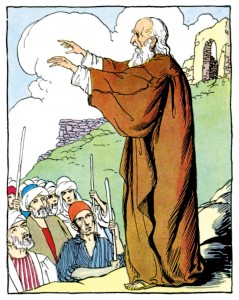
It is clear from this text that Yeshua, a Jewish rabbi (Matt 26:25, 49; Mark. 9:5; 10:51; 11:21; 14:45; John 1:38, 49; 3:2, 26, 4:31; 6:25; 9:2; 11:8), expected his disciples to follow, teach accurately and spread his teachings (the good news of the kingdom of Elohim) to the world. In the religious culture of first century, Judaism disciples (talmudim) were expected to teach exactly what their rabbi or Torah teachers had taught them. This is no different in our day when students enroll in a denominational Bible college or seminary, receive ordination and are then sent out into the mission field in the name of that denomination. The students are expected to carry forth the unique teachings and doctrines of that denomination. If they do not, they will either be reprimanded and expected to realign their teachings with the denomination’s official position. If they refuse to do so, that denomination will discharge them from their duties and defrock them.

Likewise, Yeshua expected his disciples to teach the nations to “observe all things whatsoever I have com- manded you.” In fact, in Acts 1:8 Yeshua said to his disciples that, “You shall be witnesses unto me” to the whole world. This was their mission and assignment.

Yeshua, as did all Jews of his era, spoke Hebrew, and maybe even Aramaic. The word for “commanded” (Matt 28:20) as in “whatsoever I have commanded you …” in either the Hebrew or Aramaic is the word mitzvah, which would have been the same word used in Matthew 5:19 where Yeshua says, “whosoever breaks one of these least commandments, and shall teach men so, he shall be called least in the kingdom of heaven …” (emphasis added). The word mitzvah in Hebraic religious thought is a clear reference to the Torah commandments of YHVH in the books of the Law of Moses.David uses the term mitzvah (in its plural form mitzvot) numerous times in Psalm 119 equating it with the Torah-law of Elohim as given to Moses and the children of Israel.

It was these same commandments (mitzvot) that Yeshua stated in the Sermon on the Mount that he told his disciples to “think not” that he had come to destroy, that he taught would never pass away as long as heaven and earth stood, that he said whoever would break one of the least of them and teach men so would be called least in the kingdom of heaven, and whoever would keep them and teach men so would be called the greatest in the kingdom. It was these same commandments that Yeshua commissioned his disciples to teach and observe, to keep, hold fast and preserve.

Even in his final word to his disciples before his death, Yeshua commanded his disciples to adhere to the Torah and to convey to those who would follow them the same message.

Can there be any doubt as to what Yeshua’s view of the Torah was, and what his expectations were for his disciples in this regard? How is it that the church has diverged so greatly from the fundamental teachings of Yeshua and his disciples when so many teach that he and his disciples came to “do away with the law?” It has been admitted, by even some in the church, that Christianity is not the religion of Jesus/Yeshua, but rather the religion about the Person of Jesus/Yeshua. For it to be fully the religion of Yeshua and his early disciples, it would have to uphold that obedience to the Torah’s standards of righteous living is a requirement of Christians today.


 

The Spiritual Law of Reciprocity

Genesis 28:22, I will surely give the tenth. To whom would Jacob ultimately tithe? We don’t know, but Jacob may have been making a prophecy about his descendants bringing their tithes and offerings to the house of El or the temple that would eventually be built in that exact spot.

Jacob’s dream in Genesis 28 was his first, life-changing personal encounter with the Elohim of his fathers (Gen 28:10ff). What is his response? It was to serve YHVH and to worship him by giving him one-tenth (a tithe) of his increase (verse 22). What prompted this response on Jacob’s part? Why was such a response appropriate?

When did you have your first encounter with your Heavenly Father and Master? Have you faithfully used the first fruits of your increase to honor, worship and express gratitude to him ever since? If not, why not? Scripture calls not tithing “robbing Elohim” and that as a result a curse may be on your finances (see Mal 3:8–11). Proverbs 3:9 lays out a solid truth about how tithing is a form of worshipping the Creator. “Honour [glorify] YHVH with thy substance, and with the first fruits of all thine increase, so shall thy barns be filled with plenty, and thy presses shall burst out with new wine.”

The Scriptures reveals the spiritual law of reciprocity: You reap what you sow (Gen 8:22; Gal 6:7–9). If you don’t sow you will not reap. If you sow evil or good you will reap the same. Jacob had to learn this law the hard way. In Job 4:8 we read, “Even as I have seen, they that plow iniquity, and sow wickedness, reap the same.” Jacob gained the birthright through posing as Esau (a deception) and Laban in turn deceives Jacob by putting Leah under the veil posing as Rachel in Jacob’s marriage bed.

It is very easy to see the principle of reaping and sowing in others’ lives, but can we see it in our own life? It is very difficult to do so! Aren’t we prone to concoct every excuse and argument imaginable to justify our sinful actions and then blame the results on others? Prayerfully take a long and hard look at your life, examine hardships and trials, and honestly ask yourself the question: am I reaping what I have sown? It is never too late to repent and make a course correction—to bring your life into agreement with YHVH’s Word and will and to start reaping the blessings.


Blog Scripture Readings for 11/18 through 11/24/12

Aside

Parashat Vayetzei — Genesis 28:10 – 32:3
Haftarah — Hosea 12:13 – 14:10 | ( Hosea 12:12 – 14:9 )*
Prophets — 1 Samuel 4:1 – 11:15
Writings — Psalms 43:1 – 49:20
Testimony — Matthew 26:1 – 28:20; Mark 1:1-45
 * Verse numbers in parenthesis refer to the verse number in Christian Bibles, which sometimes differs from Jewish Bibles.

Most of this week’s blog discussion points will be on these passages. If you have general comments or questions on the weekly Scripture readings not addressed in a blog post, here’s a place for you to post those. Just use the “leave a reply” link below.

The full “Read Through The Scriptures In A Year” schedule, broken down by each day, can be found on the right sidebar under “Helpful Links.” There are 4 sections of scripture to read each day. One each from the Torah, the Prophets, the Writings, and from the Testimony of Yeshua. Each week, the Torah and haftarah readings will follow the traditional one-year reading cycle.

Weekly Blog Scripture Readings for 11/18 through 11/24/2012