Are You Free to Break the Law If You’re Dead to It?

Romans 7:4, You have been made dead with regard to the Torah. David Stern in his commentary (The Jewish New Testament Commentary, p. 375) explains that it is not the Torah that has been made dead (or abrogated), nor is a believer made dead in the sense of no longer responding to its truth. Rather, he has been made dead not to all of the Torah, but to three aspects of it: (1) its capacity to stir sin in him (vv. 5–14), (2) its capacity to produce irremediable guilt feelings (vv. 15–24), and (3) its penalties, punishment and curses (8:1–4).

23243067

To fully understand Paul’s writings, one must have a complete understanding of the Torah and all of its aspects. Most individuals coming from the Christian theological perspective have a very limited and narrow understanding of the Torah (or as they term it, the law). For example, they fail to understand that how we react to the Torah—obediently versus disobediently—will determine how Torah “reacts” to us.

For example, YHVH has embedded into the Torah a cause-and-effect spiritual mechanism: obey and be blessed, disobey and suffer the consequences, i.e., the curses. Other laws in the universe with which we are familiar have the same cause-effect rewards-punishment systems built into them.

How about the law of gravity? Try jumping off a tall building! Paul in verse 13 asks whether we are implying that the (good) Torah, like gravity, is bad? His reply is that it’s not. Gravity, like Torah is good. It is when someone defies gravity and jumps off a tall building that gravity takes on a negative connotation. Is this because gravity is inherently evil? No. The law of gravity is for our benefit, since it keeps man from spinning (or floating) uncontrollably off of this earth into outer space.

So what causes men to jump off of tall buildings? Gravity or the evil inclination inside of their character? The answer is obvious. The same idea applies to the Torah. Paul says in verse 13 that it was sin working death in him through something good (i.e., theTorah), so that sin might be clearly exposed as sin.

So the Torah is very beneficial at exposing the sin in our lives, bringing it out into the open so that it can be dealt with (through confession, repentance, and faith in the blood atonement of Yeshua), so that we might be redeemed, justified, sanctified and finally reconciled to YHVH. Even the Torah’s “negative” side has a very beneficial outcome for those who are willing to follow YHVH’s path of reconciliation and righteousness.

Many Christians resist the Torah not because it’s inherently evil, but because of their own evil inclination, which resists and rejects anything that casts himself in a negative light and forces him to deal with the resident sin in his life.

Romans 8:7 explains the root of this problem in man: “The carnal mind is enmity against Elohim, for it is not subject to the Torah-law of Elohim, nor indeed can be.”

At the beginning, Adam and Eve were not subject to Elohim’s Torah-instructions and quickly rebelled against his clear commands, and humans have been following in this path of pride and rebellion ever since.

 

To Circumcise or Not to Circumcise — That Is the Question

Romans 4:11, Sign of circumcision. Circumcision is a seal of righteousness not the cause of righteousness. Humans are perpetually endeavoring to mold religion into their own image in order to highlight their goodness and remove the focus off of YHVH’s terms and conditions for receiving his grace, love, imputed righteousness resulting ultimately in the glorification of man. This is humanism, the fundamental premise of which is the goodness of man resulting in the promotion or elevation of man (in his own eyes, at least) and the demotion of Elohim.

20439258

The religion of humanism originated in the Garden of Eden where the serpent (Satan), in the first lie, told man that he could attain immortal life not by having faith in and assiduously adhering to the word of Elohim, but by twisting or conforming the word of Elohim to suit man’s carnal passions. After Adam and Eve had succumbed to the alluring lies of the serpent, they attempted to make amends for their disobedience to YHVH’s word by covering themselves in their own works of self-righteousness. This they did when they fashioned an apron of fig leaves to cover the shame (the result of their disobeying YHVH’s word) of their (spiritual and physical) nakedness. These garments—a symbol of man’s self-righteousness based on his own “good works”—were made to conform to man’s body. In Hebraic thought, fig leaves are a metaphor for Torah (YHVH’s instructions in righteousness). Man’s first sin was to twist YHVH’s word and to rebel against that word or the instructions of YHVH (i.e., the Torah). His first religious and legalistic act was to attempt to atone for his own sins (by covering himself with fig leaves) through his own efforts. They attempted to conform the Word of Elohim to fit their own carnal passions. This scheme of man to save himself through his own works-based or humanistic attempts didn’t relieve man of his sin guilt nor redeem him from the wages or result of sin, which is death, then, and it doesn’t work now. Atonement of sins occurs only through the shedding of blood, which likely occurred when YHVH made animal skins (most likely from a lamb) for Adam and Eve to wear to replace the fig leaves they had made for themselves (Gen 3:21).

A Biblical Overview of the Subject of Circumcision 

The first question many will ask is whether redeemed believers should practice circumcision today or not. Continue reading →


New Video: The Feast of Pentecost and the Bride of Yeshua

In this brief video, Natan Lawrence shows the relationship between the feast of Pentecost (or Shavuot), the marriage of YHVH to the children of Israel at Mt. Sinai, the wedding chuppah (canopy), the holy of holies, and the upper room experience on the day of Pentecost, and the marriage of Yeshua the Bridegroom to redeemed believers in the Song of Solomon.


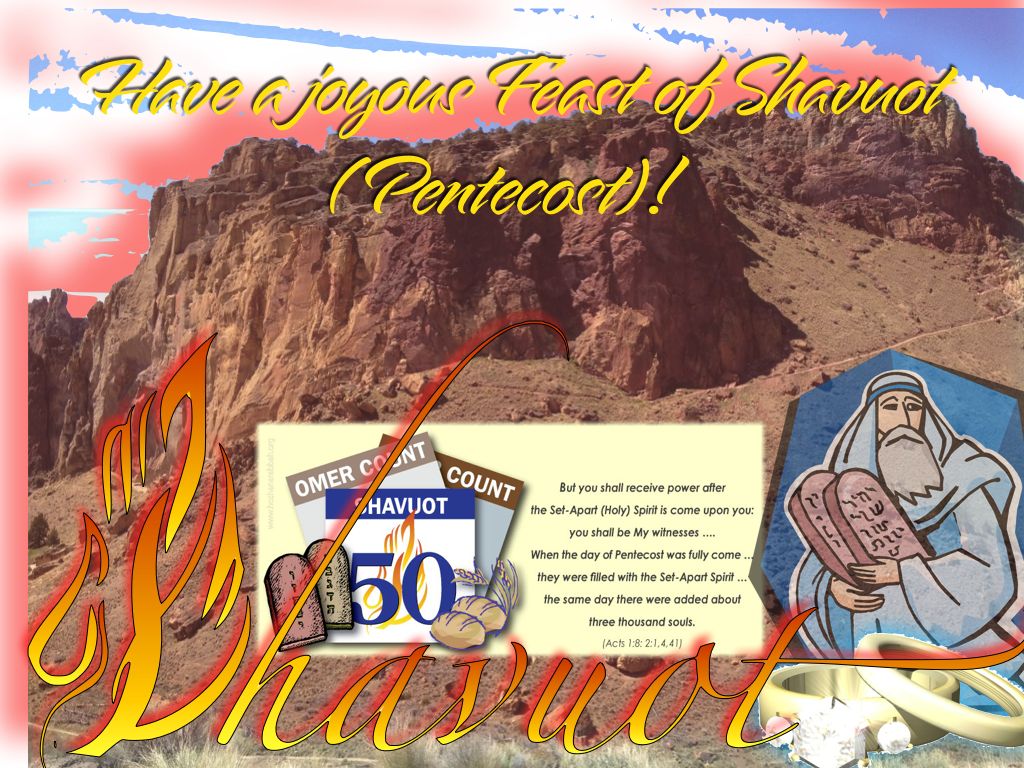
Joyous Shavuot (Pentecost)!

slide.001


Blog Scripture Readings for 5/19 through 5/25/13

Aside

Parashat B’ha’alatcha — Numbers 8:1 – 12:16
Haftarah — Zechariah 2:14 (10)* – 4:7
Prophets — Jeremiah 39:1 – 45:5
Writings — Song of Songs 3:1 – 8:14; Ruth 1:1 – 4:22
Testimony — Romans 5:1 – 11:36

* Verse numbers in parenthesis refer to the verse number in Christian Bibles.

Most of this week’s blog discussion points will be on these passages. If you have general comments or questions on the weekly Scripture readings not addressed in a blog post, here’s a place for you to post those. Just use the “leave a reply” link below.

The full “Read Through The Scriptures In A Year” schedule, broken down by each day, can be found on the right sidebar under “Helpful Links.” There are 4 sections of scripture to read each day. One each from the Torah, the Prophets, the Writings, and from the Testimony of Yeshua. Each week, the Torah and haftarah readings will follow the traditional one-year reading cycle.

Weekly Blog Scripture Readings for 5/19 through 5/25/13.

Chag Shavuot Sameach (Happy Feast of Weeks/Pentecost)!


Nuggets From Song of Solomon Chapters 1 and 2

Song of Solomon chapter 1

Song 1:2, Kisses of his mouth. This is referring to the tokens of Yeshua’s love for his bride: his grace and pardon, the joy and peace that comes from knowing him, the hope he has given us for the present and the future, and the fruits and gifts of his Spirit.

Your love is better than wine. Though wine joys the heart and calms the nerves, it is but a temporary and superficial fix to life’s problems. Like a band-aid on a wound, it doesn’t get to the cause of the problem. The love of Yeshua, on the other hand, is a river of life that is a never-ending source of joy, which strengthens and heals us at the deepest levels.

Ephesians 5:18 says, “Be not drunk with wine … but be filled with the Spirit,” which is Yeshua’s love gift or mohar to his betrothed bride. The Set-Apart Spirit — its fruits and gifts — is Yeshua’s engagement ring, down payment, guarantee, pledge or earnest money (2 Cor 1:22; 5:5) of our future inheritance (i.e., marriage to him) until the full redemption (or glorification of our bodies at the resurrection) of the purchased possession (the redeemed believer, Eph 1:14).

Song 1:3, Your name is better than ointment poured forth. (Heb. sheman: oil.) Is the name of Yeshua better than any ointment? Ointment or olive oil soothes and heals wounded, chaffed, burned, and aching flesh. When you are wounded emotionally and spiritually, there is always a place of healing and comfort for you at the foot of Yeshua’s cross, the foot of Yeshua’s throne, and in the arms of the one whose arms were open wide in loving acceptance of you at the cross. There is healing, forgiveness, power, victory and healing in the name of Yeshua. Faith in him overcomes all fear and anything that the world, the flesh and the devil would throw at us.

The virgins love you. Those undefiled by the world have their eyes only on Yeshua and are not drawn away by the passions of this world. They follow Yeshua the lamb, their Bridegroom, wherever he leads them (Rev 14:4). Why? Because they have not grown cold in their love for Yeshua. He is still their first love  (Rev 2:4).

Song 1:4, Draw me away. Are our (virgin) hearts drawn away from Yeshua by the world, the flesh or the devil, or are we totally dedicated to him? Do we long to be with and to know Yeshua and his love?

We will run. (Daughters of Jerusalem speaking). Are those around us drawn to Yeshua because they see our unreserved and undefiled love for him? Are we a light to our children, to our unbelieving family members, to our neighbors and work associates? Yeshua speaks of two classes of virgins: those who are wise and are prepared for Yeshua, the Bridegroom, and those who are not (Matt 25:1–13); those who are on the inside with Yeshua at his wedding feast because they love and prepared, and those on the outside who are looking in because they did not prepare themselves for him. They love Yeshua too, but not as much as the Shulamite. That’s why they were not brought into his chambers. The daughters of Jerusalem are immature, carnal believers who are not yet established in their faith and wholly serving and walking with Yeshua.

Song of Solomon chapter 2

Song 2:1, Rose of Sharon. Sharon means “plain” and is the region lying between the mountains of central Israel and the Mediterranean Sea north of Joppa and on the east side of the Jordan near Gilead and Bashan. The flower itself is not the Rose of Sharon we know, which is native to China, but is believed to be the saffron, tulip, anemone, or crocus. The redeemed bride of Yeshua is to view herself in this manner. Coming into spiritual relationship with Yeshua should cause one to have a higher view of oneself than they did while they were an unrepentant and unredeemed sinner. Coming to Yeshua greatly improves one’s self worth and self esteem.

Lily of the valley. Heb. shushan, lit. “big flower, water lily;” from suws meaning “exult, rejoice, display joy.” According to The TWOT, these were the lilies carved as a motif in the stone pillars in Solomon’s temple. It is used several times in the Song with reference to the bride. The woman’s name Shoshana (or Susanna) derives from this. This is a tall flower with a weak stem. As the tall, weak-stemmed lily that has a beautiful but heavy flower may need a stake to support it, the believer needs Yeshua to support him.

Song 2:2, Thorns. Heb. chowach meaning “to pierce, brier, thorn bush, thicket, hook, ring, fetter.” Believers are lilies among the thorny wicked of this world. Yeshua said that his followers though in the world, they were not to be of the world (John 17:10, 15). The wicked can be like thorns in flesh of the righteous. Thorns are worthless, dangerous and noxious and are good only for burning. Likewise, the wicked unrepentant will burn in the lake of fire.

Song 2:3, Apple tree in the trees of the woods. This is another analogy like the lily among the thorn simile. Yeshua’s people are to bear fruit for him. They are to be his personal garden bearing the fruit of the Spirit, and to be like the trees planted next to Yeshua who is the river of life (Ps 1:1–3). The trees of the world are barren and fruitless. This is not the case with the trees of Yeshua who bear fruit through him.

Song 2:4, Banqueting. Heb. lit. wine/yayin meaning “effervesce, wine.” Torah commands that Israelites drink wine and strong drink during the three pilgrmage festivals (Deut 14:26). This speaks of the joy of the biblical Hebrew wedding that culminates in a great wedding feast, prophetically pictured by the Feast of Tabernacles, which is a picture of the wedding supper of the Lamb.

Banqueting house …his banner over me was love. Is the groom giving her a glimpse of his house, and what she can expect once they are fully married? Does not Yeshua do this with us by giving us glimpses into the future spiritual glory he has in store for his bride in the world to come?


Are You Under the Law? I Hope Not!

Romans 3:19,  Under [the] Torah-law … all the world guilty before Elohim. Paul uses the term “under [the] law” (also found in 6:14) twelve times in his writings. In this case he is referring to those who are under the penalty for violating the Torah (the penalty of which is death, Rom 6:23; 1 John 3:4). This we know, for he speaks of guilt in the latter half of this verse: “and all the world may become guilty [subject to the judgment of Elohim] before Elohim.” 

The bottom line of what Paul is saying here is that all humans (both Jews and Gentiles) are guilty before Elohim. This is the point he is driving at, as we stated above.

Paul is breaking up the fallow ground of men’s hearts, showing them their sinfulness (unrighteousness), that they have violated the holy and righteous standards of Elohim’s law (the Torah) and in this condition need a Redeemer (a message Paul preaches more strongly later in the book of Romans).

It is Paul’s mission to bring the two opposing sides (Jew and Gentile) together, to show them their common state of sinfulness and their common need for Yeshua, the Redeemer, and their common need to dwell together in Torah-community as the body of believers in Yeshua. This is indeed the tall order to which Paul dedicated his life’s efforts and that he terms “the ministry of reconciliation” to which he has been called (2 Cor. 5:18).