Teshuvah: A Word YOU Need to Add to YOUR Lexicon

Hosea 14:2–10, Return to YHVH. (See also Joel 2:15–27 and Mic 7:18–22.) This portion of scripture opens with the words “O Israel, Return [Heb. shuv] unto YHVH your Elohim, for you have fallen by your iniquity [Heb. avon meaning “perversity, depravity”].” This passage is part of the Haftorah reading, which is part of the additional scriptures that are read with Parashat Vayelekh or Parashat Ha’azinu on “Shabbat Shuva,” which is the traditional name given to the Shabbat just prior to Yom Kippur. This Shabbat falls during the time called the forty days of Teshuvah, which starts at the beginning of the sixth month (Elul) of the biblical calendar and continues through the first day of the seventh month (called Tishrei on the traditional Jewish calendar), which is the biblical holy day of Yom Teruah (the Day of Shofar Blowing), and ends ten days later at Yom Kippur (the Day of Atonement), which is the most solemn high holy day of the year for Bible believers.
Repentance

This forty-day period is characterized by the Hebrew word teshuvah (Strong’s H8666 meaning “answer, return”), which derives from the common Hebrew verb shuv (Strong’s H7725) meaning “to turn back, to return, come or go back, restore, refresh, repair, bring back, reverse.” This same word is translated as return in the opening verse of this Haftorah portion (Hos 14:1).

In numerous places in Scripture, YHVH speaking through his prophets urges his backslid people to return to him. Why? Continue reading →


New Video: Mount St. Helens & God’s Coming Judgment on America

America wake up and turn away from your sins! See actual on-site video footage of Mount St. Helens 33 years after its 1980 eruption. This video is a brief documentary on its volcanic eruption with my personal memories of that day, and how this relates to God’s coming judgment on America, and how you can be saved out of this judgment.

IMG_0153


Beholding His Glory

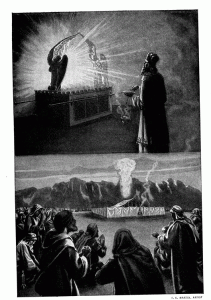
Deuteronomy 12:5, Only at the place that YHVH will choose … to place his name there … shall you seek out his Presence [habitation] and come there. The word Presence (as translated in The ArtScroll Stone Edition Chumash) is the Hebrew word sheken (shin-kaf-nun soffit; Strong’s H7933/TWOT 2387) and as a verb means “to dwell or tabernacle,” and as a noun it means “dwelling, or tabernacle.” According to TWOT, the verb is used 129 times in the Tanakh (OT) of which 43 times YHVH is the subject; that is, it describes where he dwells (e.g., on Mount Zion [Ps 74:2], among his people [Exod 25:8], or in Jerusalem [Zech 8:3]). On several occasions, it refers to his divine and glorious Presence dwelling among his people (e.g., Exod 24:16; Ps 85:9). The word mishkan, which was the portable tabernacle, sanctuary or earthly dwelling place of the glorious Presence of YHVH among his people, is derived from this word. What is YHVH saying in this verse? Namely, he is telling his people NOT to go just anywhere to worship him, but to go only where he has placed his name. How do we know where that is? It will be where his manifest glory and Presence is to be found! Where you fellowship and worship him collectively with other believers is the manifest glory and Presence of YHVH there to confirm that YHVH has placed his name there? If not, why not? Now let’s read Psalm 63:1–4,

O Elohim, you re my El; early will I seek you: my soul thirsts for you, my flesh longs for you in a dry and thirsty land, where no water is; to see your power and thy glory, so as I have seen you in the sanctuary. Because your lovingkindness is better than life, my lips shall praise you. Thus will I bless you while I live. I will lift up my hands in your name. (emphasis added)

Glory cloud

Let us briefly analyze the bolded portion of this psalm of David in light of the above discussion. To see is the generic Hebrew verb ra’ah meaning literally “to see.” The word power (Heb. oz) means “might, power and strength.” This too is a generic term.

The next word is glory, which is the Hebrew word kavod (Strong’s H3519/TWOT 943 d,e) literally meaning “heavy or weighty.” In this instance, in reference to YHVH, it refers to “the visible manifestation of God” and his glory and is often associated with his visible manifest Presence within the tabernacle (TWOT, vol. 2, p. 943).

The next word in verse two to analyze is have seen, which is an entirely different word in Continue reading →


Many Hear, But Few Do

Deuteronomy 11:27–28, That you hearken … If you do not hearken. The Jewish sages point out that he phrase “that to hear [Heb. shema]” is a metaphor for blessing, while “to not hear [lo-shema]” is a metaphor for cursing (The ArtScroll Stone Edition Chumash, p. 999).

15090964

Hearing and doing, in Hebraic thought and according to the meaning of the Hebrew word shema, are synonymous. If one hears, but does not do what he has heard, then he has not heard. Hearing, Hebraically, is more than an auditory function, but involves the activation of the heart resulting in corresponding actions resulting in either blessing (if one hears and obeys YHVH’s Word) or curses (if one does not hear and obey YHVH’s Word).

Scripture prophesies that in the future a problem would arise among the people of YHVH. The problem would not be a famine of food and water, but of the ability to hear (shema) and to do the Word of Elohim (Amos 8:11). Likewise, Isaiah prophesied that there would be those who would say (or “draw near with their mouths”), but who would not do (“but their hearts are far from me,” Isa 29:13). Yeshua accused the religious hypocrites of his day of doing the same thing (Matt 15:8–9).

Examine your words and corresponding actions. Do they perfectly align, or do you stand convicted before YHVH of disobedience and ­hypocrisy?


Blog Scripture Readings for 7/28 through 8/3/13

Aside

Parashat Re’eh — Deuteronomy 11:26 – 16:17
Haftarah — Isaiah 54:11 – 55:5
Prophets — Hosea 9:1 – 14:9; Joel 1:1 – 1:20
Writings — 1 Chronicles 2:1 – 8:40
Testimony — 1 Thessalonians 4:1 – 5:28; 2 Thessalonians 1:1 – 3:18; 1 Timothy 1:1 – 2:15

Most of this week’s blog discussion points will be on these passages. If you have general comments or questions on the weekly Scripture readings not addressed in a blog post, here’s a place for you to post those. Just use the “leave a reply” link below.

The full “Read Through The Scriptures In A Year” schedule, broken down by each day, can be found on the right sidebar under “Helpful Links.” There are 4 sections of scripture to read each day. One each from the Torah, the Prophets, the Writings, and from the Testimony of Yeshua. Each week, the Torah and haftarah readings will follow the traditional one-year reading cycle.

Weekly Blog Scripture Readings for 7/28 through 8/2/13.


After Two Days (Is That Now?)

Hosea 5:15–6:3, I will go and return to my place. This passage is a clear prophecy concerning the resurrection of the righteous dead of which Messiah Yeshua is the first to raise.

Verse two contains a Hebrew parallelism, which is a Hebraic literary device where the same thought is expressed differently back-to-back. The word revive is the Hebrew word chayah, the basic Hebrew root verb meaning “to live or to have life.” The word raise up is the Hebrew word quwm meaning “to rise, arise, stand, stand up.” According to TWOT, the basic meaning of this word “denotes rising up from a prostrate position (e.g. Josh 3:16).”

YHVH is speaking here in the broader context of this passage concerning his Messianic role as the lion of Judah (Rev 5:5). After presenting himself as such to both houses of Israel (Ephraim [i.e., the Christians] and Judah [i.e., the Jews]) at his first coming, verse 14 states that Messiah would “go away … and none shall rescue him.”

Then in verse 15 we read that, “I [Messiah speaking] will go and return to my place till they [Ephraim and Judah] acknowledge their offense and seek my face ….” (This refers to Yeshua’s absence from the earth between his first and second comings.) What is their offense? Continue reading →


Which Mountain Will You Choose: Gerizim or Ebal?

Deuteronomy 11:26–28, This passage begins with the words, “Behold, I set before you this day a blessing and a curse; a blessing, if you will obey the commandments of YHVH your Elohim, which I command you this day; and a curse, if you will not obey the commandments of YHVH your Elohim, to go after other gods, which you have not known” (Deut 11:26–28).

9939332

After this, in verse 29, YHVH instructs the Israelites that upon entering the Promised Land, they are to stop between the mountains of Gerizim and Ebal, which are located at the entry point of the land. The former mountain represents a blessing, while the later represents a curse. The town of Shechem is located between the two mountains. The Hebrew word Shechem means “shoulder” or “back” (Strong’s H7927). The shoulder supports the head, which through the disposition of the mind and the direction in which the head is pointed, determines the path a person will walk whether good or evil.

It was at Shechem, between the two mountains representing good and evil, that Israel renewed its covenant with YHVH before entering the Promised Land (Josh 8:30–35). The power of the covenant that the people made with YHVH on that day thousands of years ago is still visible in the modern land of Israel: Mount Ebal is bare and devoid of vegetation, Continue reading →