Hosea: An Ancient Prophecy That Involves Us

Hosea 2:1–22, Hosea: The Story of YHVH’s Unfailing Love for His People

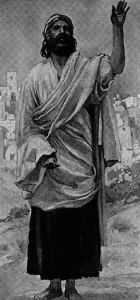
The prophet Hosea, a native of the northern kingdom of Israel, ministered to that nation (called Ephraim or the house of Israel, as opposed to the southern kingdom, called Judah or the house of Judah) for about 38 years during the middle part of the eighth century b.c. (from about 770–725 b.c.). He lived in the final tragic days of the house of Israel and prophesied that Israel’s enemy, the Assyrians, would be instruments in YHVH’s hands to bring judgment against Israel if that nation did not repent and cease its spiritual harlotry and idolatry. That the book contains references to the kingdom of Judah is probably due to the fact that the northern kingdom fell in 721–722 b.c. while Hosea was still ministering and that he most likely transplanted to Judah where he may have finished writing his book (niv Study Bible, p. 1312).
25341417

The theme of the Book of Hosea revolves around the prophet’s personal family life. YHVH’s prophets were often required to act out in their personal life something that would serve as a prophetic allegory of what would happen to the people of Israel if they failed to repent of their sin and return to YHVH. In Hosea’s case, YHVH required him to act out what had already happened to the northern kingdom. Because they had turned from YHVH, their spiritual husband, and taken to consorting with foreign spiritual lovers characterized by their forsaking the Torah, turning to serve pagan gods, and succumbing to heathen religious rituals and lifestyles, YHVH instructed the prophet to marry a harlot. In this way, the family life of Hosea would become a spiritual mirror that could be held up in front of the nation so that it could see itself as YHVH’s saw it. Furthermore, being married to an unfaithful wife gave Hosea direct insight into the emotional turmoil a husband endures when married to an adulterous woman that would provide the passion and impetus when defending YHVH in writing about the spiritual plight of adulterous Israel.

Hosea’s life must have been a sad one, for his adulterous wife bore him three children. From the text, it cannot be determined whether they were his children, or another man’s. Despite this, Hosea accepted his wife and children with an unconditional love representing YHVH’s love for Israel, Continue reading →


No Pain, No Gain

Deuteronomy 8:2–3, 6ff, YHVH afflicted/humbled you. Does the concept of YHVH afflicting his people bother you? Perhaps he will do this to us if and when we need it? The word afflict/anah (Strong’s H6031) literally means “to become low, depressed, put down or stoop.” (Note some other places where anah is used: Pss 55:19; 88:7; 90:15; 119:71, 75.) Scripture says that Israel exited Egypt with “a high hand/upraised arm” (Exod 14:8 and Num 33:3). The word high/upraised can connote haughtiness or arrogance, or it can mean that the children left Egypt triumphantly and in jubilation waving banners (The ArtScroll Stone Edition Chumash, p. 369). What do you think? Did they leave Egypt in a spirit of contrition or arrogance? If the former, then why would they need humbling?

Are we any different? Do we need to be humbled? Down through the ages, YHVH has allowed his servants to suffer, but it was for their spiritual growth and benefit. What did Paul say about his thorn in the flesh? (See 2 Cor 12:7.) Why did Job experience what he did? (Read Job 42.) The process of humbling us so that we might have a higher view of YHVH results in greater contrition on the part of humans. When this happens, the blessings, power, anointing and provision of YHVH are able to flow into our lives more readily.

How has YHVH been trying to humble your flesh that he might bring you to a deeper level spiritually? The ArtScroll Chumash comments, “It is true that Elohim subjected the people to some hardships in the wilderness, but even that was for their good; just as a father may chastise his child to prepare him for the future” (p. 983). Discuss this issue in light of the sufferings of YHVH’s servants while they were faithfully awaiting their spiritual inheritance as recorded in Hebrews 11. (Compare this with Jas 1:12–17 and 1 Cor  3:13.) Discuss the two types of judgments of YHVH as recorded in Scripture: his judgments unto repentance and his judgments unto death. What are some examples of each? Do YHVH’s saints have to go through the latter type of judgment? (Examples: Noah and the flood; Lot and Sodom and Gomorrah; the Israelites in the plagues on Egypt; the saints and the tribulation, the great tribulation versus the wrath of Elohim periods at the end of the age [these are three separate periods/events]; see also Heb 12:3–11).


New Video:Yeshua Is Your Savior, But Is He Your LORD?

Yeshua as Lord (Master) is mentioned some 740 times in the New Testament, even more than his being the Messiah (or Christ). Understanding the implications of his lordship over our lives has major implications on our salvation — even whether we are saved or not. In this video, find out why and how he is Lord (Master) and how it affects you now and eternally.


Blog Scripture Readings for 7/21 through 7/27/13

Aside

Parashat Eikev — Deuteronomy 7:12 – 11:25
Haftarah — Isaiah 49:14 – 51:3
Prophets — Hosea 2:1 – 8:14
Writings — Nehemiah 8:1 – 13:31; 1 Chronicles 1:1 – 1:54
Testimony — Colossians 1:1 – 4:18; 1 Thessalonians 1:1 – 3:13

Most of this week’s blog discussion points will be on these passages. If you have general comments or questions on the weekly Scripture readings not addressed in a blog post, here’s a place for you to post those. Just use the “leave a reply” link below.

The full “Read Through The Scriptures In A Year” schedule, broken down by each day, can be found on the right sidebar under “Helpful Links.” There are 4 sections of scripture to read each day. One each from the Torah, the Prophets, the Writings, and from the Testimony of Yeshua. Each week, the Torah and haftarah readings will follow the traditional one-year reading cycle.

Weekly Blog Scripture Readings for 7/21 through 7/27/13.


He’s Your Savior, But Is He Your LORD?

The Lordship of Yeshua

The Lordship of Yeshua over all aspects of our lives must be stressed in the Hebraic Roots Movement and, presently, to our shame, it is not. The rule of Torah is trumpeted loudly by many Hebraic roots Torah teachers, but the lordship of Yeshua, sadly, is not. Yet the lordship of Yeshua is a dominant theme in the Testimony of Yeshua (or New Testament), and we’re preaching a skewed gospel message if we don’t teach this. Not only this, but we need to teach that the Torah and Yeshua are synonymous concepts, and that without Yeshua in our lives, we can’t even properly obey the Torah.

33389587

In the Scriptures, Yeshua has many titles. In the Testimony of Yeshua he is referred to as Christ or the Messiah 569 times. But this isn’t his main title. The title Lord holds that place with more than 700 references in the Testimony of Yeshua. By comparison, the name Jesus occurs 745 times in the Testimony of Yeshua.

The Greek word for lord is kurios, which is defined as “he to whom a person or thing belongs, about which he has power of deciding; master, lord; the possessor and disposer of a thing; the owner; one who has control of the person, the master; in the state: the sovereign, prince, chief, the Roman emperor; is a title of honour expressive of respect and reverence, with which servants greet their master; this title is given to: God, the Messiah.”

Acts 10:36 and Romans 10:12 say that Yeshua is Lord of all. The lordship of Yeshua over all aspects of our lives must be stressed in the Hebrew Roots Movement. Currently it is not, even though his title Lord is mentioned more than 700 times in the Testimony of Yeshua.

We must also teach that the lordship of Yeshua equates with the rule of the Torah in our lives. This may be a hard concept for many coming out of the church system to swallow, but it is the truth of Scripture. It goes like this: The Torah = the Word of Elohim = Yeshua = the Living Word of Elohim incarnate = the Lord/Master of our Lives (John 1:1, 14; Rom 10:4–8).

Romans 10:4 says Yeshua is the “end goal of the Torah.” Continue reading →


Hear O Israel… and Pass It On

Deuteronomy 6:4, Hear O Israel. This statement (verses 4–9 coupled with Lev 19:18) is known as the “Shema” and is a statement of faith in the Jewish religion. In Mark 12:29–31, Yeshua also cites the Shema as the summation of all that Torah commands humans in order to have a proper relationship with YHVH and their fellow man. The word shema means “to hear, listen, obey.” How often, when it comes to obeying YHVH do we draw near or honor him with our lips, but our hearts are far from him? (See Mark 7:6; Isa. 29:13; Matt. 15:8.)

4319029

In Deuteronomy 6:10–16, YHVH is constantly warning his people against idolatry; idolatry is anything that gets in the way of our relationship with him. What is of higher priority in your life than serving YHVH? What in your life takes more of your time, energy and money than serving YHVH? What draws your heart away from the study of his written Word, from prayer and fellowship? What or who hinders you from moving forward in your spiritual walk? What in your life keeps YHVH from getting out of a spiritual box in your life? This is idolatry!

Several times YHVH instructs the children of Israel to be certain to instruct their children in the ways of Torah-righteousness. In the Shema, YHVH commands, “And you shall teach them [i.e., his Word] diligently to your children, and talk of them when you sit in your house, and when you walk by the way, and when you lie down, and when you rise up” (Deut 6:7). Then in verses 20–25 of the same chapter we read,

“When your son asks you in time to come, saying, `What is the meaning of the testimonies, the statutes, and the judgments which YHVH our Elohim has commanded you?’ Then you shall say to your son: `We were slaves of Pharaoh in Egypt, and YHVH brought us out of Egypt with a mighty hand; and YHVH showed signs and wonders before our eyes, great and severe, against Egypt, Pharaoh, and all his household. Then He brought us out from there, that He might bring us in, to give us the land of which He swore to our fathers. And YHVH commanded us to observe all these statutes, to fear YHVH our Elohim, for our good always, that He might preserve us alive, as it is this day. Then it will be righteousness for us, if we are careful to observe all these commandments before YHVH our Elohim, as He has commanded us.’”

Too often in the church-system Continue reading →


Yeshua in Us: The Power to Obey Torah

Philippians 1:11, The fruits of righteousness which are by Yeshua the Messiah. It is impossible for a man to keep the Torah on his own strength as Yeshua’s encounter with the rich young ruler proves (Matt 19:16–22). When the young man asked Yeshua what he must do to have eternal life, Yeshua seems to set the man up for a fall when he declares, “If you want to enter into life, keep the commandments.” Yeshua is not being disingenuous here. Were one to keep the Torah perfectly without sinning, hypothetically, one would not fall under the death penalty for violating the laws of Elohim (i.e., sin). Presumably one could earn eternal life by one’s own good works. But no man has ever accomplished this superhuman feat except the superhuman Yeshua! Continuing, when the young ruler proudly declares his perfect Torah obedience, Yeshua shows him that he was, in fact, violating the Torah in at least one area—covetousness and greed. Yeshua shows him how to come into Torah compliance, and then admonishes him to come and to follow him. What Yeshua is teaching here is that it’s impossible to keep the Torah perfectly without factoring Yeshua, the Living Torah, into the equation. The point that we can’t keep the Torah without Yeshua directly intervening in our lives, I hope to conclusively demonstrate below.

Torah scroll open 2

One way that Yeshua helps his followers obey the Torah is by sending us his Spirit as an internal spiritual force into our hearts to nudge and lead us into Torah-obedience.

What’s more, Yeshua also gives us the divine gift of his grace to accomplish the same thing. His grace removes the guilt, stain and penalties for our past sins, and with a clear conscience and a clean spiritual slate before YHVH, minus the past baggage of sin weighing us down, we are able to go forward under the power of YHVH’s Spirit to walk in accordance with his Torah. Praise Yeshua! An illustration of this would be a runner who trains wearing a backpack filled with rocks. Once the weight is removed from his back, when he runs, he feels as if he were flying through the air.

Our faith in, love for and continual abiding in Yeshua is the key to receiving his systemic spiritual empowerment to walk a life that mirrors Yeshua. Paul invites us Continue reading →