Many people don’t want to love and follow God because of the suffering and evil that exists on the earth. After all, how could an all powerful and loving God allow this to continue? They also wonder why such a God can allow bad things to happen to “good” people. Knowing the answers to these questions could radically change your life for the better. This short video offers a logical explanation.
Why Does a Good God Allow Evil & “Good” People to Suffer?
Why Does God Allow Evil to Exist on the Earth?
The following is a step-by-step logical answer to this questions.
YHVH Elohim (the LORD God, the God of the Bible) is pure love and he is holy (sinlessness), which is the opposite of evil and sin. He can have no communion or intimate relationship with that which is contrary to his character.
YHVH Elohim is love, and love can’t be self-focused (that’s egotism, self worship, selfishness and pride, which is sin and the opposite of love and holiness), and it must be outward flowing. This is why YHVH made man in his own image as a recipient of his love. It was his intent to build a family to be comprised of those who will be like Elohim who is loving and holy (sinless).
Elohim could produce robots or automatons to fawn before and worship him, but true love can’t be generated mechanically. It has to proceed from the heart out of free will choice. Love that is mechanistic or mandated legalistically isn’t love.
So instead of creating Adam and Eve as robots to “love” YHVH mechanistically or robotically and artificially, YHVH gave the first humans a heart and mind and the free will to exercise choice — whether to love him or not.
Since Elohim is love, all that proceeds from him is love. He is the definition of love, and all that he does is love. He gave man the definition of love in written form. It is called the Torah-word of Elohim and is found in the Bible. The Torah shows man how to love Elohim with all his heart, soul and might, and his neighbor as himself.
YHVH gave the first man and woman a couple of simple Torah-instructions to follow (see the Book of Genesis chapter two). All Adam and Eve had to do was to love Elohim by obeying these instructions or commandments, which would have put them not only on the path to having a loving and intimate relationship with Elohim, but between humans as well. Continue reading
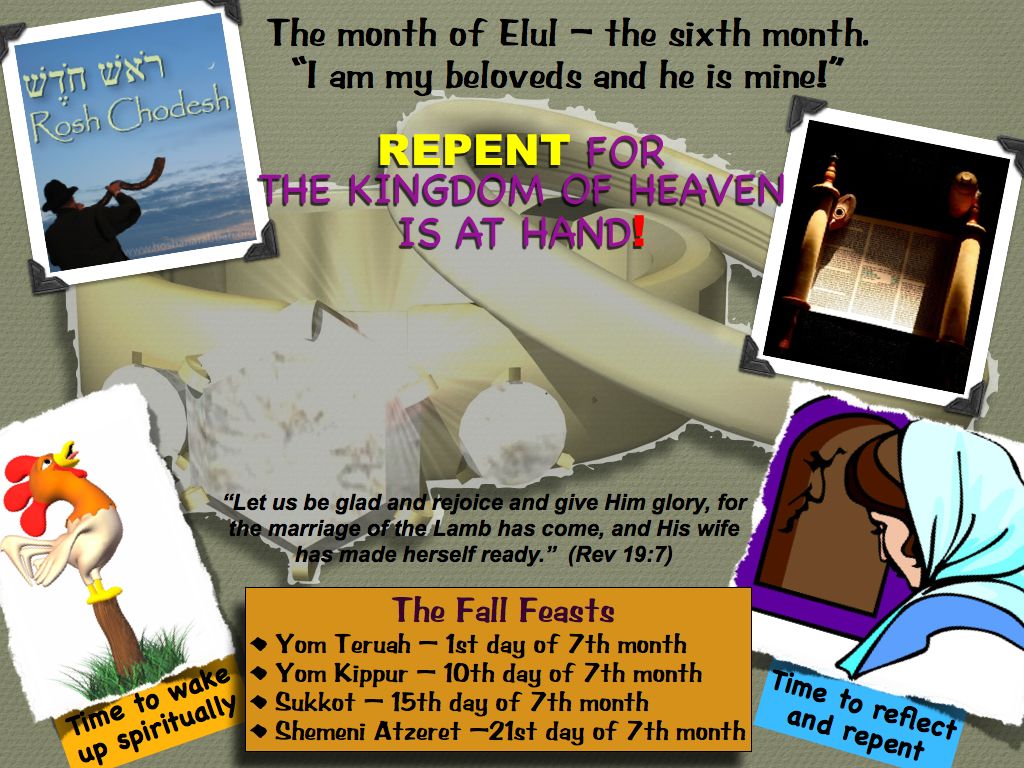
Happy First Day of the Sixth Month of Elul
Today, the new moon was spotted in the land of Israel meaning this is the first day of the biblical month of Elul—the sixth month of the biblical calendar.
In one month, YHVH’s people will begin celebrating the fall biblical festivals, which prophetically point to events surrounding the second coming of our Lord and Savior, Yeshua the Messiah, and the establishment of his millennial kingdom on earth.
It’s time to awaken from the summer spiritual doldrums and to prepare yourself spiritually…! The King of kings is coming. Are you ready?
For more information on this important month, see my previous post, “Teshuvah: A Word YOU Need to Add to YOUR Lexicon” at http://hoshanarabbah.org/blog/2013/08/03/teshuvah/.
Yeshua as Son of God Prophesied in the OT
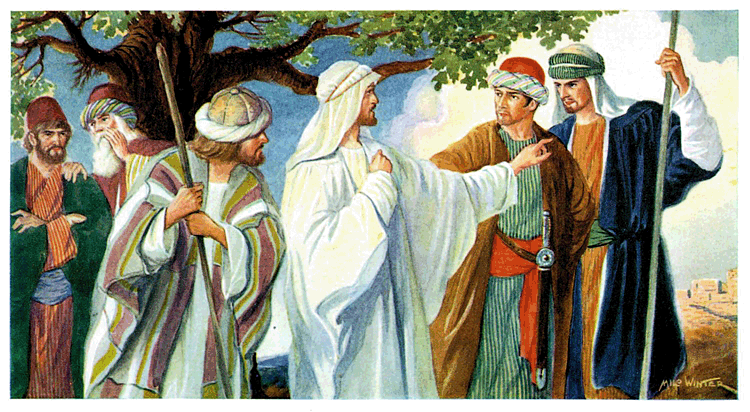
One day, Yeshua asked his disciples who they thought he was. Peter answered, “You are the Messiah, the Son of the living God. (Matt 16:15–16) How did Peter know this? Were there any hints in the Tanakh (Old Testament) that the Messiah would be the Son of Elohim, since these were the only Scriptures Peter had?
Their are numerous prophecies in the Tanakh about the Messiah. Here is a list scriptures that speak specifically that he would be the Son of Elohim with some brief comments following.
Therefore Adonai himself shall give you a sign: Behold, a virgin shall conceive, and bear a son, and shall call his name Immanuel [Heb. God with us]. (Isaiah 7:14)
Many Bible prophecies have double meanings or fulfillments. Such is the case with this prophecy. It was partially fulfilled in Isaiah’s life (Isa 8:3), but not completely. Isaiah’s son was neither deity nor was he known as “God with us.” Yeshua the Messiah was (Matt 1:23).
He shall cry unto me, “You are my father, my El [God], and the rock of my salvation.” Also I will make him my firstborn, higher than the kings of the earth. (Psalm 89:26, 27)
Again, this prophecy has a double fulfillment. It was partially fulfilled by David and his sons, but not completely. Only Yeshua, who also was from David’s lineage, fulfilled the superlative aspects of this prophecy. Not only that, Solomon, David’s son who ruled after him, wasn’t David’s firstborn. Yeshua was Elohim’s firstborn, however.
Who has ascended up into heaven, or descended? Who has gathered the wind in his fists? Who has bound the waters in a garment? Who has established all the ends of the earth? What is his name, and what is his son’s name, if you can tell? (Prov 30:4)
This is a clear and direct reference to the Son of Elohim, who, the Testimony of Yeshua (the New Testament) tells us in several places, was also the One through whom Elohim created all things (e.g. John 1:7). Continue reading
Yeshua…A Prophet Like Moses (Does the Church Really Teach This?)
Deuteronomy 18:15, A prophet from your midst, like me, shall YHVH your Elohim raise up for you. Obviously, this was fulfilled in the person of Yeshua the Messiah. The non-believing Jews, however, attempt to prove that this verse does not apply to Yeshua. For example, The ArtScroll Stone Edition Chumash in its commentary states, “Moses told the nation that just as he was one of them, so God would designate future prophets [plural] from among the people to bring them his word” (p. 1033, emphasis added). What is wrong with this statement? Is the verse quoted accurately? Moses said “prophet” singular, not “prophets” plural, as the commentary says. So in this manner, the commentators switch the focus off of one single prophet who would arise, and make it appear as if all the prophets recorded in the Scriptures helped to fulfill this prophecy. This is dishonest biblical interpretation.
On another note, does the Christian “Jesus” who, it is taught by many church leaders, broke the Sabbath and came to do away with the Torah-law of Moses fulfill this prophecy? Didn’t Moses say that the prophet would speak only the words that Elohim would give him (and the implication is that those words would not contradict what was given at Mount Sinai)? So did Yeshua come to do away with the Torah-law or not? (Read Matt 5:17–19.) In commissioning his disciples in Matthew 28:20, didn’t Yeshua tell them to do and to pass on to others all that he had commanded them? Didn’t Paul tell us to, “Follow me as I follow the Messiah” (1 Cor 11:1)? So how is it that so many people in Christianity believe otherwise about Messiah Yeshua and Paul relative to their teachings on the Torah-law? The point we are trying to make here is that the “Jesus” of the Sunday church who, it is taught, came to annul the Torah, does not fit the criteria of this prophecy of Deuteronomy 18:15–19. Either the Torah prophecy is wrong and Christian tradition is correct or it is the other way around. We choose the former to be the truth, not the latter!
Book of Joel Overview & End Times Prophecy
Analysis of the Book of Joel
Joel 1:1–20 chronicles the physical and spiritual desolation that will exist in the land of Israel (1:6, 10) just prior to the day of YHVH, the destruction of the Almighty (1:15). Israel’s pitiable condition is due to external forces (symbolized by worms, caterpillars and the lion, 1:4, 6, 7) coming against Israel laying her land waste. The prophet urges YHVH’s people to humble themselves and to call a sacred assembly fast (a probable prophetic reference to the forty days of repentance (Heb. teshuvah) leading up to the fall appointed time of the Day of Atonement (Heb. Yom Kippur).
Joel 2:1 opens by announcing the blowing of the shofar in Zion, and the sounding of the alarm (ruwa, Strong’s H7321, meaning “to shout, raise a sound, to cry out, give a blast, to shout a war-cry or alarm for battle, to sound a signal for war”) in Jerusalem. This is a clear reference to the fall festival of Yom Teruah, the Day of the Blowing of Shofars, or Day of the Shouting This is announced as a day when YHVH’s people are to tremble and to prepare for the coming of the day of YHVH, which is near.
The prophet next goes on to describe that day of YHVH as one of darkness (or obscurity) and gloominess (calamity or wickedness), heavy or thick dark cloudiness (2:1). On that day, a great army will swarm over the land with a devouring fire going before them while Continue reading
New Video: Religion Vs. Relationship—Sitting at Yeshua’s Feet Is the Key to Victory
In your spiritual walk, are you more like Martha who was busy trying to earn Yeshua’s favor with her activities or like Mary who was sitting at the Master’s feet learning and worshipping? Religious acts are important, but building a daily relationship with Yeshua is the higher level to reach for. This video explores the idea of sitting at Yeshua’s feet and the central place of the cross in the believer’s life as evidenced in the service in the Tabernacle of Moses.