From the Archives: Chanukah or Christmas, Neither or Both?

Since tonight begins the first day of Hanukkah, I thought it would be appropriate to direct you to an article that I wrote for this blog last year on Chanukah (or Hannukah) and Christmas. In this post, I contrast the two holidays and show how Christmas is about syncretism with paganism, while Hanukkah takes a stand against it. At the same time, and on the positive side, both holidays have the idea of light as their theme, which points to Yeshua the Messiah as the Light of this world. Read more about this at

http://hoshanarabbah.org/blog/2012/12/08/chanukah-or-christmas/


Celebrating Hanukkah from a Correct Perspective

This year Hanukkah starts on the night of Wednesday, November 27 and ends on Wednesday, December 5. (For free, printable monthly calendars, go to http://hoshanarabbah.org/calendars.html.)

In some Messianic circles, more is made of Hanukkah than the biblical feasts. This is wrong.

Hanukkah, Happy 2-33399066

In some Messianic circles, Hanukkah (and Purim) is listed along with the biblical feasts giving the impression that this holiday is equal to or only slightly less important than the biblical feasts. This also is wrong.

Hanukkah is mentioned only once in the Scriptures, in the Gospels, by it’s English name — the Feast of the Dedication (John 10:22). There we read that Yeshua was at the temple in Jerusalem during this holiday. This scripture doesn’t say whether he was celebrating it or not, so we don’t know.

In a certain sense, Hanukkah was to the ancient Jews what the Fourth of July or Thanksgiving is to Americans — a secular holiday commemorating a historical event. It is Continue reading →


Joseph’s Life: Prophetically Points to Yeshua, the Suffering Servant

Genesis 37–41 The Life of Joseph—A Foreshadow of Messiah Ben (Son of) Yosef

The spirit of Antimessiah (Antichrist) is on a dramatic rise in this day and age. It is even alive in the Hebrew Roots or Messianic Israel Movement where some are losing their faith in Yeshua. A few are even converting to Rabbinic Judaism, which denies the messiahship and deity of Yeshua and the divine inspiration of the Testimony of Yeshua. Some of the blame for this can be laid at the feet of a few of the modern-day descendants of the non-believing Pharisees (i.e., the Rabbinic Jews) who use clever arguments to beguile unstable and unlearned souls into humanistic reasoning devoid of a living faith in Yeshua the Savior and Redeemer of man. Because of a spiritual blindness that Scripture prophesied would come upon the Jews producing hardness of heart toward Yeshua the Messiah, unbelieving Jews ignore the numerous prophetic shadow-pictures pointing to Yeshua the Messiah contained in their own Tanakh.

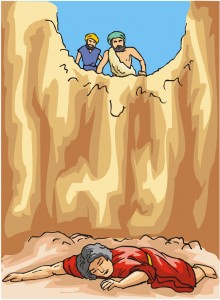
Joseph in pit 20282749

May the following study strengthen your faith in Yeshua, in his divine origination in the very heart, mind and essence of Elohim, and in the fact that he was foreordained to come to this earth to reconcile sinful man to his Heavenly Father through his self-sacrifice on the cross. All this was prophesied long ago in the Hebrew Scriptures. The ancient Jewish rabbis speak of a messianic figure coming called Messiah ben Yosef, the Suffering Servant, whose life and ministry would parallel that of Joseph, yet these same rabbis fail to see the connection between Joseph’s life and that of Yeshua. Let’s now chronicle the striking and uncanny parallels between Joseph and Messiah, the son of Joseph, the Suffering Servant (Many of these comparisons come from the book, Gleanings in Genesis, by Arthur W. Pink):

  • Joseph had two names: Yoseph (meaning “to add, increase, do again”) and Zaphnath-panaaneah (41:45) (meaning “revealer of secrets”). How do these names point to Yeshua’s mission? To answer this, consider that the sin of the first Adam caused the depopulation of YHVH’s eternal kingdom, while Yeshua, the Second Adam, came to do what in regards to YHVH’s spiritual and eternal kingdom?
  • What was Joseph’s occupation before being sold into slavery (Gen 37:2)? What was Yeshua’s spiritual “occupation”? (Not sure? Read John 10:1–18.)
  • Joseph’s father loved him more than all his brothers (37:3–4). What was the relationship between Yeshua and his Father? (Read Matt 3:17; 17:5 and John 10:17.)
  • Joseph was the son of his father’s old age (37:3). Relate this to Yeshua’s Father. Remember, old age is a metaphor for eternity. (Read John 1:1; 17:5; Mic 5:2; 1 Peter 1:20; Rev 13:8.)
  • Joseph wore a multicolored robe of distinction and honor (37:3). What did the Roman soldiers place on Yeshua at his beating Continue reading →
 

Blog Scripture Readings for 11/24 through 11/30/13

Aside

Parashat Miketz — Genesis 41:1 – 44:17
Haftarah — Numbers 7:24 – 35; Zech 2:14 – 4:7**
Prophets — 1 Samuel 18:1 – 24:30
Writings — Psalms 62:1 – 68:35
Testimony — Mark 7:1 – 10:34

Most of this week’s blog discussion points will be on these passages. If you have general comments or questions on the weekly Scripture readings not addressed in a blog post, here’s a place for you to post those. Just use the “leave a reply” link below.

The full “Read Through The Scriptures In A Year” schedule, broken down by each day, can be found on the right sidebar under “Helpful Links.” There are 4 sections of scripture to read each day. One each from the Torah, the Prophets, the Writings, and from the Testimony of Yeshua. Each week, the Torah and haftarah readings will follow the traditional one-year reading cycle.

** A different Haftarah is read when it is a special sabbath in Jewish tradition. This Sabbath is Shabbat during the (minor) festival of Chanukah. Otherwise, the Haftarah this week would be read from 1 Kings 3:15 – 4:1.

Weekly Blog Scripture Readings for 11/24 through 11/30/13.


What We Think, Say and Do Affects Our Effectiveness and Eternal Destiny

Mark 9:38–50, This is a very enigmatic passage that commentators struggle with trying to explain, since Yeshua links together so many seemingly disparate concepts. I say “seemingly,” since there is nothing average about the Master’s intellect, or his knowledge of spiritual truth. Our inability to comprehend his sayings should only spur us onward to dig all the more into their heights and depths of meaning, thus uncovering the nuggets of truth from within the transcendent intellect of our Master and Creator!

Yeshua the Master begins his discourse by discouraging sectarianism. “Those who aren’t against us are for us.” He then promises rewards to those who are kind to his disciples, implying that his disciples should in turn be kind to others who, though they may not be a part of your particular group, they may not necessarily be working against you, for they may also be kingdom workers but with different a assignment than yours (vv. 38–41).

Next, our Master warns against offense—especially those who offend (or cause to stumble) the little ones who are still young and tender in their faith. Linked with the preceding thought, the implication may be that Yeshua’s servants need to beware of not offending any of his kingdom workers whether they are part of “our group” or not. Only the Almighty sees the larger picture much as a general oversees his troops. The individual soldier knows his own marching orders, and may be oblivious to the orders of other soldier’s elsewhere, and is thus in no position to judge another soldier who has other marching orders.

Yeshua then issues a strong warning against any actions (the hand), or any directions of our lives (the foot), or any perspective (the eye) that may lead us to sin in causing one of YHVH’s kingdom workers elsewhere to stumble spiritually. Such an offense may bring us under the severe and unquenchable fires of YHVH’s eternal judgment. In other words, when we, through offensive actions and perspectives, cause one of YHVH’s kingdom workers who is operating outside of our limited view of things to stumble, we may be doing irreparable damage to the advancement of the kingdom, thus risk bringing the wrath of Elohim squarely down upon us (vv. 42–48).

Yeshua concludes his discourse with an even more mysterious statement that commingles a variety of biblical concepts. Many biblical commentators admit the difficulty of understanding this passage (e.g., Matthew Henry, Adam Clarke, Beale and Carson). He indicates that his disciples, as living sacrifices (Rom 12:1), must allow themselves to be laid on the altar of YHVH’s service like the animal sacrifices of old. As these sacrifices went through the sprinkling of salt (Lev 2:13; Ezek 43:24) and the burning of fire on the altar of sacrifice, even so, as living sacrifices doing YHVH’s kingdom work, Yeshua’s disciples must be willing to endure the fires of trials and adversity. Fire both consumes and purifies, while salt both preserves and seasons—two activities that are continually needed in the disciple’s life as part of their spiritual refinement in order for them to become perfect and sin-free like their Master.

Yeshua ends with the admonition to be salty or spicy (in our words and actions) as we advance his kingdom. But we mustn’t be offensive in our demeanor such that it causes others to stumble, thus breaking the peace between our fellow coworkers, since we are all working together for the same Master. No matter what, maintain peace one with another (vv. 49–50)!

 

The Ancient Sages Taught: Two Messiahs to Come— The Same or Different Persons?

The Scriptures Reveal Two Messiahs Are to Come —
One Who Will Be Like Joseph and One Who Will Be Like David

In Jewish literature, the Messiah whose life would resemble Joseph was referred to as the suffering servant or “Messiah Son of Joseph” (Mashiach Ben Joseph), while the Messiah whose life and ministry would resemble David was referred to as warrior king or “Messiah Son of David” (Mashiach Ben David). The Jewish sages came to this conclusion because when reading the messianic prophecies in the Tanakh they saw two different, even conflicting Messiahs whose roles were very different from each other. What was not known by the ancient Jewish sages, and was a subject of much debate, was which Messiah would come first, when he would come, would he be the same person or two different individuals, and how much time would separate the two comings.

For believers in Yeshua, this does not seem like a dilemma, for we look back in time and can see clearly that Yeshua fulfilled the Suffering Servant role at his first coming, and will fulfill the Conquering King role at this second coming. But two thousand years ago, without the benefit of historical perspective, this was not so easy a matter to figure out. Even the disciples were at times in a quandary as to which mission Yeshua was to fulfill as evidenced by their last question to him before his final ascension, “Will you at this time restore again the kingdom to Israel?” (Acts 2:6).

Let’s review some of the passages in the Tanakh that point to the two different Messiahs.

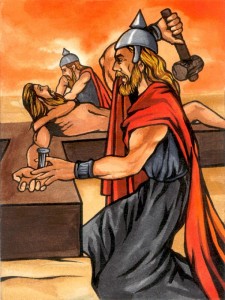
Yeshua nailed to cross16957864

Messiah Son of Joseph

  • The Suffering Servant will die a martyrs death for the sins of his people (Isa 52:13–53:12).
  • In the end of times, the Jews will look upon him whom they pierced and mourn for him as one mourns for his only son (Zech 12:9–10).
  • Verse one of Psalm 22 are some of the last words to come out of Yeshua’s mouth while he hung dying on the cross. This psalm predicts certain aspects of the Suffering Servant Messiah’s ministry.
  • John 1:45 may be a double entendre allusion to Yeshua as being not only the (adopted) son of Joseph, the husband of Mary, but to his being Messiah Son of Joseph as well.

Throne 9842706


Messiah Son of David

  • He will restore righteous government in Jerusalem (Isa 1:26)
  • He shall judge the nations (Isa 2:4)
  • All on earth shall worship him (Isa 2:17).
  • He shall rule the earth and destroy the wicked (Isa 11:4).
  • Under his rulership, all Israelites will be restored to their homeland (Isa 11:12).
  • Matthew 9:27; 12:23; 15:22; 20:30, 31; 21:9,15; 22:42 are references to the expectations of the Jewish followers of Yeshua that he was Messiah Son of David.
 

What Are Some Symptoms That a Person Is Tormented by Demons?

Mark 5:1–20, The Gadarene demoniac. This encounter between Yeshua and this demon-possessed individual teaches us about the characteristics of one who is tormented or even possessed by an evil spirit.

21446002

  • One with an unclean spirit is “unclean in thought and life” (Mark 5:2).
  • Such an individual may have a pre-occupation with things relating to death and dying (Mark 5:3).
  • They may possess superhuman strength (thanks to the aid of the demon in him, Mark 5:4).
  • They may act wild, and unable to be restrained (Mark 5:4).
  • They may be given to fits of shouting loudly (Mark 5:5), shrieking or making a shrill cry (Mark 9:18).
  • They may cut themselves, or resort to other acts of self-mutilation (Mark 5:5) or self destruction (e.g., burning oneself by fire, Matt 17:15; Mark 9:22), drowning (Mark 9:22).
  • The demoniac may possess supernatural knowledge (Mark 5:7).
  • The demon can speak through the demonized person (Mark 5:7), or cry out (Mark 9:26).
  • A demonic spirit wants to possess or inhabit something; if not a human, then an animal (Mark 5:12), or a house, an objects like idols or books (Acts 19:19).
  • They may be clothed improperly or scantily (Mark 5:15).
  • They will not a possess a “right [sound, self-controlled, sober]” mind (Mark 5:15).
  • A demonic or an unclean spirit may cause convulsions or spasmodic contractions, bodily contortions within a person, or cause a person to be hurled to the ground (Mark 1:25; 9:18, 20), wallowing or rolling around on the ground (Mark 9:20).
  • Epileptic-type seizures or madness can be some symptoms of demon possession (Matt 17:15).
  • A demoniac may foam at the mouth (Mark 9:18, 20).
  • A demoniac may grind or gnash of the teeth (Mark 9:18)
  • A demonic spirit can cause one’s body to waste away, dry up or become rigid (Mark 9:18).
  • Demonic spirits can accompany people as they come into the congregation of YHVH (Mark 1:23; Luke 4:33).
  • A demonic spirit can make one to be mute or unable to speak (Mark 9:17).