Put on you holy under and outerwear

Exodus 39:1, The holy garments for Aaron. The vestments of the high priest (kohen hagadol) are symbolic of the robes of righteousness that saints should be wearing in preparation for the return of the Messiah.
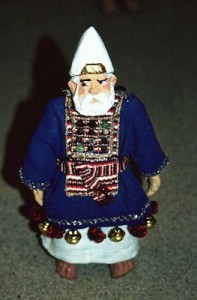
High Priest

Gold symbolizes purity of heart. Blue symbolizes heaven and spirituality. White linen pictures robes of righteousness. White symbolizes purity and sinlessness. Red represents blood—the blood of Yeshua that cleanses from sin.

The high priest wore a belt that represents truth, according to Paul (Eph 6:14).

White linen pants represented sexual purity.

The white turban represented purity of thought and humility (the opposite of conceit).

He wore a gold crown inscribed with the words, “Kadosh l’YHVH” meaning “Set-Apart to YHVH.”

The dangling pomegranates represented the fruits of our lives be they good or bad.

The golden bells jingled when the priest walked. As we go through life people hear us and see us. Our actions speak loudly and clearly. Also, Yeshua said that our words reveal the true condition of our heart (Luke 6:45). How do people really view us? What are we like in secret when no one else is around—our thought life and our words—our secret life? Is there a discrepancy between our secret and public lives? If so why? How set apart and righteous are we … in reality?

If we are called to be a set-apart priesthood then hadn’t we better get busy cleaning up our act?

Jewish tradition tells us that a rope was tied to the leg of the high priest in Second Temple times so that while ministering in the innermost sanctuary of the temple if he was impure and YHVH struck him dead (as happened to Nadab and Abihu, the sons of Aaron, when they offered up strange fire) the corpse could be dragged out by the rope.

Doesn’t all this show us that we should take being righteous and set apart seriously? Remember Hebrews 12:14: “Follow peace with all men, and holiness, without which no man will see the Master.”




Proof of America’s Slide into Neo-Barbarism

The Bible tells us that a person has a soul, and that the soul has three main subdivision: the mind, the will and the emotions. This is who a man is and what makes him a unique individual. The Bible also teaches us that each man has a conscience, and that within that conscience indigenously is a basic sense of right and wrong. On the day of Elohim’s judgment, those who follow their moral conscience and do what is right will be judged more favorably than those who don’t (Rom 2:13–16).

1658554

As a man has a conscience, so does nation, which is comprised of many men. Several words reflect the conscience of a nation. For example, the word mores is “the essential or characteristic customs or fixed morally binding customs or conventions of a community.” Another word would be ethos, which means “the characteristic spirit of a culture, era or community as manifested in its beliefs and aspirations.” Based on the mores or ethos of a people-group, that group, community or nation will form laws by which it will govern itself. In America, from its founding 240 years ago until recently, the Bible and Christianity influenced the conscience of individuals and the collective conscience of the nation. America’s founding documents — the Constitution and state constitutions — reflected a definite biblical, if not Christian, world-view. This was the ethos of the society.

America, presently, has been described by many as a “post-Christian” nation. It would seem that those who assert that it is still a Christian nation are focusing on America’s past state rather than her present state. That is not to say that there are not still many Bible believers who walk out their faith in America. They are just no longer the majority; a Christian or biblical world-view is no longer the dominant ethos reflecting the core mores of the majority of Americans. The proof of this is to simply look at the spiritual and moral values those individuals our society votes into office to rule over them from the president on down.

Now let’s define another term that is becoming more and more apropos to the times in which we are living. That word is barbarism. Barbarism (derived from the word barbarian), is defined as “the condition to which a society or civilization may be reduced after a societal collapse relative to an earlier period of cultural or technological advancement. This term may also be used pejoratively to describe another society or civilization which is deemed inferior in some way.”

Is America descending into a culture of neo-barbarism or heathenism? Let’s look at some indication that show this is likely the case. Continue reading →


Blog Scripture Readings for 2/23 through 3/1/14

Aside

THIS WEEK’S SCRIPTURE READINGS FOR STUDY AND DISCUSSION:

Parashat Pekudei — Exodus 38:21 – 40:38
Haftarah — Exodus 30:11 – 16; 2 Kings 12:1 – 17**
Prophets —Isaiah 6:1 – 12:6
Writings — Psalms 138:1 – 144:15
Testimony — John 7:25 – 10:21

Most of this week’s blog discussion points will be on these passages. If you have general comments or questions on the weekly Scripture readings not addressed in a blog post, here’s a place for you to post those. Just use the “leave a reply” link below.

The full “Read Through The Scriptures In A Year” schedule, broken down by each day, can be found on the right sidebar under “Helpful Links.” There are 4 sections of scripture to read each day. One each from the Torah, the Prophets, the Writings, and from the Testimony of Yeshua. Each week, the Torah and haftarah readings will follow the traditional one-year reading cycle.

**A different Haftarah is read when it is a special sabbath in Jewish tradition. This Shabbat is traditionally known as Shabbat Shekalim and Exodus 30:11-16 is read.

Weekly Blog Scripture Readings for 2/23 through 3/1/14.


New Video: What is the meaning and significance of the name Elim?

In Exodus 15:27 we see that upon leaving Egypt, the children came to the desert oasis of Elim with its 70 palm trees and 12 wells. Elim and its name have many prophetic implications, which is why we named our congregation after it. This video explains these things.


New Video: What is the Purpose of Biblical Rituals?

What is the purpose of biblical rituals like baptism and communion? How about the Sabbath, the biblical feasts, fringes, mezuzahs, or praise and worship services? There are good and bad rituals. In this video, learn how biblical rituals bring us closer to YHVH Elohim in heaven.


Are you a picky eater?

John 6:54, Flesh…blood. This is a Hebrew idiom for “the whole person” (see Matt 16:17; 1 Cor 15:50; Gal 1:6; Eph 6:12; Heb 2:14). This relates to Moses’ instructions that “man shall not live by bread alone…but by every word that proceeds from the mouth of YHVH” (Deut 8:3). This applies to Yeshua who was that Word of Elohim who “became flesh and dwelt among us” (John 1:1 and 14).

20101995

When one puts their faith in or believes in Yeshua (John 6:29 and 5:24), then one must also believe him — that is, not only accept him as the Son of Elohim and one’s Savior, but also follow and obey (or “eat”) him who is the Living Manna-Word of Elohim from heaven. This involves believing his words by loving him and keeping his Torah-commands (John 14:15, 23 cp. Exod 20:6), which are his words.

This is why YHVH instructed the Israelites to eat the whole Passover lamb, and to leave nothing left over (Exod 12:10). This teaches us that we are to “eat” all of Yeshua — his whole Person as represented by the bread and the wine at communion on Passover. We are to accept the totality of his Word, not just the parts that suit us, or fit with our conventional religious viewpoints as per the traditions of men.

Many claim to eat all of his flesh and drink all of his blood, yet through their anti-Torah Continue reading →


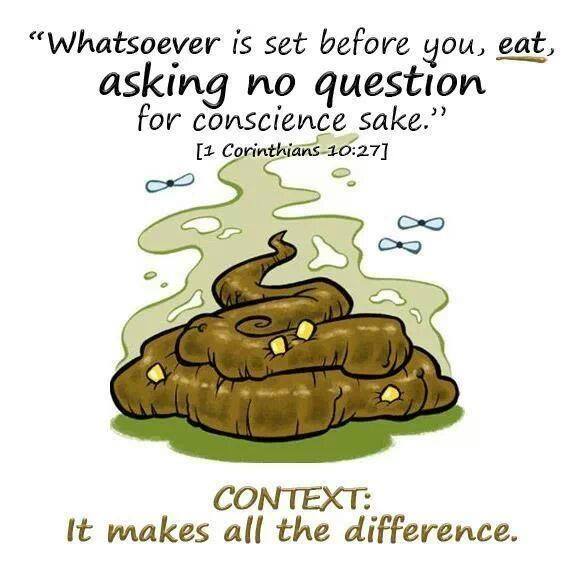
Eat whatever’s put before you!??!?? (Yeah right!)

Do you really think that Paul the apostle meant we should eat whatever is put before us when he made this statement (see graphic below) in 1 Cor 10:27, even if it violated the biblical dietary commandments? Yet many in the church will use this Bible verse to attempt to prove the biblical dietary laws — along with the rest of the Torah-law of  Moses — have been “done away with.” Hey church, it’s time to start using your noggins a little instead of thinking with your belly!

1798011_615486091852101_885740190_n

(This graphic was sent to me via Facebook and was too good to pass up, yet I don’t know whose graphic it is. If someone knows, please let me know, so I can properly attribute it.)