Blog Scripture Readings for 12-7 Through 12-13-14

Aside

THIS WEEK’S SCRIPTURE READINGS FOR STUDY AND DISCUSSION:

Parashat Vayeshev — Genesis 37:1 – 40:23
Haftarah — Amos 2:6 – 3:8
Prophets — 1 Samuel 11:1 – 17:58
Writings — Psalms 63:1 – 69:36
Testimony — Mark 8:1 – 11:18

Most of this week’s blog discussion points will be on these passages. If you have general comments or questions on the weekly Scripture readings not addressed in a blog post, here’s a place for you to post those. Just use the “leave a reply” link below.

The full “Read Through The Scriptures In A Year” schedule, broken down by each day, can be found on the right sidebar under “Helpful Links.” There are 4 sections of scripture to read each day. One each from the Torah, the Prophets, the Writings, and from the Testimony of Yeshua. Each week, the Torah and haftarah readings will follow the traditional one-year reading cycle.

Weekly Blog Scripture Readings for 12/7 through 12/13/14.


The Torah Connection

The Link Between the Infinite and the Finite — A New Paradigm in Which to View the Bible

The Torah Connection

If you were the infinite, omniscient and loving Creator of the universe who made man in his own image to have a relationship with him, how would communicate with finite man? How could you pour all that you know and are into man, so that he could experience the love, joy, peace, goodness, holiness, wisdom, understanding and truth that you have? It would be like trying to pour the world’s oceans into a thimble. The best you could do would be to distill down the essence of who you are and what you know into the simplest and most basic form and then give it to man in hopes that he would accept and understand it and then apply it to his life.
Torah scroll open 2

This is exactly what YHVH Elohim did when he gave man his Torah. The Torah is a small kernel representing the essence of the very mind, will, character and heart of the Creator, and it’s his gift to man, for man to live an abundant leading to immortality in Elohim’s eternal kingdom.

How do we know this? The Bible likens the Torah that emanates from the Eternal Creator to divine light that pierces the spiritual darkness of the man’s physical existence. Moreover, the Torah is like a path that leads man to YHVH Elohim, the Creator. It is the epitome of all wisdom, knowledge and understanding that when embraced and obeyed leads man to the fulfillment of his highest desires. This very Torah is revealed in the pages of the Bible from Genesis to Revelation. Yes, not just in the books of the law of Moses, but in the New Testament or Testimony of Yeshua as well! It is there for those who will remove their religious blinders and open their eyes to the truth that has always been there.

The Living and the Written Torah Is the Central Theme of the Bible

The Living (Yeshua the Messiah) and Written Torah (specifically the biblical books of Genesis to Deuteronomy, and in the larger sense, the entire Old Testament or Tankah) is the dominant theme of the Bible. They are one in the same thing—totally unified and absolutely indivisible, which is why I used the singular verb is and not the grammatically correct plural form of the vert to be in the previous sentence. Another way to say this is that the whole Bible is about Yeshua the Torah-Word of Elohim who was made flesh (John 1:1, 14).

To illustrate this point, as we shall discuss later, we find this dominant theme prominently highlighted at the beginning, middle and end of the Scriptures. This brief study is, by no Continue reading →

 

What Is Jacob’s Trouble in End Times Prophecy?

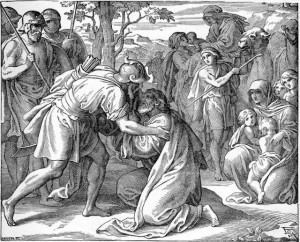
Genesis 32 is the story of Jacob’s return to Canaan after having been exiled from his homeland for 20 years. This is often referred to as Jacob’s Trouble (from Jer 30:7). His exile occurred after he obtained his divinely promised birthright through shrewd if not unscrupulous means from his brother Esau resulting in his having to flee Canaan for fear of his life due to Esau’s vengeance. Jacob found refuge in the region of Babylonia at his Uncle Laban’s home where he married Laban’s two daughters, Leah and Rachel. Genesis 32 recounts Jacob’s encounter with Esau who, along with his small army, physically stood in Jacob’s way from entering the land of his promised inheritance—later to be known as the land of Israel or Promised Land.

Jacob-Esau embrace 1

The Jewish sages believe that this encounter between Jacob and Esau is prophetic in nature and will happen again in the end times, but this time on a much larger scale and this time involving the numerous descendants of Israel and Esau. The Israelites will be attempting to return to their ancestral homeland, while the descendants of Esau will be attempting to block their way. As we proceed in this study, we will see whether this prophecy is beginning to come to pass in our days.

Rolling the film backwards a little, Laban had chased Jacob out of the area of Babylon, and yet Jacob was being blocked from entering Canaan by Esau (or Edom meaning “red”). This is reminiscent of Pharaoh chasing the Israelites out of Egypt only to find themselves blocked by the Red Sea, which is a picture of Edom (meaning “red”). In both instances, YHVH’s people were forced to totally rely on him for deliverance from their enemies who were before and behind them.

Chapter 32 is a study in how we often deal with major trials and stressful situations in life. Jacob (a) was gripped by fear, (b) resorted to fleshly schemes to appease his brother’s wrath and “to save his own hide” and that of his family, and (c) at the same time he Continue reading →


Blog Scripture Readings for 11-30 Through 12-6-14

Aside

THIS WEEK’S SCRIPTURE READINGS FOR STUDY AND DISCUSSION:

Parashat Vayishlach — Genesis 32:4(3)* – 36:43
Haftarah — Obadiah 1:1–21
Prophets — 1 Samuel 4:1 – 10:27
Writings — Psalms 56:1 – 62:12
Testimony — Mark 4:20 – 7:37

Most of this week’s blog discussion points will be on these passages. If you have general comments or questions on the weekly Scripture readings not addressed in a blog post, here’s a place for you to post those. Just use the “leave a reply” link below.

The full “Read Through The Scriptures In A Year” schedule, broken down by each day, can be found on the right sidebar under “Helpful Links.” There are 4 sections of scripture to read each day. One each from the Torah, the Prophets, the Writings, and from the Testimony of Yeshua. Each week, the Torah and haftarah readings will follow the traditional one-year reading cycle.

* Verse numbers in parenthesis refer to the verse number in Christian Bibles when it differs from the Hebrew Bible or Tanakh.

Weekly Blog Scripture Readings for 11/30 through 12/6/14.


Answers from Amos

I’ve been studying Elohim’s word this morning, and I was led to open up the little Book of Amos. I read all nine chapters. Somehow, I sensed that the answer to the question I asked in the previous post might be found therein. That question was how do we get to the next stage in our spiritual walk?

I can’t say that I have the full answer, but some spiritual insights were garnered.

15227437

The bottom line is that we need a fresh prophetic vision — a divine revelation of where YHVH wants us to go next.

It goes back to Proverbs 29:18, which says that without prophetic vision, YHVH’s people perish or become unloosened spiritually. Additionally, all prophetic vision should be on a solid Torah foundation — something that doesn’t exist among the so-called prophets in the contemporary mainstream church  system.

Amos explains the role of the prophet and how people really don’t want to hear YHVH speak to them through his servants, the prophets, much less obey the word of Elohim they’re proclaiming. So why then should YHVH send them his prophets if his people refuse to hear and to obey?

Though I’m not a prophet, as a servant of the Most High, I should be speaking prophetically as inspired by the Holy Spirit. This applies to you too. When a Bible teacher or preacher gets up in front of others to speak, he should do so prophetically; that is, in an inspired way that brings forth divine revelation from the word of Elohim. The problem is that most people start to shut the preacher off when he urges them to repent of sin. As a preacher, I can tell you this is the case. Almost every time I preach a message of repentance, someone gets offended and blames me for their angst. Instead of looking at themselves in the mirror and conforming their lives to the word of Elohim, they make excuses why it doesn’t apply to them, and then they shoot the messenger. Frankly, it get’s tiring after a while!

Okay, enough of this. Let’s see what Amos had to say. Here are some insights from this prophet I gathered this morning.

Amos 8:11, A famine…of hearing. Hearing is the Hebrew word shema, which has the compound meaning of both hearing and doing. In our modern world, the word of Elohim is more proliferated than ever before, especially Continue reading →


A personal question…

How do you get to the next level in your spiritual walk, but you haven’t been there, so you’re not quite sure what it looks like, and don’t know anyone else who’s already there who can help show you the way? I know that’s the job of the Holy Spirit, but Elohim still uses human instruments.

33347486