
Mount Ebal: More Prophetic Shadow Pictures of Yeshua

Deuteronomy 27:2, 4, 8, Set up great stones. On Mount Ebal on whole, un-cut stones, the Israelites were to write the Torah-law and then coat these stones with lime plaster. Elohim also told them to build an altar there where they were to make burnt and peace offerings.
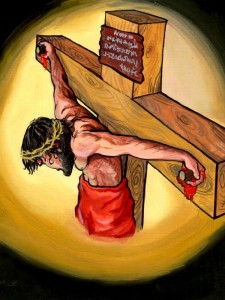
Cross, hanging on 16957854

Why was the Torah written on stones on Mount Ebal—the mountain of the curses? Why not on Mount Gerizim, the mountain of blessing? Certainly this cannot mean that the Torah is a curse, for Paul calls it kadosh (holy), just and good in Romans 7:12.

What could the stones represent? Who is the Chief Cornerstone, the Stone the builders rejected (Ps 118:22; Matt 21:42; Acts 4:11; Eph 2:20), and the stone cut without hands (Dan 2:34)?

What was the purpose of these offerings and to whom do the burnt and peace offerings point?

Could lime plaster represent robes of righteousness? Who is clothed in robes of righteousness once their sins have been atoned for? (Read Rev 19:7–8 cp. 3:5,18; Isa 61:10.)

Who was wounded for our ­transgressions and bruised for our iniquities, had laid on him the iniquities of us all, and was made an offering for sin (Isa 53:5, 6, 10)?

Who was the Living Torah, the Word of Elohim made flesh (John 1:1,14)?

Who redeemed us from the curses of the law (Gal 3:13), which came upon us as a result of our sinning (sin is the violation of YHVH’s law, 1 John 3:4), and thus bringing a death penalty upon us (the wages of sin is death, Rom 6:23)?

Does it now make sense why the Torah and the altar were placed on Mount Ebal? This is another one of the many prophetic shadow pictures in the Torah pointing to the redemptive work of Yeshua at the cross. Does this strengthen your faith that Yeshua is indeed the Messiah, the Lamb of Elohim slain from the foundation of the earth? Who else could have fulfilled these prophecies?


Blog Scripture Readings for 8-30 Through 9-5-15

Aside

THIS WEEK’S SCRIPTURE READINGS FOR STUDY AND DISCUSSION:

Parashat Ki Tavo — Deuteronomy 26:1 – 29:8 (9)* 
Haftarah — Isaiah 60:1-22
Prophets — Amos 9:1-15; Obadiah; Jonah 1:1 – 4:11; Micah 1:1 – 2:13
Writings — 2 Chronicles 1:1 – 8:18
Testimony — Hebrews 3:1 – 9:28

Most of this week’s blog discussion points will be on these passages. If you have general comments or questions on the weekly Scripture readings not addressed in a blog post, here’s a place for you to post those. Just use the “leave a reply” link below.

The full “Read Through The Scriptures In A Year” schedule, broken down by each day, can be found on the right sidebar under “Helpful Links.” There are 4 sections of scripture to read each day. One each from the Torah, the Prophets, the Writings, and from the Testimony of Yeshua. Each week, the Torah and haftarah readings will follow the traditional one-year reading cycle.

* Verse numbers in parenthesis refer to the verse number in Christian Bibles when it differs from the Hebrew Bible or Tanakh.

Weekly Blog Scripture Readings for 8/30 through 9/5/15.


Do not be overcome, be an overcomer!

Deuteronomy 25:19, Blot out Amalek. The Hebrew name Amalek literally means “I am king.” Remember how the people of Amalek attacked the children of Israel as they were coming out of Egypt (Exod 17:8)? These heathens attacked the weary, stragglers and weak Israelites who were falling behind in the rear ranks (Deut 25:18).

The Israelites defeated Amalek militarily under the leadership of Moses and Joshua when Moses stood on a hill with his arms outstretched in the form of a cross (Exod 17:10–13). It was at this spot that Israel learned that YHVH Elohim was their spiritual banner (Heb. Yehovah Nissi; Exod 17:15).

There is a spiritual lesson in this story for us today. Amalek is a spiritual picture of the world, the flesh and devil that will attack and try to destroy us spiritually as we’re coming out of our own spiritual Egypt and beginning our trek through the wilderness of life en route to Promised Land of our spiritual inheritance, which is the kingdom of Elohim from heaven.

This reminds us of Yeshua’s Parable of the Sower (Matt 13:3–9) where the good seed of the Word of Elohim was sown on four types of soil. The seed failed to grow in the three types of soil representing the world, the flesh and the devil (Matt 13:18–23). This is another picture of Amalek.

What defeated Amalek? Joshua the valiant warrior defeated the Amalekites militarily, while at the same time Moses was perched on a hill over the battlefield with his arms raised to heaven. Both Joshua and Moses are a prophetic picture of Yeshua. Joshua’s Hebrew name is Yehoshua, which is the long version of the name Yeshua. At the same time, on the mountain Moses’ arms grew tired and had to be supported and in so doing took the form a cross. What are these things a spiritual picture of? Moses and Joshua combined form a prophetic picture of Yeshua defeating the world, the flesh and the devil at the cross on Golgatha’s hill. Only when Moses’ arms were raised up to heaven in surrender and supplication to the Almighty did Joshua experience victory over the Amalekites. Similarly, only through prayer and the intercession on our part and through the resurrected Yeshua the Messiah in heaven acting as our Great High Priest before Elohim’s throne will we be able to defeat the spiritual enemies that are attempting to prevent us from entering the Promised Land of our spiritual inheritance.

The enemies of our salvation will attempt to destroy us when were weak, tired and falling behind in our spiritual walk. However, when we determine to fight, we have Yeshua’s victorious death on the cross as well as his help in heaven to overcome our enemies.

One of YHVH’s covenant names is Yehovah Nissi or YHVH Is My Banner. A military banner is something used to help build the morale of troops during the battle. YHVH is our strength and morale booster in the time of battle, and through or faith in YHVH-Yeshua, we already have the victory over the world, the flesh and the devil!

This lesson illustrates the fact that the Scriptures contain many deep spiritual mysteries and truths that if it weren’t for the physical examples or prophetic shadow-types contained therein they might otherwise be obscured to us and too difficult to comprehend.


Yeshua Teaches About Divorce

A commentary on Deuteronomy 24:1–4

While on this earth, Yeshua taught on many subjects pertaining to all areas of human existence—136 in all. He taught on everything from angels to worship, from money to taxes, sexuality to celibacy, fasting to food, joy to sorrow and yes, on the subject of divorce, as well (see Matt 19:1–12).

Malachi says that YHVH hates putting away, a Hebraism for divorce (2:16). Yet Yeshua says in Matthew 19 that in the Torah divorce was permitted if one of the parties had a hardened heart resulting in irreconcilable differences. Adultery was cause for divorce if the offending party refused to repent.

YHVH married the whole House of Israel (i.e., all twelve tribes) at Mount Sinai and the Torah was the marriage agreement (See The Bible: The Good News – The Story of Two Lovers & YHVH’s Set-Apart Feast Days Are the Outline of that Love Story: A Plan of Redemption where the Jewish wedding is outlined historically and prophetically in a biblical context, available at http://www.hoshanarabbah.org/pdfs/love_story.pdf). Ezekiel describes the marriage between YHVH and Israel succinctly and allegorically in Ezekiel 16:6–8.

Yet because both the Houses of Judah and Israel committed spiritual adultery by whoring after foreign gods and lovers and failed to live up to their marital agreements they had made with YHVH at Mount Sinai when they said “I do” three times (Exod 19:8; 25:3, 7). YHVH sent prophet after prophet as recorded in the pages of the Tanakh (Hebrew Scriptures) in attempts to turn the heart of Israel back to him, yet her heart was hardened toward him and she refused to repent of her adulteries; therefore, YHVH was forced to do that which he hates and dissolve the marriage and divorce Israel.

In light of these issues, what are the prophetic implications of the divorce of YHVH from the nation of Israel and his future remarriage to the same nation? To understand this issue and to gain a deeper understanding of YHVH’s wonderful plan of salvation for his people, read “The Prophetic Implications of Divorce in Light of the Two Houses of Israel,” which is available at http://www.hoshanarabbah.org/pdfs/divorce.pdf.


Are Jewish fables and the Torah the same thing?

Titus 1:14, Jewish fables. Many Bible teachers in the mainstream church teach that this verse refers to the Torah. They use it in attempting to prove that the commandments of the Torah are no longer valid for believers. Is this correct? In reality, Paul can’t be referring to the Torah here without contradicting himself elsewhere. In numerous places, he strongly upholds and defends obedience to the Torah (Rom 3:31; 7:7, 12, 14; 13:8–10; 1 Cor 7:19; 9:21; Gal 3:10; 6:2; 2 Tim 6:14; Tit 2:14) and even claims to follow it himself (Acts 21:24; 24:1425:8; 28:17; 1 Cor 9:21). He must be talking about the Jewish traditions of men, which Yeshua said in Matthew 15:3–9 and Mark 7:7–9 make of non-effect the word of Elohim.

In fact, this is exactly what Paul is referring to here in this verse when he says “Jewish fables and commandments of men.” This is not a reference to the Torah the commandments of which came from YHVH Elohim, and not from men. In the same verse, Paul contrasts these commandments of men with “the truth” from which men have turned away. What is this truth? The Bible defines its own terms. Elohim is the source of truth (Deut 32:4 cp. Pss 86:11; 89:14; 117:2), he is truth (Ps 25:10; 31:5; 33:4), and his Torah is truth (Ps 119:142, 151).

One example of a Jewish fable and a commandment of men would be the idea that one can’t be saved unless they’re first circumcised, which was the subject of the Acts 15 council. Paul vehemently fought this Jewish fable, and the whole Book of Galatians, for example, largely deals with this issue. If Paul had meant the Torah when mentioning “Jewish fables” then this makes Paul into a schizophrenic liar (since he promotes and lauds the Torah and claims to follow it elsewhere), and it makes the word of Elohim contradict itself, and it puts Paul at odds with Yeshua who upheld the Torah (Matt 5:17–19) and with himself when he said to imitate Yeshua the Torah-keeper as he himself did (1 Cor 11:1).


A video that the Spirit of Antichrist doesn’t want you to watch


New Video: The Bridegroom Is Coming — Awake, Repent & Prepare!

The sixth month of the biblical calendar occuring in the late summer is the time to awake spiritually, repent of sin and to prepare for the fall biblical festivals, which prophetically picture the second coming of Yeshua, the Heavenly Bridegroom of the saints. This video discuss how and why to get ready spiritually.