Blog Scripture Readings for 8-23 Through 8-29-15

Aside

THIS WEEK’S SCRIPTURE READINGS FOR STUDY AND DISCUSSION:

Parashat Ki Tetze — Deuteronomy 21:10 – 25:19 
Haftarah — Isaiah 54:1-10
Prophets — Amos 2:1 – 8:14
Writings — 1 Chronicles 23:1 – 29:30
Testimony — 2 Timothy 4:1-22; Titus; Philemon; Hebrews 1:1 – 2:18

Most of this week’s blog discussion points will be on these passages. If you have general comments or questions on the weekly Scripture readings not addressed in a blog post, here’s a place for you to post those. Just use the “leave a reply” link below.

The full “Read Through The Scriptures In A Year” schedule, broken down by each day, can be found on the right sidebar under “Helpful Links.” There are 4 sections of scripture to read each day. One each from the Torah, the Prophets, the Writings, and from the Testimony of Yeshua. Each week, the Torah and haftarah readings will follow the traditional one-year reading cycle.

Weekly Blog Scripture Readings for 8/23 through 8/29/15.


Rules, rules and more rules…a good or bad thing?

Deuteronomy 21–25

This portion of the Torah (Deut 21:10–25:19) contains 72 commandments, which is more than in any other Torah portion. In this passage there are rules pertaining to all aspects of human relations showing that the “Torah deals with the real world. It does not present a world where all people get along with one another or rush to take care of one another’s property. Instead, it ‘takes into account the grim reality that people do not achieve the desired observance of “you shall not hate others in your heart”’” (A Torah Commentary For Our Times, vol. 3, p. 150).

In studying this portion, one can easily miss the point of a particular command if one views it strictly in its pashat (most literal) meaning. For these commands to have relevance in our day, one must view them as principles that have a broad range of application. The specific examples Torah gives are merely representative of one of but many life situations to which the principle behind the example could apply. Keeping this in mind, this Torah portion will give you much to ponder pertaining to your day-to-day walk (or halakhah).

In these chapters we see a plethora of laws concerning many seemingly small details regarding human life. Many people in the church have the tendency to broadly sweep away these commandments with such dismissive cliches as, “We’re now under grace …” or “We’re not under the law anymore …..” But please observe how many of the civil laws of our nation regulating actions between various members of society are based upon YHVH’s laws found in the Torah. As we make our way back to a more biblically-based lifestyle and orientation, we begin to see that (a) YHVH cares about the details of our lives and (b) these laws, while sometimes hard to understand, are for our own well-being and blessing. Do you still nurse a “pick and choose” or “have it your own way” mentality with regard to YHVH’s biblical commandments choosing to follow the ones you want and making excuses why you can’t (or don’t want to) follow the rest? By doing so, what blessings are you depriving yourself of, and how are you hindering your love relationship with YHVH?

Some of the laws in these chapters may be hard to observe nowadays. With others, due to our church background, we may have the tendency to spiritualize them away, thus, in essence, rendering them of non‑effect in our lives and thereby placing ourselves above YHVH’s Torah-law and thus becoming a law unto ourselves. Is this not humanism: every man doing what is right in his own eyes instead of obeying YHVH whatever the cost? Who is the Master of your life? You or YHVH?

How do you view laws about women wearing men-type clothing, wearing fringes on the corners of your garments, mixed certain types of fibers in clothing, lending without interest, caring for the widows and orphans, personal hygiene, family purity laws (e.g. men not having sexual relations with their wives during their monthly cycles), removing blood from all meat before eating it, men wearing beards, faithfully tithing, following the biblical dietary laws, and observing YHVH’s Sabbaths (weekly and annual), etc.? These are lifestyle-changing laws, many of which go contrary to the mores of our society.

Are we not called to be a kadosh, set-apart, special and peculiar (i.e., treasured) people before YHVH? What progress are you making to bring your life into conformity to his standards of righteousness?


An EMP would accomplish ‘death to America’

From http://www.washingtontimes.com/news/2015/aug/18/jams-woolsey-peter-pry-emp-a-shariah-approved-nucl/

A Shariah-approved nuclear attack —An EMP would accomplish ‘death to America’

By James Woolsey (former head of the CIA) and Peter Pry — Tuesday, August 18, 2015 
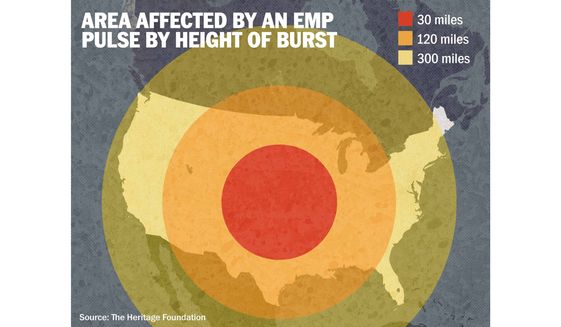
EMP Graphic to accompany Woolsey article of Aug. 19, 2015

EMP Graphic to accompany Woolsey article of Aug. 19, 2015


Watch Video


By James Woolsey and Peter Pry — Tuesday, August 18, 2015

Congress must stop President Obama’s nuclear deal with Iran. The most important reason — Iran can threaten the existence of the United States by making an electromagnetic pulse (EMP) attack using a single nuclear weapon.

It may obtain one, relatively easily, by cheating in the use of the nuclear infrastructure permitted them under the agreement.

U.S. intelligence cannot meet the impossibly high standard of assuring that Iran cannot acquire a single nuclear weapon and, given the regime’s existing nuclear infrastructure, cannot with absolute certainty guarantee that Iran does not already have one.


PHOTOS: Vladimir Putin auditions for role as James Bond villain


Secretary of State John Kerry’s assertions on June 16 that the United States has perfect intelligence on Iran’s nuclear program are not credible: “We know what they did. We have no doubt. We have absolute knowledge … .”

No.

Former CIA Director Michael Hayden is right to correct Mr. Kerry: “He’s pretending we have perfect knowledge about something that was an incredibly tough intelligence target while I was director, and I see nothing that has made it any easier.”

Mr. Kerry’s disregard of the limits of U.S. intelligence is reason enough to reject the deal — since just one nuclear warhead can threaten the existence of the United States.

A single nuclear weapon detonated at high altitude over the United States would generate an EMP that could black out the electric grid and other life-sustaining, critical infrastructures, such as communications, transportation, banking and finance, food and water. The Congressional EMP Commission estimated a nationwide blackout lasting one year could kill anywhere from two of every three Americans by a low estimate up to nine of 10 Americans by starvation and social disruption.

“Death to America” is more than merely an Iranian chant — Tehran’s military is planning to be able to make a nuclear EMP attack.

On July 21 at the annual meeting of the Electric Infrastructure Security Summit in Washington, Rep. Trent Franks quoted from an Iranian military textbook, recently translated by the Defense Intelligence Agency’s National Intelligence University. The textbook, ironically titled “Passive Defense” (2010), describes nuclear EMP effects in detail. It advocates in more than 20 passages an EMP attack to defeat decisively an adversary.

The official Iranian military textbook advocates a revolutionary new way of warfare that combines coordinated attacks by nuclear and non-nuclear EMP weapons, physical and cyber-attacks against electric grids to black out and collapse entire nations. Iranian military doctrine makes no distinction between nuclear EMP weapons, non-nuclear radio-frequency weapons and cyber-operations — it regards nuclear EMP attack as the ultimate cyber-weapon. EMP is most effective at blacking-out critical infrastructures, while it also does not directly damage the environment or harm human life, according to Iran’s “Passive Defense”:

“As a result of not having the other destructive effects that nuclear weapons possess, among them the loss of human life, weapons derived from electromagnetic pulses have attracted attention with regard to their use in future wars … . The superficiality of secondary damage sustained, as well as the avoidance of human casualties, serves as a motivation to transform this technology into an advanced and useful weapon in modern warfare.”

Because EMP destroys electronics directly, but people indirectly, it is regarded by some as Shariah-compliant use of a nuclear weapon. “Passive Defense” and other Iranian military writings are well aware that nuclear EMP attack is the most efficient way of killing people, through secondary effects, over the long run. The rationale appears to be that people starve to death, not because of EMP, but because they live in materialistic societies dependent upon modern technology.

For example, an Iranian article on nuclear EMP attack, “Electronics To Determine Fate Of Future Wars” (1998), concludes hopefully (from the Iranian author’s perspective):

“If the world’s industrial countries fail to devise effective ways to defend themselves against dangerous electronic assaults, then they will disintegrate within a few years … . American soldiers would not be able to find food to eat nor would they be able to fire a single shot.

Written 17 years ago, Iranian military doctrine has assessed nuclear EMP attack against the United States for now nearly two decades.

The Iranians have done more than just think about EMP attack.

The Congressional EMP Commissionfound that Iran has practiced launching missiles and fusing warheads for high-altitude EMP attack, including off a freighter. Iran has apparently practiced surprise EMP attacks, orbiting satellites on south polar trajectories to evade U.S. radars and missile defenses, at altitudes consistent with generating an EMP field covering all 48 contiguous United States. Iran launched its fourth satellite on such a trajectory as recently as February 2015.

A single nuclear weapon would complete the list of requirements.

Finally, because a nuclear EMP attack can be conducted by surprise and anonymously — deterrence may not work against EMP.

Deterrence depends upon knowing who attacked and being able to retaliate. Unlike a nuclear weapon used to blast a city, high-altitude EMP leaves no collectible bomb debris for forensic analysis to identify the aggressor.

EMP attack by missile or balloon launched off a freighter could be from many possible actors. Even Yemen’s Houthis have Scud missiles and know how to use them, having recently killed the chief of Saudi Arabia’s air force with a Scud strike on King Khalid Air Force Base.

Hundreds of satellites are in low earth orbit, unseen when approaching the United States from the south, that could help disguise the origins of an EMP attack. And the EMP could damage the means necessary to identify the attacker and U.S. retaliatory capabilities.

One Iranian nuclear weapon is one too many for an Iran ruled by theocratic totalitarian genocidal imperialists.

No deal.

• R. James Woolsey is a former director of Central Intelligence and is chairman of the Foundation for Defense of Democracies. Peter Vincent Pry is executive director of the EMP Task Force on National and Homeland Security and served in the Congressional EMP Commission, the House Armed Services Committee, and the CIA.

 

Repentance—The Law of Return & Key to Spiritual Breakthrough

Now Is the Time to Repent of Sin

There is no better time to focus on repentence than during the biblical month of Elul, which occurs just prior to the fall biblical festivals. During this month, our focus is to be on repentance, restoration and preparation for the coming of the Messiah, which the fall feasts prophetically picture.

Yeshua wiped out the shame and penalty of sin by his death on the cross NOT the Torah!

Hebrew Word Definitions

There are two biblical Hebrew words that together present the complete picture of what true repentence is. The first word is nacham meaning “to be sorry, console oneself, repent, regret, comfort, be comforted.” According to The Theological Dictionary of the Old Testament (TWOT), The origin of the root of this word seems to reflect the idea of “breathing deeply,” hence the physical display of one’s feelings, usually sorrow, compassion, or comfort. The root occurs in the Ugaritic … and is found in OT proper names such as Nehemiah, Nahum and Menehem. The Greek lxx renders nacham by both metanoeo and metamelomai. The Greek word metanoeo means “to change one’s mind, i.e. to repent or to change one’s mind for better, heartily to amend with abhorrence of one’s past sins.” Wilson’s Old Testament Word Studies says this of nacham:

In regard to others, to pity,  to have compassion … in regard to one’s own doing, to lament, to grieve; hence to repent; in English, to rue; often of one who repents, grieves, for the evil he has  brought upon another.” The New Strong’s Expanded Exhaustive Concordance says of nacham: to breathe strongly, by implication, to be sorry … to repent means to make a strong turning to a new course of action. The emphasis is on turning from a less desirable course. Comfort is derived from ‘com’ (with) and ‘fort’ (strength). Hence, when one repents, he exerts strength to change, to re-grasp the situation, and exert effort for the situation to make a different course of purpose and action.  The stress is not upon new information or new facts which cause the change as it is upon the visible action taken.

The second Hebrew word is shuv (from which the Hebrew word teshuvah derives, which Continue reading →


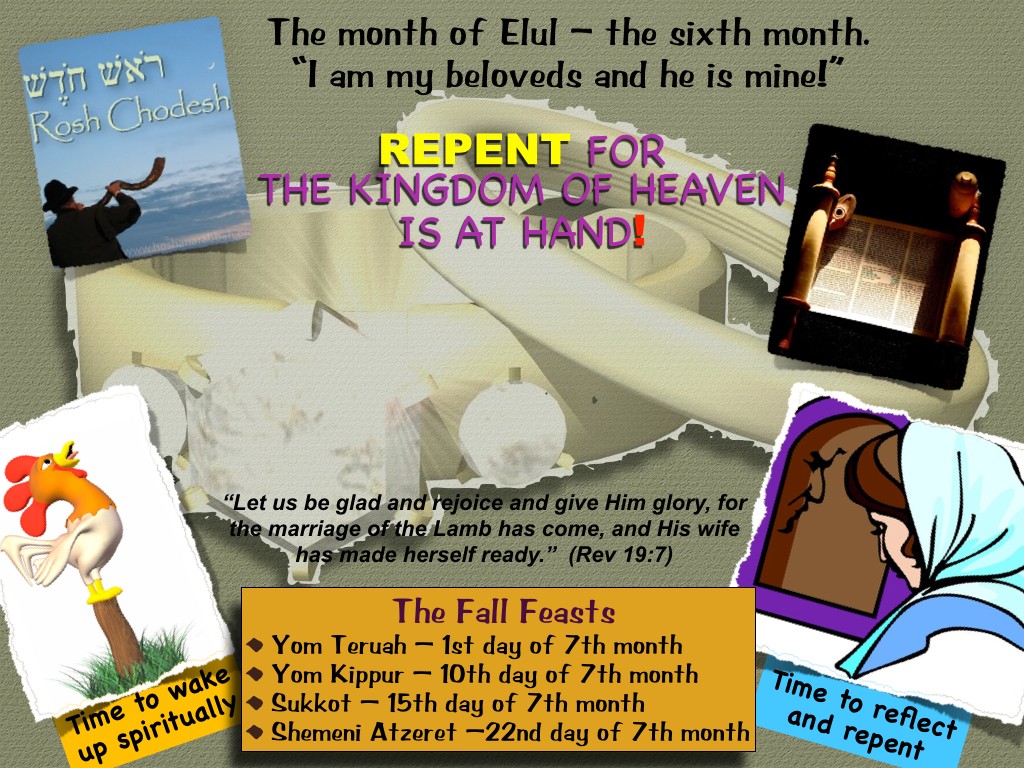
The Month of Elul and How It Relates to You

Yom Teruah (the Day of Shofar Blasts or Shouting) — the first fall biblical festival — is less than a month away. It falls on the first day of the seventh month on the biblical calendar.

Several days ago, the sixth month began, which is called the month of Elul. This month marks the time of preparation for Yom Teruah, which prophetically pictures the time when Yeshua the Messiah returns to this earth and meets his bride.

In the brief article below, we discuss why we need to prepare and some ways to prepare to meet Yeshua at his second coming.

Elul graphic.001

Yom Teruah or the Day of Shofar Blasts or Shouting (commonly called Rosh Hashana or the Feast of Trumpets) occurs at the end of the summer months and marked the beginning of the fall harvest or festival season for the ancient Hebrews. Prophetically, the summer months between the spring feast of Shavuot/Weeks (Pentecost) and the fall feast of Yom Teruah is a spiritual picture of what is often called the “Church Age,” which is the period of time from the Feast of Pentecost in Acts 2 until the return of Yeshua the Messiah at the end of the age and lasting for approximately 2000 years. For many, especially those living in hotter climes, summer is a time of leisure, vacation, weariness and fatigue due to the excessive heat. Likewise, many Bible believers have fallen asleep growing spiritually weary while waiting for the return of the Messiah. Yeshua discusses this issue in the Parable of the Ten Virgins (Matt 25) who all grew weary and fell asleep awaiting the coming of the Bridegroom (Yeshua).

This all changes on the first day of the seventh month of the biblical Hebrew calendar when off in the distance the sound of a shofar blast suddenly pierces the atmosphere and registers in the eardrums of those who have fallen asleep. Not only does this shofar blast signal the beginning of the seventh month when the new crescent moon is sighted, but it Continue reading →


Be Prepared: Economic Collapse May Be Around the Corner

Doomsday clock for global market crash strikes one minute to midnight as central banks lose control

China currency devaluation signals endgame leaving equity markets free to collapse under the weight of impossible expectations

Time is now rapidly running out. From China to Brazil, the central banks have lost control and at the same time the global economy is grinding to a halt. It is only a matter of time before stock markets collapse under the weight of their lofty expectations and record valuations.

The FTSE 100 has now erased its gains for the year, but there are signs things could get a whole lot worse.

It is only a matter of time before stock markets collapse under the weight of their lofty expectations and record valuations.

1 – China slowdown

China was the great saviour of the world economy in 2008. The launching of an unprecedented stimulus package sparked an infrastructure investment boom. The voracious demand for commodities to fuel its construction boom dragged along oil- and resource-rich emerging markets.

• Ambrose Evans-Pritchard: China cannot risk the global chaos of currency devaluation

• Why China has devalued the renminbi

The Chinese economy has now hit a brick wall. Economic growth has dipped below 7pc for the first time in a quarter of a century, according to official data. That probably means the real economy is far weaker.

The People’s Bank of China has pursued several measures to boost the flagging economy. The rate of borrowing has been slashed during the past 12 months from 6pc to 4.85pc. Opting to devalue the currency was a last resort and signalled the great era of Chinese growth is rapidly approaching its endgame.

Data for exports showed an 8.9pc slump in July from the same period a year before. Analysts expected exports to fall only 0.3pc, so this was a huge miss.

The Chinese housing market is also in a perilous state. House prices have fallen sharply after decades of steady growth. For the millions who stored their wealth in property, it makes for unsettling times.

2 – Commodity collapse

The China slowdown has sent shock waves through commodity markets. The Bloomberg Global Commodity index, which tracks the prices of 22 commodity prices, fell to levels last seen at the beginning of this century.

The oil price is the purest barometer of world growth as it is the fuel that drives nearly all industry and production around the globe.

• Andrew Critchlow: Oil companies travel back to 1986 in search of a future

Brent crude, the global benchmark for oil, has begun falling once again after a brief rally earlier in the year. It is now hovering above multi-year lows at about $50 per barrel.

Iron ore is an essential raw material needed to feed China’s steel mills, and as such is a good gauge of the construction boom.

The benchmark iron ore price has fallen to $56 per tonne, less than half its $140 per tonne level in January 2014.

3 – Resource sector credit crisis

Billions of dollars in loans were raised on global capital markets to fund new mines and oil exploration that was only ever profitable at previous elevated prices.

With oil and metals prices having collapsed, many of these projects are now loss-making. The loans raised to back the projects are now under water and investors may never see any returns.

Nowhere has this been felt more acutely than shale oil and gas drilling in the US. Tumbling oil prices have squeezed the finances of US drillers. Two of the biggest issuers of junk bonds in the past five years, Chesapeake and California Resources, have seen the value of their bonds tumble as panic grips capital markets.

As more debt needs refinancing in future years, there is a risk the contagion will spread rapidly.

4 – Dominoes begin to fall

The great props to the world economy are now beginning to fall. China is going into reverse. And the emerging markets that consumed so many of our products are crippled by currency devaluation. The famed Brics of Brazil, Russia, India, China and South Africa, to whom the West was supposed to pass on the torch of economic growth, are in varying states of disarray.

• Is the global economy headed for another crash? Three signs to watch out for

• Regulators could be responsible for next financial crash

• Global stock markets jolted by China’s historic renminbi devaluation

The central banks are rapidly losing control. The Chinese stock market has already crashed and disaster was only averted by the government buying billions of shares. Stock markets in Greece are in turmoil as the economy grinds to a halt and the country flirts with ejection from the eurozone.

Earlier this year, investors flocked to the safe-haven currency of the Swiss franc but as a €1.1 trillion quantitative easing programme devalued the euro, the Swiss central bank was forced to abandon its four-year peg to the euro.

5 – Credit markets roll over

As central banks run out of silver bullets then, credit markets are desperately seeking to reprice risk. The London Interbank Offered Rate (Libor), a guide to how worried UK banks are about lending to each other, has been steadily rising during the past 12 months. Part of this process is a healthy return to normal pricing of risk after six years of extraordinary monetary stimulus. However, as the essential transmission systems of lending between banks begin to take the strain, it is quite possible that six years of reliance on central banks for funds has left the credit system unable to cope.

Credit investors are often far better at pricing risk than optimistic equity investors. In the US while the S&P 500 (orange line) continues to soar, the high yield debt market has already begun to fall sharply (white line).

6 – Interest rate shock

Interest rates have been held at emergency lows in the UK and US for around six years. The US is expected to move first, with rates starting to rise from today’s 0pc-0.25pc around the end of the year. Investors have already starting buying dollars in anticipation of a strengthening US currency. UK rate rises are expected to follow shortly after.

7 – Bull market third longest on record

The UK stock market is in its 77th month of a bull market, which began in March 2009. On only two other occasions in history has the market risen for longer. One is in the lead-up to the Great Crash in 1929 and the other before the bursting of the dotcom bubble in the early 2000s.

UK markets have been a beneficiary of the huge balance-sheet expansion in the US. US monetary base, a measure of notes and coins in circulation plus reserves held at the central bank, has more than quadrupled from around $800m to more than $4 trillion since 2008. The stock market has been a direct beneficiary of this money and will struggle now that QE3 has ended.

8 – Overvalued US market

In the US, Professor Robert Shiller’s cyclically adjusted price earnings ratio – or Shiller CAPE – for the S&P 500 stands at 27.2, some 64pc above its historic average of 16.6. On only three occasions since 1882 has it been higher – in 1929, 2000 and 2007.


Steeples, Sun-God and Phallus Worship

Deuteronomy 16:22, You shall not erect for yourselves a pillar, which YHVH your Elohim hates. The word pillar literally means “stand (upright), be set (over), establish.” One of the derivatives of this word is pillar or standing image. Such pillars were erected for pagan religious purposes (see TWOT). C.J. Koster in his book The Final Restoration (reprinted as Come Out of Her My People) cites historical evidence for relating these pillars to the Egyptian and Babylonian obelisk, which was connected to sun worship (see also https://en.wikipedia.org/wiki/Obelisk )and the phallic symbol (also https://en.wikipedia.org/wiki/Phallic_architecture). He states that these pillars were commonly erected at the entrances to pagan temples (also https://en.wikipedia.org/wiki/Obelisk) as fertility symbols in honor of the sun deity (Koster. p. 79).

Steeple2- 14634675

Even as an Egyptian obelisk of this sort sits in the very center of the Catholic Church’s St. Peter’s Square in Rome, so, according to Koster, it is traditional for obelisk-shaped steeples to be found on Christian churches to this day in the form of a steeple (Ibid., p. 81). Richard Rives in his book, Too Long In the Sun, makes the same connection between the Egyptian obelisk, Canaanite standing pillars and the Christian church steeple (p. 136).

What is the point here? YHVH commanded Israel to destroy these pagan symbols and to have nothing to do with them. They were abominations that would defile YHVH’s set-apart people. Have his people heeded his command? Many of these remnants of ancient pagan cultic practices remain in both the Protestant and Catholic churches to this day (Easter/Ishtar, Christmas/Saturnalia, the Christmas tree/Tamuz tree, the Christmas wreath/a pagan fertility symbol, Lent, Easter eggs and rabbits, and the list goes on and on).

Does YHVH’s command to his people of the end times to come out of spiritual Babylon (see Rev 18:4) now take on a new meaning to you?