Where Are YOU?

Genesis 3:9–13, Where are you? Elohim asks Adam and Eve direct and specific questions, but instead of taking personal responsibility and answering the questions, they defend themselves, make excuses, justify themselves, blame shift, and accuse others including blaming Elohim. When confronted with their sin, humans have been doing this ever since — defending self and ego at all expenses. This is the result of the taint of sin and this behavior has been passed on from one generation to the next. The Spirit-led person must counter this proclivity of the soul to justify, excuse and obfuscate one’s sin.

Furthermore, when YHVH asked the first humans where they were after they had sinned, he wasn’t asking them where they were physically. Being obniscient, he knew this already. Instead, he was asking them them, “Where are you spiritually in your relationship with me in regards to obedience to the instructions in righteousness I gave you to obey?” This is the same questions the Creator is still asking men to this day.


Gardening—Man’s Noblest, Elohim Ordained Profession

Genesis 2:15, Tend/dress and keep it. Tend is the Hebrew word avad meaning “to work or serve.” Being a gardener was Adam’s occupation. Yeshua was the second Adam. After Yeshua’s resurrection, interestingly, he was mistaken as the gardener (John 20:15).

Gardening tools.

The Torah teaches sustainable living and stewardship of the earth. The terms sustainability or sustainable living are currently fad concepts that are bandied about by those seeking to be politically correct—whatever that is supposed to mean. Wikipedia, the online encyclopedia, defines sustainability as follows:

Sustainability is the capacity to endure. For humans, sustainability is the long-term maintenance of responsibility, which has environmental, economic, and social dimensions, and encompasses the concept of stewardship, the responsible management of resource use. In ecology, sustainability describes how biological systems remain diverse and productive over time, a necessary precondition for the well-being of humans and other organisms.

As the writer of the Book of Ecclesiastes said, there is nothing new under the sun. In the beginning, Elohim placed man in the idyllic paradise called the Garden of Eden instructing him “to tend” (serve, work, till, dress) and “to keep” (guard, observe, protect) the garden (Gen 2:15). Man was commanded to become the steward of what Elohim had created—to preserve, maintain and to care for it.

To this day, YHVH has never rescinded these instructions to man even though modern environmentalists and conservationists may think they originated the idea of responsible stewardship of the environment. Long before Rosseau, Thoreau, the Continue reading →


Blog Scripture Reading for 10-11 Through 10-17-15

Aside

THIS WEEK’S SCRIPTURE READINGS FOR STUDY AND DISCUSSION:

Parashat Noach — Genesis 6:9 – 11:32
Haftarah — Isaiah 54:1 – 55:5
Prophets — Joshua 8:1 – 14:15
Writings — Psalms 8:1 – 14:7
Testimony — Matthew 6:16 – 10:26

Most of this week’s blog discussion points will be on these passages. If you have general comments or questions on the weekly Scripture readings not addressed in a blog post, here’s a place for you to post those. Just use the “leave a reply” link below.

The full “Read Through The Scriptures In A Year” schedule, broken down by each day, can be found on the right sidebar under “Helpful Links.” There are 4 sections of scripture to read each day. One each from the Torah, the Prophets, the Writings, and from the Testimony of Yeshua. Each week, the Torah and haftarah readings will follow the traditional one-year reading cycle.

Weekly Blog Scripture Readings for 10/11 through 10/17/15.


Back from Sukkot NW 2015 with photos!

My family and I are back home from Sukkot/the Feast of Tabernacles 2015. This was my 48th Sukkot. What can I say about this year’s Feast without sounding trite, using cliches or relying on overly superfluous words? Not sure. So I will just give the facts, let the Ruach inspire me with the words to say while I’m writing, and, beyond this, I invite any who were in attendance to offer up verbal word pictures of what happened and how they were touched by YHVH.

Seventy-five plus people were in attendance at the Griffen Park Campground on the banks of the wild and scenic Rogue River in Josephine County. Interesting, as redeemed believers, we’re largely descended from the tribes of Joseph and preparing to be the bride of Yeshua — hence, Josephine. Maybe this is all coincidental, but we trust that YHVH directs our steps and chooses to place his name where he wants us to meet  with him on his feast days. It’s not unusual  for him to give us confirming signs along the way. By the way, a griffen is another name for a cherubim. We rented the entire campground, thus preempting any outside influences from entering the camp. This created a much cleaner and more peaceful spiritual atmosphere thus giving us a more accurate prophetic foretaste of what life will be like during Yeshua’s 1000 year-long millennial reign on earth after his second coming.

The weather was the best we have ever had! The lowest daytime temps were in the 70s and most of the time we had temps in the mid to high 80s and several days into the low 90s. Unlike last year, some of us got to go swimming in the river a few times. The seven folks that were baptized in the river were happy about this as well.

Sukkot attendees came from four western states, and our five speakers/Bible teachers Continue reading →


Yeshua Is the Living Torah

Yeshua was the Torah-Word of Elohim that was Elohim, and who came to earth to live in flesh form (John 1:1–14).

He was the I am that was before Abraham (John 8:58)

Rom 10, Yeshua is the ultimate expression, end goal of fullest fulfillment of Torah (Rom 10:4). Paul equates Yeshua, the Living Torah, with the written Torah of Moses (verses 5–10). In Rom 10:11 through 21, Paul goes on to relate this very truth to being the central message of the gospel that Isaiah prophesied (Isa 52:7) would be preached to redeem both houses of Israel to Yeshua their Messiah.

Yeshua, was the Torah-Light-Word led who instructed, fed and watered Israel through the wilderness.

1 Cor 10:4, Yeshua was spiritual Rock that fed the Israelites.

Acts 7:38, Yeshua was the one who spoke from Mt. Sinai and who was with the angel that led the Israelites in the wilderness.

Yeshua is the Living Manna (John 6:48–51).

Yeshua equates himself with Torah (John 6—manna).

Yeshua referring to himself as the Light of the world (John 8:12, 9:5; 12:46) urged his disciples to believe in that Light and to become children of Light (John 12:35–36).

Believers are not only called to emulate their Master and become light as he is light, but they are called to put on the “armor of light” which is likened to walking in righteousness (Rom 12:12–13) after the similitude of their Father in heaven who is called the Father of lights (Jas 1:17) and who dwells in unapproachable light (1 Tim 6:16). This is the same light that caused Moses’ face to radiate with light upon descending Mt. Sinai after having been in the presence of YHVH (Exod 34:33, 35).

In the Gospel of Matthew, Yeshua urged his followers to be lights in this dark world and to be a candlestick on a hill (Matt 5:14–16).


The Torah in the Beginning, Middle and End of the Bible

As stated at the beginning of this brief study, the Living and Written Torah is the dominant theme of the Bible. Let’s quickly review three parts of the Bible—the beginning, the middle and the end—to illustrate our point.

In Genesis one, at the beginning of the Bible we find the following.

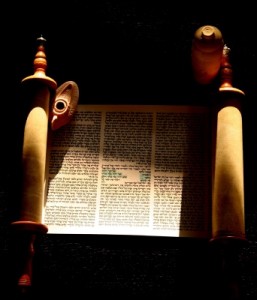
Torah scroll open 2

  • Genesis 1:1, The Hebrew grammatical marker word consisting of an aleph and tav (the first and last letters of the Hebrew alphabet) are found twice in verse one, just before and after the word heaven. They are the fourth and seventh Hebrew words in this sentence. The astute Bible student see this as a prophetic reference to Yeshua, who is the Beginning and the End (the Alpha and Omega AW, Rev 1:8, 11; 21:6, 22:13), and to the fact that Yeshua would come from heaven in the fourth millennia and would come back to earth from heaven in the seventh millennia.
  • Genesis 1:3, Light was the first creative act of Elohim. Light is a biblical metaphor for Torah or the Word of Elohim (Prov 6:23; Ps 119:105). Light pierced and still pierces the darkness of evil. Darkness is a biblical metaphor for Torahlessness or all that which is of the world, the flesh and the devil and which is contrary to or in rebellion against the will and Word of Elohim (John 1:5; 3:16–21).
  • Genesis 1:3–5, Light is mentioned five times here. Some Bible teachers refer to this as the five points of light—a reference to the five books of the Torah (Gen through Deut), and to Yeshua, who was the light of the world before the sun was created on the fourth day in Gen 1:14. Yeshua, that same spiritual Torah-light will replace the sun in the New Jerusalem (Rev 21:23; 22:5).
  • In Genesis 1:3, we find the complete spelling of the word light (aleph, vav, resh), as opposed to a defective spelling minus the vav that the physical sun gives (see Gen 1:14, the first reference to light in that verse is spelled defectively). This points to the supreme and supernal Torah-light from heaven, which is Yeshua, the Torah-Word of Elohim that was made flesh and dwelt among men (John 1:1,14), and who was the spiritual Light of the world (John 1:4–5; 8:12).
  • Next we come to the middle of the Bible, which is Psalm 119. This is the Bible’s longest chapter and the highest praise of Torah to be found in all of the Scripture. This psalm examines all aspects of the Torah much like a jeweler examining and admiring every facet and angle of the world’s largest and most priceless diamond. In this psalm, we learn what should be our view of and response toward the Torah of Elohim.
  • Finally, we come to the end of the Bible, which is the Book of Revelation. In the last two chapters of the Bible we find a number of references to the written Torah, and to Yeshua, the Living Torah.
  • Revelation 22:14 states, “Blessed are they who keep his [Torah] commandments, that they may have the right to the tree of life, and may enter through the gates into the city.”
  • Revelation 21:23; 22:5 (also 2 Cor 4:6) reveals that Yeshua will be the light of the New Jerusalem. Yeshua is the Light of the World (John 1:4–5; 8:12) and the Sun of Righteousness (Mal 4:2) whose face shines like the sun (Rev 1:16). As the pre-incarnate Yeshua, Living Torah-Word of Elohim was the light that illuminated the earth until day four of creation when the physical sun was created, Yeshua will once again be the Light of the world.
  • Revelation 22:3, In the New Jerusalem, there will be no more curse because there will be no more sin or Torahlessness (1 John 3:4, sin is the transgression of the Torah), which brings on the curses of the law (Deut 28:15–68), which death (Ezek 18:4; Rom 6:23)—the ultimate curse for violating the Torah, which are Elohim’s instructions in righteousness.
  • Revelation 22:12, Yeshua is bringing spiritual rewards to his servants based on how faithful they were to obeying and teaching the Torah (cp. Matt 5:19).
  • Revelation 22:13, The alpha and omega or (in Hebrew) the aleph and tav—the beginning and end of the Torah-Word of Elohim—is another reference to the written Torah and to Yeshua, the Living Torah. This is a repetition of the same concept found in the first verse of the Bible.
  • Revelation 22:15 (also 21:8), Outside of the New Jerusalem are found sinners or those who are Torahless.
  • Revelation 22:17, The Spirit and Bride say come. Who gets to come? Those who have prepared themselves for the marriage supper of the Lamb by putting on the robes of the righteous acts of Torah (see Revelation 19:7–9, NIV and NAS). The Scriptures define righteousness as obedience to the Torah (Ps 119:172).
  • Revelation 22:18–19 tells us to neither add nor subtract from the Book of Revelation, and by implication, the entire Bible. This echoes the warning Moses wrote at the end of the Torah (Deut 4:2; 12:32).
  • Revelation 22:20–21, The Hebrew word amein is found twice in the last two verse of the Bible including the very last word of the Scriptures. Amein means “verily, truly” and is a Hebrew word that originates from the Hebrew word emet/ /<nt meaning “truth.” The word emet is spelled aleph, mem and tav, which are the first, middle and last letters of the Hebrew alphabet. Therefore, emet is a word that signifies all that is revealed on the subject from aleph to tav, thus comprising all that can be written on it and no more can be added to it. This is a one-word in Paleo-Hebrew word pictures literally means “the highest head and source of all knowledge.” Thus, the very last word in the Bible clearly points to both the written Torah of YHVH Elohim, and to Yeshua, the Living Torah, which is the Word of Elohim in human form. Spiritually speaking as revealed in the Bible, these two are one and are indivisible.
 

Yeshua the Messiah in the Every Book of the Bible

In Genesis, Yeshua is the eternal Torah-light of the world, the breath of life and the seed of the woman.

In Exodus, he is the Passover lamb, the Torah-Word of Elohim, and the way to the Father in the tabernacle.

In Leviticus, he is our atoning sacrifice and our high priest.

In Numbers, he is the pillar of cloud by day and pillar of fire by night.

In Deuteronomy, he is the prophet like unto Moses.

In Joshua, he is the captain of our salvation who leads us into the kingdom of Elohim.

In Judges, he is our judge and lawgiver.

In Ruth, he is our kinsman redeemer.

In 1 and 2 Samuel, he is our trusted prophet.

In Kings and Chronicles, he is our reigning king.

In Ezra, he is the builder of our temple, which houses the Spirit of Elohim.

In Nehemiah, he is the rebuilder of the broken down walls of human life.

In Esther, he is our Mordechai who saves us from those who would kill, steal and destroy us.

In Job, he is our ever-living Redeemer.

In Psalms, he is our shepherd to lead us in the ways of Torah-life.

In Proverbs and Ecclesiastes, he is our wisdom.

In Song of Solomon, he is our Loving Bridegroom.

In Isaiah, he is the Suffering Servant who bears our sins, the Repairer of the Breach between the two houses of Israel, and the Prince of Peace.

In Jeremiah, he is our Righteous Branch.

In Lamentations, he is the weeping prophet.

In Ezekiel, he is the one who rejoins the two sticks of Israel bringing them to worship Elohim together his temple.

In Daniel, he is the fourth man in life’s fiery furnace and our Ancient of Day.

In Hosea, he is the faithful husband forever married to the backslider.

In Joel, he is the baptize of the Holy Spirit.

In Amos, he is our burden bearer.

In Obadiah, he is mighty to save.

In Jonah, he is our great foreign missionary.

In Micah, he is the messenger of beautiful feet.

In Nahum, he is our strength and shield, and the avenger of Elohim’s elect.

In Habakkuk, he is Elohim’s evangelist crying, “Revive thy works in the midsts of the years.”

In Zephaniah, he is our Savior.

In Haggai, he is the restorer of Elohim’s lost heritage.

In Zechariah, he is a fountain opened up in the house of David for sin and uncleanliness.

In Malachi, he is the Sun of Righteousness arising with healing in his wings.

In Matthew, Yeshua the Messiah is the King of the Jews.

In Mark, he is the servant.

In Luke, he is the Son of Man, feeling what you feel.

In John, he is the Son of Elohim.

In Acts, he is the Savior of the world.

In Romans, he is the righteousness of Elohim.

In 1 Corinthians, he is the Rock, the Father of Israel.

In 2 Corinthians, he is the triumphant one giving victory.

In Galatians, he is your liberty. He set you free.

In Ephesians, he is the head of his spiritual body.

In Philippians, he is your joy.

In Colossians, he is your completeness.

In 1 and 2 Thessalonians, he is your hope.

In 1 Timothy, he is your faith.

In 2 Timothy, he is your stability.

In Titus, he is truth.

In Philemon, he is your benefactor.

In Hebrews, he is your perfection.

In James, he is the power behind your faith.

In 1 Peter, he is your example.

In 2 Peter, he is your purity.

In 1 John, he is your life.

In 2 John, he is your pattern.

In 3 John, he is your motivation.

In Jude, he is the foundation of your faith.

In Revelation, he is the Righteous Judge of the world, the Avenger of the saints, your coming King, your First and Last, the Beginning and the End, the Keeper of creation, the Creator of all, the Architect of the universe and the Manager of all times. He always was, he always is and always will be. He’s unmoved, unchanged, undefeated, and never undone. He was bruised and brought healing. He was pierced to heal our pain. He was persecuted and brought freedom. He was dead and brought life. He is risen and brings power. He reigns and brings peace. The world can’t understand him, the armies can’t defeat him, the public schools can’t kick him out and the leaders can’t ignore him. Herod couldn’t kill him, the Pharisees couldn’t confuse him, the people couldn’t hold him, Nero couldn’t crush him, Hitler couldn’t silence him, the communists can’t destroy him, the atheists can’t explain him away, and the New Age can’t replace him. He is life, love, longevity and Lord. He is goodness, kindness, gentleness and Elohim. He is holy, righteous, mighty, powerful and pure. His ways are right, his word is eternal, his will is unchanging, and his eyes are on me. He is my Redeemer, he is my Savior, he is my Guide, he is my peace, he is my joy, he is my comfort, he is my Lord, and HE RULES MY LIFE!

Author Unknown, edited by Natan Lawrence