Do your feelings determine your actions? What are feelings and can they be trusted? More and more people are basing what they do on their feelings and those of others, instead of on objective logic and truth. This video discusses how feelings-based choices is causing many people in our society to make wrong, even devestating life decisions.
The concept of grace rooted in the Torah, not the NT
Exodus 33:12–13, Grace. (Heb. chen meaning “favor, grace, charm, acceptance”). The Hebrew word chen (found 69 times in the Tanakh), which is translated as grace, in this verse is equivalent to the Greek word charis, which is found 156 times in the Testimony of Yeshua and is translated as grace 130 times in the KJV.
The equivalency of these two words is confirmed by the translators of the Septuagint (the Greek Tanakh) who used charis in place of chen when translating the Hebrew Tanakh into Greek beginning in the third century B.C. According to the TWOT, in the vast majority of occurrences of chen in the Tanakh, the focus of attention is not on the giver, but on the recipient. The emphasis is on the relationship of the superior to an inferior (e.g., a king to his subjects). What this teaches us is that despite sin and rebellion against him, YHVH (the king) is gracious (to humans, his subjects).
Contrary to what many in the church have been led to believe, the grace of Elohim is a very prominent theme in the Tanakh. Examples of this include Noah who found grace in YHVH’s eyes (Gen 6:8), or the children of Israel although dead in their sins in Egypt and deserving of YHVH’s wrath, they were saved by the blood of the lamb. There are a number of other references to the grace of Elohim in the Tanakh as well (Gen 18:3; Exod 3:21; 33:16,17; 34:9; Ps 84:11; Zech 12:10).
How are you saved?
John 3:16–18,
For Elohim so loved the world that He gave His only begotten Son, that whoever believes in Him should not perish but have everlasting life. For Elohim did not send His Son into the world to condemn the world, but that the world through Him might be saved. He who believes in Him is not condemned; but he who does not believe is condemned already, because he has not believed in the name of the only begotten Son of Elohim.
So How Then Are We Saved?
The Christian church has come up with various formulas to “get a person saved” such as altar calls and saying the sinners prayer. There are no examples these kinds of things in the Bible. Instead, the Scriptures give us general guidelines and examples to follow. There are no formulas. What follows is a list of examples from the apostolic writers of how people were saved in early church era.
For example, in Acts 2:14–37 we read that Peter preached the gospel and that the hearers were pricked in their hearts (verse 37). This resulted in a spontaneous, Holy Spirit-led response on the part of the hearers of the gospel or good news message of salvation. After this, the people were baptized for the remission of sins in the name of Yeshua and subsequently received the Holy Spirit (verse 38). All this happened on the same day (verse 41). When directed by the Holy Spirit, spiritual transformations can happen quickly!
A little later in Acts chapter three (verses 11 to 26), Peter preached another short sermon and then invited the people to “repent and be converted that your sins may be blotted out.” This resulted in about 5000 people coming to faith in Yeshua (Acts 4:4).
Next in Acts 8:4–17, we find that the gospel was preached (in Samaria) and people believed it and were baptized. There were no altar calls; only a spontaneous reaction to the preaching of the good news of the message of salvation through Continue reading
What happens when you die?
John 3:13, No one has ascended to heaven. Most Christians believe that when they die, they immediately go to heaven in spite of Yeshua’s clear statement in this verse. Many believers see this verse as referring to saints who died before his resurrection, but not true of those who died afterwards, even though Yeshua doesn’t say this. Therefore, they reason, this is why, according to Peter, David, who was born before Yeshua, is still resting in his grave awaiting the last days resurrection (Acts 2:29).
If what the majority Christians believe on this subject is true, then the saints of old are second class citizens and YHVH is a respecter persons (which he is not, see Acts 10:34; Rom 2:11) in that they have to wait for resurrection day and for their ultimate reward of eternal life, while saints born since Yeshua receive their glorified bodies immediately upon death.
Laying aside all the church traditions and doctrines of men, what does the Bible in the simplest and clearest terms say about the timing of the saints receiving immortality? Paul states that the resurrection of all the dead saints and their receiving immortality occurs not at the time of their physical death, but at the second coming of Yeshua at the last trumpet (1 Cor 15:51–54; 1 Thess 4:13–18 cp. Rev 11:15, 18).
In reality, men’s eternal inheritance isn’t heaven, but the New Jerusalem, which is coming down from heaven to the new earth (Rev 21:2).
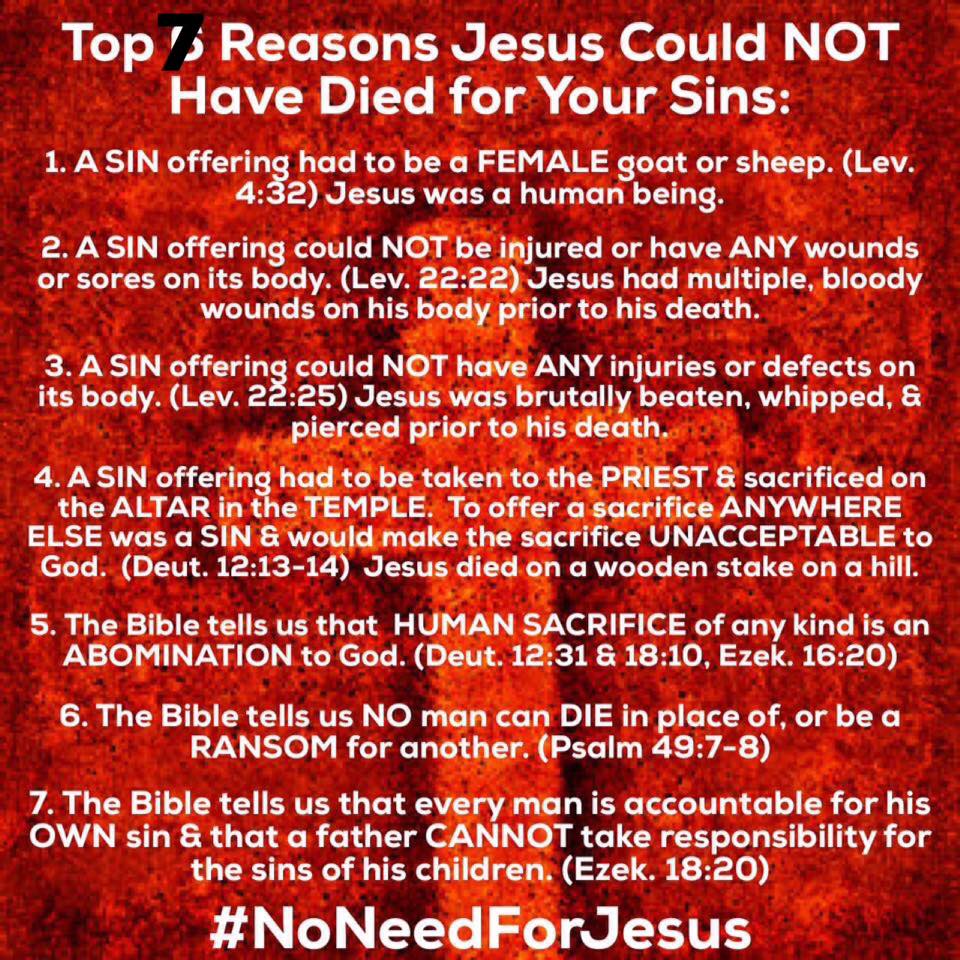
The Top Seven Reasons Why Yeshua Couldn’t Have Died for Your Sins REFUTED
Have you seen this meme making the rounds? Someone sent it to me and asked how I would answer it. Like most of the lies from the evil one, these arguments seem convincing on the surface, but in reality they are easy to answer. For those who know the Scriptures, it can be done blindfolded with both tied behind the back, while hanging upside-down and eating an ice cream cone!
- Liars and deceivers often will take one scripture verse out of context and try to make a doctrine out of it, while ignoring many other verses on the same subject. Those who are novices in understanding the Scriptures will often fall for this ploy. Don’t be a novice, but study the Word of Elohim daily, and sit under Bible teachers who aren’t themselves novices! To understand what the Bible is really saying, you have to read all the verses on a subject. In this case, the author ignores all the verses that speak of a ram or a bull being offered up as an atonement for sin, which prophetically points to the salvific death of Yeshua (e.g., Gen 15:19; 22:13; Exod 29:15–31; 29:36; Lev 4:3–21; 5:16, 18; Lev 16:11 and about 50 other verses as well that I could give!)
- This argument so ridiculous that it defies common logic. The Torah stipulates that a sin offering had to be free of injury or blemish BEFORE being sacrificed, not while being sacrificed. How do you sacrifice something without injuring it? Give me a break!
- Same answer as #2.
- Yes, Yeshua was killed outside the city walls of Jerusalem, yet his blood was sprinkled or spilled inside of Jerusalem near the temple when the Romans scourged him and placed the crown of thorns on his head. Not only that, the writer of Hebrews likens Yeshua’s death to the that of the red heifer which was killed OUTSIDE the Tabernacle of Moses and later outside of Jerusalem. As I have stated numerous times before in my studies on the tabernacle, the red heifer speaks of Yeshua’s initial death for sinners on cross, while the sacrifices that occurred inside the tabernacle speak of our need, once initially redeemed, of having to stay under the blood of Yeshua by continually repenting of the sins we commit subsequent to our initial salvation.
- Again, the idiocy and deception of the arguments of those who speak against the death of Yeshua! Yeshua’s death wasn’t human sacrifice! He gave his life up willingly by his choice as a ransom or atonement for sin. The Romans weren’t looking at his death as a human sacrifice, but as capital punishment. That’s like saying that every time the government kills a criminal it is human sacrifice, or that when the Torah stipulates capital punishment for certain crimes, it’s human sacrifice. The Bible condemns human sacrifice, since it involves doing so in the worship of pagan deities. Furthermore, to call Yeshua’s death human sacrifice is to accuse Yeshua’s Father—YHVH Elohim—of murder and human sacrifice. This is blasphemy! May it never be so!!
- Yes, no man can die for another man—only for himself because a life is only worth a life. But Yeshua was no ordinary man. The Scriptures reveal that he was the Creator—the one who created all men, and that he was Elohim/God in the flesh. This means that his life was worth more than all that of all humans combined, which is why he could die for everyone. This cannot be said of any ordinary human.
- Yes, everyone is accountable for his own sins, but Yeshua was different than any ordinary man. First, he never sinned, so he never came under the death penalty for sin like all normal men have. Second, he willingly chose to lay down his life for sinners (that you and me) as a sin offering in our place to pay for the death penalty we all have incurred for our sins. Because he was sinless, and because, was the Creator, and because his life was worth more than all the humans he had created, he was in a position, by his choice, to pay the price (the death penalty) for all of men’s sins.
It took me about 15 minutes to answer these questions! That’s how easy they are to debunk.
Don’t fall for the lies of the evil one, and don’t let them shake your faith!
Beware of Donald Trump!
Written by Jon Alexander, one of this blog’s readers. (Reprinted with permission.)
Prior to WWII, Germany was reeling for various reasons (mostly economic collapse due to the Versailles treaty). Numerous factions were running for power within the very volatile environment; the social democrats, the socialists, and the Nazis were the big three parties.
The social democrats were not the same as we have today, but supportive of the Weimar Republic which was a semi-presidential representative federal republic. Eventually the republic failed the people so much that they became enraged. Strong personalities got attention and factions that had been less popular years before gained political traction.
Out of this socialists, the anti-democrats, the National socialists (Nazis), and others struggled for power. Hindenburg won the election of 1932, but was forced to give Hitler the chancellorship for political reasons. Eventually Hindenburg died and, due to other political moves and outcomes, Hitler was able to set up his dictatorship.
I write this because I feel that we are missing something. America has become very split and volatile. We just got done electing a near socialist twice in Obama. He was elected largely due to frustration with our system. Now the other side is frustrated and, so far, supporting someone who has tyrannical language as his platform. Sadly, people actually view this as an asset. I fear Trump more than I do Bernie. While I loathe socialism, I also loathe tyrants. I am not calling Trump a Hitler in the sense that he is willing to extinguish people and push atrocities; but I am in the sense that he is riding the populist anger and his platform is “I will fix this” and little more. Policy isn’t ever central to his personal provocation; but singular power. How do we fix immigration? Elect Trump-he will force Mexico to build a wall. How do we fix healthcare? Elect Trump, he will get it done. How do we create jobs? Elect Trump, he knows how to create jobs.
The problem is that these solutions aren’t within the framework of our Constitution (and perhaps reality). We are a Constitutional Republic that is specifically put in place so that an individual can’t fix things or ruin things alone. It requires policy and non-independent work. Trump supporters openly admit to wanting someone who insults and conquers opponents. They want someone who will punish their opposition, not realizing that under such a system, you may become the opposition.
We have become like the Israelites who, frustrated with their godly system, looked for a king. How long before we abandon our liberty for the ease of a tyrant?

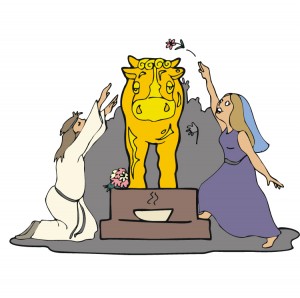
Golden Calf Worship Among YHVH’s People Today
Let’s look at the series of events that occurred as the children of Israel were leaving Egypt, which have major relevance to what is occurring in mainstream Christianity in our day. If we fail to learn the lessons of history, we’ll likely repeat the mistakes of history. It has to do with golden calf worship.
YHVH redeemed the children of Israel out of Egypt and set the slaves free. He blessed them not only by giving them their freedom, but by giving them the wealth (gold and silver) of Egypt as well. We read that the Israelites exited of Egypt with a high hand. They were victorious, free and wealthy.
YHVH led them into the wilderness en route to the Promised Land — normally an eleven day journey. They had some difficulties: Pharaoh tried to kill them at the Red Sea, they lacked clean drinking water, and they had food issues, but YHVH provided them deliverance from Pharaoh, gave them clean water, manna and meat, and they overcame these trials.
Next, YHVH led the Israelites to the foot of Mount Sinai, and on Shavuot he made a covenantal agreement with them and gave them his Torah as their national constitution. They agreed to obey him and to keep his commandments. He promised to bless them if they remained faithful to him.
Moses went up to Mount Sinai to receive the Torah-covenant on two tablets of stone. While he was gone for 40 days, the people grew worried and anxious and become weary Continue reading