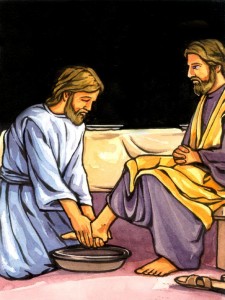
John 13:8, You will never wash. Peter rejected Yeshua’s washing his feet not because of human obstinateness, but because of his honor for Yeshua. Washing the feet of one’s guests was an act of hospitality on the part of a host and was usually performed by a servant, not the host. Peter considered it to be demeaning for the Master to be performing the task of a servant, yet this is exactly what Yeshua was attempting to demonstrate. As the Messiah, he came to lay down his life in loving service for his disciples and not to be served (Matt 20:28; John 10:15; 15:13). Yeshua then made the point that his disciples should following his example in serving one another (vv. 12–17).
Donald Trump the Hammer? Like a Samson??
This post on the comments page from Handmaiden4Him has given me great pause for consideration! Therefore, I decided to publish it on the blog. I would value your comments. I think we’re all trying to figure some things out—what is the Father up to for America? Natan
From from Handmaiden4Him:
I was voting for Marco Rubio, and I saw Donald Trump winning…then I began to ask the Lord about him. I felt like the Lord was confirming to me that “the Donald” (my quotes) would win. I asked the Lord, “Why?” I began to remember the story of Samson…FOR NO REASON. I remembered how Samson had the nazarite calling and how he was kind of like “the world is my oyster” kind of a guy. If he saw something he liked, he TOOK it. He taunted the Philistines, enemies of Israel, and they were afraid of him. He was also strong and attracted women—also women that were going to use him like Delilah, who represents the beauty of the “enemy,” and who would steal his strength She finally got a very independent man to reveal the source of his strength—his hair. I thought, “wow.” I saw a picture in my mind of Donald Trump. Hmmm…
Now Trump is no saint, that’s for sure. But Elohim anointed King Cyrus. Was he a believer? No. So I began to consider Trump and wonder why Elohim would not appoint a strong believer like Cruz or Rubio. I felt like He was saying,”they don’t stand a chance.” That would make people even sadder if they got into office and their hands were tied. Trump’s name, in German is Trumpf. It’s the German spelling. It doesn’t mean “trumpet” like you think. It means “hammer.” Jeremiah 23:29 “Is not my word like fire,” declares YHVH, “and like a hammer that breaks a rock in pieces?”
I felt like what Elohim was saying that things need to be broken before they can be fixed again. So knowing what I feel that Elohim has in mind, I’ve been praying for several weeks and am committed to praying for Trump(f) until the day he walks into the oval office.
I could be wrong, and I’ve missed Elohim before, but I don’t take elections likely, even though we are not invested in this country like we are in the kingdom of Elohim, but i know that Elohim does guide and direct our steps desires for us to prosper in the place in which we live and has a destiny for country. I flew to Washington, DC, by myself, to attend a rally to defund planned parenthood, and prayed while I was there.
Father, protect Donald Trump from greed, manipulation, corruption, and allow him to smash strongholds and stiff necks that block all efforts to restore this country to greatness again—greatness that comes from the kingdom of Elohim in men and women that live in her—in Yeshua’s name. Amein.
Donald Trump being like a Samson…a very interesting analogy that seems to ring true to me, even though I’m no great fan of the man. How about Balaam’s ass (or Jonah’s fish, for that matter)? YHVH sometimes uses very unlikely creatures for his purposes! I’m going to post your comment on the main blog (after I’ve corrected some typos). Thank you very much for these insights! Natan
What is Yeshua worth to you?
John 12:5, Three hundred denarii. This large sum is equal to 300 days’ wages for a common laborer. (See notes at Matt 18:24.)
To the natural mind, Judas’ objection to the use of this expensive spice (worth between $30,000 and $50,000 in today’s money) to anoint someone’s feet seems illogical and a total waste. By contrast, from our perspective, we can look backwards historically with perfect 20–20 hindsight and realize that for Yeshua, the Messiah and Savior of the world, he was worth every penny of the spikenard and much more. Yet, from the perspective of Yeshua’s followers, Yeshua’s true identity and mission still weren’t clear. This confusion wouldn’t clear up until after his resurrection and glorification (v. 16). So for some of them, Mary’s act of faith in anointing Yeshua’s feet with a year’s wages of spice seemed to be illogical folly.
This spice, most likely was originally intended for use on Lazarus’ body, whom Yeshua had just resurrected and so was no longer needed for that purpose, at least. It is likely that it was out of gratefulness for resurrecting her brother that Mary performed this act of love and devotion to Yeshua, not realizing that her actions were prophetic in that she was pre-anointing Yeshua’s body for his own burial ten days from that night (v. 7).
Now let us consider the following. We know that YHVH Elohim the Father gave us his greatest love gift by sending Yeshua, his Son, to this earth to live, die and resurrect for our redemption and ultimate glorification (John 3:16). How much do we love Yeshua, and what is the greatest gift we could ever give him, even if those around us thought we were crazy to do so? Have you given him all your heart? Does all that you own belong to him including your life? Would you give away all of your possessions in devotion to him if he asked it of you? Would you literally lay your life down for him as he did for you? How much do you love Yeshua?
What Was the Purpose of the Sacrificial System?
The concept of animal sacrifices may be a hard for modern people to comprehend—especially for those who are squeamish when it comes to death and blood. This ancient ritual, rooted in the nomadic lifestyles of the inhabitants of the Middle East, carried more symbolic significance for a people whose daily existence was tied to the earth and who were dependent on domestic animals for their survival. It is out of this cultural background that the biblical narrative springs and with it the ritual symbols with which the ancient people described therein could relate. With these things in mind, the following is a list showing the main reasons for YHVH’s establishment of an animal sacrificial system as a means to help man to understand spiritual lessons far beyond the actual sacrifice itself.
The laws pertaining to the sacrificial system were added to the rest of the Torah because of sin, and were in force until the time of Yeshua the promised Seed (Gal 3:19). When and why did YHVH add them making this system incumbent upon the Israelites? This occurred after and because of the sin of the golden calf. It was then that YHVH established the Levitical priesthood and subsequently gave Israel the sacrificial system to not only show them the seriousness and grave consequences of sins, but to guide Continue reading
Holiness — The Dominant Theme of Leviticus and the Bible
The focus of Leviticus is holiness and holy living. Holiness is the chief attribute of Elohim and the most defining aspect of his character. It has to do with the fact that Elohim is entirely good and without evil and moral defect and sinless. This is why the spiritual beings around his heavenly throne are constantly crying, “Holy, holy, holy” in his Presence (Isa 6:3; Rev 4:8). This is why one of his titles is The Holy One of Israel,which is used more than thirty times in the Tanakh (e.g., 2 Kgs 19:22; Ps 71:22; Isa 1:4; Jer 50:29). This is why the high priest who ministered in the Tabernacle of Moses and later in the temple wore a golden crown or headplate with the words inscribed on it, HOLINESS TO YHVH. Not only was this pointing upward to YHVH’s set-apartness, but man himself is to become holy or set-apart even as YHVH Elohim is set-apart, for we read in the Epistle to the Hebrews that the attribute of holiness is a prerequisite for a man coming into the Presence of Elohim (Heb 12:14).
The Hebrew word for holy and holiness is kadosh, which is defined as “sacredness, consecrated, set-apartness or separateness.” That which is holy or kadosh relates to that which belongs to the sphere of the sacred, godly or heavenly and is distinct or separate from the sphere of the common, profane, defiled or polluted. Everything about Elohim is holy or set-apart compared to man who is completely polluted and defiled by sin and is thus unholy (Jer 17:9; Rom 3:23; Isa 64:6).
The Tabernacle of Moses had two rooms: the holy place and the holy of holies. The nomenclature of these rooms relates to the chief attribute of Elohim, which is his holiness.
Elohim gave Moses, Aaron, the priests and Levites strict protocols to follow to insure that the tabernacle stay holy and keep from becoming profane, polluted or defiled. This involved caring for and properly handling the building and its furnishings as well as the priestly attire and their bodily, ritualistic and spiritual cleanliness. If these protocols weren’t followed, there were penalties — sometimes involving the death of the violator. If they were followed, the result was a blessed relationship with Elohim.
The requirements for coming into and ministering in the Tabernacle of Moses, the dwelling place of Elohim’s Presence (Exod 25:8) teach us several things.
First, Elohim is holy and undefiled and is thus transcendent above the earthly and human plane. He is pure, set-apart and undefiled by.
Second, heaven and the Presence Elohim is a holy and undefiled place. The tabernacle was the earthly dwelling place of Elohim’s Presence (Exod 25:8). It and everything about it was to remain holy or set-apart. Nothing was to defile it.
Third, maintaining a high standard of holiness with regard to everything pertaining to the tabernacle teaches us that no one can come into the Presence of Elohim without first going through proper protocols to become undefiled.
Forth, there was a death sentence upon those who refused or neglected to follow these protocols. This teaches man to fear, honor, respect and even to dread Elohim who has the power over life and death. Man cannot come into Elohim’s Presence in a casual, cavalier or arrogant manner in a defiled or polluted state.
Fifth, the Tabernacle of Moses was a “processing center” to aid man in going from an unholy, polluted and sinful state to progressively becoming more and more holy and sinless. Eventually, man could come to a place — by following YHVH’s protocols of holy living — of intimate fellowship with Elohim. This is pictured by the inner room, or holy of holies, of the tabernacle where the Presence or Kavod of Elohim was dwelt. The holy of holies is representative of Elohim’s heavenly throne room.
Sixth, man was created in Elohim’s image to have an intimate relation with him and with the capability of reflecting his divine character. When man sinned in the garden, man’s relationship with Elohim was cut off. The Tabernacle of Moses shows man how to deal with the pollution or defilement of sin through blood atonement and the eventual sacrifice of Yeshua on the cross to which all the bloody, sacrificial rituals of the tabernacle pointed.
Seventh, there is no other way for man to come into the Presence of Elohim except through the protocols that he has established. Man has to recognize his sinfulness, turn away from his state of unholiness or pollution by making the proper sacrifices. He must then turn to and embrace Elohim’s holy or righteous standards for living a sinless life.
Holiness is the greater message of Leviticus as it relates to the redeemed believer coming into conformity with the exalted and righteous standards of a holy Elohim. This occurs when one recognizes their unholiness or sinfulness, puts their faith in the blood atoning sacrifice of the Lamb of Elohim, Yeshua the Messiah who died on the cross in payment for men’s sins, and then turns from sin by adhering to Elohim’s standards of righteousness as outlined in the Torah and the rest of the Scriptures, and as lived out by Yeshua and his immediate disciples.
Holiness involves heeding Elohim’s call to become his special and treasured possession by following him and allowing him to separate us from the defilement or pollutions of the heathen nations around us (Lev 20:26; Deut 7:6; 14:2; 26:19).
This message of holiness — and the message of the entire Bible — can be succinctly summed up by Elohim’s loving and longing cry to his people on several occasions to be holy as he is holy (Lev 11:44, 45; 20:7, 26; 1 Pet 1:16). The Torah shows us how to be holy (Lev 20:7–8). The Torah (and the rest of Scripture) shows us that being holy not only involves behavior, but man’s thoughts and attitudes, words and physical cleanliness as well as the observance of holy times (e.g., the Sabbath and biblical festivals), and respect of things that are dedicated to Elohim. Men must learn to make a division or separation between the spheres of the holy and the profane and to keep them separate (Ezek 44:23; 22:26), and to not let the latter pollute the former.
The message of holiness has serious implications for each individual, for as the writer of the Epistle to the Hebrews declares, without holiness, no one will see Elohim (Heb 12:14 cp. Ps 15:2ff).

Is There Aviv Barley in the Land of Israel Now…or Not?
This year there has been some confusion as to whether the barley in the land of Israel was really aviv (or abib) or not. Some aviv barley search groups say yes, and some say no. Why the confusion, and who is right? Eventually each person has to make up their own mind, but below we will present the reasons why we agree with those who say that the barley isn’t aviv yet.
At this point, some of you may be saying, “Huh?” when it comes to the term aviv barley. What is aviv barley and what does that have to do with anything that pertains to me? So let’s quickly review some basic truths regarding the biblical calendar. It all has to do with when to keep the biblical feasts.
The Bible stipulates that months on the biblical calendar begin when the new moon is sighted. (I’ve already written several article on this subject, so I won’t give all the Scripture references here. For that info, go to http://www.hoshanarabbah.org/teaching.html#feast.) To know the dates of the biblical feasts, one must know when the months begin. To know this, one must know when the biblical new year begins—that is, when the first day of the first month of the biblical new year is.
On our modern Roman calendar, determining new year’s day each year easy to do. But this is not the case with the biblical calendar. This is why. The Roman calendar is based on the solar cycle, which is 365 1/4 days long. By contrast, the biblical calendar is a luni-solar calendar. This means it’s based on the solar cycle AND the lunar cycle. The latter is only 354 days long, or roughly 11 days shorter than the Continue reading
Blog Scripture Readings for 3-13 Through 3-19-16
Aside
THIS WEEK’S SCRIPTURE READINGS FOR STUDY AND DISCUSSION:
Parashat Vayikra — Leviticus 1:1 – 5:26 (6:7)*
Haftarah — Deuteronomy 25:17–19 | I Samuel 15:2–34**
Prophets — Isaiah 13:1 – 19:25
Writings — Psalms 145:1 – 150:6; Proverbs 1:1-33
Testimony — John 10:22 – 13:38
Most of this week’s blog discussion points will be on these passages. If you have general comments or questions on the weekly Scripture readings not addressed in a blog post, here’s a place for you to post those. Just use the “leave a reply” link below.
The full “Read Through The Scriptures In A Year” schedule, broken down by each day, can be found on the right sidebar under “Helpful Links.” There are 4 sections of scripture to read each day. One each from the Torah, the Prophets, the Writings, and from the Testimony of Yeshua. Each week, the Torah and haftarah readings will follow the traditional one-year reading cycle.
* Verse numbers in parenthesis refer to the verse number in Christian English Bibles when it differs from the Hebrew Bible or Tanakh.
** A different Haftarah is read when it is a special sabbath in Jewish tradition. This week it is Shabbat Zachor on the traditional calendar.
Weekly Blog Scripture Readings for 3/13 through 3/19/16.