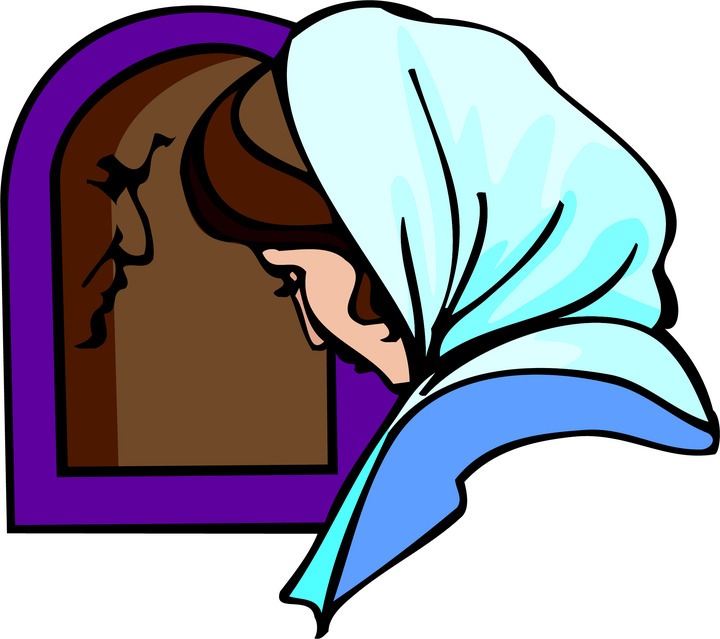
We all have been (or still are) an adulterous woman…

Adultrous Woman

Numbers 5:11–31, This passages deals with a curious ritual involving wives suspected of adultery called the Law of Jealousies whereby the woman is hauled before the priest, her head is uncovered and, according to Jewish tradition, her dress is ripped open just above her breasts (b.Talmud Sota 7a). She then has the choice to drink a concoction of earth from the floor of the tabernacle mixed with the set-apart (kadosh) water from the bronze laver into which is dipped a piece of paper that contains the curses written on it. If she is guilty of the charges of adultery when she drinks the bitter waters, her belly shall swell and her thigh (Heb. yarek or side or loins,which are the seat of procreative power) shall rot as a result of a divine judgment. If she is guiltless, the bitter waters will have no effect on her. If she refuses to drink the bitter water and her husband still suspects her unfaithfulness, then he is free to divorce her, even though she has admitted no guilt. According to Jewish tradition, this legal procedure was carried out by Israel’s highest court in Jerusalem (Sota 7b).

Some biblical commentators see a parallel here between the adulterous woman and the trial and execution of Yeshua at the cross. After only a casual reflection on the issues, this may seem unlikely. But ponder this for a moment. Did YHVH liken his Continue reading →


What is evil? The Torah or man’s sin nature?

Romans 7:4, You have been made dead with regard to the Torah. Are you free to break the law if you’re now dead to it? David Stern in his Jewish New Testament Commentary (p. 375) explains that it is not the Torah that has been made dead (or abrogated), nor is a believer made dead in the sense of no longer responding to its truth. Rather, he has been made dead not to all of the Torah, but to three aspects of it: (1) its capacity to stir sin in him (vv. 5–14), (2) its capacity to produce irremediable guilt feelings (vv. 15–24), and (3) its penalties, punishment and curses (8:1–4).

To fully understand Paul’s writings, one must have a complete understanding of the Torah and all of its aspects. Most individuals coming from the Christian theological perspective have a very limited and narrow understanding of the Torah (or as they term it, “the law”). For example, they fail to understand that how we react to the Torah—obedience versus disobedience—will determine how Torah “reacts” to us. For example, YHVH has embedded into the Torah a cause-and-effect spiritual mechanism: obey and be blessed, disobey and suffer the consequences, i.e., the curses of the Torah. Other laws in the universe with which we are familiar have the same cause-effect rewards-punishment systems built into them. How about the law of gravity? Try jumping off a tall building, for example. Paul in verse 13 asks whether we Continue reading →


Are You a Slave to Sin or Righteousness (i.e. Torah)?

Romans 6:14–15 says,

For sin shall not have dominion over you, for you are not under the law, but under grace.…What then? Shall we sin, because we are not under the law, but under grace? Elohim forbid!

What is Paul saying here? Paul is saying that sin (i.e., Torahlessness, 1 John 3:4) shall not have dominion over those who have faith in Yeshua and who have died to their old sinful nature as pictured by the baptism ritual (Rom 6:1–10). The Bible is clear: the wages or sting of sin is death (Rom 6:23; 1 Cor 15:56), for sin is the violation of the Torah (1 John 3:4), and those who are spiritually alive to Elohim through Yeshua (Rom 6:11) not only have had their sins forgiven, but they’re not continuing in habitual sin (1 John 3:4–9). They are walking under YHVH’s merciful grace, so that if they sin (i.e., violate the Torah), they can repent and receive his grace (1 John 1:9) instead of death. This is why Paul can say that the redeemed believer is no longer under the (penalty of) the Torah, but is under grace (Rom 6:14).

Because we are under grace and we have been spared by Elohim’s mercy from the penalty for sinning (i.e., violating the Torah), which is death, does this mean that we can continue in sin (i.e., continue violating the Torah, Rom 6:15)? Certainly not! Paul strongly affirms this in verse fifteen. Elohim’s grace doesn’t give us a license to sin (i.e., to violate the Torah, 1 John 3:4). If a saint sins, he must repent of his sin and not continue in his sin (1 John 1:9), so that the mercy and grace of Elohim will cover his transgression.

Paul then goes to say (Rom 6:16–23) that since we are no longer slaves to sin because of our relationship with Elohim through Yeshua, we now have become slaves to righteousness (i.e., Torah obedience, see Ps 119:172 where righteousness is defined as Torah-obedience). The Torah not only defines what sin is, but also shows us how not to sin. It is the grace of Elohim that not only gives us grace or unmerited pardon for violating the Torah (i.e., sin), but the same grace divinely enables us to live in obedience to the Torah, so that we will not come under the (penalty of) the Torah through sinfulness. This is why Paul can go on to declare that the Torah is holy, and the commandment holy, just and good (Rom 7:12). It reveals to us the path of righteousness and how not to sin by showing us how to love Elohim and our neighbor.


Blog Scripture Readings for 6-12 Through 6-18-16

Aside

THIS WEEK’S SCRIPTURE READINGS FOR STUDY AND DISCUSSION:

Parashat Nasso — Numbers 4:21– 7:89
Haftarah — Judges 13:2-25
Prophets — Jeremiah 38:1 – 44:30
Writings — Lamentations 1:1 – 5:14; Ecclesiastes 1:1-18
Testimony — Romans 6:1 – 11:10

Most of this week’s blog discussion points will be on these passages. If you have general comments or questions on the weekly Scripture readings not addressed in a blog post, here’s a place for you to post those. Just use the “leave a reply” link below.

The full “Read Through The Scriptures In A Year” schedule, broken down by each day, can be found on the right sidebar under “Helpful Links.” There are 4 sections of scripture to read each day. One each from the Torah, the Prophets, the Writings, and from the Testimony of Yeshua. Each week, the Torah and haftarah readings will follow the traditional one-year reading cycle.

Weekly Blog Scripture Readings for 6/12 through 6/18/16.


SHAVUOT — Getting in Tune With the Heavenly Philharmonic

Orchestra conductor hands

This is a story — not just any story, but our story — yours and mine. It’s the story of our lives, the  story of our people. It’s an old story, yet a new story. Only the faces and places have changed. The plot remains eternally the same. It’s the story of the Creator reaching out to humans, who struggle to accept his love, yet who end up largely refusing it. It’s a never-ending cycle going from one generation to the next.

This story started a long time ago. When in Egypt, the children of Israel were in tune spiritually to the rhythms and beat of Egypt (a biblical metaphor for this world).

YHVH led the Israelites out of Egypt into the quietude of the wilderness. The Hebrew word for wilderness is midbar and is from dabar meaning “to speak, declare, converse” and is related the word d’bar meaning “to hear.” Thus, one could say that YHVH led the Israelites into the wilderness to hear him speak his word,  and to enter into conversation with him — an impossibility in the noise and confusion of the environment of Egypt where man is at the center of everything and a lot is going on. The wilderness was a sterile and neutral environment devoid of the noise and confusion of man-made stuff.

The first place YHVH brought the Israelites to was the foot of Mount Sinai so he could speak to them face to face.

Before they could hear him, they had to prepare themselves. They had to make themselves clean and set apart from the physical and carnal impurities and distractions of the world and the flesh, which impede one’s ability to hear YHVH -— to connect with their Creator (Exod 19).

YHVH spoke to them, but it was too much for them to hear. It frightened them because they weren’t ready to hear him and to get their lives in sync with his Word — the Torah (Exod 20:19). They still had too much carnality in them. They were still too much in tune Continue reading →


The Feast of Pentecost & the Bride of Yeshua


Understanding the Feast of Pentecost