Jacob—Learning to Submit to Elohim the Hard Way

Genesis 28:22, I will surely give the tenth. To whom would Jacob ultimately tithe? We don’t know, but Jacob may have been making a prophecy about his descendants bringing their tithes and offerings to the house of El or the temple that would eventually be built on that exact spot.

Jacob’s dream in Genesis 28 was his first, life-changing personal encounter with the Elohim of his fathers (Gen 28:10ff). What was his response? It was to serve YHVH and to worship him by giving him one-tenth (a tithe) of his increase (verse 22). What prompted this response on Jacob’s part? Why was such a response appropriate? When did you have your first encounter with your Heavenly Father and Master? In following the example of Jacob, have you faithfully used the first fruits of your increase to honor, worship and express your gratitude to him ever since? If not, why not? Scripture calls not tithing “robbing Elohim” and that as a result a curse may be on your finances (see Mal 3:8–11). Proverbs 3:9 lays out a solid truth about how tithing is a form of worshipping the Creator. “Honour [glorify] YHVH with thy substance, and with the first fruits of all thine increase, so shall thy barns be filled with plenty, and thy presses shall burst out with new wine.”

The Scriptures reveal the importance of the spiritual law of reciprocity: You reap what you sow (Gen 8:22; Gal 6:7–9). If you don’t sow you will not reap. If you sow evil or good you will reap the same. Jacob had to learn this law the hard way. In Job 4:8 we read, “Even as I have seen, they that plow iniquity, and sow wickedness, reap the same.” Jacob gained the birthright through posing as Esau (a deception) and Laban in turn deceives Jacob by putting Leah under the veil posing as Rachel in Jacob’s marriage bed. It is very easy to see the principle of reaping and sowing in others’ lives, but can we see it in our own life? This is very difficult to do! Aren’t we prone to concoct every excuse and argument imaginable to justify our sinful actions and then blame the results on others? Prayerfully take a long and hard look at your life, examine hardships and trials, and honestly ask yourself the question: Am I reaping what I have sown? It is never too late to repent and make a course correction—to bring your life into agreement with YHVH’s Word and will, so you can start reaping Elohim’s blessings.

Honesty, patience and submission to authority are fruits of righteousness. What did YHVH have to teach Jacob about these fruits of the Spirit? Jacob was impatient in submitting to YHVH’s will and waiting for the birthright to come to him in a righteous way. How did YHVH use Laban to correct these character flaws in Jacob? Jacob had to go into the Babylonian world for a season in order to be refined before being ready to be a patriarch worthy of honor and an example of righteousness as the father of the twelve tribes of Israel. What is YHVH allowing you to go through to refine you of character flaws and defects to prepare you for the future mission he has for you? Are you submitting to his refining fires that are burning the wood, hay and stubble out of your life (1 Cor 3:12–15), or are you resisting him thereby forcing him to “turn up the heat” of his discipline to help you “to get the point” and learn your lesson? (Read Heb 12:5–15.)

Jacob was forced to go east (toward Babylon) as a form of exile and punishment for his sins. After serving as a bondservant to Laban for 20 years, he returned westward to Canaan, the land of promise. This eastward-westward movement was a pattern followed by Jacob’s descendants later on several occasions. Even Abraham left Babylon and went west to Canaan. What are the prophetic implications of this in the end times when YHVH is calling his people to “come out” of spiritual Babylon (Rev 18:4)?

Jacob builds a complete family in “exile” consisting of twelve tribal leaders. To return to the Promised Land of Canaan, he had to encounter Esau (or Edom) who is the father of many of the modern day Arab peoples. What is this a prophetic picture of? Did the Jewish exilic remnant encounter Esau’s descendants when they come back from Babylon under Ezra and Nehemiah? Is it happening again in our time as the exiled Jews return to Israel—their homeland? Who currently is opposing their return and is openly vowing to annihilate them? Consider Edom’s opposition to Jacob past, present and future. What (or who) is really behind this opposition to Israel’s (Jacob’s) inheriting his birthright that includes a land inheritance whose borders are from Egypt to the Euphrates River in modern Iraq?

Jacob vowing to tithe to Elohim was his acknowledging his submission to Elohim and to his will—that Elohim was the Lord over his life. Complete submission to Elohim came hard for Jacob. The same is true for us, and when we tithe this is an act of worship of Elohim and acknowledgement that we have come to a higher place of surrender in our lives.


 

When Did Easter Replace Passover?

Matthew 28:1, When did the early Christians first celebrate a day commemorating the resurrection of Yeshua?

Although the resurrection of Yeshua the Messiah is a biblical and historical fact, it’s celebration (known as Easter), is neither commanded in the Scriptures, nor was it celebrated by the original disciples of Yeshua. It is purely an invention of the church, which eventually replaced Passover! Here are the facts:

In A History of Christianity (vol. 1), Kenneth Scott Latourette states that notice of Easter as a festival occurs in the middle of the second century, but that festivals commemorating the resurrection of Messiah were presumably observed by at least some Christians from much earlier times (p. 137). Church historian, Philip Schaff, also attributes the beginning of the Easter festival to the middle of the second century (History of the Christian Church, vol. 2, p. 207). He states that the Christian Passover naturally grew out of the Jewish Passover, as the Lord’s Day (Sunday) grew out of the Sabbath. “It is based on the view that Christ crucified and risen is the centre of faith. The Jewish Christians would very naturally from the beginning continue to celebrate the legal Passover, but in the light of its fulfillment by the sacrifice of Christ, and would dwell chiefly on the aspect of the crucifixion. The Gentile Christians, for whom the Jewish Passover had no meaning except through reflection on the cross, would chiefly celebrate the Lord’s resurrection as they did on every Sunday of the week.” He notes that the early Christians commemorated the entire period between the death and resurrection of Yeshua with vigils, fasting, special devotions, meetings culminating in a resurrection feast celebrating the whole work of redemption. The feast of the resurrection gradually became the most prominent aspect of the Christian Passover (Easter celebration), but the crucifixion continued to be celebrated on Good Friday” (ibid., pp. 207–208).

Christians universally kept the Passover on the biblical date of Abib (also known as Nisan) 14/15, irrespective of the day of the week until A.D. 135 according to leading Sabbath scholar Prof. Samuele Bacchiocchi quoting the fourth century Christian historian Ephiphanius (From Sabbath to Sunday, p. 81). “This conclusion,” continues Bacchiocchi, “is supported indirectly by the two earliest documents mentioning the Passover celebration, since both emphasize the commemoration of the death rather than the resurrection of Christ. The Ethiopic version of the apocryphal Epistle of the Apostles [or Didache] says, ‘and you therefore celebrate the remembrance of my death, i.e., the Passover’ (ch. 15). In the Coptic version the passage is basically the same, ‘And you remember my death. If now the Passover takes place …’ (chap. 15)’ (ibid., p. 82).

The second document that attests to the early church’s emphasis on the death rather than the resurrection of Yeshua is the Sermon on the Passover, by Melito, Bishop of Sardis (died ca. A.D. 190). According to Bacchiocchi, Melito provides a most extensive theological interpretations of the meaning of the Passover for early Christians. “Though Melito makes a few passing references to the resurrection, it is clear from the context that these function as the epilogue of the passion drama of the Passover. The emphasis is indeed on the suffering and death of Jesus which constitute the recurring theme of the sermon and of the celebration” (ibid., p. 83).

“The resurrection,” Bacchiocchi admits, “however, did emerge in time as the dominant reason for the celebration not only of the annual Easter-Sunday, but also of the weekly Sunday. The two festivities, in fact,… came to be regarded as one basic feast commemorating at different times the same event of the resurrection.” Bacchiocchi concludes,

It would seem therefore that though the resurrection is frequently mentioned both in the New Testament and in the early patristic literature, no suggestion is given that primitive Christians commemorated the event by a weekly or yearly Sunday service. The very fact that Passover, which later become the annual commemoration of the resurrection held on Easter-Sunday, initially celebrated primarily Christ’s passion [death] and was observed on the fixed date of Nisan [Abib] 15 rather than on Sunday, makes it untenable to claim that Christ’s resurrection determined the origin of Sunday worship during the lifetime of the Apostles. (ibid. p. 84)


Genesis 28:10–32:3 Parashat Vayeitzei (A Gospel Oriented Torah Study)

This Torah study is subdivided in sections by topic in a magazine format thus making it easy to watch at several sittings.

May you be blessed as you watch this video.

For a free, printable adult and youth Torah study guide on this Torah portion (parashah), please go to http://www.hoshanarabbah.org/parshiot.html


Blog Scripture Readings for 11-19 Through 11-25-17

Aside

THIS WEEK’S SCRIPTURE READINGS FOR STUDY AND DISCUSSION:

Parashat Vayetzei — Genesis 28:10 – 32:3(2)*
Haftarah — Hosea 12:13(12) – 14:10(9)*
Prophets — Judges 18:1 – 21:25; 1 Samuel 1:1 – 3:21
Writings — Psalms 48:1 – 55:23
Testimony — Matthew 28; Mark 1:1 – 4:19

Our annual Scripture Reading Schedule for 2017-2018 is available to download and print.

Most of this week’s blog discussion points will be on these passages. If you have general comments or questions on the weekly Scripture readings not addressed in a blog post, here’s a place for you to post those. Just use the “leave a reply” link below.

The full “Read Through The Scriptures In A Year” schedule, broken down by each day, can be found on the right sidebar under “Helpful Links.” There are 4 sections of scripture to read each day: one each from the Torah, the Prophets, the Writings, and from the Testimony of Yeshua. Each week, the Torah and haftarah readings will follow the traditional one-year reading cycle.

* Verse numbers in parenthesis refer to the verse number in Christian English Bibles when they differ from Hebrew Bibles or the Tanakh.

Weekly Blog Scripture Readings for 11/19/17 through 11/25/17.


Video: Understanding the Prophetic Mystery of Jacob’s Ladder and the Gospel


New Covenant or Renewed Covenant? What Are Its Terms and Conditions?


Matthew 26:28, New testament.

Did you ever wonder where the terms New Testament or New Covenant came from? Yes, you will find these phrases used in the Testimony of Yeshua portion of your English Bible in exactly nine places (Matt 26:28; Mark 14:24; Luke 22:20; 1 Cor 11:25; 2 Cor 3:6; Heb 8:8, 13; 9:15; 12:24), but does the English translation do justice to the Hebrew and Greek words behind them and to the biblical concept of the “New Covenant” as it is commonly called?

Let’s begin to answer this question by first asking a  question. When you think of the word new, what comes to your mind? A brand new car? A new house? A new pair of shoes?

You see, in English there is one common word for new, while Greek and Hebrew have more than one word for new. While English speakers are limited to one word, they nuance the meaning of new by adding qualifiers to the word new (e.g. brand new as opposed to used but it’s new to me) to differentiate between brand new versus new to me, or refurbished or repaired new. 

In the Testimony of Yeshua, there are two Greek words for new: neos and kainos, and each one has a different connotation. Neos more often means “brand new or numerically new,” while kainos means “renewed, refreshed or repaired or qualitatively new.” When you see the term New Covenant or New Testament used, in eight of nine time the authors use kainos. Only in Hebrews 12:24 is neos used in reference to the new covenant.

The Testimony of Yeshua’s preference over using the Greek word for renewed over the Continue reading →


Will the Real Judas Please Stand Up?

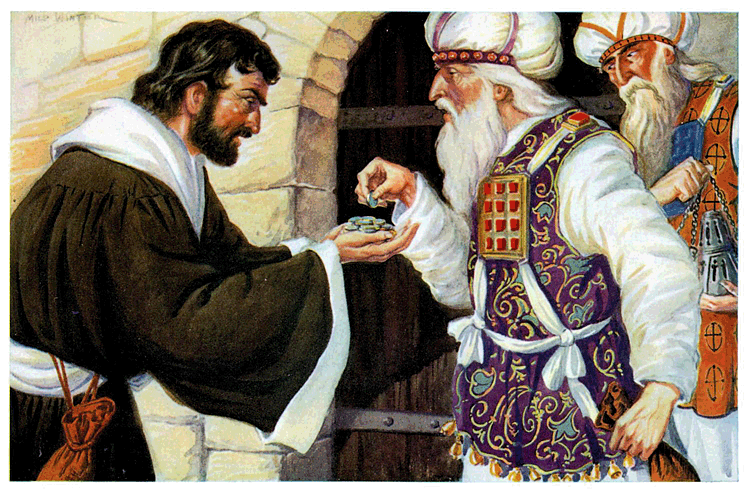
Matthew 26:14–15, Then Judas. When Yeshua plainly stated that he’d be crucified soon, Judas evidently became disillusioned, since he was expecting a Conquering King Messiah, not a Suffering Servant Messiah. With Yeshua as a conquering king, Judas could have expected a prominent position in Yeshua’s government.

The lust for money and power were likely the motives behind Judas’ following Yeshua (after all, Judas carried the money bag for Yeshua’s ministry). When Yeshua predicted his crucifixion, Judas’ incentives for following him suddenly vanished. Judas figured he’d salvage what he could of his unfulfilled expectations and enrich himself, even if it meant betraying Yeshua for money. Judas had come to the conclusion that Yeshua was a false Messiah faker and that he had wasted several years of his life following him, so, in his mind, giving Yeshua over to the Jewish authorities wasn’t an act of betrayal at all, but was an act of civil service to expose Yeshua as a trouble-making fraud.

To Judas, the Jewish leaders had been right after all to reject Yeshua as the Messiah. To them, he was merely a pretender, a deceiver, an agitator and a troubler, and Judas had come to the same conclusion. When Judas came to this realization, he now found it advantageous to his personal well-being to cast his lot in with the Jewish religious establishment and to make some money from it as well.