Did Yeshua Eat Leavened Bread During the Passover/Last Supper Communion Service?


There has been a perennial question among many Christians as to whether Yeshua ate leavened or unleavened bread during his last supper Passover communion service. This is because of the Greek words for bread that appear in the Greek NT manuscripts. The excerpt below answering this question is from a larger article I wrote years ago entitled “Passover…When Do We Celebrate It? At the Beginning OR the End of Aviv 14?” available at https://www.hoshanarabbah.org/pdfs/psvr_dy.pdf .

I take the position that Yeshua didn’t eat leavened bread during communion, since it would have violated biblical (Tanakh or OT) types and shadows pointing to Yeshua’s sinlessness. I cannot and will not eat leavened bread in communion because I don’t want in any way to imply or even remotely suggest that Yeshua was a sinner. In this excerpt from my article, I explain the reasons for my position.

Unleavened Bread Versus Leavened Bread

At this point, many questions arise for the honest Bible student. Whatever Yeshua was doing with his disciples Passover-wise, it was before he was to suffer, as Luke 22:15 states. Was he eating an actual Passover lamb? Or just eating bread that was now to become an emblem of his body, a picture of the sacrificial lamb itself? If he was eating bread, and not lamb itself, then why is the term for the bread that he ate with his disciples that night a reference to generic bread (see Matt. 26:26; Mark 14:22; Luke 22:9; 24:30; 24:35; John 13:18), and not unleavened bread, which is a totally different word in the Greek language? To be sure, unleavened bread, not leavened bread, was eaten during the Passover meal in accordance with the Hebrew Scriptures (Num. 9:10-11; Josh. 5:11).

Could this reference to generic (leavened) bread, to which the Gospel writers make unanimous reference in all of their accounts, have been referring to Yeshua as “the bread of life?” Yeshua refers to himself as the “bread of life” (the same Greek word [artos, Strong’s G740] for generic, leavened bread is used in Yeshua’s “Last Supper” accounts as well as in his references to his being the bread of life) in several places in the Gospel of John (6:31, 33, 34,  35, 41, 48, 50, 51, 58). If Yeshua was keeping an early Passover meal with his disciples, that is, early on the fourteenth of Abib instead of late on the fourteenth, which is when the Jews kept it and when the Passover lamb was sacrificed in the temple, which corresponded to when Yeshua was hanging on the cross, then it would have been permissible to eat leavened bread. Torah commands that only unleavened bread be eaten during the seven-day Feast of Unleavened Bread between the fifteenth and the twenty-first days of the first month (Exod. 12:15; 13:6-7; 23:15; 34:18; Lev. 23:5-6; Num. 28:17; Deut. 16:3, 8). Leavened bread is not prohibited from being eaten on the fourteenth (although the Hebrew Scriptures or Tanakh does forbid its being eaten during the actual Passover ceremony itself [Num. 9:10-11; Josh. 5:11], which would have started at the end of the fourteenth and overlapped into the fifteenth, which was the first day of the Feast of Unleavened Bread), though it is safe to say, that most Israelite homes had already been de-leavened by then. The Jews kept Passover (and still do to this day) at the end of the fourteenth and ate their Passover meal actually at the beginning of the fifteenth, which is the beginning of the time when Torah forbids the eating of leavened bread for seven days.

So Yeshua could have eaten leavened bread at the beginning of the Passover day as an object lesson to his disciples (and to us) that he was the bread of life, to which the Passover lamb pointed, and he would not have violated Torah.

That Yeshua ate leavened bread is one line of reasoning that some students of Scripture use to attempt to disprove that his last supper was a Passover Seder. However, to counter this point, some will refer to the Scripture passage in 1 Corinthians 11:17-34, which is a reference to the last meal that Yeshua had with his disciples. There is no mention specifically here of a Passover Seder, but only a meal and the term for bread here is artos­, the Greek word for generic, leavened bread. Does this, passage therefore prove that what Yeshua did with his disciples was not a Seder, even though Yeshua himself referred to it as such? If so, why the usage of the word artos and not the Greek word azumos (Strong’s G106) for unleavened bread? Furthermore, some find it unimaginable that Yeshua would be partaking of leavened bread and likening it to his body, when leavened bread contains yeast or sour dough, a type of sin, and we know that Yeshua had no sin in him. Others say that it was appropriate for him to eat leavened bread, since he took our sins upon himself and that he went to the cross with leaven (a picture of our sins) in him. It might also be added that using the generic term for bread (in reference to the last supper) does not prove conclusively that it was indeed leavened bread. It could have been unleavened. Unleavened bread is still bread. It’s simply a flat bread. But why doesn’t Scripture say so then? If we believe that every detail of Scripture is divinely inspired, we have reason to be confused when certain things do not seem to add up.

We take the position that Yeshua did not eat leavened bread during his Paschal meal, and for a very good reason. In the levitical sacrificial system, YHVH forbad the offering of leavened bread with the sacrifices on all occasions except on the Feast of Pentecost when two leavened loaves were lifted up representing Israel. Even the twelve loaves of bread on the Table of Showbread in the Tabernacle (representing Israel in a purified or sin-free state) were unleavened. Leaving is clearly a picture of sin. Yeshua, the perfect sacrificial Lamb of Elohim fulfilled the sacrificial system types perfectly. It seems unthinkable that the Lamb of Elohim, slain from the foundation of the world, who was sin-free, could have eaten leavened bread and had leavening, a picture of sin, in him when he went to the cross. For this reason, we believe Yeshua ate unleavened bread.


Mary and Elizabeth: Godly Women Produce Godly Sons!

A brief discussion from the Gospel of Luke about Mary (the mother of Yeshua) and Elizabeth (the mother of John the Baptist) may shed some clues on why their sons attained such high spiritual stature. Behind godly sons are often godly mothers!

Luke 1:6, Righteous…blameless. Zachariah and Elizabeth (Heb. Elishevah) were totally Torah-observant to the point of being blameless in YHVH’s eyes. This confirms Moses’ words in Deut 30:11–14 that Torah-obedience isn’t outside the realm of human possibility as some in the church erroneously teach today.

Luke 1:28, Blessed are you among women. These words of Gabriel were repeated verbatim in Elizabeth’s prophecy concerning Yeshua (verse 42). Doubtless this was a supernatural confirmation to Mary concerning her role as the mother of the Messiah, for how could her cousin have known what the angel had spoken to her previously?

Luke 1:36, Elizabeth your relative. While Mary was of the royal lineage of David through her father, she also was a relative on her mother’s side of Elizabeth, the priest-wife of Zacharias, who was a daughter of Aaron (Luke 1:5).  In Matthew one and Luke three two different genealogies are given for Yeshua, both of which  go back to King David. One is presumed to be that of Joseph and the other is that of Mary. In this way, Yeshua was a direct descendant of David legally through Joseph, his step-father, and genetically through Mary, his mother. Does this mean that Mary was of priestly as well as Davidic lineage. Yes, but not patrilineally, only matrilineally. In the Scriptures, tribal lineage was determined through the father’s family line and not the mother’s.

In the case of Mary and Elizabeth, they would have shared common grandparents making them cousins. Their grandfather would have been a priest. In the case of Elizabeth, her father—the son of her priestly grandfather—would have carried the priestly line making her a daughter of Aaron (Luke 1:5). In the case of Mary, her mother would have been her priestly grandfather’s daughter meaning that she was of priestly lineage but not her children, unless she married a priest.

It seems that Yeshua would have carried some priestly blood in his genes, but he was not legally a priest through patrilineal descent. To be sure, Yeshua was a priest, but not one of Aaronic lineage but after the order of Melchizedek, which was the priesthood of the firstborn son passed on generationally. Yeshua was the first born son of Elohim eternally, which is why he is presently at the right hand of Elohim acting as our Great High Priest (Heb 1:3 cp. 3:1; 4:4; 8:1).

Therefore, Mary laid claim to a Davidic as well as a priestly lineage (Jesus the Messiah, by Edersheim, p. 105). This means that Yeshua was not only of direct Davidic lineage but was of priestly lineage as well.

Luke 1:39, Now Mary arose. Those with similar divine missions or callings naturally want to be with others like them. Such divine encounters are too unbelievable and incomprehensible for those who haven’t encountered something similar that it is hard to relate to those who have. This is probably why, in part, the prophets of old, at times, lived together in a community. Those who see into the spiritual realm and operate by faith are constricted spiritually when they have to be around those who don’t.

Luke 1:41–45, When Elizabeth heard. During this greeting, Elizabeth had a spiritual encounter that helped her to connect the dots to understand what was going in YHVH’s divine plan for John and Yeshua. Zechariah would have revealed to her the angel’s previous message (vv. 13–17). Now when the babe leapt in her womb at Mary’s arrival and she was filled with the Spirit (a visceral experience), and then prophetic words came out of her mouth, this was evidence and confirmation to both of them of YHVH’s plans for their sons. YHVH has supernatural ways of conveying his divine will to his people, so that only people of faith will see and understand. All others, unless confronted with visible signs and empirical evidence (as verified by logic, or observable evidence or experience), will dismiss these spiritual revelations and circumstances as delusion. The unbelievers usually resort mockery and scoffing ridicule. Those who walk by faith and hear the voice of YHVH and know his ways of communication are undeterred, however, as they follow the Elohim wherever he leads them.


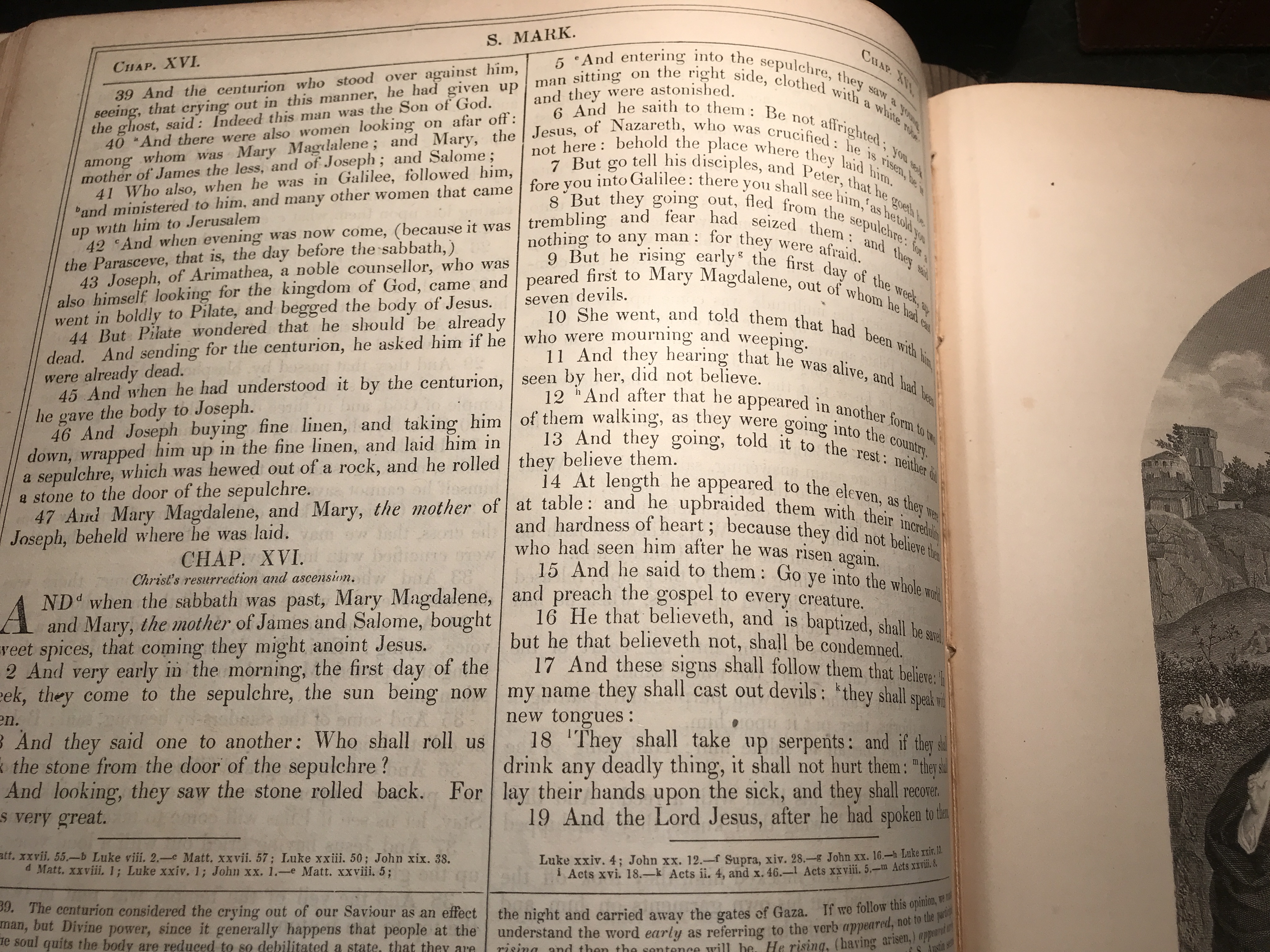
Mark 16:15–18: In or Out of the Bible?


Mark 16:9–20, The Great Commission. Many modern scholars call into question the genuineness of these last twelve verses. For a discussion on whether these verses of Mark’s Gospel should be included in the Bible, see E. W. Bullinger’s (1837-1913) The Companion Bible (appendix 168).

Bullinger states that the two oldest Greek manuscripts of the Testimony of Yeshua (from the fourth century) don’t contain these verses. On the other hand, more than six hundred other Greek manuscripts do contain them as do the oldest Syriac manuscript known as the Peshitto (which Bullinger believes is from the second century) and the Curetonian Syriac (from the third century). He notes that Jerome when translating the Bible into Latin (The Vulgate, A.D. 382) had access to Greek manuscripts older than any now extant,which is why he included these twelve verses in his Bible. Additionally, he notes that the Gothic Version (A.D. 350), the Coptic (fourth or fifth century), the Armenian (fifth century), Ethiopic (fourth to seventh centuries) and Georgian (sixth century) versions all contain these last twelve verses. Bullinger goes on to say that there are nearly one hundred ecclesiastical writers before the oldest extant Greek manuscripts who attest to the authenticity of these verses. Moreover, between A.D. 300 and 600 there are about two hundred more writers who do.

Bullinger gives two reasons why he believes these verses may have been omitted from several of the oldest Greek NT manuscripts. After the destruction of Jerusalem in A.D. 70 extending forward one hundred years, there is a complete blank regarding the history of the early church and a complete silence about this era from Christian writers. Therefore, no one knows what was going on in the church during this period including whether such signs and wonders as enumerated in these last verses in Mark’s Gospel were still occurring. He speculates that when later translators came to the last twelve verses of Mark and saw no trace of these spiritual gifts currently being manifested in the church (in the fourth century), some marked them as doubtful, spurious or even omitted them altogether. This same doubt has been passed on to modern scholars.


Genesis 42–46 Two Brothers and the Two Houses of Israel in End-Time Prophecy (Pt 2)

To read part one of this post, go to https://hoshanarabbah.org/blog/2017/12/12/genesis-42-46/

Judah Approaches Joseph (Gen 44:18)

Judah came near to Joseph was willing to lay down his life for his younger brother (Gen 44:18–34). This is another prophetic picture of the future Messiah who would come to this earth in willingness to give his life as a ransom to save his brothers. The Scriptures call Yeshua the “Lion of the tribe of Judah” (Rev 5:5) who initiated the process in seeking to save his brothers who were spiritually lost (Rom 5:8; Luke 19:10; Matt 18:11; ), and who Yeshua referred to as the lost sheep of the house of Israel (Matt 10:6; 15:24).

Joseph Had to Reveal Himself (Gen 45)

The brothers didn’t recognize Joseph because he resembled an Egyptian; he had to reveal himself to them. Today, Christians (the descendants of Joseph according to Gen 48:16, 18 and Rom 9:24–27 and the descendants of Abraham according Eph 2:11–19; Gal 3:7, 14, 28, 29), are revealing themselves to their brother Judah through several ways:

  • Through donating money to Jewish relief agencies.
  • Through Christian tourism of Israel.
  • Through Christian interfaith organizations (Bridges for Peace, Christians United for Israel, Christian Friends of Israel, etc.).
  • Through the Messianic Jewish Movement
  • Through the Messianic Israel Movement.
  • Through America’s (and Britain’s) military, political and economic support of the nation of Israel.

Two Messiahs in One Story

Judah and his brothers didn’t recognize Joseph; he had to reveal himself to them (Gen 45:1–4). They were “blinded” to Joseph’s identity. Most of Judah has spiritual blindness to this day (Rom 11:25). They are largely blind to Yeshua the Messiah, son of Joseph, and to the fact that Christians (many of whom are the descendants of Abraham through Joseph) are their long lost brothers. So in our story, Judah plays a dual role: that of spiritually blind Judah and that of the Messiah, the Lion of the tribe of Judah. His former role is prophetically emblematic of the Jewish nation including the modern Jews who have been largely blind to their Messiah (the Son of Joseph), and in the latter role as Yeshua the Messiah who was willing to lay down his life to save his brothers.

Even as Judah was a prophetic antetype of the Jewish people and the Jewish Messiah, likewise Joseph also fulfilled an antetypical role of the Messiah. He too was the spiritual father of his people—Ephraim and Manasseh—the dominate tribes of the Northern Kingdom of Israel who went into apostasy and become as “lost sheep” among the nations of the world (Hos 7:8; 8:8; Ezek 34:16 and numerous other scriptures). Therefore, Joseph prophetically represents the “lost sheep of the house of Israel” and the Messiah who would come and seek out those sheep.

The Jewish sages have seen a prophetic picture of the coming Messiah Son of Joseph (Mashiach ben Yosef), the Suffering Servant in the story of Joseph. They have written about the Suffering Servant Messiah figure, who they felt would be a descendant of Ephraim and who would come to redeem the lost sheep or exiles of the house of Israel in preparation for a second Messiah to come. They refer to him as the Conquering King or the Messiah the Son of David (Mashiach ben David). Although I have found no instances where they also identify Judah with the coming Messiah, it is not hard to see some allusions to this in the interplay between Joseph and Judah. Let’s note what the sages write about Joseph as well as the descendants of his grandsons, Ephraim and Manasseh. Notice the striking similarities between modern Christians and those the Jewish sages viewed would be the followers of Messiah Son of Joseph?

What kind of blessing was this prediction that one day [Jacob’s] descendants—the Ten Tribes—would be scattered among the nations? R. Munk explains: while it is true that the dispersion was caused by the unfaithfulness and sinfulness of Ephraim’s descendants (Hos 7:8ff), Jacob’s blessing was not in vain for “they will return to God” and will have their share in the world to come ([Talmud] Sanhedrin 110b). And R. Eliezer adds: ‘Even the darkness in which the Ten Tribes were lost will one day become as radiant as the day’ (according to the version of Avos d’Rabbi Nosson 36). And in the perspective of history, did not these exiled children of the Patriarchs enlighten the nations among whom they were scattered? They did so by teaching their conquerors the fundamental ideas of the knowledge and love of God, ideals they had never forsaken. Hence they too have a messianic vocation and their Messiah the … Messiah son of Joseph (Succah 52a), also called Messiah son of Ephraim (Targum Yonasan on Exodus 40:11), will play an essential role in humanity’s redemption, for he will be the precursor of the … Messiah Son of David…. (emphasis added, note bolded part).

The Family of Israel Is Finally Reunited/Regathered (Gen 46:1–7)

These verses recount the move of Jacob and his family to Egypt where they were reunited with Joseph and his family. This event prophetically foreshadows a time in the future that the Jewish sages call the final redemption, which is to occur at the coming of Messiah Son of David as he comes to establish the Messianic Era (Millennium). The sages teach that an aspect of that final redemption includes the reunification of the two houses of Israel into one kingdom under Messiah Son of David, which is prophesied in Ezekiel 37:15–28. Interestingly, from antiquity, the Jewish sages have chosen Ezekiel’s prophecy as the corresponding scripture passage from the biblical prophets (called the Haftorah) which, in their understanding, best correlates to the Torah portion (parashah) that includes Genesis 46. These sages understood that the events recorded here in the lives of the patriarchs are indications of future events that would occur in the lives of their descendants.

The final redemption or regathering and then the reuniting of Judah and Ephraim at Messiah’s return is mentioned numerous times in the Scriptures (e.g., Hos 5:15–6:4; 1:11; Acts 3:21; Ezek 37:25). This will be a supernatural work of the Spirit of Elohim (Ezek 36:19–32).

Life in the Land of Goshen (Gen 46:34)

After the reunification of the divided family, the Israelites settled in Goshen, which was in the Nile River delta area and was, and to this day is, the prime farm land of Egypt. It was a veritable promised land compared to the arid regions of Canaan.

Prophetically, could Israel’s settling in Goshen after being reconciled and reunited be a spiritual shadow picture of the Millennium? I believe so.

The Jewish sages have long taught that history for the people of Israel is continually repeating itself in cyclical patterns as YHVH accomplishes his purposes among his people over and over again. He is continually endeavoring to reveal his plan of redemption and reconciliation to those who have eyes to see. He is continually reaching out the loving hand of redemption to the next generations of Israelites. This cycle, like a wheel that keeps turning around and around, will turn one more time in the last days in what the sages refer to as the final regathering of the exiles or the final redemption of Israel. This will involve not only the resurrection of the dead, but the reuniting of the divided kingdom of Israel, the regathering of the Israelite scattered exiles back to the land of Israel, and the coming of the Messiah who will set up his reign over this earth called the Messianic Era. This is even better known in Christians circles as the Millennium. The Jewish sages have taught this for thousands of years—and still teach it—because they had read and believed what the biblical prophets have written in this regard.

Conclusion

I believe that the story of the reuniting of Joseph with his brothers a prophetic antetype speaking to the future reunification and redemption of the two houses of Israel with the Messiah as the initiator and focal point of this redemptive process. This process began to occur at the first coming of Yeshua and will culminate at his second coming and it involves the regathering of the lost sheep of the house of Israel. This process will climax at the end of the age where the children of Israel will be regathered and reunited to worship YHVH in spirit and in truth (John 4:23) under the rulership of King Yeshua the Messiah, Son of Joseph/David (Ezek 37:15–28) during the one-thousand-year-long Millennium.


Joseph, Ephraim, Manasseh and Benjamin in End Times Prophecy

Here are a few of my thoughts on who Joseph, Ephraim, Manasseh and Benjamin represent in end times Bible prophecy.

In studying the Jewish sages of old, I am amazed at how prescient they were about end time events. They gained this understanding often as they studied the lives of notable biblical characters.The sages had the strong sense that history would repeat itself— often again and again for the people of Elohim. This they observed in the cyclical patterns of Israel’s own history where YHVH gave them the truth, they remained faithful to it for a while, and turned from it, were punished and then returned to Elohim only to have the cycle repeat itself again and again.

As I have studied their method of predicting the future based on past events in Israel’s history, this has led me to some of my own speculations, which I present to you below.

Joseph, Ephraim and Manasseh Antetypical of Christianity

Joseph’s wife was the daughter of an Egyptian priest. Jospeh married into the religious system of Egypt. He is a picture of Christian church, which has married itself to Babylon by syncretizing itself with certain pagan traditions and belief systems. Joseph is a picture of the end time lukewarm church. Ephraim and Manasseh were products of the union of Joseph (an Israelite) and Potifera (an Egyptian). Though they were Israelite, they were genetically a mixture of both Israelite and Egyptian blood. In fact, they resembled Egypt so much that Jacob, when blessing them, didn’t even recognize who they were. They were strangers to him. Though they were spiritual mulattos, their spiritual destiny was to identify wholly with their Israelite heritage, which would necessitate their renunciation of their Egyptian ties. In the end times, YHVH is calling Christians to renounce the pagan ties they have through their association with the harlot church system and to come completely out of spiritual system of Babylon, which is a mixture of biblical truth with pagan traditions and traditions of men the make of non-effect the word of Elohim.

Benjamin Is Antetypical of the End-Time Bride of Yeshua

Benjamin was the “son of my [Jacob’s] right hand.” He was Jacob’s youngest and most beloved son (after Joseph’s departure). Judah was willing to lay down his life for his youngest brother. Because of the love Judah had for Benjamin, the descendants of both tribes never separated, and the tribe of Benjamin stayed permanently identified with the tribe of Judah. Even Paul, the Jew and an apostle to the Gentiles, was from the tribe of Benjamin.

In the end times, Christians are like Joseph and his two sons. Most Christians take after Manasseh, which means “forgetful” in that they have forgotten the Torah. Those Christians who love Yeshua and keep his (Torah) commandments take after Ephraim, which means “doubly fruitful” in that they have both Yeshua and the Torah. Judah is both a picture of the Jews and of Messiah Yeshua, while Benjamin could also be a picture of the remnant of Torah-keeping believers who have permanently attached themselves to their Hebrew roots, to the Torah, to Yeshua and who have no involvement with the spiritual Babylon.

Joseph Is a Type of the American Government

Joseph became ruler of Egypt. In the end times, America, which is the largest Christian nation and hence contains the largest number of Joseph’s descendants (through Ephraim), is the leader of spiritual Babylon. In Egypt there were seven years of plenty, then seven years of famine. Egypt was the greatest nation of the world at the time. When the world (and Egypt) fell on hard times economically due to famine, Joseph turned Egypt into a socialistic state. This he accomplished through the Egyptian government’s purchase of all the means of production, the land and by indebting the world to it and by turning its own people into serfs working for the government. Is this same scenario happening in America? We have had our years of prosperity, and now we are entering into seven lean years where the government’s answer to these problems is to socialize this nation at a rapidly expanding rate including the nationalizing, in part, of more and more of the private business sector.


 

Communion or the Lord’s Supper Explained in Its Hebraic Context


The Importance of Memorials and Symbols

Obedient and truth-seeking disciples of Yeshua will want to love him by keeping his commandments (John 14:12), and by teaching and doing everything he commanded (Matt 28:20). They will be following Paul’s example to imitate Yeshua (1 Cor 11:1) as well heeding John’s admonition “to walk just as [Yeshua] walked” (1 John 2:6).

With regard to obeying YHVH’s commands, symbols and memorializations figure prominently in YHVH Elohim’s spiritual economy. Why is this? They are teaching aids. Physical humans need physical things to help them to comprehend spiritual truths and ideals. Using symbols, commemorations and memorializations is a method of teaching and relates to pedagogy, which is “the method and practice of teaching, especially as an academic subject or theoretical concept.” A effective teacher endeavors to build bridges of understanding between what the student knows and what the teacher wants to teach the student— between the known and the unknown, between what the student understands now and what the teacher wants his students to learn. A successful teacher learns the skill of building bridges of understanding with his students to bring them to a higher level of understanding. The same is true of YHVH Elohim as we works with humans to teach them about spiritual things.

On a spiritual level, YHVH Elohim, our Heavenly Teacher, employes similar pedagogic or teaching techniques as he endeavors to bring men to a higher level of understanding heaven’s spiritual truths and realities. The use of symbols and memorials as teaching tools is essential to this process of teaching and learning.

The Bible is full of symbols and memorials that represent or point to something else and act as teaching aids to assist humans in learning about Elohim and what he requires of us. For example, the very name of the Creator, YHVH (Yehovah), is a memorial, symbol or remembrance (Heb. zeker from zakar) of who Elohim really is (Exod 3:15). His name is a Continue reading →


List of President Trumps 163 Accomplishments in 2017


[Editor’s note: The following comprehensive list of Trump accomplishments has been compiled for WND’s Thank Trump Campaign, which provides a free way to send personalized messages of thanks directly to the White House at ThankTrump.us]

With mainstream media and establishment politicians stacked against him from the moment he announced his run for the presidency, Donald J. Trump has been in an ongoing pitched battle to communicate his plans – and his eventual successes – to Americans. Through public rallies and social media, he has managed to bypass the traditional information gatekeepers and has spoken directly to the people.

Yet, Americans are subjected to a relentless drumbeat from the Democratic Party, amplified by virtually the entire establishment press, that Trump is not only undisciplined, unfit for office and possibly racist, but that embarrassingly little has been accomplished by the Trump administration.

And while he has befuddled and disappointed some – with major promises such as Obamacare repeal and a border wall unfulfilled or put on the backburner – the stunning reality is this: Donald Trump has amassed a long and remarkable list of actions and accomplishments that will surprise average Americans, even those who support the president and consider themselves well-informed politically.

Here, then, is an accounting of the truly significant achievements of the first eight months of the Trump presidency, compiled in conjunction with the Thank Trump Card Campaign, which has a dedicated website, ThankTrump.us. The accomplishments are all the more noteworthy as they have been carried out in an environment of unrelenting negativity on the part of not only the Democrats and almost the entire news media, but the Beltway establishment itself, the entire donor class, the “Deep State,” and even many Republicans wedded to the D.C. “swamp.”

DECEMBER

  1. Regulatory reform: President Trump announced Dec. 14 his administration has far exceeded its promise to eliminate regulations at a 2:1 ratio and impose no lifetime net regulatory costs. In total, agencies issued 67 deregulatory actions while imposing only three new regulatory actions, a ratio of 22:1. Federal agencies also achieved $8.1 billion in lifetime net regulatory cost savings, the equivalent of $570 million per year.
  2. Jobs: Some 228,000 new jobs were created in November, highlighting the strongest U.S. labor market since the turn of the century. The government also reported Dec. 8 that unemployment was unchanged at 4.1 percent, but that’s still nearly a 17-year low.
  3. Military: The Trump administration asked a federal court Dec. 7 for an emergency stay to delay a court order to begin opening the military to transgender recruits by Jan. 1.
  4. Israel: While the previous three U.S. presidents promised during their election campaigns to recognize Jerusalem as Israel’s capital, President Trump on Dec. 6 became the first to follow through. In his official order, Trump also ordered the U.S. Embassy to be moved to Jerusalem from Tel Aviv. Israeli Prime Minister Benjamin Netanyahu responded: “President Donald Trump, thank you for today’s historic decision to recognize Jerusalem as Israel’s capital. The Jewish people and the Jewish state will be forever grateful.”
  5. Immigration: The Department of Homeland Security released figures Dec. 4 showing Trump is delivering on his pledge to more strictly control immigration and deter would-be border-crossers. Border Patrol arrests dropped to a 45-year low in the fiscal year that ended Sept. 30, down 25 percent from a year earlier. ICE said the number of people apprehended away from the border jumped 25 percent this fiscal year. The increase is 37 percent after Trump’s inauguration compared to the same period the year before.
  6. States’ rights: President Trump signed two executive orders Dec. 4 that gave back about 2 million acres of land to the state of Utah by modifying executive orders by President Obama. Arguing the Antiquities Act “requires that any reservation of land as part of a monument be confined to the smallest area compatible with the proper care and management of the objects of historic or scientific interest to be protected,” Trump reduced the federal government’s control of the Bear’s Ear National Monument to just 201,876 acres, pointing out that the important objects of scientific or historic interest described described in Obama’s proclamation are protected under existing laws and agency management designations. He also reduced the Grand Staircase National Monument in Utah from nearly 1.9 million acres to about 1 million.
  7. Immigration: Secretary of State Rex Tillerson announced Dec. 3 the Trump administration is withdrawing from the Global Compact on Migration, arguing the pact would “undermine the sovereign right of the United States to enforce our immigration laws and secure our borders.” Tillerson made the announcement just before the opening of a global conference on migration in Puerto Vallarta, Mexico.
  8. Tax reform: Propelled by the engagement of President Trump, the Senate on Dec. 1 passed the biggest rewrite of the nation’s tax system since 1986, reducing rates for businesses and individuals. The Republican-led House passed a similar bill in November. The two chambers of Congress will negotiate a reconciliation of the two bills that they expect to put on the president’s desk before the end of the year.
  9. Health care: The Senate tax-reform bill passed Dec. 1 eliminates Obamacare’s individual mandate, the linchpin of Obama’s government-controlled health-care system, which penalizes taxpayers for choosing not to buy health insurance.

    NOVEMBER

  10. Stocks: The Dow Jones industrial average surged more than 331 points Nov. 30 to close above 24,000 for the first time in history. Stocks were buoyed by the possibility of the Senate passing the Republican tax-reform bill championed by President Trump.
  11. Mining: Mining increased 28.6 percent in the second quarter and was the leading contributor to growth for the nation and in the three fastest-growing states of North Dakota, Wyoming and Texas, according to the Commerce Department’s Bureau of Economic Analysis.
  12. North Korea: In response to North Korea’s buildup of nuclear weapons and missiles, the communist nation was officially designated a state sponsor of terror by the Trump administration on Nov. 20. The Treasury Department followed up with sanctions on organizations and companies doing business with North Korea.
  13. Regulation reform: Attorney General Jeff Sessions announced Nov. 17 the Department of Justice will cease the practice initiated by President Obama of issuing “guidance memos” to enact new regulations that sometimes have had the effect of changing federal laws.
  14. Iran: Trump issued a memorandum Nov. 16 determining that the U.S. has enough petroleum coming from countries other than Iran to permit “a significant reduction in the volume of petroleum and petroleum products” purchased from the mullah-led nation.
  15. China trade: During President Trump’s visit to China in November, trade and investment deals worth more than $250 billion were announced that are expected to create jobs for American workers, farmers and ranchers by increasing U.S. exports to China and stimulating investment in American communities.
  16. Government transparency: The federal government on Nov. 9 made public more than 13,000 additional documents from its files on President John F. Kennedy’s assassination, under orders from President Trump. It was the fourth released since October, when the president allowed the immediate release of 2,800 records by the National Archives.
  17. International liberty: President Trump proclaimed Nov. 7, the 100th anniversary of the Bolshevik Revolution, as the National Day for the Victims of Communism
  18. Religious liberty: The Department of Agriculture issued a guidance Nov. 6 that ensures Christians who opposed same-sex marriage would not be discriminated against for their beliefs.
  19. Job growth: President Trump announced in the Oval Office Nov. 2 that the semiconductor manufacturing company Broadcom Limited is moving its headquarters from Singapore to the United States. Broadcom is a Fortune 100 company that already employs more than 7,500 workers in the United States, and that number is expected to grow exponentially, with an estimated $20 billion to be spent on employees annually. Broadcom CEO Hock E. Tan said the decision to relocate Broadcom was driven by “his desire to give back to this country that has given me so much.”
  20. Government reform: EPA Director Scott Pruitt placed 66 new experts on three different EPA scientific committees who espouse more conservative views than their predecessors. To prevent conflicts of interest, Pruitt signed a directive Oct. 31 banning scientists who receive EPA grants from serving on the agency’s independent advisory boards. 

    OCTOBER

  21. Job growth: The White House announced Oct. 25 a new drone Integration Pilot Program that will accelerate drone integration into the national airspace system. Under the program, the Department of Transportation will enter into agreements with state, local, and tribal governments to establish innovation zones for testing complex UAS operations and to attempt different models for integrating drones into local airspace. Calling drones “a critical, fast-growing part of American aviation, increasing efficiency, productivity, and jobs, the White House said they “present opportunities to enhance the safety of the American public, increase the efficiency and productivity of American industry, and create tens of thousands of new American jobs.”
  22. Government reform: Melania Trump, while embracing a more active and public schedule as first lady, is running one of the leanest East Wing operations in recent history, according to a Fox News analysis of White House personnel reports that found she has significantly reduced the number of aides on the first lady’s office payroll in comparison to her predecessor, Michelle Obama. During President Obama’s first year in office, 16 people were listed working for Michelle Obama, earning a combined $1.24 million a year. This year, just four people were listed working for Melania Trump as of June, with salaries totaling $486,700.
  23. Obamacare: Trump signed an executive order Oct. 12 that directs three federal agencies to rewrite regulations to encourage the establishment of cheaper health plans that can be purchased across state lines and are not bound by certain Obamacare rules and regulations. The directive would allow small-business owners, trade groups and others to join together to purchase health insurance. The plans would not be required to include benefits such as prescription drugs. Trump also wants to expand the sale of stopgap policies that don’t cover pre-existing conditions, mental health services and other costly benefits.
  24. Consumer optimism: U.S. consumer sentiment unexpectedly surged to a 13-year high as Americans’ perceptions of the economy and their own finances rebounded following several major hurricanes, a University of Michigan survey showed Oct. 13.
  25. Iran nuclear agreement: President Trump announced Oct. 13 he will not certify the Iran nuclear deal and vowed that the U.S. would pull out unless changes are made. He also unveiled a new strategy, the  culmination of nine months of deliberation with Congress and allies, on how to best protect American security from the rogue mullah-led regime. The plan includes denying the regime funding and any paths to a nuclear weapon and ballistic missiles. The Department of the Treasury sanctioned more than 25 entities and individuals involved in Iran’s ballistic missile program. The U.S. also sanctioned 16 entities and individuals that have supported Iran’s military and Revolutionary Guard Corps in the development of drones, fast attack boats and other military equipment.
  26. United Nations: The United States is quitting the United Nations’ Educational, Scientific and Cultural Organization. Heather Nauert, a State Department spokeswoman, announced the move will be made before the end of the year “This decision was not taken lightly, and reflects U.S. concerns with mounting arrears at UNESCO, the need for fundamental reform in the organization, and continuing anti-Israel bias at UNESCO.”
  27. Homeland security: The Supreme Court dismissed a major challenge to President Trump’s travel ban on majority-Muslim countries Oct. 10 because it has been replaced by a new version, sending the controversy back to the starting block. The ruling is a victory for the Trump administration, which had asked the court to drop the case after Trump signed a proclamation Sept. 24 that replaced the temporary travel ban on six nations with a new, indefinite ban affecting eight countries. That action made the court challenge moot, the justices ruled.
  28. EPA reform: Environmental Protection Agency Administrator Scott Pruitt announced Oct. 9 a new set of rules that will override the Clean Power Plan, the centerpiece of President Barack Obama’s drive to curb global climate change. The agency is moving to undo, delay or block more than 30 environmental rules, the largest regulatory rollback in the agency’s 47-year history.
  29. Immigration: The Trump administration submitted to Congress Oct. 8 a 70-point proposal that calls for increased border security, interior enforcement of immigration laws and a merit-based immigration system. It includes funding and completing construction of a southern border wall, improving expedited removal of illegal aliens, protecting innocent people in “sanctuary cities,” ending extended-family chain migration and establishing a point-based system for green cards to protect U.S. workers and taxpayers.
  30. Religious liberty: Attorney General Sessions on Oct. 6 issued guidance to all administrative agencies and executive departments regarding religious liberty protections in federal law in keeping with Trump’s May 4 executive order. The guidance interprets existing protections for religious liberty in federal law, identifying 20 high-level principles that administrative agencies and executive departments can put to practical use to ensure the religious freedoms of Americans are lawfully protected. Attorney General Sessions also issued a second memorandum to the Department of Justice, directing implementation of the religious liberty guidance within the department. Among the principles are “the freedom of religion extends to persons and organizations,” “Americans do not give up their freedom of religion by participating in the marketplace, partaking of the public square, or interacting with government” and government “may not restrict acts or abstentions because of the beliefs they display.”
  31. Missile defense: The Department of Defense reprogrammed approximately $400 million for U.S. missile defense systems.
  32. Religious liberty: The Trump administration expanded religious and moral exemptions for mandated contraceptive coverage under Obamacare. Obama’s signature legislation required that nearly all insurance plans cover abortion-inducing drugs and contraception, forcing citizens to violate sincerely held religious or moral beliefs, pay steep fines, or forgo offering or obtaining health insurance entirely. The interim final rules note that the United States “has a long history of providing conscience protections in the regulation of health care entities and individuals with objections based on religious beliefs and moral convictions.” The rule aligns with the U.S. Supreme Court’s unanimous ruling protecting the Little Sisters of the Poor, which says the government cannot fine religious groups for following their faith.
  33. Immigration: Amid strong Democratic opposition, the House Homeland Security Committee gave first approval to the broad scope of President Trump’s border wall Oct. 4, clearing a bill that would authorize $10 billion in new infrastructure spending, new waivers to speed up construction, and 10,000 more border agents and officers to patrol the U.S.-Mexico line.
  34. Space exploration: President Trump revived the National Space Council for the first time in 25 years to assist him in developing and implementing long-range strategic goals for the nation’s space policy. The pace program will refocus on human exploration and discovery. Vice President Mike Pence, who chaired the National Space Council’s Oct. 5 meeting, said the administration aims to establish a renewed American presence on the moon and from that foundation become the first nation to bring mankind to Mars. The administration also will renew America’s commitment to creating the space technology needed to protect national security. And Pence pointed out the intelligence community reports that Russia and China are pursuing a full range of anti-satellite technology designed to threaten our U.S. military effectiveness.
  35. Abortion: The Office of Management and Budget on Oct. 2 issued a Statement of Administration Policy (SAP) to strongly support the Pain-Capable Unborn Child Protection Act (H.R. 36), which would generally make it unlawful for any person to perform, or attempt to perform, an abortion of an unborn child after 20 weeks post-fertilization.
  36. Protecting life: The president issued a statement Oct. 1 renewing the nation’s “strong commitment to promoting the health, well-being, and inherent dignity of all children and adults with Down syndrome.” The president observed “there remain too many people – both in the United States and throughout the world – that still see Down syndrome as an excuse to ignore or discard human life.” He said Americans and their government “must always be vigilant in defending and promoting the unique and special gifts of all citizens in need” and “should not tolerate any discrimination against them, as all people have inherent dignity.”
  37. Protecting life: The Department of Health and Human Services has published a draft of a new strategic plan that states in its introduction that life begins at conception. The personhood of the unborn child is central to the abortion debate — as even the justice who wrote the landmark Roe v. Wade opinion has acknowledged — because, if established in law, it would nullify a “right” to abortion. The largely overlooked HHS strategic plan for 2018-22 states the agency “accomplishes its mission through programs and initiatives that cover a wide spectrum of activities, serving and protecting Americans at every stage of life, beginning at conception.”
  38. Tax reform: Trump is working with Congress to lower taxes by seven points for the middle class and lower business taxes to a 15 percent rate.

    SEPTEMBER

  39. Lower courts: Trump is filling up lower courts with lifetime appointees. In the estimation of Democratic official Ron Klain, a “massive transformation is underway in how our fundamental rights are defined by the federal judiciary.” Klain, lamenting Trump’s moves, said the president “is proving wildly successful in one respect: naming youthful conservative nominees to the federal bench in record-setting numbers.” On Sept. 28, Trump announced an eighth wave of judicial candidates, with nine more names.
  40. Canada trade: In September, the Commerce Department, siding with Boeing, slapped a 219 percent tariff on the import of Canadian-made Bombardier jets, arguing they are supported by subsidies from the governments of Canada and the U.K., creating an unfair market.
  41. Korea trade: Trump began the process of renegotiating the United States-South Korea Free Trade Agreement in September.
  42. Climate: In September, Trump shut down a climate-change advisory panel under the direction of NOAA, the National Oceanic and Atmospheric Administration, that critics have contended was formed largely to promote President Obama’s climate policies, arguing it lacked representation from “those who think the empirical evidence points to human actions contributing little to global warming and that attempting to reduce it would slow the conquest of poverty around the world.” The EPA also has decided not to renew the appointments of dozens of scientists on various scientific advisory panels.
  43. Economy: Household wealth reached a record high of $1.7 trillion in the second quarter due to rising property values and gains in financial assets, according to a Federal Reserve report.
  44. Homeland security: In September, Trump signed an executive order to enhance vetting capabilities and processes for detecting attempted entry into the United States by terrorists or other public-security threats.
  45. North Korea: After some 25 years of failed negotiations to contain Pyongyang’s nuclear program, the communist regime’s latest threatening actions were met by President Trump with a warning that military action, including a preemptive nuclear attack, would be considered. After Trump’s warnings, North Korean dictator Kim Jong Un backed off on his threat to attack the U.S. territory of Guam.
  46. North Korea: On Sept. 7, the U.S. fully deployed the THAAD missile defense system to South Korea despite objections from Pyongyang’s chief ally, China.
  47. North Korea: In September, Trump signed an executive order significantly expanding U.S. authority to target individuals, companies and financial institutions that finance and facilitate trade with North Korea, most of which are Chinese. Meanwhile, China’s central bank has ordered banks in its massive banking system to immediately stop doing business with North Korea.
  48. United Nations: In his first speech to the United Nations General Assembly, Trump told the global body in September, “I put America first and you should do the same with your nations.” In the speech, he also explicitly denounced socialism and communism, pointing to Venezuela as an example of what happens when socialism is successfully implemented.
  49. Immigration: President Trump, in September, rescinded Obama’s Deferred Action for Childhood Arrivals order, which gave de facto amnesty to some 800,000 people who came to the country as children with their illegal-alien parents. Trump delayed implementing his order for six months to give Congress time to come up with a legislative solution.
  50. Stock markets: Through the first week of September, the Dow Jones Industrial Average had 34 record highs. From Election Day to the Inauguration, the Dow rose more than 1,500 points. It climbed another 2,500 points from Inauguration Day, reaching more than 22,400 in mid-September, a gain of more than $4 trillion in wealth since Trump was elected. The Dow’s spike from 19,000 to above 21,000 in just 66 days was the fastest 2,000-point rise ever. The S&P 500 and the NASDAQ also have set all-time highs. On Aug. 7, the Dow closed with an all-time high for the ninth day in a row, the first time the market has had a run of that length twice under one presidency.

    AUGUST

  51. North Korea: In August, the U.S. initiated a resolution in the U.N. Security Council establishing sanctions that would cut North Korea’s export revenue by a third. Another resolution passed Sept. 11 with new sanctions.
  52. North Korea: The U.S. implemented its own sanctions in August on 16 Chinese and Russian individuals and entities for conducting business with North Korea.
  53. Business optimism: In August, the National Federation of Independent Business said its Small-Business Optimism Index reached 105.3, the highest since 2006 and an 11 percent jump since the week before Trump was elected. The Wells Fargo/Gallup Small Business Index said small business owners are the most optimistic since July 2007. The Bloomberg Consumer Comfort measure reached a 16-year high, with current views of the economy also reaching a 16-year high. The Conference Board’s Consumer Confidence Index rose in July to near a 16 year high, with consumers short-term outlook improving.
  54. Job growth: While the new administration certainly can’t take all of the credit – and the government itself doesn’t create jobs – employers make hiring decisions based on the long-term economic outlook, and the president has a great deal to do with that. The Bureau of Labor Statistics reported nearly 1.3 million new jobs were created during Trump’s first 200 days. Meanwhile, Obama, in his first six months, saw the loss of more than 4.1 million jobs in his first 200 days. The bureau said 6,000 construction jobs were added in July for a total of 82,000 since January. In addition, 16,000 manufacturing jobs were added in July, a total of 70,000 since January. The labor-force participation rate increased to 62.9 percent in July. In June, there were 6 million job openings in the U.S., one of the highest levels recorded.
  55. U.S. manufacturing: During Trump’s first six months, the manufacturing index was the highest it had been since 1983 under President Reagan. The National Association of Manufacturers’ Outlook Survey showed the highest two-quarter average, of 91.4 percent, for manufacturing optimism in the survey’s 20-year history. The Institute for Supply Management reported its June barometer of manufacturing rose to 57.8, the fastest pace in three years.
  56. China trade: The president signed an order in August to investigate Chinese theft of U.S. intellectual property. The IP Commission Report estimates that the annual cost to the United States economy from IP theft could be as high as $600 billion, with China as the major contributor.
  57. Infrastructure: The Trump administration aims to dramatically reduce permitting time for projects from 10 years to two years, spurring investment and job creation.
  58. Argentina trade: The U.S. struck a deal in August to export pork to Argentina that will allow U.S. pork to enter the Argentine market for the first time since 1992, a potential $10 million a year market for American producers.
  59. Trade: More than $2 billion in fines were assessed to China and Canada in August for illegal trade practices.
  60. Immigration: DHS in August ended the Central American Minors Parole Program that had allowed certain minors from El Salvador, Guatemala and Honduras to enter the U.S.
  61. Immigration: A report in August said that due to reforms and additional hirings of immigration judges, the number of deportation orders increased by nearly 28 percent compared to the same period of time in 2016.
  62. Immigration: In August, the government also said that of the 42,000 illegal immigrants in federal prisons, nearly all of them either had deportation orders or were being investigated for possible deportation.
  63. Immigration: The U.S. Citizenship and Immigration Services in August denied requests from employers to import cheap foreign labor into the U.S. for high-skilled jobs if the employers could not explain why they wanted to pay a lower wage for such work.
  64. Military: Trump elevated the Department of Defense’s Cyber Command to the status of Unified Combatant Command in August, demonstrating an increased focus on cyber security.
  65. Military: In August, Trump directed the military not to move forward with a controversial Obama-era mandate to allow, for the first time, transgender individuals to be recruited into the armed forces.
  66. Islamic jihad: In August, Trump presented in an address to the nation a new military strategy that put Pakistan on notice for supporting jihadists and warned Kabul it would no longer receive a “blank check,” moving the U.S. away from the Bush-era policy of “nation-building” and focusing on “killing terrorists.”
  67. Veterans Administration reform: President Trump signed the Veterans Appeals Improvement and Modernization Act in August, streamlining the lengthy process that veterans undergo when appealing disability benefits claims with the VA. More than 470,000 veterans are awaiting decisions regarding their appeals. The Veterans Affairs administration is the first agency to post information on employee disciplinary action online.
  68. Veterans Administration reform: The president signed the Harry W. Colmery Veterans Educational Assistance Act in August, which provides educational benefits to veterans, service members and their family members, including tuition, fees, books, housing and other additional costs.
  69. Government reform: The president signed an executive order in August projected to save billions of dollars by streamlining and expediting the permitting process for infrastructure projects. The order establishes a two-year goal for the federal government to process all of the actions required by federal law for the environmental reviews and permits of major infrastructure projects.
  70. Welfare reform: In August, the Department of Health and Human Services rescinded an Obama-era directive that had allowed states to request a waiver to ignore work requirements for the poor in order to receive welfare.
  71. Welfare reform: In August, more than 1.1 million fewer Americans were on food stamps under President Trump, compared to the Obama administration.
  72. Law enforcement: In August, the DOJ launched an opioid fraud and abuse unit to fight opioid prescription abuses.
  73. Second Amendment: In August, the Justice Department terminated Operation Choke Point, an Obama program encouraging banks not to do business with “high risk” businesses, which was used to target gun dealers.

    JULY

  74. Gross Domestic Product: GDP in the second quarter of the year increased by 2.6 percent, more than doubling the first quarter performance.
  75. Unemployment: The jobless rate decreased from 4.8 percent to 4.4 percent from January through June 2017. In contrast, during the first six months of 2009, Obama’s first year in office, the rate increased from 7.8 percent to 9.5 percent.
  76. Oil drilling on federal lands: In July, Trump signed an order boosting oil and gas development on federal lands.
  77. Coal power: In July, President Trump kept his campaign promise to coal miners and rolled back the previous administration’s “Stream Protection Rule,” which targeted the industry with estimated costs of at least $81 million a year.
  78. Made in USA: Trump has convinced companies such as Ford, Chrysler and Carrier Air Conditioners to manufacture and build plants in the United States. At the White House, Corning announced with the president it was investing $500 million in new U.S. production, creating 1,000 new jobs. Foxconn, the world’s largest contract electronics manufacturer, which makes the iPhone, announced in July it was investing $10 billion in Wisconsin to build a factory that will employ 3,000 workers directly and up to 22,000 workers indirectly.
  79. Disarming jihad: In July, the Trump administration ended a CIA program to arm “moderate” Syrian rebels after previous efforts of its kind were shown to have aided Islamic jihadists, including the terrorists who carried out the disastrous Benghazi attack in which four Americans, including the ambassador, were killed.
  80. Islamic jihad: After months of heavy fighting, Iraqi coalition forces finally pushed ISIS fighters out of Mosul in early July. The U.S. is also supporting efforts to rid the Philippines of ISIS cells.
  81. Government reform: Trump created the Office of American Innovation in July to streamline and improve the government for future generations.
  82. Government reform: Trump signed an executive order in July implementing tough new lobbying standards for political appointees, including a five-year ban on lobbying and a lifetime ban on lobbying for foreign countries.
  83. Law enforcement: In July, federal gun-crime prosecutions by the DOJ in the preceding three months increased 23 percent over the same period in 2016.
  84. Law enforcement: In what Attorney General Jeff Sessions described as the “largest health-care fraud takedown operation in American history,” the DOJ in July charged more than 400 people, including doctors and medical facilities, who it said were prescribing unnecessary opioids to addicts and fueling the current drug crisis.
  85. Law enforcement: Sessions and the DOJ cracked down on illegal leaks of classified information from within the government, pursuing three times more investigations in the first six months of the Trump administration than had been open at the end of the Obama administration. The administration created a counterintelligence unit within the FBI for the investigations.

    JUNE

  86. Oil pipelines: Trump approved the Dakota Access Pipeline project and the construction of the Keystone XL oil pipeline from Canada, which are expected to create more than 42,000 jobs and $2 billion in earnings. The Dakota Access Pipeline, which is transporting 500,000 barrels of oil a day, has reinvigorated the North Dakota economy. In June, Trump approved production of the New Burgos Pipeline to Mexico.
  87. Inflation: The rate decreased to an eight-month low in June to 1.6 percent.
  88. China trade: For the first time since 2003, American beef imports have returned to China, opening up a $2.5 billion market to American ranchers and producers.
  89. Cuba relations: Trump in June delivered on his campaign promise to roll back the Obama administration’s agreement with Cuba, which Trump contends benefitted the Cuban regime at the expense of the Cuban people.
  90. Apprenticeships: Trump signed an executive order in June making it easier for businesses to start and expand apprenticeship programs.
  91. Property rights: Trump issued an executive order in June to begin the process of rescinding the 2015 Waters of the United States rule, which has been used to expand federal control over private land. Under the Obama administration, the broadly crafted rule was applied to “navigable waters” such as man-made ditches and water that accumulated after heavy rain.
  92. Homeland security: On June 19, DHS announced it had implemented a method of tracking whether or not visitors leave the United States. Twenty years ago, Congress ordered the installation of an entry-exit tracking system, but the Clinton, Bush and Obama administrations never took action, allowing millions of people to remain on temporary visas. Approximately 416,500 people overstayed their visas in 2015 alone.
  93. Paris Climate Accord: Trump, in June, pulled the U.S. out of the global agreement, which, according to a study by NERA Consulting, could have cost the United States economy nearly $3 trillion. According to the same study, by 2040, 6.5 million industrial sector jobs could have been lost, including 3.1 million manufacturing sector jobs.
  94. NATO: Trump’s urging of NATO members to pay their fair share of financial support for the military alliance has resulted in an increasing of allied contributions of $10 billion, according to NATO’s secretary-general, Jens Stoltenberg.
  95. Russia: The administration in June implemented the Global Magnitsky Human Rights Accountability Act, which blacklisted certain Russian citizens for human rights violations.
  96. Russia: In June, on the same day President Trump met with Ukrainian President Petro Poroshenko, the U.S. Treasury Department imposed sanctions on 38 Russian individuals and entities involved in the conflict with Ukraine.
  97. Immigration: ICE arrested an average of 13,085 people each month from February through June, whereas the average during the last three months of the Obama administration was 9,134 arrests per month.
  98. Immigration: Trump’s Department of Homeland Security canceled in June the Deferred Action for Parents of Americans program created by the Obama administration in November 2014 that would have given amnesty to about 4 million illegal immigrants.
  99. Military: In June, the Trump administration authorized the Defense Department to set troop levels in Afghanistan. The expanded authority given to the military could also be seen in U.S. operations in Somalia.
  100. Veterans Administration reform: Trump signed the Veterans Accountability and Whistleblower Protection Act in June to allow senior officials in the VA to fire failing employees and to establish safeguards to protect whistleblowers. The department reported it had fired more than 500 employees since January 2017 and suspended nearly 200 as part of the president’s efforts to restore integrity and accountability.
  101. Veterans Administration reform: In June, the VA announced the adoption of a medical records system successfully used by the Defense Department, ending a decades-old problematic rift in sharing information between the two agencies.
  102. Veterans Administration reform: A new White House VA Hotline to help veterans, fully staffed by veterans, went live in June.
  103. Education: Trump’s education secretary, Betsy DeVos, in June appointed Adam Kissel, a noted critic of the Obama administration’s implementation of Title IX – the much-abused 1972 federal law that bars discrimination in education “on the basis of sex” – and a strong supporter of free speech, as deputy assistant secretary for higher education programs. The staff of the Title IX enforcement office was reduced in the 2018 budget.

    MAY

  104. Middle East: Trump strengthened traditional alliances with Israel and the Arab nations, which had deteriorated badly under President Obama.
  105. Middle East: During a visit to Saudi Arabia in May, his first foreign trip as president, he announced the signing of a $110 billion arms deal with Saudi Arabia, with another $350 billion of arms for the following 10 years. American and Saudi businesses signed similar agreements on the same day, with billions of dollars to be invested in the U.S. Trump also gave a major speech to leaders of 50 Islamic nations, challenging them to fight Islamic terror.
  106. Personal income: According to the Bureau of Economic Analysis, U.S. personal income rose 0.4 percent in May, while a 0.3 increase was expected.
  107. Housing: The U.S. Census Bureau found housing sales recently have doubled compared to the same period under President Obama. The annualized housing sales rate for May 2017 was 610,000, compared to just 376,000 in 2009. New home prices hit a record high in May, according to the Commerce Department. In 2011, houses for sale were on the market an average 84 days. This year, it’s just 45 days.
  108. Mexico trade: Mexico agreed in June to curb its exporting of raw and refined sugar to the U.S, benefitting the American industry.
  109. Trade: Trump announced in May that he intends to renegotiate the North American Free Trade Agreement, NAFTA, to better reflect the modern economy while benefitting every party to the pact.
  110. Syria: After the Syrian regime used chemical weapons against civilians, President Trump authorized strikes in May against the airbase that launched the chemical attacks, destroying 20 percent of Syria’s operational aircraft.
  111. Immigration: In May, the administration said the number of child illegal immigrants entering the nation monthly had fallen below 1,000 for the first time in several years.
  112. Voter fraud: In May, Trump created a commission to investigate voter fraud chaired by Vice President Mike Pence and vice-chaired by Kansas Secretary of State Kris Kobach.
  113. Education: In May, the administration announced it will create a school choice plan and give states the option of implementing it, rather than making it a federal program.
  114. Religious liberty: On the annual National Day of Prayer in May, Trump signed an executive order on religious liberty that included a loosening of IRS restrictions, known as the Johnson Amendment, against political activities by tax-exempt religious organizations. The order also attempted to make it easier for employers not to provide contraceptives if they had religious objections and gave Attorney General Jeff Sessions greater authority regarding religious liberty policy.
  115. Abortion: In May, the administration broadened the scope of the Mexico City Policy to restrict funding to any international health organization that performs or gives information about abortions, expanding the amount of money affected from $600,000 to nearly $9 billion.

    APRIL

  116. U.S. Supreme Court: Keeping a major campaign promise, President Trump nominated to the highest court a strict constructionist and originalist in the mold of Antonin Scalia, Neil Gorsuch, who was confirmed by the Senate and sworn in as an associate justice in April. In his first term, in June, Gorsuch voted in every case with the justice generally regarded as the most conservative, Clarence Thomas. The conservative Committee for Justice said in a report that Gorsuch’s early performance says a lot about both what he will be like as a Supreme Court justice “and what the president can be counted on to do as more high court vacancies occur. Conservatives hoping for a solid conservative majority on the court in the near future had good reason to cheer.”
  117. Immigration: The administration announced illegal border crossings had decreased by 40 percent in the first month of Trump’s presidency. By Trump’s 100th day in office, crossings had decreased by 73 percent, thanks to the president’s policies deterring people from attempting to enter the country.
  118. Offshore oil drilling: In April, Trump signed an executive order to extend offshore oil and gas drilling and reissue a leasing program to develop offshore resources. The order reversed Obama’s December ban on drilling in the Arctic and parts of the Atlantic Ocean.
  119. China trade: Trump initiated an investigation in April into whether or not Chinese and other foreign-made steel and aluminum threaten U.S. national security. China has 26 percent of the steel market in the U.S., and Chinese steel imports are up nearly 20 percent over the last year.
  120. Made in the USA: President Trump signed the “Buy American and Hire American” executive order in April, prioritizing the interests of American businesses and workers. “Buy American” protects American industry from unfair competition by targeting the abusive use of waivers and exceptions to laws on the books. Trump’s “Hire American” effort calls for the reform of visa programs, ensuring that they no longer displace American workers, while fully enforcing laws governing the entry of foreign workers.
  121. Agriculture regulations: In April, in an effort to help farmers affected by NAFTA and the trade imbalance with Canada, Trump signed an executive order ordering the Department of Agriculture to find and eliminate unnecessary regulations.
  122. G-7: In April, the administration refused to sign the G-7 joint statement because the other nations could not agree to include support for nuclear and fossil fuels without support for the Paris climate agreement. The G-7, consequently, did not issue a joint statement.
  123. Russia: In April, the administration refused to issue waivers to any companies that wanted to do business with Russia, which was under economic sanctions, including ExxonMobil, which had applied for a waiver.
  124. Immigration: In March and April, the DOJ announced plans to speed up the deportation of imprisoned illegal aliens, instructing U.S. attorneys to employ stricter guidelines in the prosecution of immigration crimes while seeking to hire 125 immigration judges in the next two years.
  125. Immigration: Trump signed an executive order in April cutting funding for sanctuary cities, and despite encountering opposition from city officials, ICE agents have been enforcing U.S. immigration laws in those cities.
  126. Immigration: In the first 100 days of the Trump administration, arrests and deportations of criminal aliens such as MS-13 members were up 38 percent compared with the last year of the Obama administration. ICE conducted a crackdown on the gangs that resulted in the arrests of nearly 1,400 people. The Trump administration also cooperated with Central American countries to combat MS-13 recruitment in the region. An estimated 6,000 MS-13 gang members were arrested during the president’s first five months.
  127. Military: In April, Trump gave Defense Secretary James Mattis authority to set troop levels in Iraq and Syria for the fight against ISIS. And military commanders were granted authority to perform military actions without approval from Washington. As a direct result, this newly autonomous U.S. military made large advances against ISIS.
  128. Islamic jihad: Under the increased autonomy Trump gave the Defense Department, the U.S. dealt a heavy blow to ISIS in Afghanistan in April, dropping a GBU-43B – known as MOAB or the “Mother Of All bombs” – the largest non-nuclear bomb in existence, on a complex of ISIS tunnels. At least 94 ISIS fighters were killed, including four commanders, and tunnels and weapon stockpiles were destroyed.
  129. Veterans Administration reform: In April, Trump signed the VA Choice and Quality Employment Act of 2017 to authorize $2.1 billion in additional funds enabling veterans who live more than 40 miles from the closest eligible VA medical facility, experience wait times of more than 30 days to schedule an appointment, or meet other special criteria to be treated outside the VA system.
  130. Law enforcement: In April, Attorney General Jeff Sessions, in an effort to give back local control to police departments, ordered the Department of Justice to review Obama’s agreements with local police departments.
  131. Education: In April, Trump signed an executive order requiring Secretary of Education Betsy DeVos to review department regulations with the intent of returning power to the states and local governments.
  132. Abortion: In what was regarded as the first major national pro-life bill in more than a decade, Trump signed in April a Congressional Review bill into law annulling a recent Obama administration regulation that would have prohibited states from discriminating in awarding Title X family planning funds based on whether a local clinic also performs abortions.
  133. Abortion: The Trump administration in April cut off U.S. funding of the United Nations Population Fund, which has links to inhumane abortion programs such as China’s one-child policy (which became a two-child policy in 2015). More than $32 million was instead shifted to the U.S. Agency for International Development.
  134. Abortion: In April, Trump appointed pro-life advocate Dr. Charmaine Yoest, the former president of Americans United for Life, as assistant secretary of public affairs for the Department of Health and Human Services, replacing a strong Planned Parenthood supporter. Later, two pro-life advocates who had worked for the Family Research Council were appointed to key positions. And Valerie Huber, an abstinence education advocate, was appointed in June as chief of staff to the assistant secretary for health at the HHS.

    MARCH

  135. Trade deficit: Trump signed an executive order in March directing a review of and reporting on major U.S. trade deficits.
  136. Middle East: In March, the administration, led by U.N. Ambassador Nikki Haley, condemned a report against Israel by the U.N. Economic and Social Commission for Western Asia that was deemed anti-Semitic, prompting the resignation of the commission’s executive director.
  137. Economy: U.S. homebuilder confidence rose to its strongest level in nearly 12 years, as strength in the jobs market and improving wages bolstered demand for homes.
  138. Syria: In March, the Trump administration successfully forced the G-20 to remove its opposition to protectionism and temper its support for free trade. Any mention of climate change was eliminated from its joint statement.
  139. Government reform: In March, Trump signed an executive order to perform an audit on every executive branch agency to reduce spending and waste and improve services.

    FEBRUARY

  140. Savings for oil companies: Trump signed a bill in February that eliminated a Dodd-Frank rule requiring oil companies such as Exxon Mobile to publicly disclose the taxes and fees they pay to foreign governments, which would have cost the industry as much as $385 million annually.
  141. Finance reform: The administration ordered review of the 2010 Dodd-Frank financial oversight law in February while urging Congress to remove the Consumer Financial Protection Bureau’s authority to supervise banks and financial companies, returning that power to other federal and state regulators.
  142. Russia: The administration countered Russian propaganda by launching two government-run media outlets in February broadcasting in Russian.
  143. Military: In February the administration reached a tentative deal with Lockheed Martin to purchase 90 F-35 jets at the lowest price in the program’s history. The first 90 planes were about $725 million below budget, with billions of dollars in additional savings expected. The deal saved at least one U.S. ally, Japan, $100 million.
  144. Government reform: In February, the president announced he did not plan on filling numerous government positions he considered unnecessary.
  145. Law enforcement: In February, President Trump signed three executive orders to strengthen law enforcement.The first strengthens the law against international crime organizations. The second combats anti-law-enforcement crimes. The third seeks a strategy for reducing crime in general, including, in particular, illegal immigration, drug trafficking and violent crime.
  146. School bathrooms: Trump, in February, reversed Obama’s executive order requiring public schools to allow students to use bathrooms and locker rooms according to their preferred “gender identity.”
  147. Second Amendment: President Trump signed a bill into law in February repealing an Obama-era Social Security Administration rule adding mental disability determinations to the background check registry. The Obama regulation potentially allowed the denial of Second Amendment rights to many competent, mentally healthy citizens.

    JANUARY

  148. Trans Pacific Partnership: Trump signed an executive order in January removing the U.S. from the international pact, which critics charged was a monumental compromise to American sovereignty and would take millions of jobs away from American workers.
  149. Persecuted Christians: Reversing Obama administration policy, Trump pledged in January that Christian refugees suffering persecution in Muslim countries would be given priority over other refugees seeking to enter the United States.
  150. Homeland security: Trump signed an executive order in January banning people from seven countries regarded by the Obama administration as havens for terrorism from entering the U.S. for 90 days and blocked all refugees for 120 days while the administration assessed its security process. After legal challenges, the administration issued a revised order in March, and in June the U.S. Supreme Court decided a version of the ban could go into effect until the court addresses its constitutionality in October.
  151. Immigration: The DOJ resumed the criminal prosecution of first-time illegal border crossers after it had been stopped by the Obama administration.
  152. Government reform: Trump signed an executive order in January to expedite environmental reviews of infrastructure projects, to jumpstart industry spending and investment.
  153. Manufacturing regulations: Trump signed an executive order in January reducing regulations on manufacturers.
  154. Abortion: In January, Trump expressed strong support for the annual pro-life March for Life. Vice President Mike Pence became the first vice president to speak at the event, and White House senior adviser Kellyanne Conway also spoke.
  155. Regulatory reform: Trump set up task forces in every agency to remove “job killing regulations” and increase “economic opportunity.” The Trump administration is on track to finish the first phase of its regulatory reform program with $645 million in net annual regulatory savings, according to an analysis by the American Action Forum. By comparison, during President Obama’s years in office, more than 22,700 regulations were imposed on Americans at a cost to American consumers, businesses and workers of more than $120 billion each year. AAF called Trump’s order reducing regulation and controlling regulatory costs “one of the most significant developments in regulatory policy in decades,” noting it was the first time in U.S. history that the executive branch has established a regulatory budget.
  156. Women in business: Trump launched the United States-Canada Council for Advancement of Women Entrepreneurs and Business Leaders with Canadian Prime Minister Justin Trudeau in February.
  157. Immigration: Trump expanded deportation priorities, signing an executive order in January that includes people who “have committed acts that constitute a chargeable criminal offense,” which could include anyone who entered the country illegally, leading to a significant increase in arrests.
  158. Military: In January, Trump signed a memorandum to begin the expansion and rebuilding of the U.S. military.
  159. Government reform: Trump signed an executive order Jan. 23 placing a hiring freeze on federal employees.
  160. Regulatory reform: Shortly after his inauguration, President Trump signed an executive order mandating that for every new regulation, two regulations must be revoked. In practice, the administration has exceeded that mark, rescinding or delaying more than 860 regulations, or 16 regulations for every new one implemented.
  161. Abortion: In January, Trump signed an order reinstating the Mexico City Policy, which defunded the International Planned Parenthood Federation and other organizations that promote foreign abortions.
  162. President’s salary: President Trump, as promised during his election campaign, has donated his salary.
  163. Technology: After his election, Trump met with top tech leaders, including Mark Zuckerberg of Facebook, Bill Gates of Microsoft and Jeff Bezos of Amazon. According to Gates, it was “a good conversation about innovation, how it can help in health, education, the impact of foreign aid and energy, and a wide-ranging conversation about power of innovation.”


Seven Trump Accomplishments That Evangelicals Like

From the Christian Post at https://www.christianpost.com/news/7-trump-accomplishments-evangelicals-like-210289/

1 / 8
(PHOTO: WHITE HOUSE)President Donald Trump meets with a group of evangelical leaders in the Oval Office on Monday Dec. 11, 2017 in Washington, D.C. He was presented with the “Friends of Zion Award.”

Evangelicals have drawn much criticism after a large majority of them voted for President Donald Trump in 2016, and as many evangelical leaders have acted as informal advisers to the administration. But with 2017 coming to a close, the administration has done much in its first year that conservative evangelicals are celebrating.

Going into the 2016 general election, Trump and his campaign made a concerted effort to reach out to evangelical conservatives, a voting bloc that was once skeptical of Trump in the primaries but grew to become one of his key bases.

Considering that he made many promises to evangelicals and social conservatives during the campaign, specifically in the areas of abortion, and religious and judicial nominations, let’s take a look at seven Trump administration accomplishments that have been supported by evangelicals.

(to view the rest of the article, click on the Christian Post link at https://www.christianpost.com/news/7-trump-accomplishments-evangelicals-like-210289/)