Blog Scripture Readings for 3-1 Through 3-7-2020

Aside

Parashat Tetzaveh — Exodus 27:20 – 30:10
Haftarah — Ezekiel 43:10-27 | 1 Samuel 15:2-34; Deuteronomy 25:17-19**
Prophets — 2 Kings 12:1 – 18:37
Writings — Psalms 142:1 – 150:6
Testimony — John 4:1 – 6:71

Our new annual Scripture Reading Schedule for 2019-2020 with daily readings is available to download and print. If you are still working through 2018-2019’s Scripture Reading Schedule, the link will still be available on the right sidebar under “Helpful Links”. If you are using a mobile device or tablet, the link may be below, meaning you’ll need to scroll down instead.

Most of this week’s blog discussion points will be on these passages. If you have general comments or questions on the weekly Scripture readings not addressed in a blog post, here’s a place for you to post those. Just use the “leave a reply” link or the “share your thoughts” box below.

The full “Read Through The Scriptures In A Year” schedule, broken down by each day, can be found on the right sidebar under “Helpful Links.” There are 4 sections of scripture to read each day: one each from the Torah, the Prophets, the Writings, and from the Testimony of Yeshua. Each week, the Torah and haftarah readings will follow the traditional one-year reading cycle.

** A different Haftarah is read when it is a special sabbath in Jewish tradition. This week it is Shabbat Zachor on the traditional calendar with a special reading. Otherwise, Ezekiel 43:10-27 would be read.

Weekly Blog Scripture Readings for 3/1 through 3/7/2020.


Is YOUR prayer incense to Elohim?

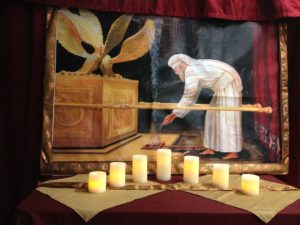
Psalm 141:2, Prayer…incense. The prayer of the righteous are as sweet smelling incense going up before the throne of Elohim (Rev 5:8; 8:3, 4),and is a form of praise and worship, and which this verse likens the evening sacrifice offered in the Tabernacle of Moses. This is the higher sacrificial system to which the Levitical system pointed, and which elsewhere Scripture calls the sacrifice of praise (Jer 33:11; Heb 13:15 cp. Ps 54:6). Thanksgiving to the Almighty is also an aspect of this higher sacrifice (Lev 7:12–13 cp. 2 Chron 29:31; Pss 107:22; 116:117; Jon 2:9; Heb 13:15). Worship, praise and thanksgiving should be the daily incense that the saints lift up before Elohim. Why is prayer a sacrifice? To take time out of our daily routines and away from the pursuits of life including making money, time with family and friends and doing the things we want is a sacrifice of our time and effort. It shows the Almighty not only our love and devotion, but faith in and dependence on him and thankfulness for all that he has given us. 


What is the “mother” of all sins?

Psalm 138:6, Lowly…humble. YHVH prefers the lowly (Isa 66:2; Matt 5:8; Jas 4:6; 1 Pet 5:5) and finds human pride to be abominable (Prov 6:16–17). Human pride is perhaps the mother of all sins. It prevents Elohim from working with a person, for a proud person is unable to see themselves as they really are, and fails to recognize their sinfulness and their need for a Redeemer, and thus is unable to come into alignment with commandments of Elohim that produce his character in a person, thus bringing the person into a spiritual relationship with Elohim. Pride prevents and destroys relationships between humans and between humans and Elohim. That’s why Elohim hates it so much. Humility brings a person closer to Elohim; pride keeps a person far from Elohim. 


Are YOU Saved? How do you know?

John 3:16, Everlasting life.

Salvation — What Is It and Do You Have It?

What is Salvation?

The dictionary defines the word salvation as “the deliverance from the power and effects of sin.” In a general sense, salvation is “preservation from harm, ruin or loss.” Relating the first definition, which is biblical in nature, to the second definition, which is generic in nature, we see that salvation is the deliverance or preservation from the power of sin, which causes harm, ruin or loss. Salvation and redemption are synonymous terms in biblical Hebraic thought. We will discuss the idea of redemption below.

So what is sin that it causes harm, ruin or loss, and what is being harmed or being lost such that we need deliverance? Very simply, Scripture (the Bible) defines sin as the violation of YHVH Elohim’s (the LORD God’s) Torah-laws (1 John 3:4). What is YHVH Elohim’s Torah-law? It is the instructions, precepts or teaching of YHVH as found in the first five books of the Bible, which can then be expanded to include the entire Bible or Word of YHVH. Man is commanded to live by every word found in Scripture (Deut 8:3; Matt 4:4). Man is to hear and do the Words of YHVH (Deut 6:4), place YHVH’s words in his heart (Deut 6:6), teach them to his children (Deut 6:7), and to make them the basis for all that he does and thinks (Deut 6:8). The words or laws of YHVH Elohim can be summed up as loving YHVH and loving one’s neighbor (Deut 6:5; Lev 19:18; Mark 12:30; John 14:15). The cornerstone of those laws is found in the well-known ten commandments as found in Exodus 20. They are…

  • I am YHVH your Elohim.
  • You shall have no other gods before me.
  • You shall not take my name in vain.
  • Remember the Sabbath day to keep it set-apart. 
  • Honor you father and mother.
  • You shall not murder.
  • You shall not commit adultery
  • You shall not steal.
  • You shall not lie.
  • You shall not covet your that which belongs to your neighbor.

The first five statements constitute loving YHVH Elohim, while the last five constitute loving one’s fellow man. These ten statements are but the beginning of YHVH’s laws as outlined in Scripture, which if man break, man is guilty of sin. There are 613 such laws in the Tanakh (Old Testament) and more than 1050 in the Testimony of Yeshua (New Testament). This may seem like a lot of laws for man to have to follow, but in reality, it is nothing compared to the hundreds of law books that constitute the laws of most nations on earth. Whole law libraries are established to contain them all!

Continue reading
 

The Courtyard Curtains and YOU

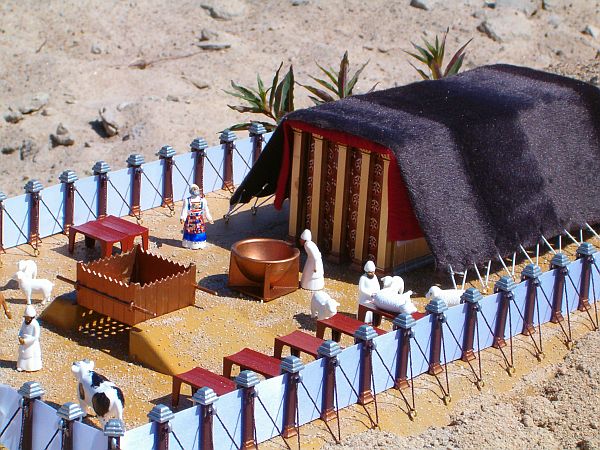
Exodus 27:9–19, Court of the tabernacle.The tabernacle’s outer court was approximately 150 feet long by 75 feet wide (or 11,250 square feet, which is about one-fourth of an acre) in size.

The curtains of the outer court (Exod 27:9–19) were made of fine white linen and was seven-and-a-half feet tall. The linen curtains speak of robes of righteousness the bride of Yeshua will wear on her wedding day (Rev 19:8).

Sixty pillars supported the outer curtain. They were set in heavy bronze (or brass) bases topped by silver capitals. These pillars represent redeemed humanity wearing robes of righteousness. Wood symbolizes humanity, while bronze symbolizes judgment against man because of sin, and silver represents redemption or Elohim’s ransom price for man’s sin.

The Outer Curtain in More Details. 

The outer curtain was approximately 150 feet long by 75 feet wide and seven and-a-half feet tall. The curtain was just tall enough so that a tall man could not look over the top and see inside. The curtain was made of fine-twined white linen which stood in stark contrast to the surrounding gray-brown drab desert surroundings. White linen represents robes of righteousness. The priests wore white linen robes (Exod 28:39–43) and the bride of Yeshua is expected to wear such garments (Rev 19:8). YHVH’s people are called a nation or kingdom of priests (Exod 19:6; 1 Pet 2:9; Rev 1:6; 5:10; 20:6). Men’s righteousness is as filthy rags (Isa 64:6) and our sins have separated us from Elohim (Isa 59:2), but YHVH has made provision for man’s sins to be washed away and for man to become white as wool or snow (Isa 1:18).

This curtain formed a barrier between man and Elohim, between the profane or polluted and the sacred and pure. The height of the curtain was just a little taller than a tall man to teach unsaved man that the way of salvation is not impossible for him to achieve, yet it is just beyond his reach, as well, without coming through the prescribed way—through the door of the curtain. The curtain was supported by 60 (6 x 10) pillars. Six is the number of man while ten represents ordinal perfection. The pillars were set in bronze bases and capped with silver capitals. Bronze represents Elohim’s judgment against man’s sin and silver represents redemption or sinners being redeemed from deserved judgment (Ezek 18:4; Rom 3:23; 6:23). Examples of bronze representing sin and judgment include the brass serpent on the pole in Numbers 21. This was a picture of Yeshua taking upon himself the judgment for man’s sins (John 3:14-17). The silver capitals represent the ransom price YHVH laid upon each of the children of Israel age 20 and upwards (Exod 30:11-16). The small amount of silver each Israelite paid for a ransom for their sins was but the minimum amount due on each person’s huge and impossible-to -pay sin debt charged on each man’s spiritual credit card. Thankfully, Yeshua redeemed each sinner not with gold or silver, but with his precious blood (1 Pet 1:18-19).

The ropes holding up the posts and pillars were made of goat hair. This is another picture of the redemptive sacrifice of Yeshua and of the price of man’s sin paid by his shed blood.

The outer curtain was white and luminescent from the light of the glory cloud; approximately seven-and-one-half feet tall so that an ordinary man could not peer over the top; the only access in was through the gate. This glowing curtain separated the bleak and drab wilderness outside from the paradise inside; darkness from light, profane from the set-apart (kadosh), death from life, confusion from order. The gate wasa four-colored woven tapestry representing the Person and work of Yeshua: purple for royalty or kingship, white for righteousness, blue for divinity or heaven and red for blood; Yeshua is the door of the tabernacle or sheepfold—he is the way to the Father, the way, life and truth; the gate was wide, but not tall­—just above the height of a tall man; it was the only way into the tabernacle.


Why are the willows weeping?

Psalm 137:2, Willows. This is the Hebrew word ârâba, which according to some lexical sources means “poplar” (e.g., The TWOT; Brown, Driver, Briggs), but according to others it refers to the willow tree (e.g., Gesenius, Wilson’s, Strong’s, All the Plants of the Bible, by Winifred Walker the renown plant artist).

Perhaps the trees in this verse were weeping willows, since the botanical name of the common weeping willow is Salix babylonica. Why is this? This is because this species of willow, which actually is native to dry areas of northern China, has been cultivated for millennia elsewhere in Asia, including in Babylon in the area Mesopotamia, since it was traded along the Silk Road to southwest Asia and Europe. 

However, the willow tree that is native to Babylonia that may be referred to in this verse, may not actually a willow (Salix babylonica), but a poplar (Populus euphratica). Both of these trees are in the family (Salicaceae) but are not the same species. The former is a willow (salix) and the latter is a poplar (populus) .

According to rabbinical Jewish commentary on this verse, the Jews hung their harps within the willow trees that grew along the river to conceal them from their captors (The ArtScroll Tanach Series Tehillim/Psalms Commentary). On the surface, this explanation doesn’t seem to make sense, since in the next verse, the very same captors are asking the Jews to play songs on these harps.

The same Jewish sages go on to explain that these ten-stringed harps or kinors were not ordinary musical instruments, but sacred ones used by the Levites in the temple service and were for praising YHVH (Ps 33:2). Before the Jewish exile, the people hadn’t treated these holy instruments with proper respect. But now, in exile, they repented of their sin, and instead of irreverently placing these instruments on the ground, they now hung them in the willow branches (ibid.).

As a way of reconciling the Jews’ hiding their harps and also playing them for their captives, the Jewish commentators suggest that Nebuchadnezzar, the same Babylonian king who had destroyed Jerusalem, would demand that the Jews entertain him musically with their harps. (In the ancient world, the Israelites may well have been famous for their skill at playing the harp—think of the young David, who was not only a skilled harpist, and became a poet and song writer as well.) The sages go on to explain that the Jews would hide their harps in the willow trees, so has not to have to play for the same heathen king who had destroyed their temple (ibid.)

Whether the trees mentioned in this verse were willows or poplars, and whether the rabbinic explanation of this psalm is correct or not, we don’t know. However, the spiritual lesson is clear. Don’t take for granted and treat irreverently those holy things that YHVH has entrusted to you, while times are good. If you do, you may live to regret your callous attitude when you suddenly find yourself in a not so pleasant situation in the midst of his refining fires of judgment. And don’t stop praising YHVH Elohim in both the good times and the bad. Perhaps if we do praise him when times are favorable for us, we won’t need to face his judgments unto repentance later on due to our lack of praising him.

 

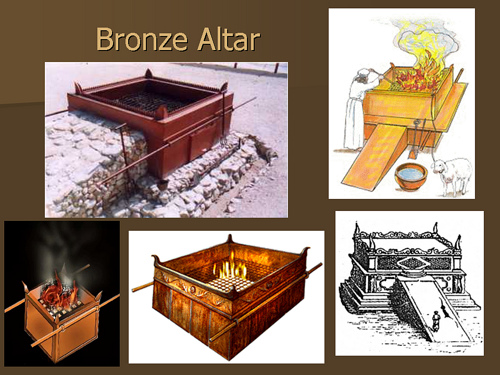
The Bronze Altar in the Tabernacle and YOU

Exodus 27:1–8, An altar. As we continue our tour of the Tabernacle of Moses, the Torah takes us next to the bronze altar of sacrifice just inside the tabernacle’s door. Everything occurring in the tabernacle revolved around this altar—EVERYTHING! This fact is highly significant, since this altar points to the “altar” of the cross on which Yeshua the Messiah died for our sins. This is one truth that the mainstream church has gotten wonderfully right: the cross and what happened there is the central point of the gospel message. One cannot read the writings of the apostles and fail to see this unless one is sadly spiritually naive and spiritually blind! 

Just inside the door of the tabernacle was the altar of sacrifice. It was made of acacia wood overlaid with bronze, which is a prophetic picture of Yeshua the Messiah bearing the judgment for men’s sins on the cross. The blood of the sacrifice was poured out on the ground at the base of the altar symbolically picturing Yeshua shedding his blood at the cross. Two lambs were offered at the altar morning and evening (Exod 29:38–42). This pictures our need to come humbly before our Father in heaven morning and evening in prayerful devotion as living sacrifices to confess our sins, to praise and thank him for saving us from the penalty of our sins, which is death (Ps 51:16–17; Heb 13:15; 1 John 1:7–9; Rom 6:23).

The Altar of Sacrifice in More Details. Upon understanding that the Person and work of Yeshua is the way into spiritual life, light and truth, one must also recognize that one’s sin liability keeps one from a having personal relationship with one’s Creator. The broken fellowship with our Father in heaven due to our uncleanness because of our sin is the reason for this. For one to have a relationship with a sinless, perfect, totally set-apart or holy Elohim,the sin problem has to be dealt with. Sin must be atoned for along with the resulting guilt, shame and penalty (i.e. death) that sin brings. In the Tabernacle of Moses, the liability and effect of sin is dealt with at the altar of the red heifer outside the gate of the tabernacle, which represents the work of Yeshua at the cross (Heb 13:10–13). There one was purified and made ready to come into the actual tabernacle. Upon doing so, the first thing one encountered when entering the tabernacle was the altar of sacrifice where both kosher animals and unleavened bread (made of the finest flour and the purest olive oil) were offered, and a wine libation was poured out twice daily (morning and afternoon, Num 28:1–8). These all picture the body of Yeshua being broken and slain for sinful man and our need to “eat” his body and “drink” his blood in a spiritual sense to which the communion elements of the Lord’s supper taken on the Passover during the seder meal symbolically point (John 6:35–58). 

Continue reading