What is the truth that will set you free?

John 8:32, Know the truth. “The truth shall make you free” is an often-quoted axiom, but few understand its deeper biblical implications. When Yeshua made this statement to Jews, what did he mean? To Yeshua what is truth? Two verses later, he mentions being a slave to sin. What is sin, and what does that have to do with truth? As many times as you’ve heard this axiom, have you heard anyone explain verse 32 in the larger context of Yeshua’s statement? We will now do so below.

We violate the sanctity of Scripture if we impose on it our own meanings. This is a cavalier and presumptuous approach to understanding the Bible and can hardly be called “rightly dividing the word of Elohim” (1 Tim 2:15).This practice often occurs with this verse. To do so is to twist the meaning of the Scriptures to fit our own human vicissitudes, agendas and biases. This is humanism and insults the mind, will and sovereignty of the Almighty as divinely revealed in his Holy Word. 

To properly understand this verse, we must look solely to the Bible for the keys to understanding it. We can start this process by first asking the question, what is truth? 

The Bible defines its own terms when it calls the Torah truth (Ps 119:142 and 151). The truth of Torah (i.e. the law of Moses) will set a person free, for when one hears and obeys the Torah, one ceases sinning (i.e. violating YHVH’s Torah-law; 1 John 3:4), and therefore doesn’t come under the penalty of the Torah-law’s judgment for breaking it, which the Bible calls sin and which leads (ultimately) to eternal death (Ezek 18:4; Rom 6:23). When one is not under the judgment of sin, one is free. With freedom comes life. 

Yeshua the Messiah himself is also the truth (John 14:6), for he is the Living Torah-Word of Elohim (John 1:1, 14). When we place our trusting faith in Yeshua and follow him, his spiritual life in the form of his Set-Apart Spirit will then flow through us and empower us to walk away from sin and follow the spiritual light of his Torah, which will keep us sin-free. This is the path that leads us toward the ultimate freedom from eternal death resulting in everlasting life (John 8:52). As such, sin will no longer have any legal claim on us, and thus we will not come into condemnation, but will pass from death into everlasting life (John 5:24). This is possible because Yeshua has taken upon himself our past sins (Rom 3:25), paid the legal penalty of them, and wiped our spiritual slate clean and has given us a fresh start in life (Gal 2:20; 1 Cor 5:17) to walk sin-free (in accordance with his standards of righteousness, which is the Torah). This is the result of knowing the truth and experiencing the freedom that comes therefrom. 

It’s astounding how so many people have been taught to believe the exact opposite of the truth—that the laws of Elohim will place you under bondage instead of setting you free!

Now that you have been set free from the traditions of men, which make of none effect the word of Elohim, you now have the freedom to understand the fuller, biblical meaning of Yeshua’s statement, “And you shall know the truth and it shall make you free.”


 

NathanTalks #7—To Young People: What’s Better Than Money, Success & Fun?

Society around us is telling us that all there is to life is to get a good education, pursue YOUR dreams, go into the corporate world, get your paid vacation and health care, climb the ladder of success, have fun, party, make lots of money and then retire at 50 of 55 and spend the rest of your life playing. Society is telling us that God is irrelevant, the Bible is a passé tale, family, marriage, and traditional values are for uneducated morons and that nothing else matters except to fulfill YOUR desires and wants. If what society is telling us is true, then why are more young people than ever lonely, empty, and committing suicide? Obviously something is wrong with this picture. In this talk, we discuss this issue and bring the wisdom of the ages to bear on this crucial topic.


What is “The Last Great Day of the Feast”?

John 7:37–41, On the last day. Haggai 2:1 is occurred on Hoshana Rabbah, the Last Great Day. In Haggai 2:7, the coming Messiah is referred to as the “Desire of All Nations,” and the prophet assures the Jews of his time that who were building the second temple, that though it was inferior in physical glory to Solomon’s Temple, it would experience a greater glory than even the previous temple. This is because the promised Messiah would be coming to that second temple.

Indeed, Yeshua come to the second temple and glorified it with his presence, but that temple is now long gone. The Testimony of Yeshua teaches us that the saints are now the temple of Elohim, since they are the temple of the Set-Apart Spirit (1 Cor 3:16; 2 Cor 6:16). The saints become that temple when the Spirit fell on them on the Day of Pentecost as recorded in Acts 2, and when the Spirit falls on and inhabits each saint subsequently. This is the glory of Elohim coming on individuals—Yeshua inhabiting the temple of his body. And this is only the beginning of the heavenly glory that the saints can hope to experience as 1 Cor 2:9 tells us, for a greater, and incomprehensible glory is yet coming to the overcoming saint (see also Isa 4:3–6 and 1 John 3:1–3).

In verse 37, Yeshua invites those who thirst spiritually to come to him. How thirsty are we for the spiritual waters of salvation that he has to offer? As Ps 118:24, the Hoshana Rabbah psalm, notes, we must cry out to the Messiah for salvation by declaring, “Hoshianah!” or “Save us now O Great One!” Similarly, we must come to the wells of salvation (Heb. Yeshua) and drink deeply (Isa 12:3) if we are to experience heaven’s blessing.

In verse 38, Yeshua declares that only those who believe in him will experience heaven’s outpouring of spiritual water for the thirsty soul. Each saint needs the glory of YHVH to fill his temple, so that the rivers of living water can flow out of us onto others. When we are baptized in the Set-Apart Spirit, our spiritual cup will be filled and will run over onto others, and we will become a river of life to those around us.

In verse 39, Yeshua explains that this river of life will flow once he has been glorified and the Spirit of Elohim has been poured out. Yeshua has been glorified and the Spirit poured out on the saints. This is what the second temple water pouring ceremony prophetically prefigured and hoped for—something that has already occurred. Therefore, at Sukkot, when we do the water pouring ceremony, we also need to realize that the Spirit has already been given. Therefore, it behooves the saint on the Last Great Day to present himself as an empty vessel to YHVH and let him fill us anew so that we can be a river of life to those around us.

Interestingly and related to verses 37 to 39, in verses 40 to 41, the gospel records that there was theological division and strife among the people pertaining the work and person of Yeshua. This juxtaposition of concepts implies that division and strife in the body of Yeshua prevents the outpouring of the Spirit. The glory of Elohim can’t fall on the body or temple of Yeshua’s body unless it is together in one place and in one accord as the saints were on the Day of Pentecost. This is a serious warning and a call for saints to put away strife and division and to come together in one accord, so that YHVH may glorify his temple by the outpouring of his Spirit thus empowering the saints to be a river of life to those around them.

John 7:37–38, On the last day. This was the last day of the seven-day long Sukkot (Feast of Tabernacles) celebration known as “the Last Great Day” (in Heb. Hoshana Rabbah). On this day, a joyous festival occurred called the Water Pouring Ceremony, where the Jews prayed for rain for the upcoming agricultural season resulting in a bountiful harvest. These rains were referred to as the former (fall) and latter (spring) rains, and were necessary to bring the crops to fruition. The Jewish people also believed that these rains were prophetic of a great outpouring of the Set-Apart Spirit that would occur during the Messianic Age (or Millennium), to which Sukkot was a prophetic allusion resulting in a great harvest of souls (again relating to the fall harvest season during which the feast of Sukkot occurred each year). During the Water Pouring Ceremony, the Jews would joyously sing Isaiah 12:2.

Behold, God (Heb. El) is my salvation [Heb. Yeshua]; I will trust, and not be afraid: for the LORD [Heb. Yah] JEHOVAH [Heb. Yehovah] is my strength and my song; he also is become my salvation [Heb. Yeshua].

Here, in typical Jewish poetic style using encrypted Hebraisms, Yeshua is claiming to be deity and the Messiah, and to be source of salvation or living waters without overtly saying it.


Can you buy your redemption through charitable giving?

Exodus 30:15 and 16, To make atonement for your souls. Some will read these verses and conclude that one can buy their redemption through charitable giving and therefore circumvent the need to place one’s faith in Yeshua’s atoning death on the cross. Does this passage suggest a theology where man can save himself from his sins by acts of charity? Let’s dig a little deeper to see what these verses are really teaching us.

In this passage, YHVH instructed the Israelites to pay an annual half-shekel temple tax. This money went, in part, toward, the service (verse 16) and constructing of the Tabernacle of Moses (e.g. Keil and Delitzsch Commentary on the OT, vol. 1, p. 459; Exod. 38:21–31), and later toward the purchase of the animals the priests sacrificed (The Temple and Its Service, by Alfred Edersheim, p. 48). In this way, the people were participating vicariously in the act of sacrificing an innocent animal as an offering or atonement for their sins. Again, the Scriptures reveal that this sacrificial system merely pointed prophetically toward the Greater Sacrifice that would come later in the Person of Yeshua, the Redeemer of Israel. (Read Isa 53.) On the point that the paying the half-shekel was a merely a temporary solution to the problem of man’s sin, Keil and Delitzsch say in their commentary on this passage,

As an expiation [atonement] for souls, it pointed to the unholiness of Israel’s nature, and reminded the people continually, that by nature it was alienated from God, and could only remain in covenant with the Lord and live in His kingdom on the ground of His grace, which covered its sin (ibid.)

Keil and Delitzsch’s point is further strengthened in Exodus 30:16, which says,

And you shall take the atonement money of the children of Israel, and shall appoint it for the service of the tabernacle of the congregation; that it may be a memorial unto the children of Israel before YHVH, to make an atonement for your souls. (emphasis added; ibid.)

The giving of the half-shekel was a memorial to what? The Hebrew word for memorial is zikrown (Strong’s H2146) meaning “reminder, token, record.” According to The TWOT, a zikrown is an object or act which brings something else to mind or which represents something else. It reminded them of their sinfulness and pointed prophetically to a Redeemer—Yeshua the Messiah— who would come and take away their sins once and for all (Heb 10:10). For a more detailed study of this subject, please see our teaching article entitled, “The Atonement: Bloody or Bloodless? Understanding the Concept of Atonement in the Torah” located on the Hoshana Rabbah website at http://www.hoshanarabbah.org/pdfs/atone.pdf.


Are Humans Created Equal?

Exodus 30:15, Rich…poor. 

This passage teaches the equality of all believers. In YHVH’s eyes, each redeemed Israelite saints are equal. To the Creator of all things and who owns everything, no one is worth more than a half-shekel, and no one is worth less than a half shekel. The rich aren’t better than the poor and vice versa. This is also the moral of Yeshua’s Parable of Lazurus and the Rich Man (Luke 16:19–21). Contrary to what many Christians have been taught, this parable isn’t a doctrinal statement about the state of the dead and the afterlife. To many people, including the rich Scribes and Pharisees of Yeshua’s day, material success denotes superiority and even divine favor. The Bible dispels this false notion. YHVH looks at the heart and character of a person and the righteous fruits of their lives, and not at the outward, physical trappings—the proverbial cover of the book. The Scriptures address this issue in several places:

Judge not according to the appearance, but judge righteous judgment. (John 7:24)

A good tree cannot bring forth evil fruit, neither can a corrupt tree bring forth good fruit.

Every tree that bringeth not forth good fruit is hewn down, and cast into the fire. Wherefore by their fruits ye shall know them. (Matt 7:19–20)

But YHVH said unto Samuel, Look not on his countenance, or on the height of his stature; because I have refused him: for YHVH seeth not as man seeth; for man looketh on the outward appearance, but YHVH looketh on the heart. (1 Sam 16:7)

Now the Torah and the rest of the Scriptures teach that all the saints are equal. But what about the rest of humanity? Are all humans created equal?

There are many ways to look at this equality issue. But let’s see what the Bible teaches.

The Bible states in several places that all humans are created in the image of Elohim. This implies equality among all humans.

The Bible also states that all humans are sinners, that all deserve death and that none are righteous of themselves. This also implies equality.

The Bible states that Elohim so loved all the world that he sent his Son to die for all humanity. This implies equality among humans.

The Bible also state that Elohim loved us while we were still sinners. This implies equality among all humans.

Elohim desires all humans to be saved. This also implies equality among humans.

The Bible furthermore states that Elohim isn’t a respecter of persons. This implies equality among humans.

The Bible teaches that there is one Torah-law standard of righteousness for all people—Israelites and non-Israelites. This implies equality.

Moreover, the Bible states that Elohim will judge all humans by that law. All humans will come before his judgment seat. Thus all are equal before the law and before the Judge of the universe.

Conversely, there is no question that the Bible teaches that Elohim favors those who love and serve him. He favors them with a special love and enters into a personal relationship with them. He blesses then in a special way (salvation, healing, answered prayers, special protection, guidance, wisdom the Set-Apart Spirit, etc.) and eventually will reward them with eternal life, glorification and inclusion into his eternal kingdom as his adopted children. So in this sense, Elohim starts out loving and treating everyone equally, but those who choose to love and obey him he favors them and extends his grace to them. In this case, not everyone is treated equally. But this is not based on favoritism on YHVH’s part, but upon the choices that humans make with regard to his initial equal treatment of all. In the end, all humans will reap what they sow. If they obey Elohim they will be blessed with immortality. If they disobey him, with eternal death.

Even though all humans are created equal by Elohim and will stand equal before him, the Bible in no way promotes the idea of economic equality among humans as socialism advocates. But this is another discussion for another time.


Blog Scripture Readings for 3-8 Through 3-14-20

Aside

Parashat Ki Tisa — Exodus 30:11 – 34:35
Haftarah — 1 Kings 18:1-39 | Ezekiel 36:16-38**
Prophets — 2 Kings 19:1 – 25:30
Writings — Proverbs 1:1 – 7:27
Testimony — John 7:1 – 9:41

Our new annual Scripture Reading Schedule for 2019-2020 with daily readings is available to download and print. If you are still working through 2018-2019’s Scripture Reading Schedule, the link will still be available on the right sidebar under “Helpful Links”. If you are using a mobile device or tablet, the link may be below, meaning you’ll need to scroll down instead.

Most of this week’s blog discussion points will be on these passages. If you have general comments or questions on the weekly Scripture readings not addressed in a blog post, here’s a place for you to post those. Just use the “leave a reply” link or the “share your thoughts” box below.

The full “Read Through The Scriptures In A Year” schedule, broken down by each day, can be found on the right sidebar under “Helpful Links.” There are 4 sections of scripture to read each day: one each from the Torah, the Prophets, the Writings, and from the Testimony of Yeshua. Each week, the Torah and haftarah readings will follow the traditional one-year reading cycle.

** A different Haftarah is read when it is a special sabbath in Jewish tradition. This week it is Shabbat Parah on the traditional calendar with a special reading. Otherwise, 1 Kings 18:1-39 would be read.

Weekly Blog Scripture Readings for 3/8 through 3/14/2020.


“Eat my flesh and drink my blood” Meaning

John 6:54, Flesh…blood. “Eats flesh and drinks my blood” is not some ribald admonition on the part of Yeshua to involve themselves in cannibalism, as I have heard some biblically naive and ignorant people claim. What did Yeshua really mean when he made this statement? 

This phrase, in fact, is merely a Hebrew idiom or metaphor meaning “the whole person” (see Matt 16:17; 1 Cor 15:50; Gal 1:6; Eph 6:12; Heb 2:14). This relates to Moses’ instructions that “man shall not live by bread alone…but by every word that proceeds from the mouth of YHVH” (Deut 8:3). This applies to Yeshua who was that Word of Elohim who “became flesh and dwelt among us” (John 1:1 and 14).

When one puts their faith in Yeshua (John 6:29 and 5:24), then one must also believe him—that is, not only accept him as the Son of Elohim and one’s Savior, but also follow and obey (or “eat”) him who is the Living Manna-Word of Elohim from heaven.

This involves believing his words by loving him and keeping his Torah-commands (John 14:15, 23 cp. Exod 20:6), which are his literal words.

This is why YHVH instructed the Israelites to eat the whole Passover lamb, and to leave nothing left over (Exod 12:10).

This teaches us that we are to “eat” all of Yeshua—his whole Person as represented by the bread and the wine at communion on Passover. We are to accept the totality of his Word, not just the parts that suit us, or fit with our conventional religious viewpoints as per the traditions of men.

Many believers claim “to eat” all of Yeshua’s flesh and drink all of his blood, yet through their anti-Torah theologies they rip pages out of their Bibles and toss many of YHVH’s biblical instructions and commands into the spiritual trash can claiming these were for the Jews and not for Christians.

Sadly, this is exactly what Adam and Eve did when they listened to the serpent’s lies at the tree of knowledge and rebelled against YHVH’s clear commands. The devil deceived them into take a pick-and-choose approach to the Word of Elohim. This was the first sin that humans committed.

The Bible defines sin as violating the words, commands or Torah of Elohim (1 John 3:4). It is also a sin not to believe in Yeshua (John 16:9; 3:18–19) who is the Living Torah-Word of Elohim incarnate. It is also sin to act in unrighteousness (1 John 5:17). The Bible defines unrighteousness as violating YHVH’s Torah commands (Ps 119:172), which are the words of Yeshua.

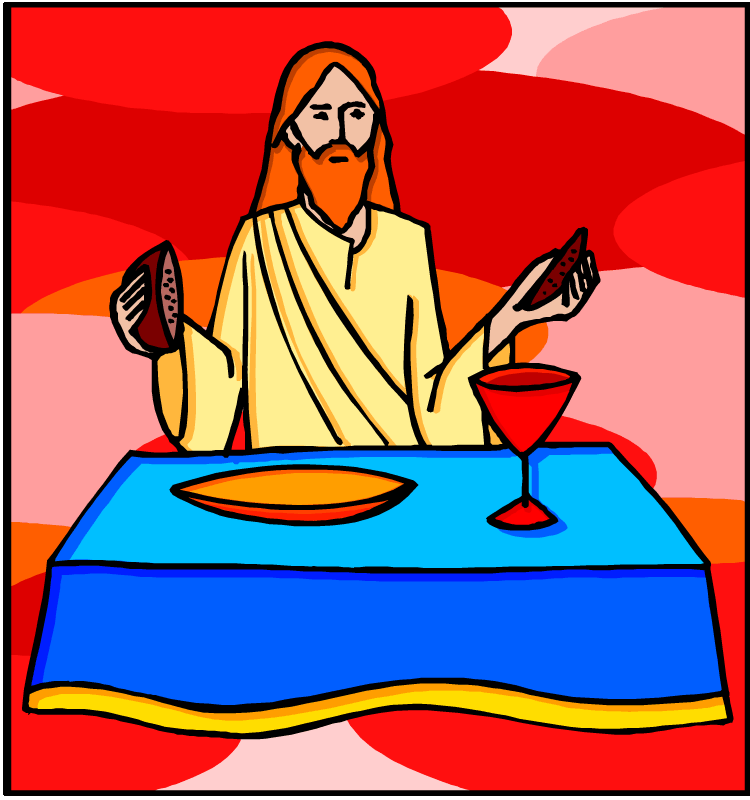
In summary, when we accept all of Yeshua by eating his flesh and drinking his blood, (i.e. partaking of the bread and wine at communion) we are confessing that we accept the totality of who he was and is. If we fail to believe and obey all of his words, then to the degree that we do so we are walking in sin, don’t love him and don’t even know him (1 John 2:3–4).