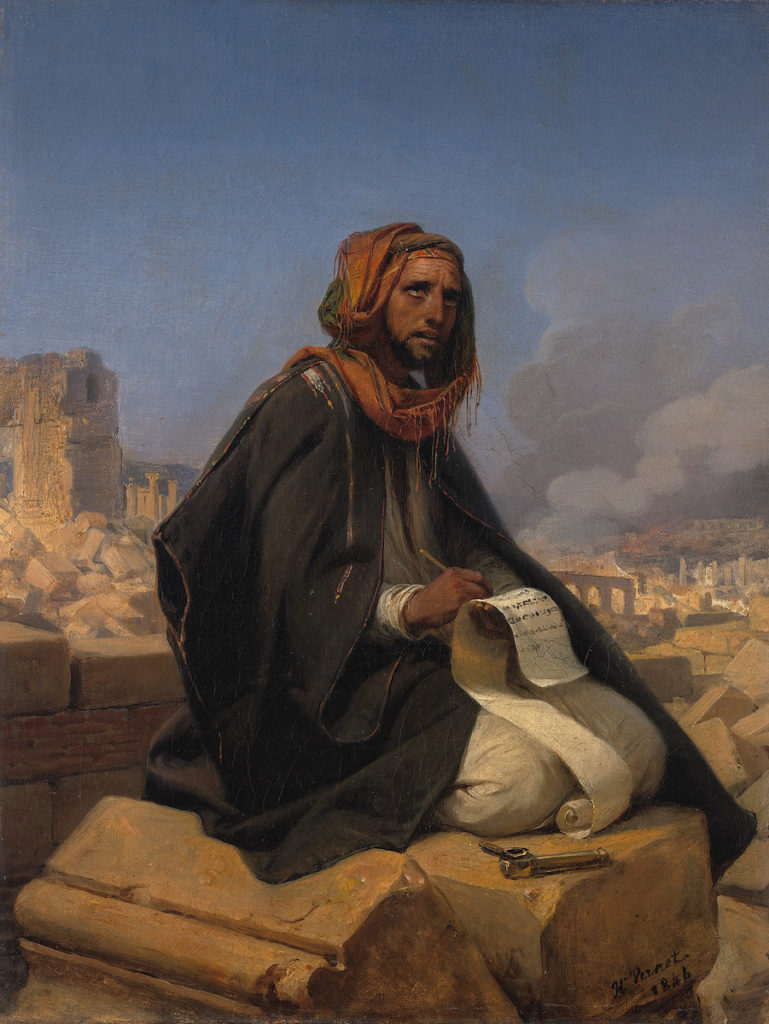
Jeremiah the prophet received a direct call from YHVH Elohim to warn the nation of Judah, YHVH’s people, of impending judgment if they would not repent and return to his Torah. YHVH commissioned the prophet to warn and to rebuke those at all levels of society: kings, princes, priests and people (1:18). Is it likely that YHVH will raise up a prophet or prophets in the last days prior to the return of Yeshua the Messiah who will be doing the same thing as Jeremiah?
Jeremiah did not feel adequate to the job (1:6), yet YHVH assured him that he was, for YHVH personally had called and empowered him to do what seemed to be an impossible task: for one man, as YHVH’s representative, to set his face against an entire nation and to survive the resulting wrath of the wicked against that righteous man of YHVH (1:7–10; 18–19).
In the end times, will there yet arise true prophets in which the Word of YHVH is shut up like fire in their bones (Jer 20:9) who will utter forth the fiery oracles of YHVH, which like a hammer will smash to pieces the rock-hard hearts of YHVH’s obstinate, rebellious and sinful people (Jer 23:29)?
Yeshua prophesied that in the last days false prophets would arise, and if possible, would deceive the very elect (Matt 24:11, 24). If Satan the adversary has his false prophets on the scene just prior to Yeshua’s return attempting to deceive YHVH’s people, will not YHVH have his true prophets likewise on the scene to warn, rebuke, provoke, incite, encourage, and give spiritual direction to his people?
Some Christian teachers through their unbiblical teachings on the subject of prophets and prophecy are inoculating YHVH’s people against believing that Jeremiah-type prophets will arise in the last days. It is taught that during the New Testament dispensation until the second coming the character and ministry of the prophets is totally different than those during Old Testament times. Since we are living during the so-called age of grace, these teachers reason, YHVH’s prophets now speak only words of edification, exhortation and comfort, and any modern prophets who warn, rebuke, judge, call YHVH’s people to repentance, or otherwise speak in harsh, black and white terms could not be sent of YHVH, for that type of prophet is a thing of the past. They tell us that such a prophet brings strife, division, and disharmony within the church, makes people feel uncomfortable in their sin and therefore cannot receive the church system’s stamp of approval. Is it reasonable to assume that YHVH will limit himself and the going forth of his Word to the constraints of these soft-shoe teachers?
Leviticus 25, in part, lays out Israel’s social welfare and economic system. Basically, it was a free market capitalistic economic system where private individuals owned property and small businesses and controlled the means and productions of goods and services, and the central government’s involvement in the lives of people was minimal. This is not the case in a purely socialistic (a Marxist or communistic) economic system where the government owns much or most of the property and controls, to one degree or another, the means and distribution of goods and services, and where government regulation of people’s lives is tremendous. The capitalistic system that YHVH gave to Israel, however, contained some quasi-socialistic checks and balances in that greedy or even exceptionally gifted and ambitious individuals couldn’t become excessively rich at the expense of the poor.
Socialistic economic philosophy demands that the wealth of the nation be equally distributed among everyone including the poor. This may sound good in theory, but it doesn’t work. In reality, socialism stifles individual initiative by punishing (often through taxation and other means of wealth confiscation and redistribution by the government) those who, through hard work, sacrifice, initiative, and inventiveness have become wealthy. So, it stands to reason, why should the wealthy work hard if the fruits of their labors will only be confiscated and be given to the poor or the “have nots, ” or to those who refuse to work?
At the same time, capitalism is also a flawed system, since in time, the wealthy often end up owning much of the land and control most of the wealth. Human nature being what it is, the greedy wealthy will turn a capitalistic system into oligarchic capitalism where only a few rich capitalists control nearly everything including the economic and political systems. This is the end times system that is described in Revelation 13 and 18 and is called Babylon the Great. Such a system ends up enslaving people through economic and political means, thus creating a veritable feudalistic-type serfdom where rich and powerful business oligarchs who control the government are the new nobility (see Rev 18:13, 23).
With these things in mind, as you are reading through chapter 25, notice how YHVH instructed the poor to be cared for. There was no government welfare system based on taxing the producers and giving to the non-producers. Everyone worked for their living. In fact, the Torah commands everyone to work for six days, and then to rest on the seventh day (Exod 20:9). Sloth and laziness weren’t optons. Even the extremely impoverished were expected to harvest food from the agricultural fields. At the same time, those who owned the fields were to leave the corners of their fields unharvested and not to glean their fields, so the poor would have something to harvest (Lev 23:22; the Book of Ruth). In the Testimony of Yeshua, fathers were expected to provide for their households. Those who didn’t were considered worse than heathens (1 Tim 5:8). Similarly, widows under the age of 60 were expected to support themselves through their own work, while those over the age of 60 could be supported by the local church, but they had to recompense the church through acts of service (1 Tim 5:9–14). Once again, the Bible in no way allows for or promotes a system of government handouts. Except in rare situations, everyone was expected to work.
In this chapter, we also see how the Bible handles the issue of debt, and how it requires people to work to pay off their debts. Bankruptcy wasn’t an option. The Torah allows those in debt to sell themselves into servitude to their debtors through a system called bond service. The debtor would work for the lender until the debts were paid and at the end of seven years all remaining unpaid debts had to be forgiven. This system taught fiscal responsibility to debtors, yet at the same time, it required lenders to show mercy and grace to the poor. Again, the Bible in no way promotes a system of government welfare handouts. Everyone had to work. If you didn’t work, you didn’t eat (2 Thess 3:10). Only the extremely poor who were unable to make a living (e.g. widows and orphans) were cared from the public coffers (Deut 14:28–29; 26:12–13). The Levites were care for publicly as remuneration for caring for and teaching the people spiritually. They also worked as farmers and tradesmen.
Notice how the jubilee year prevented the wealthy from acquiring all the land, and how every 50 years there was a redistribution of land, so that those who through sloth, mismanagement of their resources, or through unfortunate circumstances lost their land could get their land back. Such individuals were mercifully given a second chance to start over again and to learn from their past mistakes. Lending to the poor was encouraged, and the charging of interest to them was prohibited.
As you read through this chapter, consider how YHVH deals with the perennial social and economic ills that have plagued the world from time immemorial compared to how men currently deal with these same problems, and usually end up making matters worse.
Though it would be difficult to implement such a system in our highly collectivized and industrialized society of today, it is likely that in the future, during the Millennium, when the Torah will be the rule of the earth and an agrarian society will likely be the dominant economic paradigm, that such a Torah-based system will once again be put in place.
Leviticus 25:2, When you come into the land. TheStone Edition Chumash, translates Leviticus 25:2(b) as follows, “When you come into the land that I give you the land shall observe a Sabbath rest for [YHVH].” Note the emphasized portion. Though the Jewish sages say this does not imply that YHVH rests, it acknowledges the fact that as YHVH “rested” after his creation of the world, so too Israel was to rest in the seventh year from its agricultural work (an activity that allows the created [i.e. humans] to share with the Creator in the act of creation) to commemorate Elohim’s act of creation (The ArtScroll Rashi Leviticus, p. 318). The Jewish sages also note that the comparison between the jubilee and the Sabbath is that both bear testimony to Elohim’s creation of the universe in six days and his rest on the seventh. They further note that the seven years of the shemittah (sabbath year) cycle allude to the six thousand years of history that will be climaxed by the seventh millennium, which will be a period of peace and tranquility (TheArtScroll Stone Edition Chumash, p. 697).
Note how everything ancient Israel did in their day-to-day life brought them into worshipful relationship with their Creator by causing them to recall both what he had done for them (past tense) and what he would do for them prophetically (future tense).
Leviticus 25:4, A sabbath of rest unto the land.The land sabbath teaches us that our means of producing an income belong entirely to YHVH. He gives us life, breath, land, health, eyesight, physical and mental abilities and everything else that we need to survive. Now imagine losing, say, your health or your eyesight? Or due to an illness, suppose through a stroke or an injury to the head, you became mentally impaired. Where would you be financially? We belong to YHVH and he gives us everything we need with which to work our land, do our job, raise our family, educate ourselves, and to exist. Are we as grateful to him as we should be?
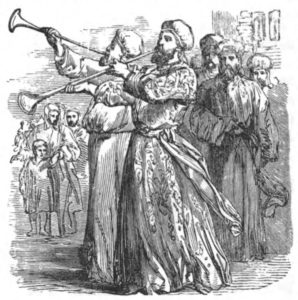
Leviticus 25:9, Jubilee. The word jubilee is the Hebrew word yovel (KcUh) meaning “ram’s horn trumpet.” The ram’s horn would be sounded at special events as a proclamation of great joy and jubilation such as would be the case at the commencement of the Jubilee Year when all debts were forgiven, all indentured servants were set free, all land was returned to its original owners, and all agricultural activity ceased for a year of rest. The arrival of the Jubilee Year was announced on Yom Kippur (Day of Atonement) with the blast of a shofar called the shofar hagadol or the great or final shofar blast (to be distinguished from the first and second shofar blasts that occur on the feasts of Shavuot (Pentecost) and Yom Teruah (Day of Trumpets or Shofar Blowing or Shouting) respectively. This same event prophetically corresponds with the return of the exiles (the “lost ten tribes”) to the land of Israel (which is an aspect of what the Jewish sages call the “final redemption”) and the return of Yeshua the Messiah.
Our new annual Scripture Reading Schedule for 2019-2020 with daily readings is available to download and print. If you are still working through 2018-2019’s Scripture Reading Schedule, the link will still be available on the right sidebar under “Helpful Links”. If you are using a mobile device or tablet, the link may be below, meaning you’ll need to scroll down instead.
Most of this week’s blog discussion points will be on these passages. If you have general comments or questions on the weekly Scripture readings not addressed in a blog post, here’s a place for you to post those. Just use the “leave a reply” link or the “share your thoughts” box below.
The full “Read Through The Scriptures In A Year” schedule, broken down by each day, can be found on the right sidebar under “Helpful Links.” There are 4 sections of scripture to read each day: one each from the Torah, the Prophets, the Writings, and from the Testimony of Yeshua. Each week, the Torah and haftarah readings will follow the traditional one-year reading cycle.
Weekly Blog Scripture Readings for 5/10 through 5/16/2020.
Leviticus 24 is one complete thought. The next thought begins with “And YHVH spoke to Moses in Mount Sinai saying…” in chapter 25. Caring for the tabernacle’s menorah, the 12 loaves of show bread and dealing with a blasphemer upon closer analysis aren’t three disparate and unrelated subjects, but indicate a continuum of thought that eventually relates to the modern mainstream church. Let’s see how.
Leviticus 24 is divided into three subsections: caring for the menorah, baking and placing the show bread, and punishment for the blasphemer. Each new section begins with the Hebrew word vav meaning “and,” which expresses a new thought, but is also a continuation of the previous thought. What do these three sections have to do with each other?
The menorah is a spiritual picture of Yeshua and the redeemed believer. It is also a prophetic picture of Yeshua who is the tree of life to which each redeemed Israelite is attached and draws his spiritual sustenance through the Spirit of Elohim. (Yeshua is the vine and the saints are his branches, John 15:1.) The gold in the menorah represents pure, godly character of righteousness. A menorah produces heat and light through its flame. Light represents the fruit of the Spirit of Elohim, and heat represents the power of the gifts of the Spirit. This is how a saint reaches the world: he is a light in the darkness around him and lets his light shine through the fruit of the spirit, and then reaches the world through the supernatural power gifts of the Spirit. The menorah also represents the Feast of Weeks or Shavuot when YHVH gave his people his Torah instructions in righteousness, and then latter wrote his Torah on their hearts by his Spirit in Acts chapter two on the day of Pentecost.
The show bread is a picture of redeemed Israel (the twelve tribes) bringing the bread of life, the Word of Elohim, to the world. The bread was covered in frankincense representing the prayers of the saints not only praising YHVH, but interceding for those who are spiritually lost.
The death of the young blasphemer is what happens when parents don’t raise their children correctly by reaching out to them with the truth of Torah—they blaspheme Elohim and are killed in judgment. Perhaps the Israelite woman had married an Egyptian who was not a believer in Elohim and the Torah and thus she was unequally yoked with a heathen unbeliever. Perhaps they were both followers of Elohim, but they raised their child incorrectly by not teaching him the lover and fear of Elohim—giving him the spiritual bread of life (represented by the table of showbread). Either way, the Israelite woman (a picture of the church) was not discipling her child in the word of Elohim and not being a spiritual light to him (represented by the menorah) and she lost her child because of it. How many redeemed believers (and church leaders) spiritually abort their children because they didn’t properly disciple or raise them in the Torah-Word of Elohim?
Leviticus 23:2, Feasts. These feast (moedim) days are set-apart times for YHVH’s consecrated people. They are divine appointments between the Creator of the Universe and his called-out ones. Furthermore, they are love feasts (Jude 12) between YHVH-Yeshua and his bride, the saints of the Most High Elohim. The seven feasts of YHVH are also the perfect seven-step divine plan showing how YHVH-Yeshua will redeem his backslid people Israel, his adulterous bride, back to himself. These days are the embodiment of the gospel (the good news) message of the coming marriage between Yeshua and his bride and the establishment of his kingdom upon this earth in a full and universal sense! We show our belief, faith, love, anticipation and obedience to him by walking them out.
To not set aside time for YHVH feasts from one’s secular schedule is to ignore the call of the Bridegroom, Yeshua, for us to go out to meet him. It is to deprive oneself of the joys of communing with the Set-Apart (Kadosh) One of Israel in this special and set-apart way. It is to disregard and treat as common and profane the consecrated times that YHVH established for him and his people to come together. It is to disregard the covenants, the national constitution and marriage agreement between YHVH and his people—redeemed Israelite believers who have been grafted in to the olive tree of Israel through a relationship with Yeshua, the Messiah, the Anointed Sent One of Israel (Rom 11:13–24; Eph 2:11–19). To disregard YHVH’s feast days is to show disregard for his Torah-commands—his precepts, teachings and instructions in righteousness. To do this is to violate his commandments, which is sin (1 John 3:4)!
So what’s keeping you from celebrating YHVH’s feasts?
Leviticus 23:2,My feasts [Heb. moedim]. YHVH calls these feasts his feasts. They’re not men’s feasts or the Jewish feasts! They came from YHVH and belong to him. When men pervert YHVH’s feasts by mixing in pagan traditions, they’re no longer YHVH’s feasts, but men’s feasts (e.g. Isa 1:13–15; Amos 5:21; Hos 2:11). When men pollute his feasts and appointed times, YHVH says that he hates them because they’re no longer his feasts (Isa 1:14–15).
In Ezekiel 20, we see that YHVH’s feasts (or sabbaths) are a covenantal sign between YHVH and his people (Ezek 20:12) that they were to live by (Ezek 20:11), yet which Israel, in rebellion, refused to do while in the wilderness. Instead they defiled his sabbaths by, presumably, not doing them and doing other things on those holy days (Ezek 20:13). Israel’s rebellion against YHVH with regard to their refusal to keep his sabbaths brought upon them YHVH’s judgments (Ezek 20:13). In other words, it was YHVH’s will for the Israelites to keep his sabbaths in the wilderness, but because of their idolatrous rebellion, they refused to do so.
In fact, YHVH calls refusing to observe his sabbaths idolatry and for this sin (along with other sins), the Israelites had to wander in the wilderness for forty years (Ezek 20:15–16). In profaning his sabbaths, YHVH accuses the Israelites of despising his Torah (Ezek 20:16).
YHVH then goes on to urge his people to not follow the example of their rebellious forefathers, but rather to walk in all of his Torah commands (including his sabbaths, Ezek 20:18–20). Because of their profaning his sabbaths, he punished them by scattering them in exile among the heathens. Those modern saints who refuse to keep YHVH’s Sabbath and feasts are walking in the same sin as the ancient Israelites.
Often people who refuse to keep YHVH’s feast days holy do so because the feasts conflict with their secular activities (such as their jobs). YHVH calls this idolatry and being like the heathen (Ezek 20:30, 32).
In the end times, YHVH is going to separate his people out from the heathen and bring them back into covenantal agreement with him including obedience to his sabbaths (Ezek 20:33–38). He will purge from his people those rebels who refuse to obey him including keeping his sabbaths (Ezek 20:38), which are a sign of his covenantal relationship with them.
In Genesis chapter one when Elohim created the sun and moon, he called the former “the greater light” and the latter “the lesser light” (Gen 1:16). The former rules the day and the lesser rules the night (ibib.). This is prophetic of the role of Yeshua and the saints in the world.
Yeshua the Messiah is the Light of the world (John 1:6–9; 8:12; 9:5) or the Sun of Righteousness (Mal 4:2) or the Greater Light to show man the path of spiritual light in the darkness of this world. The saints are like the moon or the lesser light that reflects the light of the sun or the greater light into the darkness of this world. Yeshua shines his spiritual light onto his disciples who then take that light and evangelize those lost in spiritual darkness with the message of the gospel. This is the great commission!
The biblical feasts are calculated based on the lunations of the moon. The seven biblical holidays speak of YHVH’s plan of salvation to show man the way to Yeshua who is the Greater Spiritual Light as represented by the sun. The feasts are like a tract or sermon by which the saints preach the gospel message of salvation to the world. The saints as the lesser light reflecting the message of salvation through Yeshua the Greater Light into the darkness of this world through their adherence to the biblical feasts. This is one reason why the moon—the lesser light—is so pivotal to YHVH’s calendar and feasts.
The traditional calendar currently used by the non-believing, rabbinic Jews is off; it’s not in accordance with the moon though the Jews erroneously purport it to be. At the same time, they’re not bringing the gospel message of Yeshua to the world—only the doctrines of men and men’s traditions. Their whole message is askew and fails to reflect the Greater Light of Yeshua.
Similarly, the mainstream church tries to preach the gospel, but without understanding the moon, feasts and biblical calendar their message of the gospel is only a partial one and is also off spiritually.
A time may come in the future when the calendar and feasts will go strictly off the sun and not the moon. This may occur when there is a new heaven and a new earth when Yeshua is ruling on this earth and he will be the only Light of the world. That time isn’t yet, though, for it’s still the saints’ job as the lesser light to be like the moon to reflect the truth of Yeshua, the Greater Light, to this world through a lunar-based calendar upon which the biblical feasts are based.