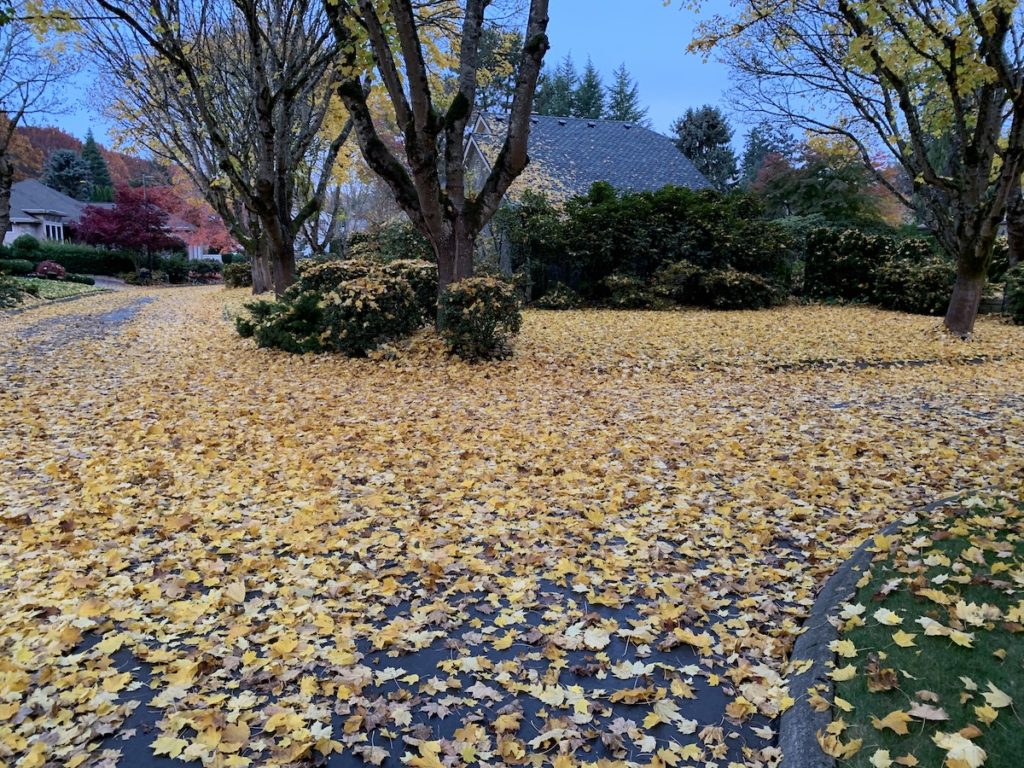
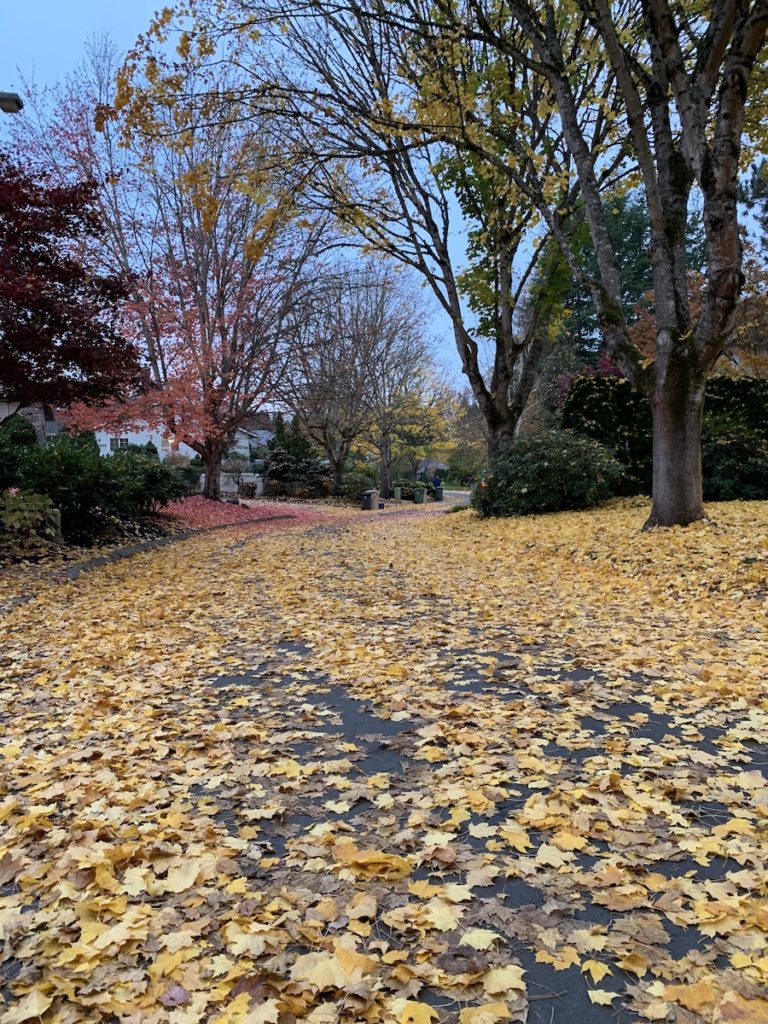
This side of the biblical New Jerusalem’s heaven on earth, this may be the closest thing to ever seeing streets of gold (Rev 21:21)! This is a neighborhood where nearly all the residents are clients of my tree service.Please savor the Creator’s handiwork during this most beautiful time of the year.
Our new annual Scripture Reading Schedule for 2020-2021 with daily readings that began on 10/11/20 is now available to download and print. The link to the previous 2019-2020’s Scripture Reading Schedule will still be available on the right sidebar under “Helpful Links” into next year. If you are using a mobile device or tablet, the link may be below, meaning you’ll need to scroll down instead.
Most of this week’s blog discussion points will be on these passages. If you have general comments or questions on the weekly Scripture readings not addressed in a blog post, here’s a place for you to post those. Just use the “leave a reply” link or the “share your thoughts” box below.
The full “Read Through The Scriptures In A Year” schedule, broken down by each day, can be found on the right sidebar under “Helpful Links.” There are 4 sections of scripture to read each day: one each from the Torah, the Prophets, the Writings, and from the Testimony of Yeshua. Each week, the Torah and haftarah readings will follow the traditional one-year reading cycle.
Weekly Blog Scripture Readings for 11/8 through 11/14/2020.
As I stand on the high ground of the Rock of Elohim and view with alarm the demonic spirit of Antichrist rising like a black tsunami tide all around me, I am confronted both with the instinctive urges of fight and of flight. Part of me wants to escape this chaos, and part of me wants to fight it. At the same time, I hear the words of Yeshua ringing in my ears: “Occupy till I come.” Also coming into my spirit are all of the other Bible verses that talk about overcoming evil and standing against it. So unless or until YHVH instructs me to flee and tells me where to go, I have no choice but to fight. But how? As I ponder this question and search the Scriptures for answers, below are some more revelations on this issue.
1 Chronicles 16:5, Asaph…made music. Praise and Worship Music—The Prophetic Anointing and a Battle Weapon. Asaph was a Levite (v. 4) from the lineage of Gershon (1 Chron 6:39, 43), who ministered musically before the ark of the covenant (a symbolic picture of the throne room of Elohim; see Rev 11:9) foe the purpose of offering thanksgiving and praise to YHVH Elohim (1 Chron 16:4). Like David, he was musically gifted and prophetic psalmist and musical composer; he wrote 12 psalms (Psalms 50 and 73–83). Aspah was one of David’s prophets (2 Chron 35:15) and the father of lineage of Levite minstrels who prophesied through or with the aid of music (1 Chron 25:1, 2, 5).
Elsewhere, Scripture reveals that sometimes when musicians played, the hand of Elohim would come upon those with prophetic gifts and divine revelation would come forth (2 Kgs 3:15; 1 Sam 10:5).
Music also calmed the nerves of those who were tormented demonically because the evil spirit would flee when praise and worship occurred. This was the case when David played his harp for Saul (1 Sam 16:23).
The sons of Asaph also used music as a warfare weapon to defeat Israel’s foes by sending confusion into the camp of their enemies resulting in self-inflicted murder and mayhem (2 Chron 20).
From these examples, we see from Scripture that praise and worship not only brings on the anointing of Elohim, but can also be a vehicle for prophetic words. Inspired praise and worship music can also pacifies evil spirits and can act as a warfare weapon to bring confusion into the camp of the saint’s enemies resulting in victory for YHVH’s people.
This type of supernatural warfare against the enemies of YHVH Elohim and his people is akin to walking into a dark room and turning on a light; the darkness flees immediately in the presence of light. Similarly, evil spirits flee in the presence of anointed praise and worship and confusion occurs in the camp of Elohim’s enemies.
Now is the time for YHVH’s end time prophetic warrior-minstrels to rise up against the spirit of Antichrist that is trying to take over our towns, cities, states, counties, provinces, nations and the world. Who has the spirit of boldness (Acts 4:23–31) to rise up in the name of Yeshua the Messiah to praise our El Elyon (the Most High El), and to proclaim the everlasting gospel and around us, with signs and wonders following (Matt 28:18–20 ; Mark 16:15–18), and to do so in the face of and over Satan’s workers and the demonic spirits empowering them (2 Cor 10:1–6; Eph 6:10–20 cp. Luke 9:1; 10:19) that are spreading chaos in our midst?
Are you willing to be part of this end time army of warrior saints who will boldly step out to confront YHVH’s enemies as his Spirit leads?
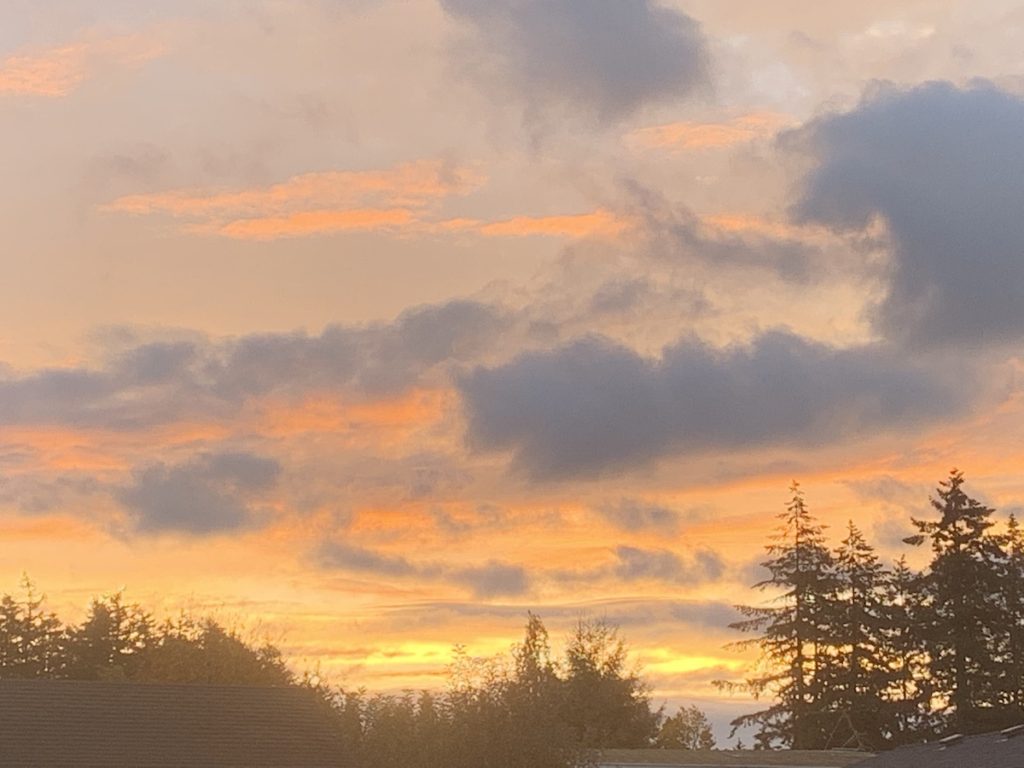
The view from my front door at 7 AM looking east. I have to remind myself daily the while the outlook around us in the world may be bleak, the uplook is always glorious!
This morning I arose at my usual 5 AM and immediately checked the internet news to see who had won the U.S. presidential election. What I discovered, and not to my surprise, the election is still too close to call and we may not know the outcome for several days. In the mean time, the mumbling, bumbling fossilized buffoon and his uber-leftist, Marxist-leaing running mate are ahead, so who knows how this political cookies is going to crumble. This obviously begs the question, what if…(not that the braggadocio, hyperbolic blabbermouth on the other side is a saint or the Messiah, but at least he makes an attempt to be patriotic, somewhat conservative and a quasi-Christian who loves America and its traditional values)?
As I was pondering this question in my prayer time this morning, the Ruach nudged me to consider Psalm 144:1. Though I’ve read this verse many times, I was led to consider this verse in its larger context in light of the the entire world’s leftist, totalitarian drift toward the global government and tyrannical political, economic and religious system that is described in the book of Revelation chapters 13, 17 and 18, which is called Mystery Babylon the Great, which is headed by the demon possessed Man of Sin or Antichrist, which will persecute and kill many saints, and which King Yeshua the Messiah will destroy at his second coming.
Psalm 144:1–15, Trains my hands for war. An aspect of our doing warfare and battle against our enemies is to allow YHVH to fight them for us in his own ways (vv. 2–8), and to sing praises to him (v. 9), trusting that he will give us salvation or deliverance from our adversaries (v. 10). One way or the other, happiness and blessings come to those who put their faith in YHVH (vv. 12–15).
It is also interesting note that in this psalm David declares that YHVH is the one who “trains my hands for war, and my fingers for battle,” and then he goes on to describe how YHVH is like a protective fortress and high tower around him (presumably for group defense) as well as his a personal fortress or shield (for a one man defense). So does that mean that the saint is take refuge behind YHVH who is our fortress and shield, while shooting at the enemy? Not exactly.
The psalmist then goes on to describe how powerless and insignificant man really is—presumably at fighting his own battles, when he confesses, “what is man that you take knowledge of him…that you are mindful of him? Man is like a breath; his days like a passing shadow” (vv. 3–4).
Then in the next few verses, David goes on not to describe how David is to fight his enemies, but how YHVH will come down and fight on his behalf and rescue him from his enemies (vv. 5–8).
After that, David breaks into a psalm of praise about how YHVH delivered him and his servants from the sword of the enemies and rescued them from lying the machinations and falsehoods of those who sought to destroy them (vv. 10–11).
David then describes the overflowing blessings and happiness that come upon the saints and their children when they trust in YHVH to fight for them (vv. 12–15).
What’s going on in this seemingly contradictory psalm? What is David really saying here? Even though YHVH trains the saint’s hands to fight, and YHVH is a fortress and shield from which to fight behind, at the same time, man is a powerless entity, who must cry out to YHVH to fight his battles for him. Yes, that’s just the point. In YHVH Elohim’s spiritual order of things, the opposite of what seems like the natural and logical things to do when attacked, that is, to get out there and to fight and defend oneself against the enemies through natural means, is actually the wrong approach. More often than not, our greatest weapon is to battle spiritually, not physically, by cry out to YHVH Elohim and then trust in him to fight our battles for us. Some other Bible passions come to mind in this vein.
Let Elohim arise, Let His enemies be scattered; let those also who hate Him flee before Him. (Psalm 68:1)
So shall they fear The name of YHVH from the west, and His glory from the rising of the sun; when the enemy comes in like a flood, the Spirit of YHVH will lift up a standard against him. (Isa 59:19)
And Moses said to the people, “Do not be afraid. Stand still, and see the salvation of YHVH, which He will accomplish for you today. For the Egyptians whom you see today, you shall see again no more forever. (Exod 13:14)
For in it the righteousness of Elohim is revealed from faith to faith; as it is written, “THE JUST SHALL LIVE BY FAITH [in Elohim].” (Rom 1:12 from Hab 2:4)
And they overcame [Satan] by the blood of the Lamb and by the word of their testimony, and they did not love their lives to the death. (Rev 12:11)
Many more verses could be quoted here, but you get the point, but to end this discussion, please read Habakkuk 3:17–19.
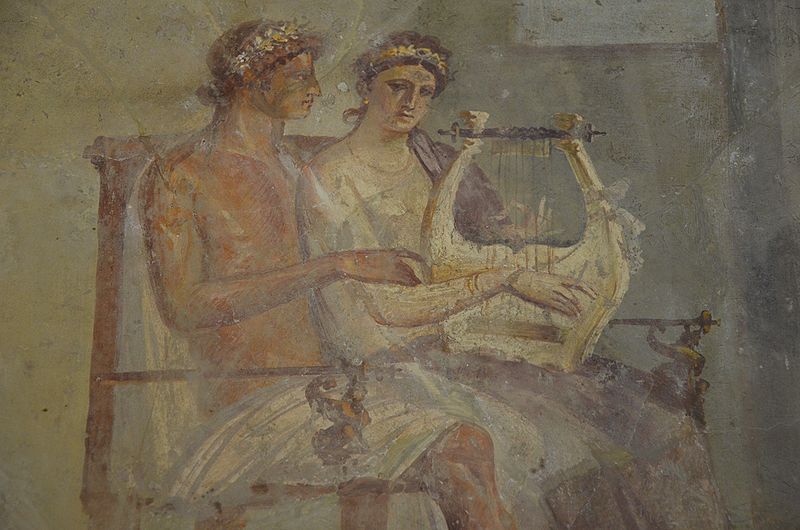
Psalm 144:1, 9, Trains my hands for war…Harp of ten strings [NKJV]/an instrument of ten strings [KJV]. (See notes at 1 Chron 16:5.) This was likely the kinnor or the lyre-type harp also known as the David harp. It is similar to the nevel (or nebel) harp (which presumably had more than 10 strings [Josephus’ Ant. vii.12.3; J. Talmud Sukkah 5.6]), which is mentioned in verse nine in addition to the ten-stringed instrument (presumable another type of harp). The instrument of ten strings mentioned in verse nine (Heb. asor) may have also been a ten-stringed variety of the nevel harp (The International Standard Bible Enclyopedia, vol. 3., pp. 442).
According to Josephus, the first century Jewish historian, the kinnor had ten strings (Ant. vii.12.3), which is the instrument that David played to comfort Saul (1 Sam 16:23), The kinnor could either be played with a bow or plucked by hand (ibid., vol. 3., pp. 440–441). The Levites used this instrument along with others in their temple praise and worship.
Why is a musical instrument of ten strings mentioned in verse nine? Perhaps David is referring to the ten strings of this lyre-type harp for man’s ten fingers (see v. 1) with which to do spiritual battle against the enemy.
Elsewhere in Scripture, we see that physical warfare often involved spiritual warfare that encompasses singing, praising and worshipping YHVH Elohim resulting in miraculous and divinely orchestrated victory over one’s enemies. Think of the Israelites marching around Jericho (Josh 6), Gideon defeating the Midianites after blowing shofars and lifting up the name of YHVH (Judg 7), or King Jehoshaphat and his armies defeating Judah’s enemies (2 Chron 20). It is important to keep in mind that behind one’s physical enemy are unseen satanic entities against whom the saint must not only defend himself but also fight in the power of Spirit of Elohim (e.g. see 2 Cor 10:4–5 and Eph 6:10–18).
Our new annual Scripture Reading Schedule for 2020-2021 with daily readings that began on 10/11/20 is now available to download and print. The link to the previous 2019-2020’s Scripture Reading Schedule will still be available on the right sidebar under “Helpful Links” into next year. If you are using a mobile device or tablet, the link may be below, meaning you’ll need to scroll down instead.
Most of this week’s blog discussion points will be on these passages. If you have general comments or questions on the weekly Scripture readings not addressed in a blog post, here’s a place for you to post those. Just use the “leave a reply” link or the “share your thoughts” box below.
The full “Read Through The Scriptures In A Year” schedule, broken down by each day, can be found on the right sidebar under “Helpful Links.” There are 4 sections of scripture to read each day: one each from the Torah, the Prophets, the Writings, and from the Testimony of Yeshua. Each week, the Torah and haftarah readings will follow the traditional one-year reading cycle.
Weekly Blog Scripture Readings for 11/1 through 11/7/2020.