Are the following Scriptures prophetic references to the current “pandemic” or something similar? Watch and pray…
For nation will rise against nation, and kingdom against kingdom. And there will be famines, pestilences [Greek: plagues], and earthquakes in various places. (Matt 24:7)
Compare Matthew 24:7 to Revelation 6:7.
So I looked, and behold, a pale horse. And the name of him who sat on it was Death, and Hades [i.e. spiritual and physical death] followed with him. And power was given to them over a fourth of the earth, to kill with sword, with hunger, with death, and by the beasts of the earth [or “beasts of the field,” which is an Old Testament Hebraism referring “to evil men”]. (Rev 6:7)
The Torah Origins of the Communion Ritual and the Priesthood of All Believers
Why were the priests allowed to eat some of the offerings? What’s this all about? Let’s answer this question with a question. Why do believers in Yeshua eat the communion elements, and what do they represent? Is there a connection between the Levitical priests eating of the sacrifice and the saints eating the communion elements? Now let’s explore this idea.
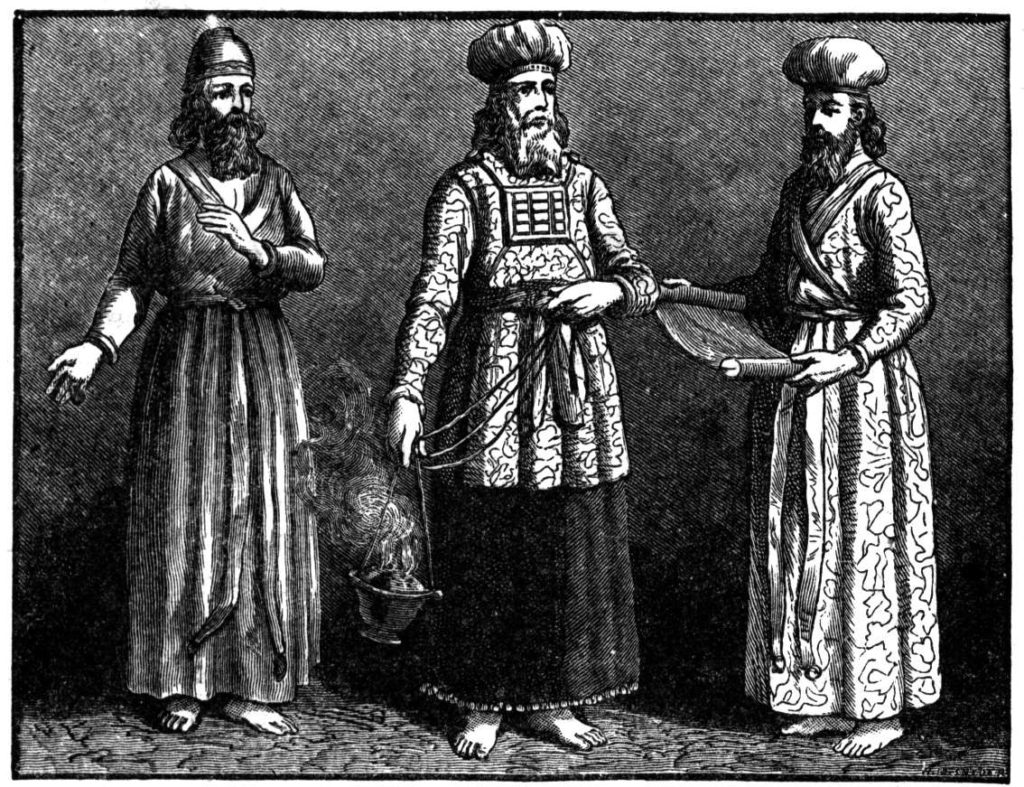
In Leviticus 6:26 and 29, only the male priests were allowed to eat of the sin offering. Likewise, YHVH commanded the male priests to eat the baked unleavened bread of the minchah offering (Lev 6:16, 18). Yeshua himself not only continued this Levitical practice, but expanded and elevated it to a higher level at his last supper.
When Yeshua initiated communion among his disciples, what in essence was he saying? Simply this. His disciples were all now his holy or set-apart priests. This is the origination of the concept of the priesthood of all believers, or the royal priesthood as Peter terms it (1 Pet 2:9), or a kingdom of priests John calls it who will rule with King Yeshua in his millennial kingdom (Rev 1:6; 5:10; 20:6).
It was YHVH’s desire that the children of Israel would become such a priesthood even before he called the Levites to be his set-apart priests (Exod 19:6). However, they failed in this mission when they chose to worship the golden calf instead of YHVH (Exod 32). At that time, YHVH chose the faithful Levites to be his priests instead of the firstborn male leaders from all the tribes of Israel (Exod 32:26, 29; Num 3:11–13, 44).
Moreover, Isaiah prophesied about the priesthood of all believers—a priesthood that would extend beyond the confines of the Aaronic priesthood (Isa 66:21 cp. Dan 7:18). This higher level priesthood would extend beyond the patriarchal male leaders, who were the original priests in Israel (Exod 19:22, 24), to include all the Israelites, both male and female (Exod 19:6), as well as Gentiles who have been grafted into Israel through Yeshua the Messiah (Gal 3:28–29; Eph 2:11–19; Rom 11:11–32), which Paul refers to as the Israel of Elohim (Gal 6:16).
Being a kingdom of priests who will teach the inhabitants of planet earth the ways of Elohim is the role and destiny of all the modern day saints of Elohim who have been washed of their sins (i.e. Torahlessness, 1 John 3:4) in the blood of Yeshua (Rev 1:6), for they will reign with Yeshua on this earth (Rev 5:10) for a thousand years as Elohim’s resurrected and glorified adopted sons and daughters (Rev 20:6; John 1:12 cp. Rom 8:14–15, 23; 9:4; 2 Cor 6:18; Gal 4:5–6; Eph 1:5; 1 Jhn 3:1–2; Rev 21:7).
So saints of the YHVH Elohim, encourage yourself with these immutable promises from the Word of Elohim! Are you presently preparing yourselves now for auspicious and lofty role?
Leviticus 7:13, Leavened bread. The Torah prohibited the offering of leavened bread on the altar (Lev 2:11). There are only two instances where leavening in bread was permitted in the tabernacle service. In this verse, leavened bread was offered in conjunction with the peace offering (Lev 2:13), where it was eaten as part of the sacrificial meal. This was not a sin offering, but the peace offering. Therefore the bread of this offering didn’t represent the body of Yeshua. It was merely part of the fellowship meal representing a peaceful and loving relationship between the offerer and the Creator, and was similar to a family picnic, dinner or barbecue. But it wasn’t placed on the altar, nor was it a part of the sacrifice, therefore, it wasn’t a prophetic picture of the sinless Yeshua dying on the cross.
The second instance of leavened bread being offered in a tabernacle service occurred when the Torah instructs the priests to wave two loaves of leavened bread on Shavuot or Pentecost before YHVH (Lev 23:17). These two loaves prophetic and symbolic metaphors for the two houses of Israel (the northern kingdom and southern kingdom)—a spiritual picture of Jews and Christians. In this ceremony, the gracious and merciful Creator was demonstrating his acceptance of his people despite their sin.
Leviticus 7:23, Not eat any fat. All the organ fat of the ox, sheep and goats was used as part of the sacrificial service (Lev 7:30–31).The organ fat was given to YHVH as part of the burnt offering (Lev 1:3), the peace offering (Lev 3:3–4), the sin offering (Lev 4:8–10, 19). Fat is the Hebrew word cheleb/CKJ meaning “fat of humans or animals” or metaphorically, “the choicest, best part, or abundance of the land.” Therefore, the fat as one of the choicest parts of the animal was reserved for sacrifice to YHVH on the altar. But not eating fat, the Israelites in their minds preserved a reverence for YHVH’s altar upon which the fat or the best part was offered to YHVH. To eat the fat was to show irreverence for that best part that belonged to Elohim, which is why the offender was cut off from the nation of Israel. As living sacrifices who have been redeemed or bought with the blood of Yeshua, are we giving YHVH the best part of our lives? After all, he so loved us that he gave us Yeshua, which was the best he had to offer.
Leviticus 7:26,Not eat any blood.
The Supreme Significance of Blood
YHVH revealed in the Torah that the life of flesh is in the blood (Lev 17:11). Therefore, the blood symbolizes the whole life of the living being. This is why the blood being poured upon the altar made atonement for the souls of men (Lev 17:11–12), since it represented and pointed to the shedding of Yeshua’s blood when he sacrificed his life on the cross in atoning for men’s sins. Respecting the blood is necessary not only because it symbolizes the sanctity of the life of man who was made in the Creator’s image (Gen 1:26 cp. 9:6), but more importantly, because of the blood of Elohim’s Son that was shed for man’s redemption (Lev 17:11). For one to eat the blood showed disdain for what the blood typifies. In times past, this was so important to YHVH that a violation of this prohibition resulted in banishment from the nation of Israel.
The blood was to be reserved for the sacrificial service, where it was used symbolically to represent Yeshua’s shedding his blood on the cross. The blood of a lamb was put on the door posts to protect men from YHVH’s judgment against sin (Exod 12:7, 13). Moses sprinkled the blood of oxen on the people symbolizing their coming into covenantal relationship with YHVH (Exod 24:5–8). Additionally, the blood of sacrificed animals was sprinkled throughout the tabernacle, on Aaron and his sons, and all around the altar to sanctify it. All these acts and uses of the blood were illustrative of the unrestricted cleansing power of the blood of Yeshua (Rev 1:5; 7:14; 12:11; 1 Pet 1:2, 19; Heb 9:12; 10:19–22; 12:24; 1 John 1:7; Matt 26:28), which is why YHVH expected his people to treat the blood with a reverence. Those who didn’t evidenced a heart of indifference for the set-apart or kadosh things of Elohim—an intolerable offence in the Creator’s eyes.
On the dark and satanic side, the blood of humans and animals is profaned through demonic rituals involving drinking it and even cannibalism. This is an abominable perversion of holy communion and was an aspect of ancient heathen religions (Ps 16:4; Ezek 39:17, 19 cp. Num 13:32), and is a practice in which the end time antichrist heathens of the Babylonian whore system will engage (Rev 17:6; 18:13, 24).
Isn’t your life already busy enough? Who has time for a six-hour Passover Seder commemorating something that happened thousands of years ago? What could this possibly have to do with my life here and now, you may ask? How can a 3500-year-old Biblical ritual in any way relate to those living in the age of the laser, satellites, the worldwide web and computers? Well, let’s see!
The Preacher said in Ecclesiastes 3:15, “That which is has been already and that which will be has already been.…” Life is full of paradoxes. Do advancements in technology, science, economics, medicine, religion, and world government really promise to give men the rest for their weary souls for which they long?
How about a different approach to the questions and problems facing modern man? Is it possible to go forward by going backwards? This is a thesis that the ancient prophet Yermeyahu (Jeremiah) proffered to those who had ears to hear. He said, “Thus says YHVH, ‘Stand by the ways and see and ask for the ancient paths, where the good way is, and walk in it; and you will find rest for your souls. But they said, we will not walk in it’” (Jer 6:16). What were those ancient paths to which this white-haired Jewish prophet referred? This question is answered three verses later: “Because they have not listened to My words, and as for My Torah, they have rejected it also” (verse 19). YHVH through his prophets has been showing men the way of rest for their souls for thousands of years, yet men consistently refuse to listen. They always have a better way, so it seems!
The festival of Passover is one of the most ancient paths to be found in all of the Scriptures. In it are contained clues that will help the partakers of it to understand the past, present and the future.
A God-hater, Karl Marx, the father of modern communism, said that religion is the opiate of the masses. Yes, this can be said of dead, truthless and spiritless religion. But how about that religion which gives definition, purpose, meaning, hope and destiny to a man’s life? How could anything that comes directly from the Loving Father who created you and me in his own image be detrimental to us?
It has been said that the religion of the Bible tells a person where he has come from, where he is at and where he is going. Could it not be said that a man who knows the answers to these questions possesses true wisdom and wealth, and has indeed found rest for his troubled soul?
One of the most important scriptures in the Jewish faith is the famous shema passage of Deuteronomy 6:4–9. This passage, which is like a “pledge of allegiance” for the Jews, starts out by saying, “Hear [shema], O Israel …” The word shema literally means “to hear and to do.” Later, in verse five, the shema continues, “And you shall love YHVH your Elohim with all your heart, and with all your soul and with all your might.” Loving our Heavenly Creator is not just a mind-thing, but also an action and a doing thing. It is something we act out and participate in. This is the Hebrew way … the ancient paths! As a path is for the purpose of walking down, even so, Passover is meant to be celebrated. This is how YHVH’s people showed their love and devotion to him. Yeshua, the Jewish Messiah, reiterated this when he said, “If you love me, keep my commandments [or Torah mitzvot]” (John 14:15).
This is what the Passover Seder is all about. We, as humans, learn by doing. We learn obedience by obeying. We learn to love by loving. We learn about heavenly and spiritual mysteries by walking out the types and shadows found in Scripture (of which Passover is but one) that point to the heavenly and spiritual domain or dimension of YHVH himself. The French have a saying: L’appétit vient en mangeant. Translated this means: Appetite comes while eating. Or we could say that the more one eats (delicious food) the more one wants. David said in Psalm 34:8, “O taste and see that YHVH is good: blessed is the man that trusts in him.” The more we walk out the commandments of our Heavenly Father, the more of his goodness we behold, the more of his blessings we receive, the more our soul finds rest, the more we want to walk out his commandments, the more we behold his goodness, and so on goes this wonderful spiritual growth-cycle.
So why do we go to the trouble, expense and time to celebrate a Passover Seder? First, it helps us to fulfill the commands YHVH gave to us to do at Passover, such as eating lamb, unleavened bread and bitter herbs; telling our children the story of the Passover; holding a “set apart convocation” and so on (Exod 12:14–20, 43–49; Lev 23:4–5; Num 9:2–3; 28:16; Deut 16:1–3). But again we ask, what is the significance and relevance to us of this celebration?
Passover is but the first piece of a panoramic puzzle or the first thread in a rich tapestry of YHVH’s plan of redemption of mankind. Though the children of Israel kept the first Passover 3500 years ago in the land of Egypt, this ancient celebration is not only a memorial of what occurred then, but is of utmost significance to the spiritual life of the Believer today. It has future or prophetic implications, as well. Passover is the first step of a spiritual journey that, if one continues in it faithfully to the end, will lead one into the very presence of YHVH Elohim, our Heavenly Father, himself. What a journey! Let’s look at it.
The Spiritual State of America and Other Formerly Christian Nations
Isaiah 1:3,The ox knows its owner.The “Beasts of the Field Explained.” Apostasy and spiritual degradation leads to one place: a complete loss of one’s spiritual identity. When one forgets one’s spiritual heritage and relationship with their Creator, they becomes, in a sense, like an animal, maybe even worse. (See 2 Pet 2:12 and Jude 1:10.)
As an interesting side note, Scripture prophesied that Israel would become animalistic in its apostate condition as it sought to imitate the heathen nations around it. As a result and in judgment, YHVH would allow Israel to be taken over and swallowed up by the same nations, which Scripture refers to by the Hebraism or Hebrew poetic metaphor “the beasts of the field.” In Deuteronomy 7:22, we see that this same Hebraism represent the nations of the earth from which Israel was to stay separate. (See also Jer 12:9; 27:6; Dan 7:3.) The children of Israel were scattered or exiled and became “meat” or prey for all the beasts of the field (Isa 56:9; Ezek 34:5; Hos 2:12). Scripture likens exiled Ephraim (the Northern Kingdom), who fell into idolatry and mixed with the beast (Gentile) nations, to beasts of the field themselves (Hos 2:16–19 cp. Acts 10:12). In the future, YHVH will make a covenant (a marriage betrothal agreement or ketubah) with Israel who had themselves become “beasts of the field” (Hos 2:18; see also Jer 31:31–33 cp. Rom 1:23,18–25).
Can you see America and the formerly Christian West in this? These nations were once a predominately Christian, but now have rejected and scorn their spiritual heritage. What has been the result of this spiritual and moral declension? What is the current state of Christianity in these formerly Western Christian nations? Can we not see how YHVH has been lifting his hand of blessing off of them, and how with their spiritual and moral decline they have been declining economically, geopolitically and culturally?
The Hebrew Word Goy (Meaning Gentile) Explained
Isaiah 1:4,A sinful nation.The Word Goy Explained. The word nation is the Hebrew word goy meaning “gentile”or, in a spiritual sense, “heathen”This is one of a number of passages in Scripture where Israel is referred to as a gentile nation.
In the KJV, Goy is translated in the Tanakh as nation 374 times, as heathen 143 times, as Gentiles 30 times, and people 11 times. Whenever the word gentile is used in the KJV it is the word goy. According to Strong’s Concordance, the meaning of goy is “a foreign nation; hence a Gentile; also (fig.) a troop of animals, or a flight of locusts.”According to GeseniusHebrew-Chaldee Lexicon,the word goy means “a people, a confluence of men,” and “contextually in holy Scripture it is used to refer to the other nations besides Israel, the foes of Israel, and strangers to the true religion of Israel.”
There are times when this word refers specifically to Israel:
The descendants of Joseph in general (Gen 48:19)
The Southern Kingdom of Judah when it forsook Elohim and its covenant with him and became like the surrounding heathen nations (Isa 1:4)
The Northern Kingdom of Israel or Ephraim or Samaria (Isa 9:1)
Israel in general (Isa 26:2; 49:7; Ps 33:12; Gen 12:2; 35:11).
There are numerous other instances in Scripture where the words goy or goyim (plural) are applied to the descendants of Abraham. Scripture’s use of the term is unbiased and lacks any of the pejorative implications that have been applied to the term subsequently (e.g. Gen 17:4, 5, 6, 16; 18:18; 25:23; 46:3; Exod 19:6; 33:13; Deut 4:6, 7, 8, 34; Ezek 37:22).
As already noted, goy simply means “people group.” The Greek word ethnos (Strong’s G1484) as found in the Testimony of Yeshua is equivalent in meaning to the Hebrew word goy.
There For the Grace of Elohim Go All of Us!
Isaiah 6:4–7, Coal …from the altar. Which altar in the temple did this coal come from and what did it represent spiritually and prophetically? What deeper truth was YHVH trying to teach Isaiah here? There were two altars in the Tabernacle of Moses: the altar where animals were sacrifice—a symbolic and prophetic picture of Yeshua’s atoning death on the cross, and the incense altar in the holy place.
This is an important question that has dangerous implications. Why? Because truth is like a sharp sword that cuts. It separates good from evil, light from darkness, sin from righteousness; it differentiates between those who are of Elohim and those who are of the world, the flesh and devil; that is, those who are of the kingdom of the god of this world—Satan the devil. Oooh, that hurts! But the fact remains: we are either in Elohim’s kingdom or the devil’s kingdom. To ignore or renounce the former is to acquiesce knowingly or unknowingly, it makes no difference, to the latter. For these reasons, most people flee from answering the question “What is truth.” This is because their deeds are evil and they do not want the glorious light of YHVH’s Truth to shine into their lives and to expose their evil deeds as John declared about Yeshua in John 3:18–21.
He who believes in [Yeshua] is not condemned; but he who does not believe is condemned already, because he has not believed in the name of the only begotten Son of Elohim. And this is the condemnation, that the light has come into the world, and men loved darkness rather than light, because their deeds were evil. For everyone practicing evil hates the light and does not come to the light, lest his deeds should be exposed. But he who does the truth comes to the light, that his deeds may be clearly seen, that they have been done in Elohim.”
Not only that, let us not forget an important fact: there are two kinds of truth. Truth with a capital T and truth with a small t. The former is divinely revealed Truth, while the latter is truth at a physical level (e.g. 2 + 2 = 4 or the law of gravity). To acknowledge the former means that one has to accept not only the idea of divine revelation, but a Divine Revealer. If so, then there is a Divine Judge who determines right and wrong. If this is true, then that Judge will bless those who live up to that divine Truth, and curse those who do not.
To acknowledge the existence of divinely revealed Truth carries with it serious implications regarding one’s lifestyle. That is why most humans choose the downward path (call Baalism or feeding from the tree of the knowledge of good and evil) of sin and succumb to the notion that God is dead or irrelevant. Not only that, they attack those who believe in Elohim (the Jews and the Christians), they attack the Bible—the Word of Elohim, they attack the Holy Land where Elohim placed his name, and they attack anything that remotely represents any of these things (e.g. morality, marriage, the family, church, male and female genders and so on). This is the spirit of Antichrist, which we see rising up like a tidal wave of evil in these last days all over the world. But the reality is that these are only the death throes of Satan and his kingdom of darkness, for he knows that his time as the ruler and god of this world is short, and that King Yeshua is coming soon to dethrone him. That is why the devil is pulling out the all the proverbial organ stops in a vain attempt to prevent the inevitable and inexorable march of Truth!
For these reasons, it is important that you understand the answer to the question, “What is Truth?”
John 18:38, What is truth?
In this age of moral relativism or situational ethics, it is unpopular to believe in, much less purport, that there is one single truth. Most humans live under the notion that every person can determine their own truth for themselves. The problem with this delusion is that when your truth conflicts with my truth there will inevitably be conflict. Ultimately, there will be a breakdown in law and order leading to anarchy resulting in unending theft, murder and wars. This was the case in primeval and medieval societies like Europe before strong central governments evolved to enforce law and order. The history of British Isles alone before there was a strong king in London was one series of blood baths after another by various raping and pillaging parties.
The concept of animal sacrifices may be a hard for modern people to comprehend—especially for those who are squeamish when it comes to death and blood. This ancient ritual, rooted in the nomadic lifestyles of the inhabitants of the Middle East, carried more symbolic significance for a people whose daily existence was tied to the earth and who were dependent on domestic animals for their survival. It is out of this cultural background that the biblical narrative springs and with it the ritual symbols with which the ancient people described therein could relate. With these things in mind, the following is a list showing the main reasons for YHVH’s establishment of an animal sacrificial system as a means to help man to understand spiritual lessons far beyond the actual sacrifice itself.
The laws pertaining to the sacrificial system were added to the rest of the Torah because of sin, and were in force until the time of Yeshua the promised Seed (Gal 3:19). When and why did YHVH add them making this system incumbent upon the Israelites? This occurred after and because of the sin of the golden calf. It was then that YHVH established the Levitical priesthood and subsequently gave Israel the sacrificial system to not only show them the seriousness and grave consequences of sins, but to guide them forward on the path toward redemption and salvation.
The Levitical system foreshadowed and pointed to the Messiah’s ultimate sacrifice (Heb 9:11–12).
The tabernacle offerings were specifically designed to spiritually draw the offerer near to Elohim through the sacrifice of a prescribed animal (Ps 51:16–17; 50:12–15 cp. 1 Pet 2:21).
Elohim commanded offerings to assist the offerer to better understand himself; his attitude, and his personal relationship with Elohim (e.g. Gen 3:21; 4:3–5; 8:20; 22:1–2 cp. 1 Cor 11:28).
Altars were erected by the patriarchs in order to honor Elohim through sacrifice after having had direct contact with him (Gen 12:6–8; 13:18; 26:24–25; 35:1; 35:2–4; Exod 17:13–16; cp. Exod 20:12).
Proper and regular sacrificial offerings kept the children of Israel in direct contact with the Elohim of the patriarchs (Exod 5:3; 10:25; cp. 1 Tim 2:5).
To make the offerer holy (set-apart) so that he would be allowed to approach and commune with the Set-Apart Elohim of Israel (Isa 43:15; 57:15; Lev 19:2 cp. 2 Cor 6:16–18).
Under certain circumstances, blood, as used in the Levitical system, could serve as a purification agent for both people and objects (Heb 9:18–23 cp. Luke 2:22–24).
The blood of the animal sacrifices served to cover the offerer’s sins, thereby allowing him to draw near to the Set-Apart Elohim of Israel. However, the offerer could only be forgiven for specific sins through full repentance and by returning to Elohim’s way of life as outlined in the Torah (Lev 1:4; 4:35; 23:27–28; Heb 10:3–4; cp. Rom 4:7–8).
The purpose of the animals offered by the Levitical priesthood served as a shadow of the blood of Messiah, which does not merely cover our sins, but removes all of the sins of the person who accepts Yeshua’s offering of himself for that sinner (Heb 9:11–12, 24–28; 1 Pet 1:18–19; Eph 5:25–27; Lev 25:47–49; Rom 5:11; John 1:29 cp. Heb 13:10–13).
Words and Definitions
(These words are the Hebrew words behind the English words offering and sacrifice as translated in the KJV):
Asham: (Strong’s H817/TWOT 180b) meaning “guilt, offense, sin, guiltiness, trespass, fault, compensation (for offense), trespass or sin offering.”
Chag: (Strong’s H2282/TWOT 602a) meaning “festival, feast, pilgrim-feast, festival-gathering, festival sacrifice.”
Chatah: (Strong’s H2403/TWOT 638e) meaning “sin, sinful, sin offering, condition of sin, guilt of sin, punishment for sin, purification from sins of ceremonial uncleanness, sinner.”
Ishshah: (Strong’s H801/TWOT 172a) meaning “burnt offering, offering made by fire, fire offering.”
Korbawn: (Strong’s H7133/TWOT 2065e) meaning “offering, oblation, sacrifice.”
Minchah: (Strong’s H4503/TWOT 1214a) meaning “to apportion, to bestow, gift, tribute, offering, present, oblation, sacrifice, meat or grain offering (Gen 4:3–5).”
Necek: (Strong’s H5262/TWOT 1375a) meaning “drink offering, libation, molten image, something poured out (Gen 35:14).”
Nedabah: (Strong’s H5071/TWOT 1299a) meaning “voluntary, free-will offering.”
Olah: (Strong’s H5930/TWOT 1624c,d) meaning “whole burnt offering/sacrifice, ascent, stairway, steps, to go up (Gen 8:20; 22:2,3,6,7,8,13).”
Qatar: (Strong’s H6999/TWOT 2011,2011e,g) meaning “to sacrifice, burn incense, burn sacrifices, make sacrifices smoke, incense, incense altar.”
Shelem: (Strong’s H8002/TWOT 2401b) meaning “peace offering, requital, sacrifice of alliance or friendship, voluntary sacrifice of thanks.”
Tenuwphah🙁Strong’s H8573/TWOT 1330b) meaning “swinging, waving, wave offering, shaking.”
Terumah,: (Strong’s H8641/TWOT 2131i) meaning “a heave offering, any offering; an offering of grain or money, etc.; contribution, oblation.”
Zebach: (Strong’s H2077/TWOT 525a) meaning “sacrifices of righteousness, sacrifices of strife, sacrifices of dead things, the covenant sacrifice, the Passover, annual sacrifice, thank offering.”
Zabach: (Strong’s H2076/TWOT 525) meaning “to slaughter, kill sacrifice, slaughter for sacrifice”(Gen. 31:54; 46:1).
YHVH instituted the basic sacrificial system after the fall of man, and it served to point the way to the coming of Yeshua the Messiah, the eventual Redeemer and Savior of mankind. Later on, YHVH established a more elaborate sacrificial system and appointed the Levites to administer it. This occurred after the golden calf incident in Exodus 32 and in conjunction with the establishment of the Tabernacle of Moses. Paul makes reference to this “added law” in Galatians 3:19.
Depending on how one understands the scripture passages recording the vision of Ezekiel’s Temple (Ezek 40–48), there may or may not be a reinstitution of part of or the whole sacrificial system during the millennium. Some believe that Ezekiel’s Temple is only an allegorical picture of Yeshua’s atoning death on the cross and speaks to YHVH’s plan of salvation and therefore will never be built. Others feel that it is yet to be built.
After the fall of man, YHVH made Adam and Eve coats or garments of skins or leather (Gen 3:21). Though the Scriptures don’t tell us, we can guess these were made of leather from a kosher animal such as a cow, sheep or goat. In other words, YHVH probably sacrificed a kosher animal like a lamb to cover their physical and spiritual nakedness. This would have marked the beginning of the sacrificial system and thus pointed to Yeshua’s atoning death on the cross through his shed blood — the Lamb slain from the foundation of the world.
The next occurrence of a sacrifice was that of righteous Abel in Genesis chapter four. After that, animal sacrifices become a common occurrence with the male head of each family acting as the officiant or priest for his family. It was not until the golden calf incident (Exod 32) that the responsibility of the male head of the family to perform sacrifices passed to the Levites, thus, initiating the Levitical priesthood with its sacrificial system.
Sacrifices are no longer necessary, since Yeshua our Messiah offered his body as the ultimate sacrifice for our sins, once and for all, forever (Heb 10:10–21).
When I first wrote this article a few years ago, I viewed the idea of creating and living in one’s own so-called “God (or Elohim) bubble” as a defensive mechanism for dealing with the attacks from the world and the devil around us: One could slip into one’s own God bubble as a refuge in the time of trouble. While this is still a true concept, there is, perhaps, a greater principle at play here that needs mentioning: Perpetually living in one’s “God bubble” is not only a defensive strategy, but are lifestyle and offensive strategies as well. First, it is a way to stay continually abiding in Yeshua who is the vine and we are the branches (as per John 15) as well as a way to stay in his river of life constantly.
Second, it is also an offensive strategy. There is very little that the ordinary person can do about the evil plans of the Babylon the Great New World Order’s spirit of Antichrist to takeover the world and also our lives. By living in a perpetual God-bubble day-by-day as a lifestyle and mindset, we will not only be making the world around us a better place, but we will be radiating the love and truth of Elohim outward to those living in the darkness of hopelessness and despair. This is a way for us to fulfill Yeshua’s command to be salt and light.
Create You Own “God” Bubble to Deal With Life’s Attacks
May everyone reading this take careful note and pay close attention to the following: Creating a “God”-space bubble around you is a biblical strategy to protect yourself from the attacks of one’s spiritual enemies. Without it, you may not survive theses attacks.
Who is the main enemy of our soul that is hell-bent on turning each of us into a spiritual casualty and a notch in his gun belt? Who is the one who is inexorably determined to pull you off the straight and narrow path that leads to Yeshua and his eternal kingdom? Who works tirelessly to pull your spiritual focus off Yeshua and his Word? Actually, the Bible reveals that the disciple of Yeshua the Messiah has three such enemies: the world, the flesh and the devil.
How do we deal with such rabidly determined enemies? There is the natural way and the supernatural way.
Most people choose the natural way to deal with adversity. It’s the default mode that, because of man’s fallen sin nature, one automatically and involuntarily chooses. It’s the way of self and flesh. The natural reactive tendency of humans when attacked is to create around themselves a fortress of pride, self-justification, self-righteousness where they blame others and seek pity as a form of defensive protection. The focus of this self-defensive strategy is on self and simply yields to path of least resistance dictated by one’s sinful nature. It is merely a natural, automatic and thoughtless default response of man’s fallen sin nature. If we don’t catch ourselves, we will automatically find ourselves doing this.
When attacked, instead of creating a defensive fortification where a focus on self forms the foundation stones in our defensive fortress wall, we need to run to the Rock of our Salvation who is our High Tower in times of trouble. David, a man after Elohium’s heart, writes about this many times in his psalms. David shows us to make YHVH and not self the focus when our enemies attack us, and how to find refuge in our personal “God” bubble. A bubble seems a fragile, an almost invisible thing with a very thin wall—something that pops easily. So get that image out of your mind. Instead, think of an invisible force-field that can easily repel any incoming projectile no matter its size, speed or destructive capabilities.
Such a bubble or spiritual force field will shield and protect us from any of our enemy’s attacks. It will insure that we weather the ferocious storms of life that blow against us. In that place, we are relying on the unlimited power and wisdom of YHVH to aid us in our time of need instead of the weak, faulty and deceptive arm of the flesh. The former leads to light and life; the latter leads to darkness and death. The former brings healing and strength; the latter glosses over pain and is merely weakness feigning as strength.
Since each person is different, each one will furnish their “God” bubble differently depending their spiritual orientation and makeup, tastes and interests. In my times of trouble, and most of other times as well, I maintain a spiritual force field around me by which I’m able to repeal spiritual attacks. When attacks happen, I then take refuge in my own personal spiritual bubble. This involves turning to the Scriptures for guidance, wisdom and encouragement. Prayer—talking to Elohim—is a vital component of my spiritual bubble or force field. Often I visualize myself either at the foot of Yeshua’ cross or before the throne of my Heavenly Father. Often I will myself involve hard physical work (to settle my emotions and to help clear my mind, which helps to me to destress and get my mind off the problem, so I can think and pray clearly). Many times, I listen to beautiful and spiritually uplifting music, which again helps me to elevate my spiritual focus. Often I find my own Garden of Eden in nature where I can imbibe in the beauty of Elohim’s creation. There I can talk with the Creator and find healing. To accomplish this, often I will work in my garden. Sometimes I write Elohim-centered psalms and poetry. David wrote many of his psalms in times of distress—even when his life was in danger. This helped him to get his mind off of his circumstances and onto YHVH, who was is salvation and deliverer. Whatever I do, in all cases, I try to get my mind off myself and onto Elohim who is my source of wisdom, hope and guidance, and my ultimate Savior and Deliverer. Often, I imagine myself falling down at the foot of the cross where I find my strength at the feet of Yeshua. I tell myself that if he endured that for me, then I can endure this for him.
For other people, their “God bubble” might be spending time with cherished and caring family members and friends, their spouse, their spiritual family, at church or during the Sabbath and biblical festivals.
This is what my “God” bubble looks like and what helps me to deal with spiritual attacks. What does your “God” bubble look like?
If you don’t have your own “God” bubble, how about making one to help you deal with the pain, stressors and attacks of life?