Numbers 30:2 (3), Vows. A vow (Heb. neder) is literally “a pledge to do something.” It places upon oneself or others or upon objects of one’s choice a status equivalent to that of a commandment of the Torah (The ArtScroll Stone Edition Chumash, p. 900).
One’s word is one’s bond. A neder is so strong that a person violating it can suffer the court-imposed penalty of lashes (ibid.) The Set-Apart One of Israel is not a man that he should lie (Num 23:19). If we are to be set-apart or kadosh as YHVH is kadosh (1 Pet 1:16; 2:9; Heb 12:14), then we must be people of our word not only in large matters, but in the smallest of matters too. Are you too casual with your words? Do you make commitments in order to sound good to others, yet you have no real intention of fulfilling your obligations? Liars will have no part in the New Jerusalem (Rev 21:8).
YHVH established order in the family structure. The man, as the head of the family, holds veto power over promises made by those under him in his family. This may be politically incorrect nowadays in a society characterized by egalitarianism, and feminism and children’s “rights,” but the Word of YHVH in the Torah is clear on this matter. This is given because the husband and father holds responsibility for promises made by those in his family (Num 30:15). To what degree are you swayed by the mores of society in this regard as opposed to the Word of Elohim? What rules do you play by in your marriage and family—society’s or YHVH’s?
Numbers 31
Numbers 31:3,Take vengeance on the Midianites. YHVH is vehemently opposed to moral looseness. Midian, through its seductive women, nearly destroyed Israel. The decisive actions of a morally straight leadership prevented Israel from going the way of so many nations that have since collapsed due to moral decay. What can we learn from this ancient account?
Sexual looseness and perversion must not be allowed to gain even a momentary toehold into our lives. Do you aggressively resist and fight against the spiritual Midianites that would destroy your life, your family, your marriage and your spiritual destiny, or do you even slightly countenance the enemies of your soul in the secret or hidden areas of your life just to placate the passions of your carnal and sin-bent nature? The spirit of Midian is to be found everywhere from the magazine rack at the checkout stand to the morning newspaper advertising women’s undergarments, from bumper stickers to billboards, from television ads (not to mention the television shows themselves) to the internet, and among political, religious leaders and entertainment celebrities. How about the modern immodest and decadent clothing styles of our youth, which barely cover the body, and where little is left to the imagination?
How does one defend oneself against this incessant onslaught of sexual immorality? Remember, the best defense is a strong offense. Resolve and settle in your heart and mind ahead of time how you will react against the darts of the enemy when you suddenly find them aimed at you, and then stick to your defense plan! Set inviolate moral boundaries for yourself that you will not cross. Pull down every mental stronghold and take every thought captive to the mind of Yeshua, and flee all lusts. (Strengthen yourself spiritually by reading the following scriptures: 1 Cor 6:18; 10:14; 2 Cor 10:3–6; 2 Tim 2:22.)
Numbers 31:4,A thousand from a tribe. All the tribes were equally represented in this fighting force to punish Midian for its culpability in causing Israel to fall into the sins of idolatry and immorality resulting in the death of 24,000 Israelites (Num 25:1–9). What can we learn from this? Each person in the spiritual body of Yeshua (or “the camp of Israel”) must take an equal role in fighting wickedness and immorality. What are you actively doing to combat these things around you? Whether you think you will make a difference or not, do you still vote, write letters to your political representatives, pray, take righteous stands against evil when and wherever possible, or support those who do so with your finances? If you are a parent, what is your responsibility to your children in this regard?
Numbers 31:8,Balaam…they slew with the sword. Jude 11 talks about Balaam being greedy for money and indicates that there are those in the end times in the body of Yeshua who will follow after this sin. How is this possible? What will be the ultimate fate of these “tares”? (See Matt 13:40.) Had Balaam believed his own good prophecies concerning Israel and not have sided with Israel’s enemies, would he no doubt would have been spared the sword of YHVH’s justice. What were his motives for siding with them? Greed and materialism blind one from YHVH’s truth and cause one to side with YHVH’s enemies. What is the end result of this action? Balaam was a deceiver and a hypocrite. He spoke one thing and did something else. Are we ever guilty of this? How rampant is the sin of duplicity within the body of believers in Yeshua today? There are people who claim to be prophets in the church who, like Balaam, speak soothing and ear-tickling prophetic words in order to profit from the people. How can we know the difference between true and false prophets? A true prophet is not greedy like Balaam. (Read Deut 18:20–22 and Matt 7:15–20.) Can a true prophet of Elohim prophesy out of the flesh something false, and if he repents, when he finds he was in error, be spared from the death penalty? (Read 2 Sam 7:1–17.)
Numbers 31:7, 17,They slew all the males … every male among the little ones … and kill every woman that has known man by lying with him. Do you suppose that every Midianite who was slain was directly culpable for causing Israel to fall into idolatry and sexual immorality? If not, why were they slain? We see a similar situation with Korah and his malcontents where the earth swallowed up not only Korah, Dathan and Abiram, but their families as well (Num 16:31–33). Even those who are not directly culpable for a particular sin, if they maintain company with sinners they will become morally tainted (1 Cor 5:6; 15:33; Gal 5:9). If the righteous dwell near the wicked is it possible for YHVH’s judgments against the wicked to overlap onto the righteous? If this were not possible then why did YHVH instruct the righteous Israelites to separate themselves from the environs of Korah’s camp (Num 16:23–27), and why does YHVH call his people to come out of Babylon the Great in the end times? (Read Rev 18:4 for the answer.) How do we separate from the wicked? In the examples just cited, we see two kinds of separation from evil: physical and spiritual. We can start by separating spiritually without separating physically, but will there ever come a time when YHVH’s people will have to separate physically? (See Rev 12:14.) How will the spiritual woman of Revelation 14 know when to do this and where to go? Will the Good Shepherd abandon or lead his sheep in the day of trouble? (Note John 10:1–5.) May we always be pressed into Yeshua, our spiritual Shepherd, so that we will always hear his voice concerning what to do and where to go and when.
Numbers 31:49,Not a man of us is missing. The remarkable grace of YHVH is evidenced in the fact that only one-fiftieth of Israel’s fighting force (12,000 of 600,000 men) took part in the campaign to defeat Midian and that not a single man was lost. What promise of YHVH was this a fulfillment of if Israel would walk in Torah-obedience? (See Lev 26:8; Deut 32:30.) What principles can we learn from this when applied to spiritual warfare? When our spiritual battles against evil are just, righteous and in accordance with YHVH’s perfect will what results can we expect? (Look up Mark 16:17–18; Luke 9:1; 10:19; Rom 8:31, 37; 1 John 4:4.)
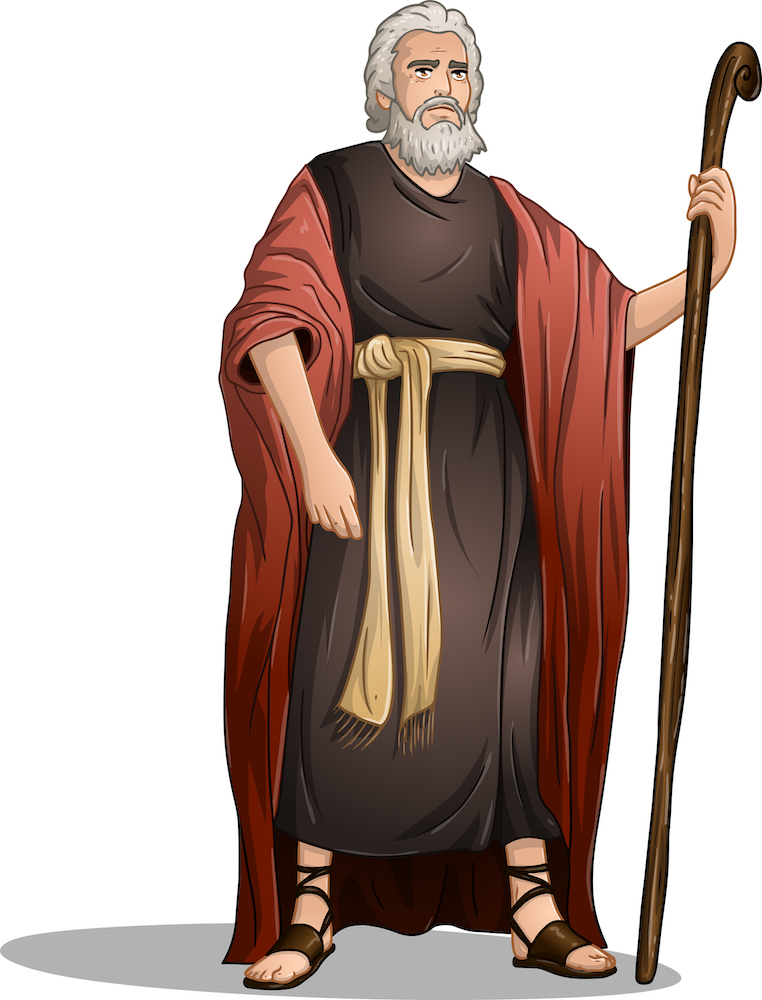
Outline of Sefer Devarim/Deuteronomy: Moses’ Farewell Address
Chapter 1:1–5, Introduction
Chapters 1:6–4:40, First Discourse
Moses gives a veiled rebuke for sin and disobedience, and gives a review of the journey from Mount Sinai to Kadesh with exhortations to obedience.
Chapters 4:44–11, Second Discourse, Part 1
The religious foundations of the covenant, the spirit in which it is to be kept and the motives to right obedience are discussed. Moses shows how the covenant defines the relationship between YHVH and Israel and emphasizes the basic spiritual demands that such a relationship imposes upon Israel.
Chapters 12–26, Second Discourse, Part 2
The code of law dealing with:
Worship, Chapters 12:1–16:17
Government, Chapters 16:18–18
Criminal Law, Chapters 19:1–21:9
Domestic Life, Chapters 21:10–25
Rituals and the Sanctuary, Chapter 26
Chapters 27–30, Third Discourse
The enforcement of the Torah-law with its blessings and curses; establishment of a fresh covenant between YHVH and Israel (i.e. the younger generation).
Chapters 31–34, The Last Days of Moses
Chapter 31, Committal of the law to the keeping of the priests.
Chapter 32, The Song of Moses (a prophecy about Israel’s future).
Chapter 33, Moses’ patriarchal blessing over the tribes of Israel.
Chapter 34, The death of Moses.
Overview of the Book of Deuteronomy/Devarim from Various Commentators
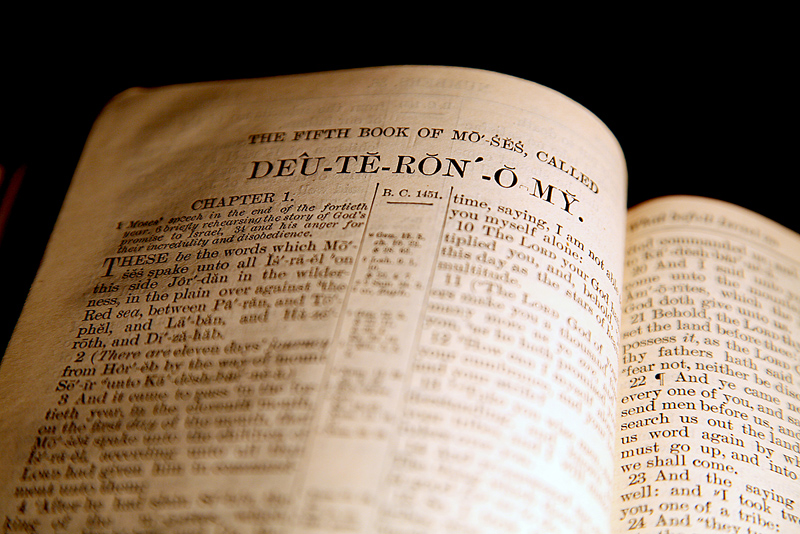
This last book of the Torah starts out with “These are the words which Moses spoke ….” The Hebrew name for Deuteronomy is Devarim meaning “words,” which is the plural form of devar meaning “word, speech, a matter or thing, a commandment, a report, a message, promise.” Note the similarity in meaning between the Hebrew word devar and the Greek word logos from John 1:1 (“In the beginning was the Word, and the Word was with Elohim, and the Word was Elohim.”). Logos means “speech, word or thing.” From this connection, we see that Yeshua was the Word of both the Old Testament (OT or Tanakh) and the New Testament (NT or Testimony of Yeshuah). He is the message of the entire Bible (Spirit Filled Life Bible, from the “Word Wealth” at Deut 1:1).
Deuteronomy is written similarly to the vassal-treaties formulated between captor and captive nations prior to 1000 B.C. It contains historical information, enumerates laws, and concludes with threats and promises (Hebrew Greek Key Study Bible, from the Introduction to Deuteronomy). From a general survey of Deuteronomy, it is sufficiently evident that the exposition of the commandments, statutes, and rights of the law had no other object than this: to pledge the nation in the most solemn manner to an inviolable observance, in the land of Canaan, of the covenant, which YHVH had made with Israel at Horeb (Deut 28:29, Keil and Delitzsch Commentary of the Old Testament, from the introductory note to Deut).
In Deuteronomy, Moses speaks like a dying father giving a farewell song to his children, all the while he celebrates Elohim as the spiritual Rock of Israel. While the eyes of the Israelites may have fixated too much upon Moses their physical leader (instead of Elohim) for forty years, Moses now attempts to redirect their eyes, trust and allegiance heavenward and onto YHVH, their real spiritual Leader who had been behind Moses—a mere human leader—all the time.
Deuteronomy is Moses’ last word and final admonition to Israel before his death. It is a review of the main points found in the first four books of the Torah. This review is for the benefit of the younger generation who has been born and/or grown up in the wilderness and who are about to enter the Promised Land. The first few chapters of Deuteronomy includes several themes that are mentioned over and over again underscoring their importance in YHVH’s eyes. They are:
Teach the children YHVH’s instructions in righteousness (i.e. the Torah).
Teach the children about their historical and spiritual roots.
Fear YHVH.
Remember the giving of the Torah at Mount Sinai and the supernatural occurrences surrounding that event.
Do not allow yourself to become involved in idolatry and the practices of the heathen nations.
Keep Torah and all will be well with you.
YHVH’s Torah commandments are eternal.
Don’t forget YHVH nor turn from the Torah—YHVH’s instructions in righteousness.
Consider these admonitions of YHVH to his people. Are we heeding these instructions and grounding our people in these things? What are you doing in your own life to take YHVH’s wise admonitions seriously?
The words of Deuteronomy are earnest and impressive. Moses looks back over the whole of the forty years of Israel’s wandering in the desert, reminds the people of all the blessings they had received, of the ingratitude with which they had so often repaid Elohim, and of the grace, mercy, love and judgments of Elohim. Furthermore, Moses explains the laws of Torah again and again, and adds to the Torah some 70 new laws, which were necessary to complete it. He never wearies of urging obedience to the Torah in the warmest and most emphatic words, because the very life of the nation was bound up with this; he surveys all the storms and conflicts which they passed through, and, beholding the future in the past, takes a survey also of the future history of the nation, and sees, with mingled sorrow and joy, how the three great features of the past—that is to say, apostasy, punishment, and pardon—continue to repeat themselves in the future also (Keil and Delitzsch Commentary on the OT, from the introductory note to Deut).
Deuteronomy is a unique book—distinct from the narrative and historical, the legal, prophetic, and devotional writings of the Scriptures, though it has affinities with each of them. In its literary aspect, it is an oratory; and as such it is unsurpassed in its rush of rhythmic sentences, its ebb and flow of exalted passion, its accents of appeal and denunciation: Moses’ speech shines as well as his face. And this noble language gives utterance to truths which are always and everywhere sovereign—that Elohim is one, and that man must be wholly his; that Elohim is righteous and faithful, merciful and loving. Elohim’s proclamation in Deuteronomy stands in relation to Israel and humanity not merely as Judge or Ruler, but as Friend and Father. “And thou shalt love YHVH your Elohim with all thy heart, and with all they soul, and with all they might.” This whole-soul love and devotion to Elohim is to be accompanied by a large-hearted benevolence towards man, and indeed towards all sentient beings; by the recognition of the retributive righteousness of El; and by the insistence on the vital importance of family life, and of religious instruction within the home. The influence of the Book of the Farewell Discourses of Moses on both domestic and personal religion in Israel throughout the millennia has never been exceeded by that of any other book in the Scriptures (Soncino Edition of the Pentateuch and Haftorahs, from the introductory note to Deuteronomy).
In this book, YHVH can also be viewed as a husband asking his bride to give her whole heart to him, to follow him and to obey him. Sadly, in the rest of the story (after Joshua), we see chronicled the sad saga of a bride having a difficult time being a good wife. In the end, Israel becomes a rebellious and adulterous wife to the point that YHVH was forced to divorce her despite his patience and mercy. Then YHVH promised to do a new thing and comes in a human form (namely, Yeshua) like Moses—so that his people would learn to relate better to him. He wanted to set his people back on the right and good path (of Torah), and to restore them as his bride. He has now betrothed himself to his people (the saints) once again (this occurred with Yeshua at the last supper), given them his Holy Spirit as their engagement ring (on the Day of Pentecost), and since then it has been a long betrothal period (2000 years), so that those saints (i.e. redeemed Israel or the one new man; Eph 2:11–19) through trials and tribulations can be spiritually refined so that she can be a good wife for him. YHVH wants to see what is actually in her (our) heart. He wants a faithful companion forever.
Moses was the first to prophesy the coming of the Messiah (Deut 18:15), and Moses is the only person to which Yeshua compared himself (John 5:46–47).
Yeshua often quoted from Deuteronomy. When asked what was the most important commandment in the Torah, he quoted Deuteronomy 6:5 and included this verse as part of his summation of the whole Torah. In his temptation in the wilderness, he quoted exclusively from Deuteronomy when resisting the devil (Deut 8:3; 6:16; 6:13; 10:20).
Deuteronomy teaches more of the heart and spirit of the Torah, and that the relationship of Elohim to his people encompasses much more than just a legalistic observance of the Torah. Israel’s covenant relationship with Elohim involves obedience and loyalty as well as love, affection and devotion, which should be the true foundation of all of our action. Success, victory, prosperity and happiness all depend upon our obedience to YHVH. The book is a must-read for an understanding of man’s obedience to Elohim based on love and fear (Deut 10:12, 13, Spirit Filled Life Bible, from the introductory note to Deut).
In a sense, Deuteronomy is not only a synopsis, but a commentary on the first four books of the Torah. This book along with the Epistle to the Hebrews contain the best comment on the nature, design, and use of the Torah (Adam Clarke’s Commentary on Deuteronomy, from the introductory note to Deut).
The Book of Deuteronomy contains not so much a recapitulation of the things commanded and done as related in Exodus, Leviticus and Numbers, as it is a compendium and summary of the whole law and wisdom of the people of Israel, wherein those things that related to the priests and Levites are omitted, and only such things are included as the people are generally required to know. Much more than a being a repetition of what preceded it, Deuteronomy is an oratory description, explanation, and enforcement of the most essential contents of the covenant revelation and covenant laws, with emphatic prominence given to the spiritual principle of the law and its fulfilment, and with a further development of the ecclesiastical, judicial, political, and civil organization, which was intended as a permanent foundation for the life and well-being of the people of Israel in the Promised Land of Canaan. There is not the slightest trace throughout the whole book of any intention whatever to give a new or second law (Keil and Delitzsch, from the introductory note to Deut).
The covenant of Deuteronomy contains all these parts. The first eleven chapters are generally a summary of the adventures of Israel beginning from the covenant they confirmed at Mt. Sinai. The actual stipulations or terms of this new covenant start with chapter 12 and go to chapter 26. Chapter 27:10-28 detail the blessings and punishments that will come depending on Israel’s compliance. Later chapters instruct how the covenant will be perpetuated.
As part of their compliance Moses instructed Israel to write this law on large stones when they crossed into the Promised Land. Likely they wrote only the instruction of chapters 12-26:15. Since they recited the blessings and curses of chapter 27-28 they probably didn’t write those or anything following with the law (Deu 27:11-14).
More Insights About the Book of Deuteronomy
In stark terms, YHVH warns the Israelites in Deuteronomy of the struggles Israel will have as it walks between two world: the lower world that attaches itself to man’s soul and attempts to pull him downward, and the upper world that pulls the spirit in man heavenward.
Deuteronomy presents Torah (as does Ps 119) as the way to be spiritually, physically, mentally, emotionally, materially elevated before Elohim and in the eyes of the surrounding nations (Deut 4:6).
In Deuteronomy, YHVH lays out two extremes: blessings for obedience and curses for disobedience; curse for following the ways of this world, and blessings for following the Word of YHVH. But seldom do individuals find themselves in one extreme or the other, for few are either totally worldly or totally heavenly in the orientation of their lives. They are usually caught up somewhere in the middle ground between the two: not totally evil and not totally good. Their lives are a mixed bag of good and evil, blessings and curses, and a double-orientation toward the heaven and the world. The Bible calls this double-mindedness (Jas 1:8; 4:8), and Yeshua decries such an individual (Matt 6:24, “one can’t serve both God and mammon”). The Bible also calls this being lukewarm—being neither hot nor cold, and YHVH hates this as well (Rev 3:15–16). Such an individual, if he isn’t careful, can find himself feeding spiritually more from the tree of the knowledge of good and evil rather than the tree of life.
YHVH lays out the highest spiritual ideal for Israel: to be wisdom in the sight of the nations (Duet 4:6), to be the head and not the tail, to be the greatest and not the least, and to be the lender and not the borrower. Such a position of status is possible thanks to following the Torah. He wants the best for his people, but achieving such is conditional on their obeying him. Many people make claim to believe in the God of the Bible, to love him and many even claim to follow and to obey him—just ask them! But in reality, do they? What are the fruits of their lives? Their true spiritual status is based on what they do, not what they profess with their mouths!
Deuteronomy affirms the sufficiency of Torah. The Torah is the Word of Elohim and nothing more needs to be added to it. It is the full revelation of YHVH when it says not to add to the Word of Elohim (Deut 4:2; 12:32). It is the bedrock of the Scriptures and the bedrock of truth. If Torah is the bedrock of YHVH’s word, then the Ten Commandments are the cornerstone in that foundation of truth, which Moses reiterates in Deuteronomy five. The rest of the Scriptures are just commentary or elucidations on Torah, or admonitions for YHVH’s people to return to Torah. The truths of the Testimony of Yeshua (the New Testament) stand firmly on the Torah and never once contradicts Torah. The Torah is the flower bud that contains the full flower, while the Testimony of Yeshua is the open flower in its full glory.
Torah keeps YHVH’s people on the straight and narrow path and from falling into the ditches on either side of the road. Those ditches are legalism and license, the letter and the spirit of the law (Deut 5:32).
Deuteronomy stresses man’s need to fear Elohim. Though loving, personal, merciful, and full of bountiful goodness, he is at the same time a consuming fire of jealousy, wrath and judgment against those who disobey him, and he will bring all men to account for their wickedness and sin (Deut 4:24; 6:15; 9:3). He warns his people not to tempt or to push him (Deut 6:16). He is also a consuming fire against Israel’s enemies (9:3).
The absolute preeminence of YHVH is stressed again and again in Deuteronomy.Putting him first in our lives starts with fearing him always (Deut 6:24), and doing what is right and good in his sight that you may be blessed and live victoriously (Deut 6:18). All this is based on YHVH’s love for his people and vice versa.
Deuteronomy defines and elucidates the true meaning of love. The Shema of Deuteronomy 6:5 declares that man is to love YHVH 1000 percent. Likewise, YHVH set his love unconditionally upon his people (Deut 7:7–9). That love is inviolate for 40,000 years, or 1000 generations (Deut 7:9).
Deuteronomy stresses the importance of relationship. Numerous passages in Deuteronomy enumerate the importance of relationships at all levels: between humans and between humans and Elohim. The horizontal and vertical aspects of love come together at the seven annual biblical feasts where YHVH’s people are commanded to gather together where he has placed his name and at the times he has set to celebrate and rejoice before him (Deut 12; 14:23ff; 16:1ff).
Deuteronomy constantly repeats and stresses Israel’s history and emphasizes the importance of understanding our history including both the defeats and victories of our forefathers. History is a great teacher, and many mistakes can be avoided by having a thorough understanding of and a healthy respect for history, and by learning the lessons of history.
Deuteronomy instructs men to circumcise or cut way the barriers of their hearts(Deut 10:16; 30:6; see also Lev 26:41). Deuteronomy is the first place YHVH commands his people to circumcise their hearts.
Deuteronomy emphasizes the need to teach Torah to our children. We are not only to be concerned about our past history, but to be future-minded people also by passing on our legacy (YHVH’s Torah instructions from heaven) to future generations (Deut 6:7; 11:19).
Deuteronomy is a song or poem where the Creator passionately woos his creation. It almost sometimes seems that YHVH is pleading with his people to follow him, to keep his commands, to enter into a forever love relationship with him so that they can be blessed abundantly and victorious, though he forcefully stresses their need for him, the curses that will come upon them if they turn away from him, the fact remains that the choice to follow him is still up to them (Deut 11:26; 30:15). The only thing over which man remains sovereign is his own heart; therefore, man has to choose to love and serve YHVH with his whole heart.
Our annual Scripture Reading Schedule for 2020-2021 with daily readings that began on 10/11/20 is available to download and print. The link to the previous 2019-2020’s Scripture Reading Schedule will still be available on the right sidebar under “Helpful Links” into next year. If you are using a mobile device or tablet, the link may be below, meaning you’ll need to scroll down instead.
Most of this week’s blog discussion points will be on these passages. If you have general comments or questions on the weekly Scripture readings not addressed in a blog post, here’s a place for you to post those. Just use the “leave a reply” link or the “share your thoughts” box below.
The full “Read Through The Scriptures In A Year” schedule, broken down by each day, can be found on the right sidebar under “Helpful Links.” There are 4 sections of scripture to read each day: one each from the Torah, the Prophets, the Writings, and from the Testimony of Yeshua. Each week, the Torah and haftarah readings will follow the traditional one-year reading cycle.
* Verse numbers in parenthesis refer to the verse number in Christian English Bibles when they differ from Hebrew Bibles or the Tanakh.
** A different Haftarah is read when it is a special sabbath in Jewish tradition. This week it is Shabbat Rosh Chodesh on the traditional calendar. Otherwise, Jeremiah 2:4-28; 3:4 would be read.
Weekly Blog Scripture Readings for 7/4 through 7/10/2021.
2 Corinthians 3:11, Passing away. This is not a reference to the Torah-law itself, but to the old or former covenant (i.e. the agreement or contract YHVH and Israel made with each other) as it phases into the new or renewed covenant. Yeshua initiated the new covenant at his last supper, but it will be finalized with the two houses of Israel (see Jer 31:31, 33 and Heb 8:8) at his second coming when the two sticks or houses of Israel are reunited (see Ezek 37:15–27) at which time he will finalize the new covenant with a reunited Israel (v. 26; see also Isa 54:10; 55:3; 59:21; Ezek 34:25; Jer 32:40; 50:5; Hos 2:18–23). We are presently in the intermediate phase between the two covenants. To view it differently, Yeshua betrothed himself to his spiritual bride (redeemed Israel, spiritual Israel or the Israel of Elohim, see Gal 6:16) at his last supper, but will marry her at his second coming. The saints who are now in Yeshua are under the new covenant as the betrothed bride of Yeshua, but all Israel will be brought into the new covenant at his second coming at which time he will finalize the covenant that he initiated with his disciples before his death.
Attaining Spiritual Maturity in the New Covenant—On Being a Spiritual Mountain Climber
(This manna from heaven was revealed and downloaded to Natan in the back country of Alaska while sitting, Bible in hand, prayerfully, overlooking Little Port Walter on Baronov Island [75 miles SE of Sitka], and while on a boat in the Pacific Ocean in the Chatham Straights between Baronov and Admiralty islands.)
On Being Spiritual Mountain Climbers
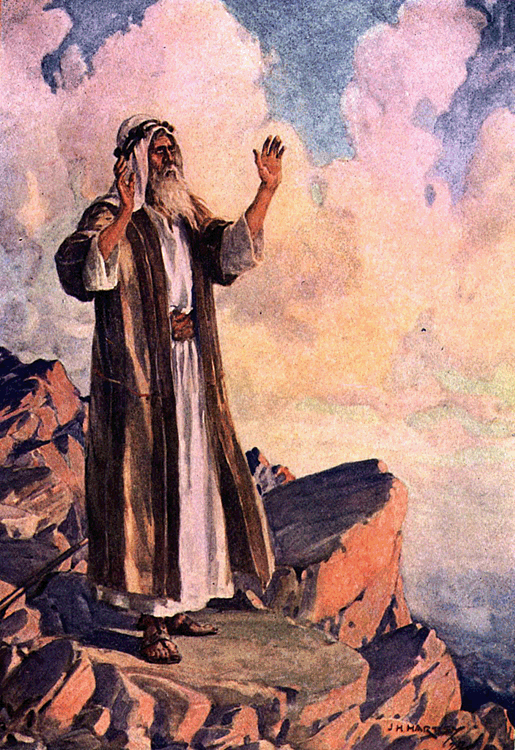
From the time that YHVH revealed himself to the children of Israel while they were enslaved in Egypt, he has been calling his people to be spiritual mountain climbers. He first called the Israelites out of Egypt and up to Mount Sinai, and then up to Mount Zion in Jerusalem. He then called his people to come even higher yet to the upper room on the day of Pentecost, and he is now calling his people to come up even higher to the New Jerusalem that is above us and is “the mother of us all” (Gal 4:26).This highest mountain of YHVH is the ultimate source of our spiritual sustenance, the source of the river of life along which the trees of life are situated (Rev 22:1–2). From this spiritual wellspring comes all divine revelation and ultimately immortal life as children of the Most High. What does it mean to be a spiritual mountain climber?
The beginning of the upward spiritual journey of YHVH’s people is memorialized in the counting of the omer, which starts on First Fruits Day occurring during the Feast of Unleavened Bread and culminates fifty days later with the Feast of Weeks or Pentecost (Heb. Shavuot; Lev 23:4–16). Each new step in this journey is a stepping stone or a launch pad to the next. For the Israelites, the journey started at sea level in the flat-land Nile River delta area of Egypt (a metaphor for this world, Satan and death) and then continued climbing higher and higher until it finally reaches heaven itself—the abode of Elohim. YHVH gave Jacob a similar perspective when he gave him the vision of the ladder to heaven in Genesis 28.
The problem is that most people only climb so far in their spiritual journey and then stop, or they grow weary along the way, or they become comfortably complacent at the level they have thus far attained and never move past that spot. Merely treading water while in the river of life means that one is making no forward movement; they may, in fact, be pulled backwards by the downward current. This is dangerous because while we think we are moving forward, we may actually be going backward! Yeshua warned the Laodicean church about such an attitude of self-assurance and complacency in Revelation chapter three.
To not move forward spiritually is to stagnate and to die. YHVH wants a people that are on the move, who will obediently follow him wherever he leads, and not stop and park along the way only to construct their religious monuments with their fossilized customs, rituals and traditions. Heaven is a far above the earthly plane, and YHVH wants children who will seek him no matter what, who have a heart to follow him no matter where, and no matter the cost. Although eternal life is a free gift from heaven, it will not be given easily. It costs nothing, but, at the same time, it costs everything! Each of us must be willing to sacrifice his all—to lose his earthly life—to gain eternal life. YHVH refuses to give out his priceless gift of eternal life willy-nilly to anyone and everyone! YHVH requires that his saints be determined, tough and gritty mountain climbers who refuse to give up until that summit is reached. He has no pleasure in those who turn back, or refuse to go on. The older generation of Israelites found this out the hard way while trekking through the wilderness—a symbolic metaphor for this physical life—en route to the Promised Land (a metaphor for eternal life or heaven on earth). Their hearts were sin-hardened and they lacked the faith in YHVH to make it all the way. Thus they perished in the wilderness just short of their goal and ultimate reward (read Heb 3:7–19; 4:1–11). Only those who doggedly overcome the world, the flesh and the devil remaining lovingly loyal and obedient to him will receive the highest reward he has to offer. As Yeshua said,
But he that shall endure unto the end, the same shall be saved. (Matt 24:13)
The Spirit Versus the a Letter of the Law—The Two Covenants
Let’s now explore what it is to climb the mountains that YHVH has placed before us to ascertain where we are at on the journey and how far we have to go to reach the ultimate summit.
Which side of the Torah do YOU lean toward? License or legalism? The letter or the spirit? Mercy and grace or judgmentalism? Is our obedience to Torah based on love or self-righteous legalism? Where is the heart of Elohim in this issue? What should be our approach—especially toward others? All too often we want leniency and grace, but are reluctant to show mercy toward others when it comes to Torah-obedience. Is Elohim a harsh judge or a loving Father? What does he want from us? Read on as we explore this issue in an effort to find the heart of Elohim on this matter.
2 Corinthians 3:2–15, Overview of the Letter Vs. the Spirit of the Torah
In this passage, Paul is not teaching against the validity or replacement of the Torah with something else. No! There is nothing wrong with YHVH’s Torah-law. How could there be? It is the Word, mind, will and heart of Elohim. Torah shows us how to love Elohim and our neighbor. It shows us how to be blessed, defines sin, shows us how to walk in the paths of righteousness, leads us to Messiah and the shows us our need for him because of our sin and inability to live up to its high standards of holiness and righteousness.
These are just a few of the wonderful benefits of YHVH’S Torah-Word, which I have discussed at length many times elsewhere. The problem with Torah, if you will, is not with Torah itself, but with what sinful and misguided people do with it. The Torah, like money alcohol or guns, is neutral. It is the misuse of these things by sinful people that is evil. For example, money is not evil; however, the love of it is as Scripture clearly states.
The problem with many people in our day who are returning to a more Hebraic and Torah-centric orientation in their spiritual walk is balance or the lack thereof. Too many people go hog-wild over Torah because the mainstream church system which they have exited had deprived them of it, and when they learn about the Torah, they run to it like a flock of starving and half-crazed sheep stampeding from a desert into verdant, lush pasture of grass. They gorge themselves and then get the runs and get all messy. (I know because I grew up on a sheep farm!) Too many people forget about Yeshua and the fact that they cannot even do Torah without him and his Spirit working in them. Sadly, people forget that we’re “under/subject to the law toward Messiah” as Paul was (1 Cor 9:21). Without Messiah, the Torah is the simply a legalistic set of rules, and those who follow it as such are simply a bunch of people trying to earn their own righteousness through their own will power. This cannot be done. The Israelites tried this and failed miserably. Most perished in the wilderness. Why do we think we can do any better?
Please keep this mind that in 2 Corinthians 3 Paul is largely talking about covenants—both the old and new, which he refers to in verses 6 and in 7 as “the ministration of death,” and which is passing away (v. 11). The Torah itself which remains is still glorious (v. 11). The Torah was merely the terms of the “Old Covenant”, not the covenant itself. Never forget that the “Old Covenant” never promised a person eternal life or ultimate salvation from sin; the New Covenant does. Moreover, there is nothing wrong with the Torah itself, for with it comes many benefits and blessings (if obeyed) and many curses including guilt, shame, condemnation and death because of sin (if disobeyed).
The problem when one lives a totally Torah-centric live is that it overlooks the necessary power of the Spirit of Elohim to work in a person’s life through a relationship with Yeshua. The problem is the rebelliousness of human nature and hard human heart which refuses to be subject to the laws of Elohim (Heb 8:7–8; Rom 8:7; Jer 17:9). We need help from above to overcome our human natures that are opposed to Elohim’s laws. That is where Yeshua comes into the picture
Moreover, the problem has never been with the Torah, or even the letter of Torah-law per se. How could it be? Torah is the instructions in righteousness from Elohim himself and are a reflection of his very mind, will and heart. There can be nothing wrong with this, since this is pure light and Truth! Now I said “the letter of the law per se.” What did I mean by this? Simply this. If one lives only by the letter of the law, and judges others by the letter, and doesn’t bring in the spirit of law, then how are we all to stand? What if YHVH only judged us by the letter and not the spirit? We would all become instant grease spots yesterday!!! No! Thankfully, his mercy triumphs over his judgment against our violation of his Torah or else we are all gonners! There for his grace go each of us.
Morevover, if we get perpetually hung up all the time on every jot and tittle of every point of the law, we will become so focused on legalism and judgmentalism that our focus will be on that instead on the love of brethren and the love of Yeshua. We will be so focused on a punctilious letter of the law obedience and judging everyone else who is not living up to our standards that we will fail to be doing the great commission and winning the lost and loving one another. That is the problems with the many people today who are leaving the mainstream Christian church and returning to a more Hebraic, Torah-centered spiritual orientation. Too many Hebraic-minded folks have become so proud of their Torah-obedience that YHVH can no longer use us to advance his kingdom. He hates this kind of self-righteous, Pharisaical pride!
The problems with Torah is humans, which is not a problem with Torah at all. Rather it is deceitful, deceived humans who twist the Torah for their own purposes or who misunderstand its full purpose. Remember what Hebrews 8:8 says? The problem was with them—the Israelites—and their lack of faith and hard hearts, and NOT with the Torah. That’s one reason that YHVH needed to make a new covenant and why the old one is passing away (Heb 8:13). So what is the remedy for the problem of human hard heartedness? As Jeremiah prophesied, YHVH this time will pour out his Spirit and change the hard and disobedient heart of faithlessness and unbelief (Heb 4:1–7) of man and give him a new heart (Heb 8:7–13; Jer 31:31–33).
Again, this can only happen as Yeshua lives out his righteousness in a person as the Spirit of Elohim changes the human heart.
Never forget what Paul said elsewhere: we are subject to the Torah through Messiah (1 Cor 9:21). This is the miracle of a transformed heart that not only wants to but is empowered to comply with the Torah. It truly is a miracle that we cannot fully understand or explain. But the fruits of it are evident in a person’s life. These are called the fruit of the Spirit. All the fruit of the Spirit listed in Galatians 5 are the fruits or manifestation of Torah obedience out of a heart of love and faith. At the same time, the works of the flesh are the manifestation of Torahlessness which is sin (1 John 3:4), and is the opposite of righteousness, which Torah defines (Ps 119:172).
So what is the spiritual blindness that Paul refers to in 1 Corinthians 3:14? It is the blindness of a hard and disbelieving heart. It is the blindness of human pride in one’s ability to live up to Torah by one’s own strength. It is pride in thinking that we’re better than the next guy who’s not living up to our Torah standard, whatever that may be. It is blindness based on a letter of the law approach to Torah instead of both a letter AND a spirit of the law approach. And yes, there can be blindness due to the guilt and shame of failing to live up to the high moral and spiritual standards. When we obey Torah out of fear of Elohim instead of love for him, this too is blindness and bondage.
So when returning to a more Torah-centric belief system and lifestyle, let us clearly walk the straight and narrow path not veering too far to the left (or license, grace, of the spirit of the law) or too far to the right (legalism, judgmentalism, self-righteousness or the letter of the law). The heart of our Father in heaven is somewhere in the middle between the two as Yeshua stated:
But the hour is coming, and now is, when the true worshipers will worship the Father in spirit and truth; for the Father is seeking such to worship Him. Elohim is Spirit, and those who worship Him must worship in spirit and truth.” (John 4:23–24)
WARNING! It is time for the saints of the Most High Elohim to boycott the corporate entity called The Church Inc. Just walk away from it! This is part of the harlot system that YHVH Elohim is calling his people out of that has tickled ears and made people spiritually drunk for far too long. Wake up saints and come out of her!
2 Corinthians 2:17, Peddling the word of Elohim.Are you as fed up with peddlers of the Word of Elohim as I am? It’s everywhere you go—people standing along the highways of biblical religion with their hands out panhandling. Even in Paul’s day as in our, the ministry of the gospel has “many” gospel peddlers.
Show me just about any big name in Christianity, Messianic, the Hebrew Roots Movement and, in most cases, I’ll show you someone who has built their ministry on shameless self promotion, hype, glitz, corporate marketing techniques and their ability to cleverly woo people to their book seller’s table or website that is chalk full of wares that promise to fill your head with the latest prophetic insights, esoteric biblical head knowledge, pop-psychological, self-help, humanistic, new-age, ear-tickling pap. It’s all yours, if you’ll only plunk down some of your hard-earned cash.
Well, I’m not the only one who’s fed up with these modern-day merchandizers of the gospel. The Apostle Paul was too. Evidently it was rampant in his day as well as we have seen in the scripture verse quoted above: “For we are not, as so many, peddling the word of Elohim…” The word peddling there means “to be a retailer, to make money by selling anything, to get sordid gain by dealing in anything, to do a thing for base gain, to trade in the word of God, to try to get base gain by teaching divine truth, to corrupt, to adulterate, peddlers were in the habit of adulterating their commodities for the sake of gain.”
These guys don’t need to bother knocking on the door of the congregation I pastor, nor at the events our ministry sponsors. The welcome mat isn’t out for them!
Haven’t these spiritual beggars read the word of Elohim? Don’t those who support them know that this was not the way of Yeshua and the apostles? How many examples in the Bible are there of the true servants of Elohim peddling the Word of Elohim, and then living off the proceeds? None! Didn’t Yeshua tell his disciples when he sent them out to preach the gospel, “Freely you’ve received, freely give?” (Matt 10:8). What about this don’t we understand? Remember how Yeshua turned the money-changers tables over in the temple, and how he lambasted the greed of the Jewish religious leaders of his day who “devoured widows houses” (see Matt 21:12; 23:14)? Sadly, little has changed in religious circles since then.
Now I’m not opposed to people freely and without coercion giving to ministries who feed them by preaching and teaching the Word of Elohim. This is totally copacetic to the biblical norm. But selling, peddling and merchandizing is another thing. Of course, none of the offending parties are doing this are they? Just ask them, as they adroitly polish their 14 karat gold-plated hallows. The problem is that the gold plating is wearing thin, and the pot-metal is showing through. The discerning person see this and avoids such people.
The truth of Elohim cuts like a sword to reveal these characters for who and what they are—soulish, greedy, carnal and lazy bums who desire to live of the fat of YHVH’s sheep instead of submitting to the Spirit, truth and Word of YHVH Elohim (Heb 4:12). Go read, if you dare, what the prophet Ezekiel had to say about these guys in Ezekiel 34. YHVH’s judgments are coming against them (verse 20)! This is an end-times prophecy (see verses 23–25).
Other scriptures deal with this issue as well. Speaking of the qualifications of a spiritual overseer, Paul writes,
Not given to wine, no striker, not greedy of filthy lucre [covetous]; but patient, not a brawler, not covetous… (1 Tim 3:3)
Speaking of the qualifications of a spiritual overseer, Paul writes,
Likewise must the deacons be grave, not doubletongued, not given to much wine, not greedy of filthy lucre [money]… (1 Tim 3:8)
Paul continues,
For a bishop must be blameless, as the steward of God; not selfwilled, not soon angry, not given to wine, no striker, not given to filthy lucre [money]… (Tit 1:7)
Speaking of false teachers, Paul writes,
Whose mouths must be stopped, who subvert whole houses, teaching things which they ought not, for filthy lucre’s sake [dishonest gain].”(Tit 1:11)
Peter instructs,
Feed the flock of God which is among you, taking the oversight thereof, not by constraint, but willingly; not for filthy lucre, but of a ready mind… (1 Pet 5:2)
Interestingly, the problem of spiritual pan-handling peddlers and money-grubbers persisted in the early church even after the death of Paul. The Didache, which is one of the earliest, non-canonical documents that exists from the apostolic age from the late first-century A.D., contains some warning, which are as cogent in our day as then. It lays down some guidelines pertaining to the traveling Bible teachers of that day, which we would do well to follow.
Let every apostle [and prophet] that comes to you be received as the Lord. And he shall remain one day, and if there be need the second also; but if he remains three days, he is a false prophet. And when the apostle departs let him take naught, save provision of bread till he be lodged. But if he ask for money, he is a false prophet.
Phinehas was no temperamental, mealy-mouthed snowflake, soy-boy in confronting evil! What are YOU doing to confront the those things that YHVH calls evil? Let the example of Phinehas and the other righteous warrior-saints of Scripture inspire you to take stand for Truth and righteousness in these dark and evil times.
Numbers 25:1, Commit harlotry. Sexual immorality has the downfall of many a saint who considers themselves to be strong, righteous and impervious to sinful temptation. There is a terrible price to pay for falling to sexual immorality as the Israelites found out.
The enemy (the world, the flesh and the devil) knows our weaknesses and will do its best to capitalize on them for our destruction. Romans 13:14 says, “But put on the Master Yeshua Messiah, and make not provision for the flesh, to fulfill the lusts thereof.”
What doors of immorality have you kept open in your life to gratify the immoral cravings of the flesh? What spiritual stronghold exists in your life that the enemy can use to keep you under its thumb and from walking in the joy and freedom of the will of YHVH? It is time to cry out to YHVH for help and deliverance and to repent.
Setting immovable boundaries in one’s heart and mind ahead of time is a major key to resisting sexual temptation successfully. It’s important to decide how far we can go without violating the spiritual guidelines the Scriptures lay out for us to stay righteous sexually, and then not allow ourself too get too close to those limits. For example, if you find yourself in a potentially compromising situation, flee that situation to alleviate the possibility of falling prey to moral compromise (2 Tim 2:22).
Young people who are naturally endowed with strong sexual urges need to bathe their minds in the godly admonitions found in Proverbs chapters one through nine (also note Eccl 11:9–10 and 12:1–14). Learning the ways of wisdom and the fear of Elohim as revealed in these chapters in Proverbs is a vital component to staying strong morally and being triumphant over the wicked temptations of the world, the flesh and the devil.
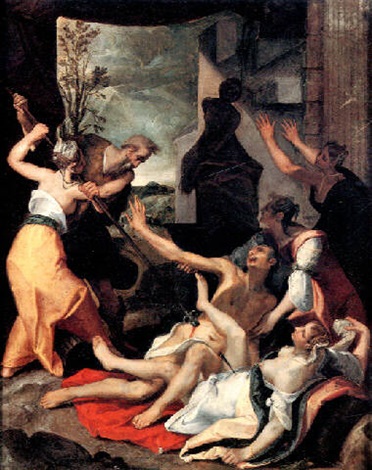
Numbers 25:7, Phinehas…took a javelin. Phinehas, the priest, rose up against evil—in this case, sexual immorality—and took a stand for righteousness, and YHVH commended him for it. Who are the Phinehases of today?
In standing against sin, Phinehas, the grandson of Aaron the high priest, was not acting as a self-appointed vigilante as it may appear. Rather, YHVH had given the priests, of which Phinehas was one, the authority to act as judges in Israel and to pronounce sentence in criminal matters (Deut 17:9–11). Additionally, Phinehas was doubly justified in his action against the fornicators, since he was an eyewitness of these sexual crimes, and the Torah teaches that the hand of the eyewitness was to be the first to rise up in executing judgment against the criminals (Deut 17:6; Ezek 44:24). So as an eyewitness and as a priest, he was legally justified in his actions. The priests and Levites were to act as Israel’s legal experts (Lev 10:10–11; Deut 24:8; 33:10; 2 Chron 17:9; 30:22; Neh 8:2, 8; Hag 2:11; Ezek 44:23; Mal 2:7) and to make determinations between the holy and the profane (Ezek 22:26; 44:23).
Who are YHVH’s priest on the earth today? According to Peter, and John the saints are those priests (1 Pet 2:7; Rev 1:6; 5:10; 20:6). As such, the saints presently possess the divinely mandated legal authority to fulfill the responsibilities of the priesthood of old when it comes to teaching the laws of Elohim to the nations in which they live (Lev 10:10–11). Moreover, Yeshua, our Great High Priest, has tasked his disciples with the responsibility and authority to judge righteously (i.e. to make judgments according to YHVH’s standards of righteousness, John 7:24), and to be spiritual fruit inspectors (Matt 7:15–20). Today, this responsibility is primarily exercised within the congregation of the righteous (1 Cor 5:12; 6:1–6). However, besides this, the righteous saints are to act as spiritual salt in this world and to be like a spiritual light on a hill for the world to see (Matt 5:13–16). This means that they are to preach the gospel to the world, to make disciples and to teach those around them all that Yeshua has commanded them (Matt 28:18–20; Mark 16:15–16). This means that the saints have heaven’s authority and commission to act as the spiritual and moral compass and conscience for the nations in which they live. This means that they will be standing against evil wherever and however they can as directed by the Spirit of Elohim, even as Phinehas did.
It is time that the righteous servants of YHVH Elohim begin to stand up in a more vocal and demonstrative way against the evil that is being foisted upon our society by those who are bent upon destroying the family, morality, and any vestiges of biblical standards of righteousness that may still exist around us. In Psalm 94:16, YHVH asks the question of his servants, “Who will rise up for me against the evildoers or who will stand up for me against the workers of iniquity?” With this in mind, the question we need to ask ourselves is this: If not me, who; if not now, when? If you have something worth living for, then do you have something worth giving your life for? If those who are caught up in demonically inspired religious systems are willing to die for their faith calling it “a holy war” and “martyrdom for their [demon] god,” can the saints of YHVH at least not take a verbal stand against the tide of evil that is sweeping our society?
The Bible is full of examples of YHVH’s servants standing against unrighteousness in their day and their receiving YHVH’s blessing for it. Several examples include the Hebrew midwives disobeying the edict of Pharaoh to commit infanticide (Exod 1:15–22), Phinehas executing judgment against the fornicators (Num 25:7–8), the three Hebrew children refusing to worship the golden image (Dan 3:8–18), Daniel violating the king’s edicts by praying to YHVH (Dan 6:10–12), John the Baptist criticizing Herod for his adultery (Mark 6:18), Yeshua turning over the money changers’ tables in the temple (Matt 21:12), and Peter and John for disobeying the Jewish leaders’ command to not preach the gospel (Acts 4:18–20). Many more examples could be given. Remember all the biblical prophets?
Numbers 25:11, Has turned back my wrath…because he was zealous. Read Psalm 94:16. What are some other examples of righteous men and women in the Bible who stood up against evil in their day whom YHVH praised for doing so? Did Phinehas rise up against evil in his own carnally-minded, emotionally-based zeal? If not, then whose zeal was he full of? (Read verse 11 again.) When we take a stand against evil as led by the Word and Spirit of the YHVH Elohim, can it ever be wrong to do so, even though the world may not agree with us and may even criticize or persecute us for doing so? Not only that, Phinehas placed his life on the line between the righteous judgment of Elohim and those who were sinning. Many times, the servants of YHVH actually have to leave their comfort zones and place themselves in harm’s way on the ragged edge between good and evil to take a stand for YHVH Elohim. (Note Aaron’s actions in Num 16:46–50.) The examples of such actions from the pages of the Scriptures are too numerous to list. Some notable examples include: