More Details That Confirm the Divine Origination of the Bible

Genesis 38:29, Pharez [Heb. Peretz]. This name means “breach” or breaking through by pressing forward.” It is from the root word meaning “breach, gap, bursting forth, outburst; broken wall.” Yeshua is from this branch of Judah. Peretz received his name because of the violent nature of his birth. He was born before his twin brother, Zerah. The Peretz family line was the more prominent of the Peretz-Zerah family lines.

Matthew Henry in his commentary notes that it’s a wonder that off all the tribes Yeshua should proceed from this one considering its incestuous origins and YHVH’s displeasure over such sin. Yet Henry goes on to say that YHVH chooses human instruments not because of their merits, but out of grace, and that Yeshua came into the world to save sinners, even the chief of sinners, including those of his own family. Moreover, the worthiness of the Messiah wasn’t to be found in any meritorious moral qualities of his ancestors, but in himself alone. It is a wonder that the Jews boast at all about their lineage in light of its incestuous origins. As Jeremiah warns, a man should not glory in anything they are or have done but only that “he understands and knows me, that I am YHVH which exercise lovingkindness, judgment, and righteousness, in the earth, for in these things I delight” (Jer 9:23–24).

The inclusion of the accounts of Judah, Tamar, Pharez and Zerah further confirm the divine origin of the Scriptures. It is the generally accepted tradition in both Jewish and Christian circles and the opinion of conservative biblical scholars that Moses wrote the Torah (the first five books of the Bible). Genesis 38 gives important background information about the founding of the tribe of Judah and, more importantly, about the origins of the Messiah who was born out of this tribe. Other than a couple of oblique prophecies, there is no overt indication in the Torah that the Messiah, the Redeemer of Israel, would could come from the tribe of Judah, yet Moses included the inglorious details of the founding of this tribal family therein for no apparent reason. Those of us looking back in history at the Messiah’s birth can see how Genesis 38 fits perfectly into the overall biblical redemption story, but those in times past looking forward to the Messiah would have likely been hard pressed to see this. From our vantage point, this is yet another proof of the hand of the Divine Providence in the writing of the Scriptures.

Genesis 38:30, Zerah [Heb. Zerach]. This name means “rising” and is from the word meaning “shining, dawning.”The root of this word means “to rise, to come out or appear.” His hand first exited the womb and a scarlet cord was placed on it, although he pulled his hand back in and his brother was the first to be born.

The tying of the scarlet cord onto the hand signifies the seriousness the ancient patriarchal communities placed upon the position of firstborn or primogeniture. The firstborn was the head elder of the family and it was his duty to care for his younger sibling. Hence, he was given a double portion of the father’s inheritance, so he would have the extra resources to help the others should the need arise. Although the hand of Zerah was the first to exit the womb, Pharez’s head crowned first and so he is considered to be the firstborn and he is listed first in the several instances in the Scriptures where their names are mentioned together.


 

Are you salty?

Mark 9:49, Seasoned with salt. Salt was used on sacrifices (Lev 2:13 [ref. to the grain offering]; Ezek 43:24 [ref. to the burnt offering]). Salt was used for both preservation and seasoning of foods. Because of its ability to last and to preserve food, salt in ancient times was a symbol of permanence and thus of a binding covenant (Num 18:19; 2 Chr 13:5, see Beale and Carson in Commentary on the NT Use of the OT).

20378702Have salt in yourselves. In the larger context of passage where Yeshua warns against sectarianism and causing offense, it seems as if he is telling us to be salty toward (i.e. purify, season, preserve) ourselves rather than others. In so doing, we’ll be more successful at being at peace with those around us, since we won’t be attempting to straighten them out thereby causing offense. Also, through the process of self-seasoning and self-purification, we’re more likely to be the salt and light to those around us that Yeshua commanded us to be (Matt 5:13–14). Our lives instead of being insipid and a dark will be tasteful and light-emanating, thus attracting others to Yeshua and to his spiritual kingdom. We’ll thus be the living sacrifices we’re commanded to be (Rom 12:1), who are seasoned with the salt of a covenantal relationship with YHVH Elohim as we give our lives in service to others for the glory of Yeshua even as our Lord, the Lamb of Elohim, gave himself as a sacrifice for us.


Blog Scripture Readings for 12-7 Through 12-13-14

Aside

THIS WEEK’S SCRIPTURE READINGS FOR STUDY AND DISCUSSION:

Parashat Vayeshev — Genesis 37:1 – 40:23
Haftarah — Amos 2:6 – 3:8
Prophets — 1 Samuel 11:1 – 17:58
Writings — Psalms 63:1 – 69:36
Testimony — Mark 8:1 – 11:18

Most of this week’s blog discussion points will be on these passages. If you have general comments or questions on the weekly Scripture readings not addressed in a blog post, here’s a place for you to post those. Just use the “leave a reply” link below.

The full “Read Through The Scriptures In A Year” schedule, broken down by each day, can be found on the right sidebar under “Helpful Links.” There are 4 sections of scripture to read each day. One each from the Torah, the Prophets, the Writings, and from the Testimony of Yeshua. Each week, the Torah and haftarah readings will follow the traditional one-year reading cycle.

Weekly Blog Scripture Readings for 12/7 through 12/13/14.


What Is Jacob’s Trouble in End Times Prophecy?

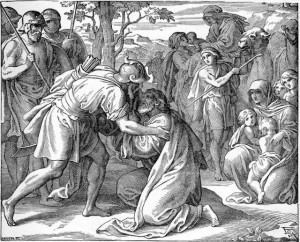
Genesis 32 is the story of Jacob’s return to Canaan after having been exiled from his homeland for 20 years. This is often referred to as Jacob’s Trouble (from Jer 30:7). His exile occurred after he obtained his divinely promised birthright through shrewd if not unscrupulous means from his brother Esau resulting in his having to flee Canaan for fear of his life due to Esau’s vengeance. Jacob found refuge in the region of Babylonia at his Uncle Laban’s home where he married Laban’s two daughters, Leah and Rachel. Genesis 32 recounts Jacob’s encounter with Esau who, along with his small army, physically stood in Jacob’s way from entering the land of his promised inheritance—later to be known as the land of Israel or Promised Land.

Jacob-Esau embrace 1

The Jewish sages believe that this encounter between Jacob and Esau is prophetic in nature and will happen again in the end times, but this time on a much larger scale and this time involving the numerous descendants of Israel and Esau. The Israelites will be attempting to return to their ancestral homeland, while the descendants of Esau will be attempting to block their way. As we proceed in this study, we will see whether this prophecy is beginning to come to pass in our days.

Rolling the film backwards a little, Laban had chased Jacob out of the area of Babylon, and yet Jacob was being blocked from entering Canaan by Esau (or Edom meaning “red”). This is reminiscent of Pharaoh chasing the Israelites out of Egypt only to find themselves blocked by the Red Sea, which is a picture of Edom (meaning “red”). In both instances, YHVH’s people were forced to totally rely on him for deliverance from their enemies who were before and behind them.

Chapter 32 is a study in how we often deal with major trials and stressful situations in life. Jacob (a) was gripped by fear, (b) resorted to fleshly schemes to appease his brother’s wrath and “to save his own hide” and that of his family, and (c) at the same time he Continue reading


Blog Scripture Readings for 11-30 Through 12-6-14

Aside

THIS WEEK’S SCRIPTURE READINGS FOR STUDY AND DISCUSSION:

Parashat Vayishlach — Genesis 32:4(3)* – 36:43
Haftarah — Obadiah 1:1–21
Prophets — 1 Samuel 4:1 – 10:27
Writings — Psalms 56:1 – 62:12
Testimony — Mark 4:20 – 7:37

Most of this week’s blog discussion points will be on these passages. If you have general comments or questions on the weekly Scripture readings not addressed in a blog post, here’s a place for you to post those. Just use the “leave a reply” link below.

The full “Read Through The Scriptures In A Year” schedule, broken down by each day, can be found on the right sidebar under “Helpful Links.” There are 4 sections of scripture to read each day. One each from the Torah, the Prophets, the Writings, and from the Testimony of Yeshua. Each week, the Torah and haftarah readings will follow the traditional one-year reading cycle.

* Verse numbers in parenthesis refer to the verse number in Christian Bibles when it differs from the Hebrew Bible or Tanakh.

Weekly Blog Scripture Readings for 11/30 through 12/6/14.


YHVH’s Original Twelve-Step Program

Genesis 29:32–35:18, The birth of the Jacob’s twelve sons and the meaning of their names. The Scriptures record that the gospel message was preached not only to the first century believers, but to ancient Israel (Heb 4:2), and to the Patriarchs (Gal 3:8) as well. Here is another example of this in the meanings of the names of the twelve sons of Jacob. His twelve sons were Reuben, Simeon, Levi, Judah, Dan, Naphtali, Gad, Asher, Issachar, Zebulun, Joseph and Benjamin (who was not born until Gen 35:18). The meanings of their names and the statements the Bible attaches to those meanings reveal YHVH’s glorious plan of salvation for mankind. The Scriptures call this message the good news or gospel.

12 twelve number laurel wreath

  • Reuben, Jacob’s first son, means “see or behold a son.” At the birth of her first son, Leah proclaimed “surely YHVH has looked upon my affliction” (Gen 29:32). The gospel message here is that YHVH Elohim saw the affliction of sinful man and gave us Yeshua, his Son.
  • Simeon means “hearing.” Leah named her second son thusly because “YHVH has heard that I was unloved” and she was hoping to receive her husband’s affection (Gen 29:33). The gospel message in this is that as a sinner, one comes to Yeshua in a lost and unloved state and separated from Elohim, and that when one hears about the Son (Yeshua the Messiah) in the gospel message, it’s at this point they receive the Father’s love.
  • Levi means “joined.” Leah named her next son this in the hopes that “now this time will my husband be joined to me” (Gen 29:34). With regard to the gospel, this can infer the union between redeemed believers and the Father and Son that occurs upon one’s salvation. The good news message is the reconciliation and union of man and Elohim through the atoning death of Yeshua and by the work of the Holy Spirit in a person’s life who helps us to conform our lives to the Word of Elohim.
  • Judah means “praise” or “now I will praise YHVH” (Gen 29:35). This is the response of the redeemed believer upon being joined to Yeshua as one is spiritually regenerated.
  • Dan means “judgment.” Rachel named Bilhah’s son Dan and exclaimed “Elohim has judged my case” (Gen 30:6). The gospel message is that when a new believer receives salvation from sin’s death penalty through Yeshua’s atoning blood, the Just Judges of the Universe’s sentence against sin has been lifted from them.
  • Naphtali means “wrestling,” upon his birth, Rachel proclaimed, “With great wrestlings have I wrestled” (Gen 30:8). This prophetically speaks of the believer’s life as he struggles against the world, flesh and the devil endeavoring to walk in a righteous and sin-free relationship with Elohim.
  • Gad means “troop or company.” At his birth, Leah exclaimed, “A troop comes” (Gen 30:11). This prophetically foretells the fellowship of believers as sons and daughters in the spiritual family of Elohim.
  • Asher means “happy,” for when he was born, Leah declared “I am happy and I will be called blessed.” (Gen 30:13). True inner happiness come to the redeemed believer who is now walking in right relationship with Elohim and in fellowship with other believers while together they pursue the hope of eternal life and inclusion in the kingdom of Elohim.
  • Issachar means “hire.” At his birth, Leah declared, “Elohim has given me my wages” (Gen 30:18). Once one is a part of the spiritual body of believers, one is equipped for works of service in advancing the kingdom of Elohim as a bondservant with the ultimate reward for a lifetime of service being eternal life and inclusion in the family of Elohim.
  • Zebulun means “dwelling, exalt and honor.” Upon the birth of her sixth son, Leah triumphantly proclaimed, “Elohim has endowed me with a good gift, and now my husband will dwell with me” (Gen 30:20). This speaks prophetically of the gift of eternal life YHVH has for those who faithfully serve him and the honor and exalted status they will have as the bride of King Yeshua the Messiah and as kings and priest in his eternal kingdom.
  • Joseph means “adding.When he was born, Rachel declared, “Elohim has taken away my reproach and YHVH shall add to me another son” (Gen 30:24). This can again be a prophetic reference to the expansion of Elohim’s spiritual family comprised of individuals who have been redeemed from the consequences and penalty of sin and who have become YHVH’s spiritual sons and daughters. This spiritual family will have its highest and fullest manifestation in the New Jerusalem heaven on earth.
  • Benjamin, which means “son of my right hand,” was born in Bethlehem (or Ephrath, Gen 35:18). This is a clear prophetic reference to Yeshua who sits at the right hand of YHVH, and to believers who are seated with Yeshua in heavenly places by faith (Eph 2:6). To be united with Yeshua in an eternal spiritual relationship ruling and reigning with him over his kingdom is the ultimate reward of the saints.It’s interesting to note that as she was dying, Rachel named her son Benoni meaning “son of my sorrow” and Jacob changed the name to Benjamin. It’s likely that Rachel died prematurely because of the curse Jacob unwittingly placed on her for hiding her father’s idols (Gen 31:32). Within the context of the meaning of the twelve patriarchs’ names pointing prophetically to the gospel message, it’s possible that there is a not so oblique allusion in the name Benoni to the sorrowful fate of idolators who refuse to accept Yeshua, the son of Elohim’s right hand, as their Redeemer and Lord. They will perish under Elohim’s hand of judgment, like Rachel (?), in the lake of fire, for we read that idolators will have no part in the New Jerusalem (Rev 22:15).

The gospel message in the names of the twelve tribes starts with Yeshua and ends with him, for he is the Aleph and the Tav (or the Alpha and Omega), the Beginning and the End, the Author and Finisher of our faith! Let’s give him the glory! Please pause and reflect on the higher spiritual message in these names. Selah.

Is it possible that the mind of man could have cleverly devised the meanings of these names and in the proper order, so they prophetically proclaim the gospel message about 1800 years before the birth of Yeshua? If this doesn’t loudly attest to the hand of Elohim at work in the writing of the Scriptures, then what does? If this doesn’t strengthen our faith, then what will?

In your own spiritual walk, where are you in this twelve-step prophetic scenario? In your spiritual walk have you passed through the reality of each of the twelve steps represented by the names of the twelve tribes of Israel? Perhaps this is the world’s original “twelve-step program”!

When the meanings Scriptures attaches to the names of the twelve tribes are combined, the following (gospel) message is proclaimed:

Behold or see the son. Surely YHVH has looked upon my affliction. YHVH has heard that I was unloved. My husband will be joined to me. I will praise YHVH. Elohim has judged my case. With great wrestlings have I wrestled. A troop comes. I am happy and I will be called blessed. Elohim has given me my wages. Elohim has endowed me with a good gift, now my husband will dwell with me. Elohim has taken away my reproach and he shall add to me another son who will be son of his right hand.

Is this your life story and spiritual testimony?


Boot Camp and Battle in Store for Yeshua’s True Disciples

Mark 1–3

It is interesting to note the order of events as Yeshua was launching his ministry. He was about to enter a war zone! After John baptized Yeshua and he received his heavenly empowerment, he first went through a spiritual boot camp before stepping onto the battlefield of public ministry. Once in the “war,” it’s worth noting where the battle lines fell.

Оружие

  • Yeshua’s spiritual boot camp was the wilderness where he fasted for forty days and nights to get his body, soul and spirit, and his mind, will and emotions in sync with the will of his Father in heaven (Mark 1:12–15).
  • His first battle was an internal one. The devil tested him in three areas: his body, soul and spirit, or, to put it another way, the lust of the flesh, the lust of the eyes and the pride of life (Mark 1:13). After overcoming himself and submitting to the will of his Father, he was now ready to launch into the war zone of public ministry.
  • His mission was to preach the message of the gospel of the kingdom of Elohim and repentance from sin (i.e. Torahlessness, 1 John 3:4; Mark 1:14–15).
  • Next he chose his cadre of spiritual warriors — his “army”— the twelve disciples (Mark 1:16–20).
  • Where better to start proclaiming the gospel message than in the local synagogue on the Sabbath (Mark 1:21)? After all, the religious folks there should be overjoyed to hear this good news, fresh message from heaven. Right?
  • His first recorded act, other than preaching, was to cast an unclean spirit out of someone Continue reading