Genesis 42–46 Two Brothers and the Two Houses of Israel in End-Time Prophecy

Biblical Types and Antetypes

A major key to understanding biblical prophecy is to recognize the relationship between antetypes and types in the Scriptures. This means that an event or a series of events occurred once, was recorded in the Scriptures, and then at a later time a similitude of the event repeats itself, but with different characters and scene.
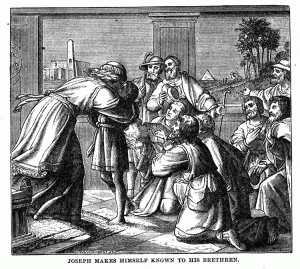
Joseph reveals self

An antetype is a type or pattern of something that occurs before the actual event occurs (sometimes incorrectly referred to as an antitype, which means opposite rather than before). In other words, the first event predicts or points prophetically to the future event. This is a way for the Creator to give clues and hints about future events that will come to pass. Those who are ardent students of his Word and those “who have (spiritual) ears to hear” will pick up on these clues and be able to have a sense of what the Creator is going to do at some future date. In this way, those who diligently seek him are rewarded with understanding or “inside information” about what he is planning to do in the future. At the same time, his divine plans and purposes will be obscured from those who don’t have a diligent heart to seek him and his truth, and who could possibly misuse the truth, if they were to discover it, for selfish purposes if they were to learn it.

Similarly, the Gospels record that Yeshua explained deep spiritual truths via parables not to make the meaning clear to the general public, but rather to obscure it. His teachings were meant to be understood only by those whom he had called that they might know the mysteries or secrets of the kingdom of Elohim (Matt 13:10–11; Luke 8:9–10).

For thousands of years, the prophets of the Bible, as well as biblical students, scholars and sages have understood the concept of antetypes and types and it has helped them to understand Bible prophecy and future events.

Biblical antetypes are identified in three ways. First, the Scriptures themselves identify events as being ante­typical. Examples would be: Continue reading


Blog Scripture Readings for 12-21 Through 12-27-14

Aside

THIS WEEK’S SCRIPTURE READINGS FOR STUDY AND DISCUSSION:

Parashat Vayigash — Genesis 44:18 – 47:27
Haftarah — Ezekiel 37:15–28
Prophets — 1 Samuel 25:1 – 31:13; 2 Samuel 1:1–27
Writings — Psalms 77:1 – 82:8
Testimony — Mark 14:53 – 16:20; Luke 1:1–66

Most of this week’s blog discussion points will be on these passages. If you have general comments or questions on the weekly Scripture readings not addressed in a blog post, here’s a place for you to post those. Just use the “leave a reply” link below.

The full “Read Through The Scriptures In A Year” schedule, broken down by each day, can be found on the right sidebar under “Helpful Links.” There are 4 sections of scripture to read each day. One each from the Torah, the Prophets, the Writings, and from the Testimony of Yeshua. Each week, the Torah and haftarah readings will follow the traditional one-year reading cycle.

Weekly Blog Scripture Readings for 12/21 through 12/27/14.


Reflections on Joseph’s Sterling Spiritual Character

Genesis 41:9, YHVH’s timing is perfect. Do you have the trust in YHVH to believe that for your life? Had the chief butler remembered Joseph prior to this how would things have been different for Joseph? Would he have had the chance to interpret Pharaoh’s dream? Would he have returned to Canaan? How would the history of the nation of Israel been different? Would YHVH’s purposes have been fulfilled?

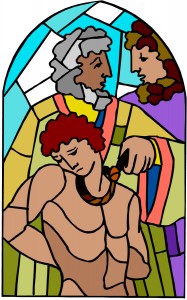
Joseph enslaved 20692041

Genesis 41:16, After all Joseph had endured—multiple false accusations, murder attempts, enslavement and imprisonment—a man of lesser spiritual stature than Joseph might have lost his faith in Elohim along the way. In this verse, what is the evidence that he hadn’t given up hope in his Heavenly Father and that he had not lost sight of the dreams and promises that YHVH had made to him many years earlier? As a form of witnessing, do you give honor to YHVH whenever you can—even to strangers? Doesn’t the fact that Joseph was able to do so in front of one of the most powerful monarchs of his day show evidence of his strong and abiding faith in and fear of YHVH even in spite of years of mistreatment and false accusations? Joseph is a powerful and encouraging example to the down-trodden of the world who have been persecuted for the their faith. It is possible to maintain faith in YHVH even in spite of dire circumstances.

Genesis 41:38, A man in whom the Spirit of Elohim is. Would this be the testimony of those heathens around you about you? If not, why? What changes in your life should you make to insure that it would be?


New Video: How to Get in the River of Life & Experience Divine Blessings

It’s time to either get in the spiritual river of life that flows from Elohim’s throne, to get in deeper, or to undam the river. Here are some suggestions to help you experience the abundant life Elohim has for you.


Money? What’s that?

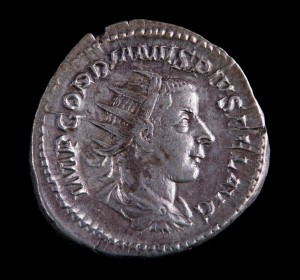
Mark 12:15, Bring me a denarius. Yeshua was so disinterested with, unaffected by and uninvolved with money that when he needed some, even for illustration purposes, he wasn’t able just to whip a coin out of his pocket, but he had to find one elsewhere. In this case, he asked someone in the crowd for a coin. When he needed to pay the temple tax, he found a coin in a fish’s mouth (Matt 17:24–27). Yeshua’s approach to money is rare among Christian ministers today.

A Roman denarius — a small silver coin.

A Roman denarius — a small silver coin.


Blog Scripture Readings for 12-14 Through 12-20-14

Aside

THIS WEEK’S SCRIPTURE READINGS FOR STUDY AND DISCUSSION:

Parashat Miketz — Genesis 41:1 – 44:17
Haftarah — Numbers 7:30 – 41; Zechariah 2:14 – 4:7**
Prophets — 1 Samuel 18:1 – 24:22
Writings — Psalms 70:1 – 76:12
Testimony — Mark 11:19 – 14:52

Most of this week’s blog discussion points will be on these passages. If you have general comments or questions on the weekly Scripture readings not addressed in a blog post, here’s a place for you to post those. Just use the “leave a reply” link below.

The full “Read Through The Scriptures In A Year” schedule, broken down by each day, can be found on the right sidebar under “Helpful Links.” There are 4 sections of scripture to read each day. One each from the Torah, the Prophets, the Writings, and from the Testimony of Yeshua. Each week, the Torah and haftarah readings will follow the traditional one-year reading cycle.

**Often a different haftarah is read when a “special shabbat” is designated on the traditional calendar. This week is the Sabbath during Chanukah and has a special maftir (concluding reading) and haftarah. Otherwise I Kings 3:15 – 4:1 is the haftarah for Parashat Miketz.

Weekly Blog Scripture Readings for 12/14 through 12/20/14.


Yeshua’s Model for Evangelism Revealed

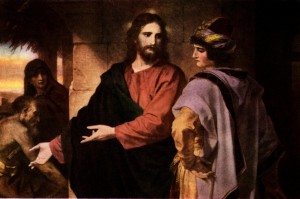
Mark 10:17–22, Yeshua’s model for one-on-one evangelism is here revealed. In his encounter with the rich, young ruler, Yeshua reveals a method of evangelizing in a one-on-one scenario. He uses the following five-step approach:

Yeshua & Rich Young Ruler 580440

  • Yeshua first establishes the character of YHVH Elohim and how man falls short of this in comparison. Namely, YHVH is good, and man is not.
  • Next, Yeshua presents the Torah as Elohim’s standard that determines the definition of good.
  • Yeshua then shows the young man that he was violated that standard of goodness by breaking the Torah.
  • He advises the young man then to repent of his Torahlessness (or of breaking YHVH’s laws, which is the biblical definition of sin in 1 John 3:4).
  • Finally, Yeshua invites the young to make the total commitment to being a good person and to follow him.

We see this evangelistic model again in Acts 17:24 when Paul addresses the Greeks on Mars Hill.