Blog Scripture Readings for 11-23 through 11-29-14

Aside

THIS WEEK’S SCRIPTURE READINGS FOR STUDY AND DISCUSSION:

Parashat Vayetzei — Genesis 28:10 – 32:3(2)*
Haftarah — Hosea 12:13(12) – 14:10(9)*
Prophets — Judges 18:1 – 21:25; 1 Samuel 1:1 – 3:21
Writings — Psalms 48:1 – 55:23
Testimony — Matthew 28:1-20; Mark 1:1 – 4:19

Most of this week’s blog discussion points will be on these passages. If you have general comments or questions on the weekly Scripture readings not addressed in a blog post, here’s a place for you to post those. Just use the “leave a reply” link below.

The full “Read Through The Scriptures In A Year” schedule, broken down by each day, can be found on the right sidebar under “Helpful Links.” There are 4 sections of scripture to read each day. One each from the Torah, the Prophets, the Writings, and from the Testimony of Yeshua. Each week, the Torah and haftarah readings will follow the traditional one-year reading cycle.

* Verse numbers in parenthesis refer to the verse number in Christian Bibles when it differs from the Hebrew Bible or Tanakh.

Weekly Blog Scripture Readings for 11/23 through 11/29/14.


A cross or a stake?

Matthew 27:32, Cross. (Gr. stauros.) As in English, a Greek word can have more than one definition. If we take only one definition for a word that may in fact have several definitions, we’re risking not furthering the cause of the discovery of truth as much as furthering own biases.

Cross at St. Augustine

This is the case with the Greek word stauros  typically translated as cross in the NT. According to the Theological Dictionary of the NT, vol 7, p. 572, stauros can have several definitions.

It’s primary definition is “an upright stake” like a fence stake. But the ancients used it as a torture instrument as well, and as such, it took on several additional definitions or forms including the following: “The cross was a vertical, pointed stake, or it consisted of an upright with a cross-beam above it, or it consisted of two intersecting beams of equal length” (ibid).

Other places in the Bible prove that Yeshua suffered and died on a t-shaped stake, but that’s another discussion for another time .


One foot in the will of Elohim and one foot out…

Genesis 26:1–29, There was a famine in the land. At the well of Lachai-roi (or “the well of the Living One seeing me,” Gen 24:62), Isaac was fruitful. There he met his wife while in communion with YHVH (24:62–64).
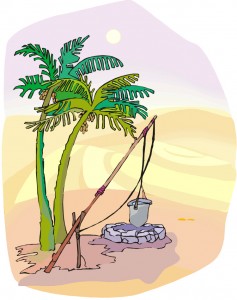
Well 20098602

Isaac also dwelt there for 20 years where he entreated YHVH because of Rebekah’s barrenness (25:21), and YHVH answered Isaac’s prayer and Rebekah gave birth to twins (25:22ff). But because of famine in the land, Isaac felt compelled to leave Canaan to seek relief in Egypt following the earlier footsteps of his father, Abraham.

Is it wise to rely on “Egypt” (a metaphor for the world) for our sustenance instead of trusting YHVH and believing that where he has planted us and blessed us is where we should stay?

While en route to Egypt YHVH, gracefully redirected Isaac away from Egypt instructing him rather to sojourn in Gerar (temporarily) where he would continue to bless him and his posterity (26:2–4). Isaac obeyed YHVH — more or less. Isaac ended up in Gerar located on the border between Canaan and Egypt and dwelt there a long time (not temporarily as YHVH had instructed him, 26:6, 8). Instead of fully obeying YHVH, it was as if Isaac was hedging his bet between faith and fear, between Canaan, the land of promise, and Egypt, the land of comfort for the flesh man.

How often do we halt between two opinions and compromise between YHVH’s will and our own in matters where he has given us clear direction?

This place of spiritual indecision and weakness put Isaac in a compromising situation (26:7). He felt compelled to lie about his wife, thus repeating the sin of his father (Gen 20:1–2).

Compromised obedience puts us in compromising situations where in order to “save our skin” we often have to compromise our values. Though Isaac was out of YHVH’s will, YHVH was still faithful to keep his promises he had made to Isaac earlier (Gen 26:3–4). Isaac was blessed one hundred fold in his wealth (Gen 26:12–14).

Despite YHVH’s blessings, Isaac’s labors were not without difficulty and opposition from an enemy who was intent upon stealing his water wells, which were rightfully his (Gen 26:12–15). In the arid regions of the Holy Land, wells are essential for survival and prosperity.

Wells are a spiritual metaphor for salvation, life, abundance and truth — things the enemy is intent on taking from us (in this light, consider Isa 12:3; 55:1–3; Ps 36:9; John 4:7–14; 7:37–39; 10:10).

 

Blog Scripture Readings for 11-16 through 11-22-14

Aside

THIS WEEK’S SCRIPTURE READINGS FOR STUDY AND DISCUSSION:

Parashat Toldot — Genesis 25:19 – 28:9
Haftarah — Malachi 1:1 – 2:7 | 1 Samuel 20:18-42**
Prophets — Judges 11:1 – 17:13
Writings — Psalms 40:1 – 47:9
Testimony — Matthew 25:23 – 27:66

Most of this week’s blog discussion points will be on these passages. If you have general comments or questions on the weekly Scripture readings not addressed in a blog post, here’s a place for you to post those. Just use the “leave a reply” link below.

The full “Read Through The Scriptures In A Year” schedule, broken down by each day, can be found on the right sidebar under “Helpful Links.” There are 4 sections of scripture to read each day. One each from the Torah, the Prophets, the Writings, and from the Testimony of Yeshua. Each week, the Torah and haftarah readings will follow the traditional one-year reading cycle.

**When a special shabbat occurs on the traditional Jewish calendar, a different haftarah is read. This week is “Shabbat Machar Chodesh” on the traditional calendar, which is when the Sabbath falls the day before Rosh Chodesh (new moon/new month) and 1 Samuel 20:18-42 is read for that special Haftarah. Typically Malachi 1:1–2:7 is read with Parashat Toldot when it is not designated a “special shabbat”.

Weekly Blog Scripture Readings for 11/16 through 11/22/14.


What Is the Greater or Higher Torah?

Matthew 23:23, Weightier matters of the Torah. What are the weightier matters of the Torah? Torah is not an end-all. It is a vehicle that leads us to something. What is that? What really matters to YHVH when all is said and done???? It is the greater Torah or the higher Torah. The Gospel of Matthew (23:23) records that Yeshua rebuked the religious leaders of his day for their not following the higher Torah. What did Yeshua really mean by “the weightier matters of the Torah”?

The Deeper Meaning of the Word “Torah”

Almost every place where you see the word “law” in the Tankah, it is the Hebrew word “Torah.” This word is used 219 times in the Tanakh or Hebrew Scriptures, and in almost every case it is translated in the KJV and in most other English Bibles as “the law.” Is this all the word law (or Torah) means? Is “law” even Torah’s main meaning?

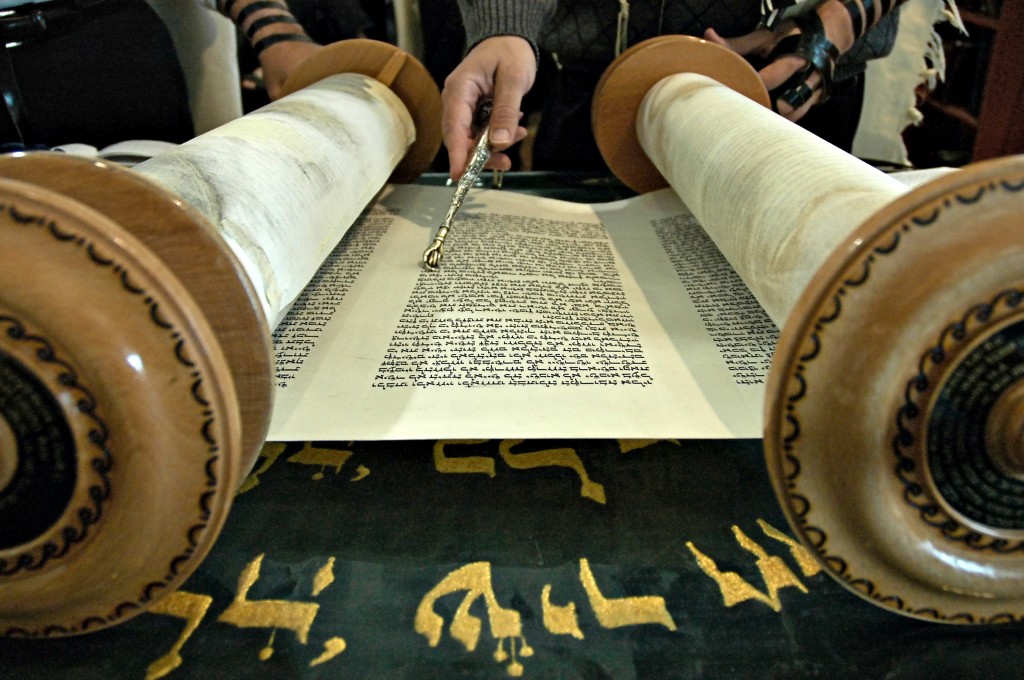
Torah reading in a synagogue with a hand holding a silver pointer

As a test of your understanding (or, perhaps, your preconditioned biases), when you think of the term “the laws” what comes into our mind: good thoughts or bad thoughts? Do you think of a list of dos and don’ts—what you can do and cannot do? Do you think of red and blue lights flashing and a siren? Do you think of a man in a blue uniform with a badge and a gun, or judge in a black robe with a gavel, or a prison? These can be scary thoughts!

Let’s see what the word Torah really means according to the Scriptures.

Let’s start understanding the full scope of this word by first reading Proverbs 13:14. There we read that the Torah is the foundation of life.

Next start reading in Proverbs 1:7 where we read that the fear of YHVH is the beginning of Continue reading


Rebekah — A Character Sketch

She was modest with a servant’s heart, selflessness and kind. Genesis 24:11–21 recounts Eliezer’s encounter with Rebekah at the well. He was not interested in a wealthy girl for Isaac. He preferred someone of modest means — the kind who would go to draw water herself, and not have servants do it for her.

Rebekah 20560425

Eliezer wanted to see how the girl would behave away from her home atmosphere, so that he would have a more accurate perspective of her character. At the well, the girl would be natural and act in accordance with her own character. At home, however her behavior might well reflect the constraints of her family’s orders or expectations. She passed the test, for she spoke only about bringing water for him, and then went on to draw water for his camels. It was second nature to Rebekah that another’s needs should be provided for. This act spoke volumes about her great kindness. That his camels had do be watered was so obvious to her that she saw no need to say she would do it.

Unlike the other girls at the well who wasted their time in idle chatter and gossip, Rebekah did her task quickly and without delay. Rebekah acted in a most exalted manner: she lowered the jug herself to spare Eliezer the effort and then actually brought the jug near his mouth, so he would not even have to hold it.

Furthermore, she drew all the water for the camels through sheer physical exertion, and Continue reading


Blog Scripture Readings for 11-9 through 11-15-14

Aside

THIS WEEK’S SCRIPTURE READINGS FOR STUDY AND DISCUSSION:

Parashat Chayei Sarah — Genesis 23:1 – 25:18
Haftarah — 1 Kings 1:1-31
Prophets — Judges 5:1 – 10:18
Writings — Psalms 34:1 – 39:13
Testimony — Matthew 21:23 – 24:51

Most of this week’s blog discussion points will be on these passages. If you have general comments or questions on the weekly Scripture readings not addressed in a blog post, here’s a place for you to post those. Just use the “leave a reply” link below.

The full “Read Through The Scriptures In A Year” schedule, broken down by each day, can be found on the right sidebar under “Helpful Links.” There are 4 sections of scripture to read each day. One each from the Torah, the Prophets, the Writings, and from the Testimony of Yeshua. Each week, the Torah and haftarah readings will follow the traditional one-year reading cycle.

Weekly Blog Scripture Readings for 11/9 through 11/15/14.