What Shape Was Yeshua’s Cross?

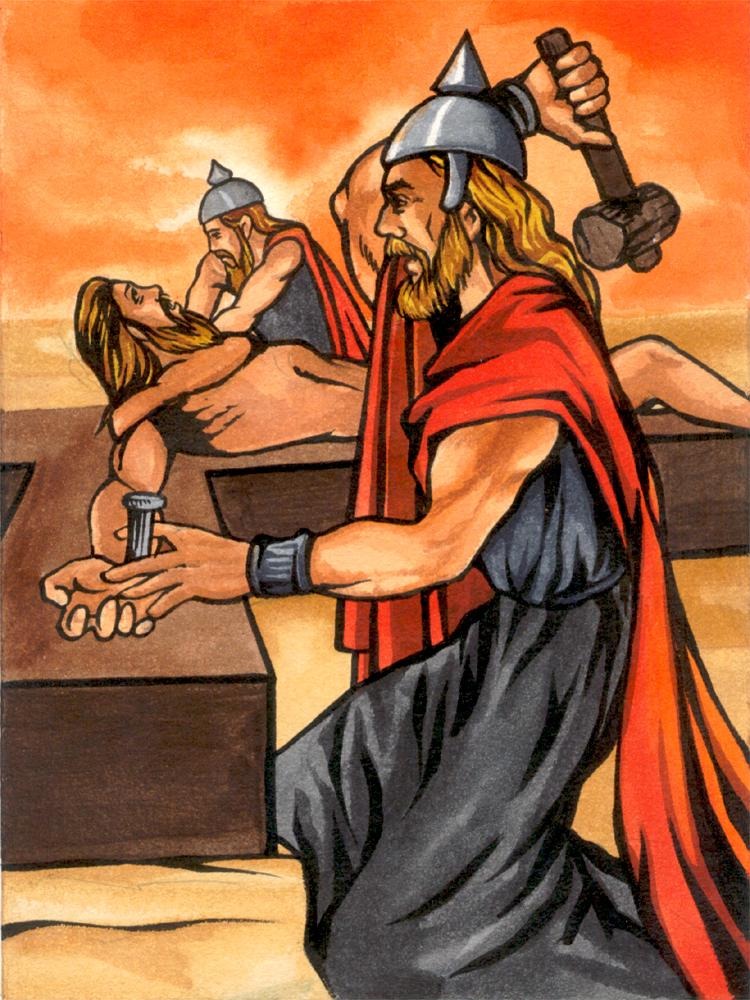
John 20:25, Nails. The Greek word for nail is in its plural form. The plurality of the word nails is corroborated by the fact that all the major English translation of the NT whether from both the Alexandrian or Byzantine texts contain the Greek word helon (nails, plural) as opposed to helos (nail, singular). This is the case in the Aramaic NT as well (see the translations of Ethridge and Murdock, for example). William Mounce whose Koine Greek grammar book is used in the majority of seminaries in the U.S. in his Greek and English Interlinear NT designates this word as in the genitive case, plural form and masculine gender.

What is the point here? Yeshua was crucified on a standard t-shaped cross, not on an upright stake minus its cross arm. Had he been crucified on the latter torture instrument, only one nail would have been used to secure his hands to the one post, not more than one nail as this text indicates, which would have been required on the traditional t-shaped cross.


You Have Priestly, Spiritual Authority in Yeshua…Use It!

John 20:22, Remit. Remit or forgive is the  word aphiemi meaning “to send away, to bid going away or depart, to send forth, yield up, to expire, to let go, let alone, let be, to let go, give up a debt, forgive, to remit, to give up, keep no longer, to permit, allow, not to hinder, to give up a thing to a person, to leave, go way from one.” From the context of the previous verse, those who have received the Set-Apart Spirit have the divine authority to relieve someone of their sin burden, although ultimate forgiveness sins in the ultimate sense resulting in salvation in the final analysis belongs only to Elohim. Perhaps this means that a Spirit-filled believer can act as a high priest and intercede for someone who is burdened down with sin and relieve them of some of that sin burden. A person can become so burdened and bent down with the guilt, condemnation and shame of sin that they cannot easily come to YHVH. By relieving them of some of that burden, they may be more able to come to salvation. This seems to be what the high priest was doing on Yom Kippur in Lev 16, and perhaps Job was doing this when interceding for his children on their birthdays.

John 20:23, If you forgive the sins [NKJV] or Whose soever sins ye remit [KJV]. As in the binding and loosing scriptures (Matt 16:19 and 18:18), Yeshua is giving his disciples judicial authority to declare a person innocent or guilty (or bound or loosed) of the charges made against him by someone else. This seems to go hand-in-hand with Yeshua giving them the keys of the kingdom (Matt 16:19) as his spiritual authorities and representatives on earth. Along with this, he gave them power over demonic forces and Elohim’s enemies (Luke 9:1; 10:19), including over sickness and disease (Mark 16:17–18).


Respect Blood—Don’t Eat It!

Leviticus 7:26, Not eat any blood. YHVH revealed in the Torah that the life of flesh is in the blood (Lev 17:11). Therefore, the blood symbolizes the whole life of the living being. This is why the blood being poured upon the altar made atonement for the souls of men (Lev 17:11–12), since it represented and pointed to the shedding of Yeshua’s blood when he sacrificed his life on the cross in atoning for men’s sins. Respecting the blood is necessary not only because it symbolizes the sanctity of the life of man who was made in the Creator’s image (Gen 1:26 cp. 9:6), but more importantly, because of the blood of Elohim’s Son that was shed for man’s redemption (Lev 17:11). For one to eat the blood showed disdain for what the blood typifies. In times past, this was so important to YHVH that a violation of this prohibition resulted in banishment from the nation of Israel.

The blood was to be reserved for the sacrificial service, where it was used symbolically to represent Yeshua’s shedding his blood on the cross. The blood of a lamb was put on the door posts to protect men from YHVH’s judgment against sin (Exod 12:7, 13). Moses sprinkled the blood of oxen on the people symbolizing their coming into covenantal relationship with YHVH (Exod 24:5–8). Additionally, the blood of sacrificed animals was sprinkled throughout the tabernacle, on Aaron and his sons, and all around the altar to sanctify it. All these acts and uses of the blood were illustrative of the unrestricted cleansing power of the blood of Yeshua (Rev 1:5; 7:14; 12:11; 1 Pet 1:2, 19; Heb 9:12; 10:19–22; 12:24; 1 John 1:7; Matt 26:28), which is why YHVH expected his people to treat the blood with a reverence. Those who didn’t evidenced a heart of indifference for the set-apart or kadosh things of Elohim—an intolerable offence in the Creator’s eyes.

On the dark and satanic side, the blood of humans and animals is profaned through demonic rituals involving drinking it and even cannibalism. This is an abominable perversion of holy communion and was an aspect of ancient heathen religions (Ps 16:4; Ezek 39:17, 19 cp. Num 13:32), and is a practice in which the end time antichrist heathens of the Babylonian whore system will engage (Rev 17:6; 18:13, 24).


Leviticus 6:1—8:36 Parashat Tzav

This is a gospel-oriented Torah study. Our goal is to connect the good news of Yeshua the Messiah (the gospel message) to its Hebraic, pro-Torah roots or foundations. The information given here is more than head knowledge. Understanding and wisdom (the right application of knowledge that is based on truth) is taught thus making biblical truth practical, relevant and applicable to your daily life. The truths of the Bible not only have the power to transform your life here and now for the better, but eventually to take you past the veil of death and into eternity.

This Torah study is subdivided in sections by topic in a magazine format thus making it easy to watch at several sittings.

May you be blessed as you watch this video.

For a free, printable adult and youth Torah study guide on this Torah portion (parashah), please go to http://www.hoshanarabbah.org/parshiot.html


Blog Scripture Reading Schedule for 4-2 Through 4-8-17

Aside

THIS WEEK’S SCRIPTURE READINGS FOR STUDY AND DISCUSSION:

Parashat Tzav — Leviticus 6:1 (6:8)* – 8:36
Haftarah — Jeremiah 7:21 – 8:3; 9:22-23 | Malachi 3:4-24**
Prophets — Isaiah 21:1 – 28:29
Writings — Proverbs 25:1 – 31:31
Testimony — John 20:1 – 21:25; Acts 1:1 – 4:22

Our new Scripture Reading Schedule for 2016-2017 is available to download!

Most of this week’s blog discussion points will be on these passages. If you have general comments or questions on the weekly Scripture readings not addressed in a blog post, here’s a place for you to post those. Just use the “leave a reply” link below.

The full “Read Through The Scriptures In A Year” schedule, broken down by each day, can be found on the right sidebar under “Helpful Links.” There are 4 sections of scripture to read each day. One each from the Torah, the Prophets, the Writings, and from the Testimony of Yeshua. Each week, the Torah and haftarah readings will follow the traditional one-year reading cycle.

* Verse numbers in parenthesis refer to the verse number in Christian English Bibles when they differ from Hebrew Bibles or the Tanakh.

** A different Haftarah is read when it is a special sabbath in Jewish tradition. This week it is Shabbat HaGadol on the traditional calendar. Otherwise, the passages in Jeremiah would be read. We’ve included both here.

Weekly Blog Scripture Readings for 4/2/17 through 4/8/17.


Parashat Vayikra—Study Guide

Leviticus 1:1-5:26 [6:7]

 Haftorah Reading

Isaiah 43:21–44:23

Testimony of Yeshua

  • On our victory over sin through Messiah: omans 8:1–13
  • Yeshua’s better sacrifice: ebrews 9:11–28; 10:1–22; 13:10–16

Overview of the Book of Leviticus/Vayikra

Key Points of Leviticus

  • Leviticus stands at the center of the Torah.
  • Its narrative covered probably only a month.
  • It is the first book of Torah that religious Jews start teaching their young children, since it is believed that those who are pure in heart (i.e., children) should be engaged in the study of purity (i.e., the laws of purification and atonement)—the central themes of Leviticus.
  • Even today, Leviticus remains the foundation for Jewish life, since it includes the laws pertaining to diet, the feasts, sex, marriage, family purity, and our relationship with our fellow man.
  • Leviticus is at the heart of the modern Jewish synagogue service, and forms the basis for the daily devotions of religious Jews. Jewish liturgical prayer is largely based on the tabernacle service outlined in this book.

Outline of Leviticus

  • The five main offerings (Lev 1–7)
  • The ordination of priests (Lev 6:8–7:38)
  • Laws of cleanliness (food, childbirth, diseases, etc., Lev 11–15)
  • Day of Atonement (Lev 16–17)
  • Moral laws regulating relationships between humans (Lev 18–20)
  • Regulations for priests, the offerings of the annual feasts (Lev 21:1–24:9)
  • Punishment for blasphemy, murder, etc. (Lev 24:10–23)
  • The Sabbatical year, Jubilee, land laws, slavery (Lev 25)
  • Blessings and cursings (Lev 26)
  • Regulations pertaining to vows made to YHVH (Lev 27)

Themes of Leviticus

  • Holiness (set-apartness) is the key theme of Leviticus. The set-apartness of YHVH and the need for man to become set-apart (Heb. kadosh; Lev 11:44).
  • The offerings and other ceremonies served to show the holiness of YHVH.
  • YHVH can only be approached through proper and prescribed protocols.
  • In Leviticus, spiritual set-apartness (holiness) is symbolized by physical perfection. All blemishes or defects symbolize man’s spiritual defects, which break his spiritual wholeness. Therefore, the religious system in Leviticus required:
    • Perfect animals for sacrifices (Lev 1–7)
    • Priests without physical deformity (Lev 8–10)
    • A woman to be ritually purified from hemorrhaging after childbirth (Lev 12)
    • Ritual purification from sores, burns, baldness (Lev 13–14)
    • Ritual purification from a man’s bodily discharges (Lev 15:1–18
    • Ritual purification after a woman’s menstrual cycle (Lev 15:19–33)
  • Those with certain diseases or ailments had to leave the camp (symbolic of leaving YHVH’s Presence—like Adam and Eve leaving the Garden of Eden after they had sinned). Israelites could be readmitted to the camp (symbolic of returning to YHVH’s Presence) only after certain protocols had been performed and the person had been pronounced whole by the priests.
  • In Exodus 19:6, YHVH calls for Israel to be a kingdom of priests. As such, they were to be a light to the nations and to show Elohim’s glory to the world (Deut 4:4–8). Israel was to be YHVH’s representation of YHVH’s kingdom on earth. Leviticus showed Israel how to walk in a set-apart (kadosh or holy) manner before YHVH and the world.

All Was Overseen by the Priests

The priests (Heb. kohenim) oversaw and controlled the sacrifices, rituals, ceremonies, and everything pertaining to the tabernacle.

It was their job to establish Israel as a kadosh (set-apart) nation, and to instruct Continue reading


Do you know what “the truth” is from a Hebraic understanding?

John 17:17, Truth. Yeshua, the One sent to this earth from Elohim in heaven, says here, “Thy [Elohim’s] Word is truth.” In Matthew 4:4, Yeshua said, “Man shall not live by bread alone, but by every word that proceeds out of the mouth of Elohim.”

So what is truth? The word in Hebrew for truth is emet (spelled aleph, mem, tav), which is comprised of the first, middle and last letters of the Hebrew alphabet. Truth embodies everything from the beginning to the very end of YHVH’s Word (literally, his Torah or the first five books of the Bible, and secondarily, the whole Bible from Genesis to Revelation).

Interestingly, the Scriptures call Yeshua “the beginning and the end of our faith” (Heb 12:2), and likens him metaphorically to alpha and omega (Rev 1:8, 11; 21:6; 22:13), which are the first and last letters of the Greek alphabet. These letters corresponds in symbolic meaning to the aleph and tav, which are the first and last letters of the Hebrew alphabet.

In Hebrew thought, truth consists of all of the Word of Elohim from the first letter in the Hebrew alphabet to the last letter. This same idea is picked up by the Jewish apostolic writers of the Testimony of Yeshua and applied to Yeshua who was the Word of Elohim sent to humanity in human form. As the human embodiment of the divine Word of Elohim he was referred to as the alpha and omega, or, in Hebrew thought, the aleph and the tav. We see this idea expressed in John 1:1–5 and 14 where it says of Yeshua,

In the beginning was the Word [Torah], and the Word was with Elohim, and the Word was Elohim. The same was in the beginning with Elohim. All things were made by him; and without him was not any thing made that was made. In him was life; and the life was the light of men. And the light shineth in darkness; and the darkness comprehended it not.… And the Word was made flesh and dwelt among us, (and we beheld his glory, the glory as of the only begotten of the Father) full of grace and truth.


John 18:38, What is truth?

Pilate asked Messiah Yeshua, the Son of Elohim, a question many inquiring minds have been asking since time immemorial, “What is truth?” (John 18:38). If someone were to ask you this question what would your answer be?

Since the word truth is found some 300 times in the Scriptures it would be safe Continue reading