Are you prepared physically and spiritually for the end times?

Genesis 47:13–26, The economic results of famine. Severe food shortages led to the people’s dependence on the government for food and survival. This is because the people had failed to prepare for such an event. 

Because of famine resulting in people starving, the Egyptian government was able to step in and literally take control of the people’s lives, their land and material possessions. The government then collectivized them by moving them into cities where it could “take care of” or control the people. In the process, the government became the master and the people became its serfs, if not slaves. 

This all happened in large part because during prosperous times the people failed to make preparations for hard times and thus became unwitting victims of natural circumstances and their own careless lifestyles. 

The more a person prepares for hard times such as famine, natural disasters or economic collapse, and the closer they are to the land thus giving them the ability to raise their own food, the less dependent upon the state they will be, the more freedom they will have, and the less likely the government will be able to control their lives. Spiritual freedom is tied to physical independence as well. 

In Revelation 13, the Bible prophesies a time coming when the end times Babylon the Great New World Order world ruling economic, political and religious system will exclude earth’s inhabitants from being able to buy and sell food and other life-sustaining essentials unless they take a subcutaneous “mark” on their bodies famously called “the mark of the beast.” 

Most people will take this mark resulting in their eternal spiritual damnation, while a few people will refuse to take it. 

Hunger and privation, whether man-caused or naturally occurring, can be means by which an evil governmental system can control its people simply because humans will do and accept virtually anything to feed their starving bodies. 

The more Elohim’s saints do now to prepare, especially spiritually, but also physically, for the horrifically hard times the Bible prophesies will occur globally in the end times, the more likely they will be to not deny their faith and to survive to meet King Yeshua the Messiah in the air as his glorified, triumphant bride!


The Two Sticks Prophecy of Ezekiel 37 Explained

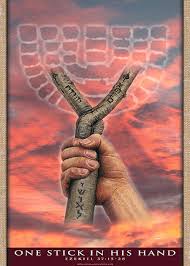
Ezekiel 37:14–28, The vision of the two sticks (trees). The second vision Ezekiel records in chapter 37 involves YHVH commanding him to take two sticks (or trees) and writing upon one stick “for Judah and for the children of Israel and his companions [i.e., those who have knit themselves together with or joined to the tribe of Judah],” and upon the other stick, write “for Joseph, the stick of Ephraim, and for all the house of Israel and his companions [i.e., those who have knit themselves together with or joined to the tribe of Ephraim].” Ezekiel was to told to then join the two sticks together, so that they would become one stick (or tree) in his hand (verses 15–17).

How were these two nations, which separated from each other some three thousand years ago, to be rejoined into one nation? That has been the subject of much debate between both Jewish and Christian commentators for years. Some modern historical revisionists view this prophecy as having been fulfilled when the Jews returned to the land of Israel in the time of Ezra and Nehemiah after their Babylonian captivity ended. But this interpretation leaves some unanswered questions. The book of Ezra, which chronicles the return of a Continue reading


The Twelve Tribes of Israel Reunited

Genesis 46:1–7, The reuniting of Jacobs family—the twelve tribes of Israel. These verses recount the move of Jacob and his family to Egypt where they were reunited with Joseph and his family.

This prophetically foreshadows a time in the future, which the Jewish sages call the final redemption, which is to occur just prior to and at the coming of Messiah Son of David (Yeshua the Messiah) as he comes to establish the Messianic Era (or Millennium) on earth.

The Jewish sages teach that part of that final redemption includes the reunification of the two houses of Israel (i.e. the Messiah-loving Jews and Torah-loving Christians) into one kingdom under Messiah Son of David. Where do we find this prophesied in the Scriptures? (Read Ezek 37:15–28, which interestingly enough is this week’s Haftorah portion!) This speaks of the family reunification or ­reconciliation of Judah and Ephraim at Messiah’s return. (Hos 5:15–6:4; 1:11; Acts 3:21; Ezek 37:25). This will be a supernatural work of the Set-Apart Spirit of Elohim (Ezek 36:19–32).

After the reunification of the divided family, where did the reunited and reconciled family move to? (Read Gen 46:34.) Goshen was in the Nile River delta area and was and to this day is the prime farm land of Egypt. It was a veritable promised land compared to the arid regions of Canaan. Could Goshen be a tiny shadow-picture of the Millennium?

The Jewish sages have a sense that history for the people of Israel is continually repeating itself in cyclical patterns as YHVH works his purposes out among his people. He is constantly endeavoring to reveal his plan of redemption and reconciliation to his people—those who have eyes to see, and he is continually reaching out his loving hand of reconciliation to the next generations of Israelites.

The Israelites settling in Goshen is but one more picture of the cyclical pattern of redemption that we see YHVH working out in the pages of Scripture all pointing toward a final climax at the end of the age where all of the children of Israel will worship YHVH in spirit and in truth (John 4:23) under the rulership of King Yeshua the Messiah, Son of Joseph/David.


Is a quiet spiritual revival occurring across the planet?

From Christianity Today at  https://www.christianitytoday.com/news/2018/december/most-popular-bible-verse-2018-youversion-app-bible-gateway.html

Here is some good news for a change!

The Top Bible Verses of 2018 Don’t Come from Jesus or Paul

For the first time in recent years, YouVersion and Bible Gateway users searched for and shared verses from Old Testament prophets the most.

 The Top Bible Verses of 2018 Don’t Come from Jesus or Paul

It’s a charge that extends back to the earliest parts of Scripture, gets repeated from the lips of Jesus, and resonates the modern world. It’s also the message of the most popular Bible verse of 2018 on YouVersion, the world’s most-downloaded Bible app.

“So do not fear, for I am with you; do not be dismayed, for I am your God,” reads the year’s top verse, Isaiah 41:10. “I will strengthen you and help you; I will uphold you with my righteous right hand.”

That exhortation from the Old Testament prophet Isaiah was shared, bookmarked, and highlighted more than any other passage by hundreds of millions of YouVersion users.

The year’s top honor at Bible Gateway comes from another Old Testament prophet. The most-read verse on the Bible website was the familiar Jeremiah 29:11: “‘For I know the plans I have for you,’ declares the Lord, ‘plans to prosper you and not to harm you, plans to give you hope and a future.’”

On the leading Bible website, either Jeremiah 29:11 or John 3:16 have topped the annual list every year. (The oft-quoted line from Jeremiah has come to be considered one of the most frequently misinterpreted Bible verses.)

The rest of Bible Gateway’s top 10 come from Psalm 23 (verses 1, 4, 6, and 6), Romans (Romans 8:28 and Romans 12:2), and Matthew (6:33).

YouVersion’s top verse, Isaiah 41:10, ranked thirteenth on Bible Gateway. Bible Gateway’s top verse, Jeremiah 29:11, also spiked to No. 1 in several countries worldwide, according to the YouVersion data.

The two Bible platforms’ lists end up being pretty different from one another each year, evidence that users tend to look up different verses online than they highlight or share during their study time on an app.

This year, Bible Gateway ranked popular verses based on 920 million searches across versions of the site. YouVersion’s picks stem from more than 1.7 billion highlights, bookmarks, and notes on more than 350 million devices.

Previously, YouVersion’s verse of the year award has gone to Joshua 1:9 (2017), Romans 8:28 (2016), and Proverbs 3:5–6 (2015). This year marks a shift to a prophet, but continues the theme of biblical reassurance to digital readers.

“This year’s data shows people worldwide are continuing to turn to the Bible in search of comfort, encouragement, and hope,” said Bobby Gruenewald, pastor and innovation leader for Life.Church and YouVersion founder.

While Isaiah 41:10 was the app’s most popular verse overall in 2018—and the top pick in the United States, France, Italy, the Netherlands, and Spain—several others were ranked as No. 1 in various countries.

Joshua 1:9, the global favorite in 2017, remained the most popular verse in the Central and South American countries of Argentina, Brazil, Colombia, and Mexico. John 3:16 took the lead spot in Bangladesh, Nepal, and Turkey. 1 Peter 5:7 topped the list in Egypt, India, and Iraq, and Matthew 6:33 was most popular in Thailand and Vietnam.

Not only was Jeremiah 29:11 the most popular verse of the year on Bible Gateway, it also claimed the YouVersion top spot in countries in the developed West (Australia, Canada, Japan, and the United Kingdom) and the Global South (Ghana, Indonesia, Nigeria, the Philippines, and the United Arab Emirates), spanning demographics in a way that other verses didn’t.

At Bible Gateway, top searches for passages included Psalm 91, Psalm 23, Genesis 1, Romans 8, and Matthew 6. Its leading keyword searches of the year were “love,” “peace,” and “faith,” respectively (“amor,” which means love, was the top keyword in Spanish, too). “Holy spirit,” was the eighth-most searched word, “forgive” ranked 15th, and “truth” came in as the 19th most commonly searched term.

And with the help of an emoji-based search on YouVersion’s Bible App, which allows users to tap images corresponding to various emotions, individuals conducted more than 18 million searches to find what the Bible might say to them in the midst of their emotional highs and lows.

YouVersion celebrated the 10-year anniversary of the app in July. In the decade since it originated as one of the Apple App Store’s first 200 applications, the Bible App has grown to include more than 1,800 versions of the Bible in more than 1,250 languages. Across the globe, via the Bible App, 27.2 billion Bible chapters were read in 2018; there were 4.2 billion audio chapter listens; more than 400 million verses were shared; and nearly a billion days of Bible plan readings were completed.

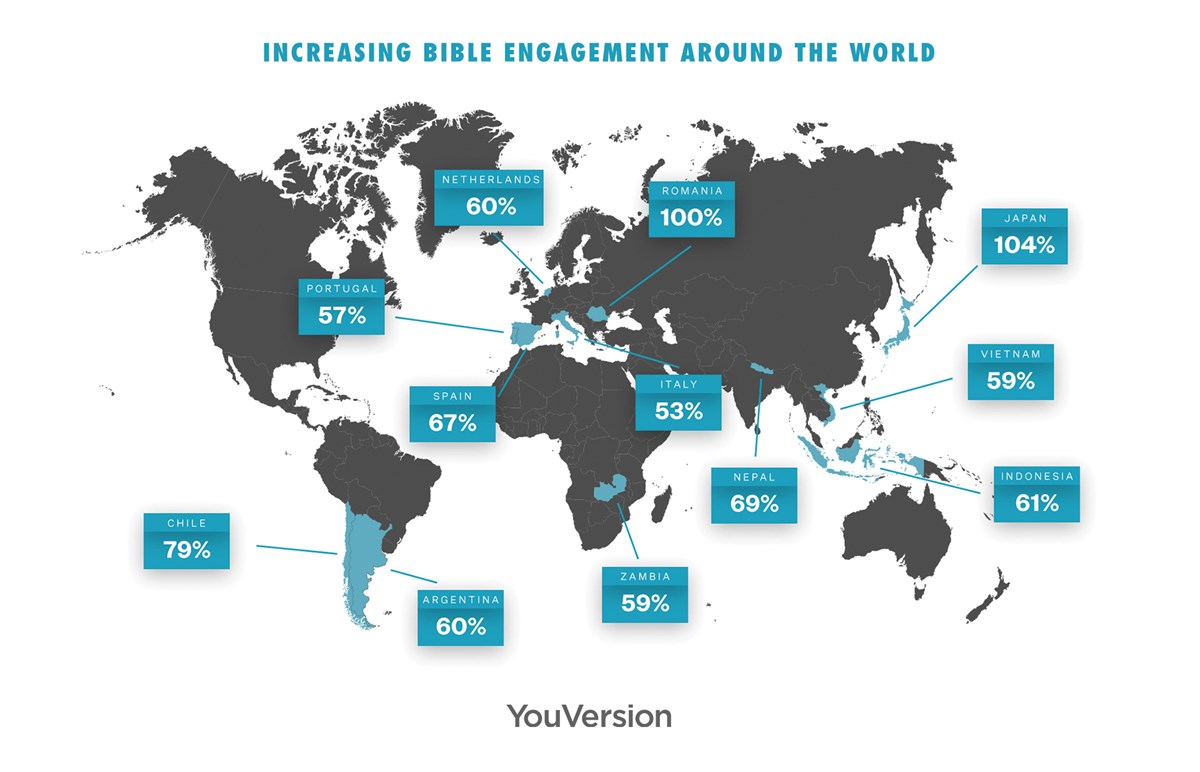
Engagement with God’s Word rose across continents. In Asia, Japan led the way in increased use of the Bible App, doubling over 2017, largely due to the addition of a new Japanese translation of the Bible within the app. Nepal (69%), Indonesia (61%), and Vietnam (59%) also saw big boosts in digital Bible engagement.

European countries like Romania, Spain, the Netherlands, Portugal, and Italy amplified their use of the leading Bible application, with increases of 100 percent, 67 percent, 60 percent, 57 percent, and 53 percent, respectively. South American countries also contributed to rising overall engagement, with use in Chile increasing by 79 percent and in Argentina by 60 percent.

“Many of us grew up with the ability to read the Bible in our heart language, but countless people around the world don’t have that privilege. That’s why we’re passionate about making the Bible available in more languages through the app,” said Gruenewald.

Overall Bible engagement on the YouVersion platform reached a new pinnacle this year, featuring a 27 percent year-over-year increase in daily use from 2017. The group’s Bible App for Kids, which launched in 2013 and is now available in 42 languages, saw an increase of 55 percent in installations in the last year, reaching 27 million devices worldwide.


 

The Yeshua Model of Evangelism

Mark 10:17–22, Yeshua’s model for one-on-one evangelism is here revealed. In his encounter with the rich, young ruler, Yeshua reveals a method of evangelizing in a one-on-one scenario. He uses the following five-step approach:

  1. Yeshua first establishes the character of YHVH Elohim and how man falls short of this in comparison. Namely, YHVH is good, and man is not. 
  2. Next, Yeshua presents the Torah as Elohim’s moral and spiritual standard that determines the definition of good—right and wrong. 
  3. Yeshua then shows the young man that he was violated that standard of goodness by violating the Torah’s standard of righteousness.
  4. He advises the young man then to repent of his Torahlessness (or of breaking YHVH’s laws, which is the biblical definition of sin, see 1 John 3:4).
  5. Finally, Yeshua invites the young to make the total commitment to being a good person and to follow him.

We see this evangelistic model again in Acts 17:24 when Paul addresses the Greeks on Mars Hill.


Ye shall reap if ye faint not!

Genesis 45:5, 7, 8, Elohim sent me. Joseph was sold into slavery at age 17, was freed from prison and made ruler of Egypt at age 30. After that, seven years of plenty followed, and then two years of famine had passed by the time he was reunited with is brothers. Only after 22 years in Egypt did Joseph finally figure out Elohim’s grand and wonderful plan for his life, and how it involved the saving of his family.

Had Joseph lost faith along the way, become embittered over his multiple misfortunes, and turned away from Elohim, the nation of Israel may have never been preserved.

Keeping one’s eyes on Elohim, and refusing to lose faith during the dark times of one’s life can yield some amazingly triumphant outcomes, as we learn from the life of Joseph.


What you do now may affect generations to come!


Genesis 44:32–34, Became surety for the lad. Christian commentator Matthew Henry on this passage states, “Judah’s faithful cleaving to Benjamin, now, in his distress, was recompensed long afterwards by the tribe of Benjamin keeping with the tribe of Judah, when the other tribes deserted it” (Matthew Henry Concise Commentary on the Whole Bible, p. 56).

It is amazing that some 800 years later the fraternal love between these two brothers remained in the collective psyches their descendents such that the tribe of Benjamin remained loyal to that of Judah. What does this say about generational blessings (and curses) or attitudes that are passed on down to one’s descendants? If curses can be passed on down to the third or fourth generation (Exod 20:5), how about blessings? The Book of Proverbs states that, “Death and life are in the power of the tongue, and those who love it will eat its fruit,” (Prov 18:21) and that, “ A wholesome tongue is a tree of life, but perverseness in it breaks the spirit,” (Prov 15:4). ­Generations of our descendants can be affected positively or negatively by the inclination of our hearts and the words of our mouth.

It had been Judah’s idea to sell Joseph to slave traders. In the meantime, Judah’s heart had changed so that he was willing to lay down his life for his brother, Benjamin, Joseph’s only full brother. This change of heart on Judah’s part and the resulting outpouring of love for his youngest brother had lasting positive results. What are the prophetic implications of this relationship between Joseph (Ephraim and Manasseh) and Judah?