As we enter the new year, will we be overcome by evil, weariness in well doing and the spirit of lukewarmness, or can we not only survive, but thrive in the toxic stew of this world? This is an exhortation and encouraging message to serious disciples and the potential bride of Yeshua the Messiah to reawaken passion and to fall in love with Yeshua all over again, and to grow in one’s love for our Heavenly Bridegroom. It is also a message on how to overcome weariness and not be overcome by influences of evil leading to discouragement and spiritual weariness. May YHVH bless you in this secular new year!
Psalm 118:6, YHVH is on my side…what can man do to me?This hints at the adage that “God plus one man make a majority.” That being the case, what is there to fear?
Psalm 118:14, He has been my salvation [Heb. Yeshua]. This is an oblique prophecy concerning the incarnation of YHVH-Yeshua.
Psalm 118:15, The right hand of YHVH. Here is another prophecy concerning Yeshua the Messiah, who was and is the right hand, and is currently at the right hand of YHVH-the Father.
Psalm 118:20, The gate of righteousness. Yeshua the Messiah, as alluded to in the previous verses, is the gate of heaven (Gen 28:17), the door to salvation(John 10:7, 9), the way, the truth and the life—the way to the Father (John 14:6), which has been opened to those who trust in and obey him. He is also the righteousness of each saint, our example to follow of righteousness, and through his imparted Spirit divinely enabling us, we can also perform the works of righteousness (which YHVH’s Torah-law defines; see Ps 119:172), which are the robes or righteous deeds of the saint (Rev 19:8).
Psalm 118:25, Save now [Heb. hoshiah nah]. In English “hosannah”.
Psalm 118:26, Blessed is he. Heb. Baruch habbah b’shem Yehovah. This was the proclamation of the Jewish people of Jerusalem who recognized Yeshua as the Messiah during his triumphal entry into that city (Matt 21:9). This same declaration will be made at Yeshua’s second coming (Matt 23:39; Mark 11:9–10; Luke 19:39; John 12:13). Learn your Hebrew now, so you can be ready!
Psalm 118:27, Sacrifice. Heb. chag. This is a reference to the pilgrimage festival sacrifice. The pilgrimage or aliyah festivals are Chag haMatzot (the Feast of Unleavened Bread), Chag haShavuot (the Feast of Weeks or Pentecost) and Chag Sukkot (the Feast of Tabernacles).
Light…horns of the altar. See note at Exodus 29:12. This is metaphorical and prophetic language referring to the death of the coming Messiah, since under the sacrificial system, the animals to be sacrificed were never tied to the horns of the altar. We can, therefore, take this verse metaphorically to mean that through the divine light or illumination (Heb. ohr) of the Messiah (the Divine Light of the world, the Word of Elohim incarnate), who is the horn or strength of our salvation (Luke 1:69), through his atoning sacrifice, that even as Messiah was tied to the altar of the cross (Isaac prefigured this in that he was tied to the altar at the akeidah, Gen 22:9), when we bind our selves to Messiah’s altar (through faith in him) we can escape the bonds of sin. The result is that we experience a festive spirit of celebration because we have been set free from the wages of sin, which is death. (The ArtScroll Tehilim/Pslams Commentary as do Keil and Delitzsch’s OT Commentary both shed some light on this issue.)
Psalm 118:29, Oh give thanks to YHVH he is good. This verse provides the lyrics for the Jewish song entitled Michah mochah the words of which in Hebrew are “Hodu l’Yehovah ki-tov ki l’olam chasdo.”
Comments can be left on Hoshana Rabbah’s Facebook page at https://www.facebook.com/HoshanaRabbah. I will do my best to read all of your comments and to answer any questions that you may have.
Do you need a spiritual pick-me-up? Do you feel far from God/Elohim? Are you depressed by all the bad news and evil that is going on in the world? Are you struggling in your faith? Are the fires of your passion for Elohim, Yeshua/Jesus waning? Are the struggles of daily life over-whelming you? Is all the crapola out there getting to you? Then watch this video and rediscover the Psalms and let them stoke your passion for YHVH Elohim, for Yeshua the Messiah, for the Bible—Word of Elohim! Let your fire of your faith be revived!!!
Open your Bible to the exact middle and where do you land? At the Psalms. Hmm!? Why is this?
Why is it that Bibles that contain only the New Testament also include the Psalms? There must be something uniquely special about the Psalms that touch the human heart like no other book in the Bible.
Many of us have all read and reread the Psalms over and over again, but now it’s time to take a look at them with fresh eyes. In this video, Nathan transparently discusses how the Psalms have been his go-to section of the Bible no matter what challenge, crisis, spiritual or emotional needs he has, or whether he is up or down. The writers of the Psalms share their most intimate struggles, thoughts, emotions and even their doubts about their faith.
The human condition has never changed from then until now. There is nothing new under the sun. All humans have the same hopes, dreams, despairs and challenges. Therefore we invite you to rediscover and even immerse yourself in the biblical Psalms. They are a portal to another dimension that can launch your life up out of the pit into the celestial plane.
Psalm 91:1 (and the rest of Psalm 91) Is the Biblical 9-1-1 to Call in Our Time of Trouble!
Recently, the city of Lahaina in Maui, Hawaii was mostly destroyed by fire. A few years ago, Sandi and I spent a week in Lahaina enjoying this paradise on earth. Our hearts are deeply saddened and words cannot explain by this tragic disaster as well as the grief and sorrow of the Hawaiians who are trying to cope with the aftermath of it.
In an instant, anyone of us could find ourselves in such an unexpected situation as those in Lahaina—without home, material possessions, the necessities of life readily available to us, or even deprived of physical itself. There for the grace of YHVH go each of us continually! Each day of life is a blessing and a gift from the Almighty not to be taken for granted.
When you find yourself in an impossible situation, this is the time to look upwards. In fact, we should be doing this each day of our lives, so that when troubles hit us, we are already prepared mentally, emotionally and spiritually to call our direct line to heaven for help!
With these things in mind, let’s review Psalm 91 starting in 91:1, and what I call “the 9-1-1 of the Bible.”
Psalm 91:1, Secret [Heb. cethar]. This word refers to “a covering, shelter, hiding place or secrecy,” and is from the root word meaning “to hide or conceal.” When troubles comes our way like a tidal wave, the natural human reaction is to stand and fight, to freeze in fear, or flee in panic. In psychology this is known as the fight, freeze or flight response. The Bible teaches us there is both a time to fight and a time to flee (Eccl 3:1; Matt 24:16; 12:14 cp. Eph 6:14; Luke 19:13), but at all times we need to be hiding in the secret place of our relationship with our Almighty Father in heaven, to which the latter part of this verse alludes. Out of that place, and from under the shadow of the wings of the Almighty and in his throne room, we will not be cowering in fear from our enemies, but we will find the courage, will and stamina to stand firm in faith, and, if necessary, to come out and to fight the enemy not in our own strength, but in that of Elohim as led and guided by his Spirit.
The Most High [Heb. El-yon]. This is one of the descriptive titles of Elohim and signifying his exaltedness, overwhelming majesty and supremacy or omnipotence. As such, Scripture reveals that Elyon is the place of protection for Israel (Pss 9:2; 91:1, 9).
Abide [Heb. luwn].This wordmeans “to lodge, stop over, pass the night or abide.” A lodge is a place where one temporarily spends the night. When dark times come our way, we need to stop over, spend the night, run to and abide in the throne room of the Almighty! This speaks of prayer, worship, praise and studying the Word of Elohim.
Psalm 91:1, 4,Under the shadow of the Almighty…under his wings.(See notes at Ps 61:4.) According to the ancient Jewish sages, Moses composed this psalm for the tribe of Levi who dwelt under the shadow of the wings of cherubim that stood over the ark of the covenant in the Tabernacle of Moses—a physical representation of YHVH’s throne room in heaven. The sages go on to explain that the psalmist describes the devout man of faith who lives with Elohim in his heart, and who never leaves Elohim’s shadow. Such a man is a true biblical hero of faith to whom Elohim pledges (v. 16) he will satisfy with long life and show him his salvation (The ArtScroll Tanach Series Tehillim/Psalms Commentary on Ps 91). This psalm ends with the promise of the blessing of long life to those love and serve YHVH, and beyond that, salvation, which is the Hebrew word Yeshua—the very name of the coming Messiah who would offer his people deliverance from the ultimate enemy, namely sin and its death penalty. The result of this deliverance is the glorious divine gift of eternal life through faith in Yeshua the Messiah—the supreme gift and blessing of all! This psalm is a prophecy pointing to the Messiah.
In Jewish understanding, the Tabernacle of Moses wasn’t complete until the glory of YHVH’s presence took residence in the tabernacle’s inner chamber of the holy of holies. This was evidence that YHVH was making this habitation his own in a most intimate way. How was it possible, the sages ask, for the Creator of the universe to inhabit a mere tent? They explain that he focused his presence into this tiny spot. This isn’t unlike a magnifying glass that reflects the suns rays into a small but focused point on a piece of wood or paper. Were the earth closer to the sun, it would be burned up. Yet the sun’s light can be brought to the earth in a concentrated form that will not cause harm. This is exactly what Elohim did when he incarnated Yeshua into the womb of Mary. The sages had the understanding that the holy of holies is a picture of man’s heart that the Creator wants to indwell, which is the most sacred sanctuary of all.
The conception and birth of Yeshua was an ultimate fulfillment of this prophecy. The fire of the Set-Apart Spirit that came down upon the disciples on the day of Pentecost in Acts chapter two was also a fulfillment of this desire of YHVH of which the fiery glory cloud that dwelt in and over the Tabernacle of Moses was a prophetic portent. Yeshua promised his disciples that through this same divine fire he would dwell in their hearts after his death, resurrection and ascension. The result of this divine encounter of Elohim with those in the upper room resulted in many repenting of their sins and coming to faith in Yeshua the Messiah (Acts 2:38–41), which is the greater message of Psalm 91.
Psalm 91:2,He is my refuge [Heb. machseh]…fortress. This refuge is a literal shelter to which one flees in times of trouble to find hope. It is like a fortress.
In him I will trust [Heb. batach].This word connotes the feeling of safety, security and confidence to the point where one can be careless or exist without cares.
Psalm 91:3,Deliver [Heb. natsal].This word means “to snatch away, rescue, save, strip, plunder, to tear oneself away, deliver oneself, to be torn out or away, be delivered, to strip off or spoil.” The Hebrew word has a much more expansive meaning than the simple English word deliver. The idea here is not just delivering one from one’s enemies, but a stripping away from or spoiling one’s enemies. One can almost imagine an enemy who is bewildered by the unexpected action of the superior force of a deliverer who suddenly swoops in like a night raider and snatches away his illegally gained loot from out of his hand. This is what our Almighty Elohim promises to do for his children who abide under the shadow of his wings.
Snare of the fowler.This is literally referring to a bird trap and the trapper. In ancient times, birds were trapped and used for food. This could be a poetic picture of Satan and his demons who fly through the air searching for human prey. A biblical example of birds being metaphors for destructive and deceiving evil spirits can be found in Genesis 15:11 and Matthew 13:4 and 19. This verse, then, is a promise to the saint of protection from evil, demonic spirits.
Psalms 22, 23 and 24 form a prophetic, messianic trilogy pointing to the circumstances surrounding the death (Psalms 22 and 23), resurrection (Psalm 23) and enthronement of Yeshua as King over Israel (Psalm 24). Psalm 24 shows how a person can ascend the “mountain” of Elohim and come into the presence of our Father in heaven. This psalm also presents the Messiah as YHVH and as the doorway to righteousness and salvation for those who seek him. He is the only way to the Father in heaven, if one will only open the door of one’s heart and let him come into one’s life.
Psalm 22
Psalm 22:1–7,You forsaken me…enthroned in the praises. When it seems that Elohim has forsaken us and the heavens seem like brass, this is the time to praise Elohim, and his presence will come. It is also the time to recall and even remind him of all the good things that he has done for us in times past (vv. 4–5). This is despite the fact that the brutish and abusive behavior of others against us often makes us feel as low as a worm (vv. 6–7). Praising and trusting in Elohim at such times is counter intuitive to the natural human mind. It is in such times that one is inclined to cease believing in their Creator and, to one degree or another, forsake him and or abandon their faith altogether. Yet at these times, this is when the faithful saint seeks the Almighty all the more, even as Yeshua did while in praying in the Garden of Gethsemane and while hanging on the cross—the very thing to which this psalm prophetically pointed. For it is verse one of this psalm that Yeshua quoted while hanging on the cross dying. He was telling us that we was the fulfillment of the prophecies contained in this psalm. In fact, this psalm has several prophetic referential touch points to Yeshua’s last moments just prior to his ignominious death. They are:
Verse 1— “My Elohim, my Elohim, why have you forsaken me?”
Verse 6— “A reproach of men, and despised by the people.”
Verses 7–8— “All those who see Me ridicule Me; They shoot out the lip, they shake the head, saying, ‘He trusted in YHVH, let Him rescue Him; Let Him deliver Him, since He delights in Him!’”
Verses 9–10— “But You are He who took Me out of the womb; You made Me trust while on My mother’s breasts. I was cast upon You from birth. From My mother’s womb You have been My El.”
verse 14— “I am poured out like water, and all My bones are out of joint; My heart is like wax; It has melted within Me.”
Verse 15— “My strength is dried up like a potsherd, And My tongue clings to My jaws; You have brought Me to the dust of death.”
Verses 16–17— “For dogs have surrounded Me; The congregation of the wicked has enclosed Me. They pierced My hands and My feet; I can count all My bones. They look and stare at Me.”
Verse 18— “They divide My garments among them, And for My clothing they cast lots.”
Because of these prophetic references to the events surrounding Yeshua’s death, Psalm 22 ranks as one of the greatest messianic prophecies in the entire Tanakh. There are simply too many unique and direct references to the specific circumstances of Yeshua’s crucifixion as recorded in the Gospels to be merely coincidental. For example, how could the psalmist have known about the Roman mode of execution known as crucifixion some 1,000 years before this event occurred? Actually, the earliest crucifixions as recorded in history were performed by the Persians and Greeks as early as 500 BC, which is still some 500 years before David penned this psalm.
Psalm 22:3–4,Enthroned…delivered them. Praise and worship is a spiritual warfare weapon. (On the dynamic spiritual power of godly music, see 2 Chron 20:20–23 and notes at 1 Sam 16:23).
Psalm 22:3–5,They trusted…you delivered. Praise and worship combined with trusting faith in YHVH is a spiritual warfare weapon that brings the saints deliverance from their enemies.
Psalm 22:12,Bulls of Bashan. Bashan is in the area of Mount Hermon in northern Israel. The southern base of Mount Hermon, in ancient times, was regarded by the pagans as Satan’s seat and the gates of hell. There the pagans erected a temple to the demon-god Pan. Later it became known as Caesarea Philippi, and there Yeshua confronted Satan by declaring that the gates of hell would never prevail against his church (Matt 16:18).
Psalm 22:26, See notes on Psalm 49:15.
Psalm 23
Natan’s Reflections on Sheep and on Being a Shepherd of Sheep on the Family Farm
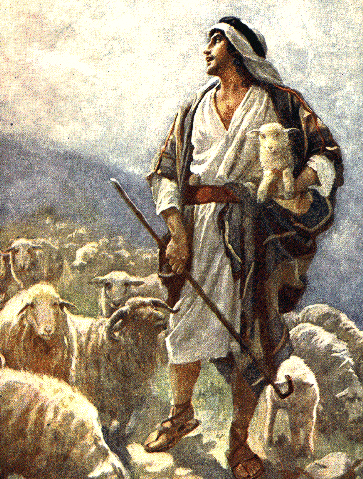
David, the author of this psalm, was a literal shepherd of sheep as we all know. This is something that both David and I had in common. This is because I lived on sheep farm from age six to 24, and like David, it was my duty to care for the sheep. We can learn a lot about ourselves and other people when we hang out with sheep. Being a shepherd makes the Bible come alive, since YHVH Yeshua likens his people to sheep, and he is our Good Shepherd who cares for us (John 10:11, 14).
During my time on the family farm, it was my responsibility to care for the sheep including feeding them twice daily, caring for the lambs, protecting the sheep from predators, keeping the gates and fences that surrounded them in good conditions, cleaning their barns, helping the ewes give birth as needed, tending to sick and wounded sheep, leading them from pasture to pasture, shearing them, and finally, butchering them. I have wrestled with sheep, chased them, led them, fed them, fondled them, sheared them and even butchered them. I loved the sheep that were under my care, and to this day, decades later, I still feel a deep, visceral love in my gut when the thought of sheep come to my mind. Whenever I have the opportunity to be around sheep, if they are tame,you will find me out with them fondling their heads and scratching them behind their ears.
Later, I married and became the father of four children and had the opportunity to shepherd my own flock of human sheep. After that, my wife and I started a congregation which I pastored or shepherded (as I like to say) for 18 years where I shepherded “sheeple.”
Here are a few of my reflections on literal sheep and caring for them and how they are like YHVH’s people (or “sheeple”).
Sheep are defenseless. About all they can do is run from a predator, and they are not fast runners. They will run until they tire out, and then will simply fall down exhausted becoming a hapless victim. When a ewe feels threatened, especially when she has lambs, she will look at you in the eye and stomp her hoof determinately in the ground as it to say, “Don’t come any closer, or I will…do something to you, but I don’t have a clue what….” It is all show, for there is nothing she can do, but hope to out run her attacker. In reality, it’s a pitiful and hopeless situation.
This psalm contains three sections that show a wonderful and logical progression from the greater (Elohim) to the lesser (man),that is, from the macro level downward to the micro level. At first appearance, these three sections may seem unrelated, but upon second glance, each section actually flows logically into to the next revealing some deep mysterious truths about YHVH Elohim’s plan of redemption for humans.
Section one (vv. 1–6) describes the creation of Elohim, which points to the glory of YHVH Elohim, the Creator. It concludes by describing the sun, which is the physical light of the world, and which is like a bridegroom in his full glory emerging from his private chambers about to marry his bride. Moreover, the physical universe is governed by physical laws, which keep it functioning in an orderly manner.
Section two (vv. 7–11) describes the glorious attributes of the Torah-law of Elohim, which reveals the character of the Creator, and it shows man what his response should be to the Almighty upon viewing the glories of his creation. Man is to worship the Creator, not the creation. When followed, the Torah helps to keep man’s life structured in a way that brings order, blessing and causes his life to function smoothly, even as the universe is structured and ordered by Elohim and functions smoothly because of his physical laws.
A Torah lifestyle is also how the saint of Elohim is a spiritual light to the world (Deut 4:6).
Moreover, as the sun’s light pierces the physical darkness of the world, the light of the Torah brings the spiritual light of Elohim into the world along with bringing many benefits to the obedient person including a blessed life.
Section three (vv. 12–14) explains what happens when the light of Elohim’s Torah shines into the darkness of a one’s life as it exposes the hidden dark areas of sin. It also shows man how to walk blamelessly before and in a right relationship with Elohim, his Creator.
This psalm then ends by stating that YHVH is man’s strength and redeemer. This is another way of saying that man is morally and spiritually weak and needs redemption from the consequences and the power of sin.
Thankfully, YHVH has the answer to this problem: he is man’s strength and Redeemer. Yeshua the Messiah is man’s Redeemer and as the sun is the physical light of the world, Messiah is the spiritual light of the world (John 1:6–9; 8:12). Elsewhere, Scripture even calls Yeshua the Sun of Righteousness (Mal 4:2), and, in his glorified state, his face shines like the sun in its full strength (Rev 1:16).
And ultimately, when a person follows the Torah through a relationship with Yeshua the Redeemer, one will eventually be raised to glory and shine like the stars in heaven (Dan 12:3; Matt 12:43), for they will be like Yeshua (1 John 3:2). HalleluYah!
Psalm 19:7–9,The Torah of YHVH. Listed here are the seven attributes of the Torah and the corresponding blessings for Torah-obedience. They are:
The Torah is perfect or complete (nothing is lacking) resulting in converting the soul of man from spiritual darkness to spiritual light. This is because YHVH’s Torah instruct, rewires or “programs” man’s personal spirit to line up with the mind, will and emotions of Elohim. When this occurs, one’s personal spirit then takes charge of and reprograms one’s soul (or mind, will and emotions) to line up with that of the Creator. This is how the spiritual conversion process works.
The Torah is sure (i.e., to build up or support; to foster as a parent or nurse; to render or be firm or faithful, to trust or believe, to be permanent or quiet; morally to be true or certain) imparting wisdom to simple people. When a person follows the Torah, he is building his house on the spiritual rock of YHVH’s Truth. He also has a road spiritual road map, blueprint or compass to follow for the rest of his life. This makes him wise because the wisdom from above is now his to follow making him wise.
YHVH’s Torah is right (or straight, not crooked) bringing joy to a person. When a person has a spiritual road map to follow, he is no longer walking in spiritual darkness wandering all over the place. He can follow the straight path that leads to YHVH Elohim and eternal life. Thus, one has a sure future and hope. Such a person has stepped into the river of life and blessing begin flowing his way. This bring joy in place of confusion, hopelessness and uncertainty.
Elohim’s Torah is pure (or beloved, choice, clean and clear) light bringing one spiritual enlightenment. YHVH’s Torah gives us insight into the mind, will and character of the Creator. When we line ourselves up with him, he will impart the spiritual light of his divine Truth to us. In his light we see light and he is the One who lights man’s inner spiritual lamp (Pss 13:2–3; 36:9; Prov 20:27).
The Torah that engenders the fear of YHVH (which is the beginning of wisdom and knowledge [Ps 111:10; Prov 1:6; 9:10]) is clean or pure and last forever (it has never been done away with!). Torah produces both kinds of healthy fear in man: the fear to disobey our Elohim (and thus suffer the consequences of sin), and reverential awe that we serve such a holy (pure), transcendent and all wise Being, and that he actually cares about us.
The Torah is true (i.e., or divine Truth and is thus stability, certainty and trustworthiness). This cannot be said about the philosophies, idealogies, religions or dogmas of men which are a concocted mixture of truth and error, good and evil.
YHVH’s Torah-judgments are righteous (i.e., right or just) meaning that YHVH is a Just Judge rendering to men the correct and just punishment for disobedience and rewards or blessings for obedience to his commandments. Those who follow YHVH’s Torah will become righteous, will be clothed in righteousness and will receive the ultimate blessing of being a suitable bride for Yeshua the Messiah (Rev 19:7–9). They will also have the legal right to partake of the tree of life (Rev 22:14).
These are the seven attributes of YHVH Elohim’s Torah-law. Why is it important to know these? Because they give us an insight into the fundamental character of Elohim. That is to say, the Torah is an extension of the very character, heart, mind, will and personality of our Creator. This is why it is patently absurd and borderline, if not totally, blasphemous to declare that the Torah-law that YHVH revealed to his people through the patriarchs and eventually in a codified form to Israel through Moses has been done away with! The perfect and immutable character of Elohim cannot be changed, annulled, improved on or abridged in any way. Make no mistake, for anyone to think that this is possible is simply a manifestation of one’s sinful arrogance, impudence, rebellion, defiance and puerile impudence against the Almighty. Elohim will never tolerate any effort of man to impugn his character. Those who do so will be judged accordingly—especially those who teach YHVH’s people these false traditions of man by which the Word of Elohim has been made of none effect.
Psalm 19:13,Great [much] transgression. There are levels of sin. True, every sin (i.e., no matter how large or small) ultimately results in death (Rom 3:23), for the wages of sin is death, and all who sin will die (Ezek 18:3), but the Torah reveals different levels of punishment for various sins. The punishment fits the crime; this is righteous judgment. What the psalmist seems to be asking of YHVH here is to help him not to commit a great sin that brings great judgment, pain and suffering during this physical existence.